

How Aaron Robert’s nomadic childhood turned art into a coping mechanism
At Arts to Hearts, we think about consistency a lot. Not as a limitation, but as a form of courage. The courage to keep showing up, keep making, keep refining not because the world is asking for it, but because you simply cannot stop.
Our Best of the Art World editorial was built around exactly that kind of artist. The ones who have been at it for decades, quietly and persistently, building a body of work so fully and completely theirs that it could not have come from anyone else. And today we are genuinely thrilled to introduce you to one of them.
Aaron Robert Baker’s story begins the way the best ones always do not with a grand plan or a dramatic turning point, but with a child, a drawing, and a teacher who paid attention. Second grade. A cheeseburger. Drawn so well that his teacher took the time to write a letter to his parents, telling them they had something special on their hands and that they should always make sure to have paper and pencils nearby.
He grew up as the youngest in what he calls a tribe of restless people—a nomadic childhood that moved him through Pennsylvania, Michigan, Ohio, Nevada, and Texas, following his father through the early days of the electronics industry. New towns, new schools, and the particular ache of always being the new kid.
And through all of it, drawing was there. Reliable, consistent, entirely his. He discovered early that if he left a drawing within view of his classmates, someone would stop and say, whoa, that’s cool. He learned that art connects people. That lesson has never left him. And if you spend any time with his work, you will understand exactly why.
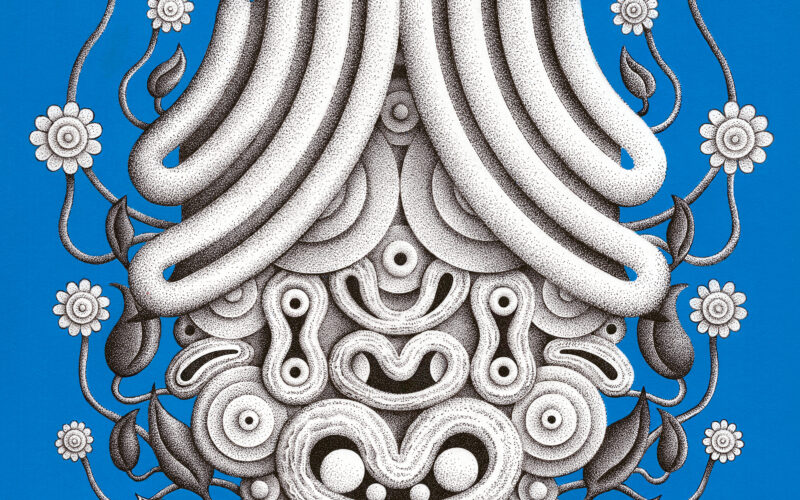
Because what Aaron does and we say this having looked at a lot of art is genuinely unlike anything else. He works in archival ballpoint pen and acrylic, a humble combination that sounds simple until you see what he does with it.
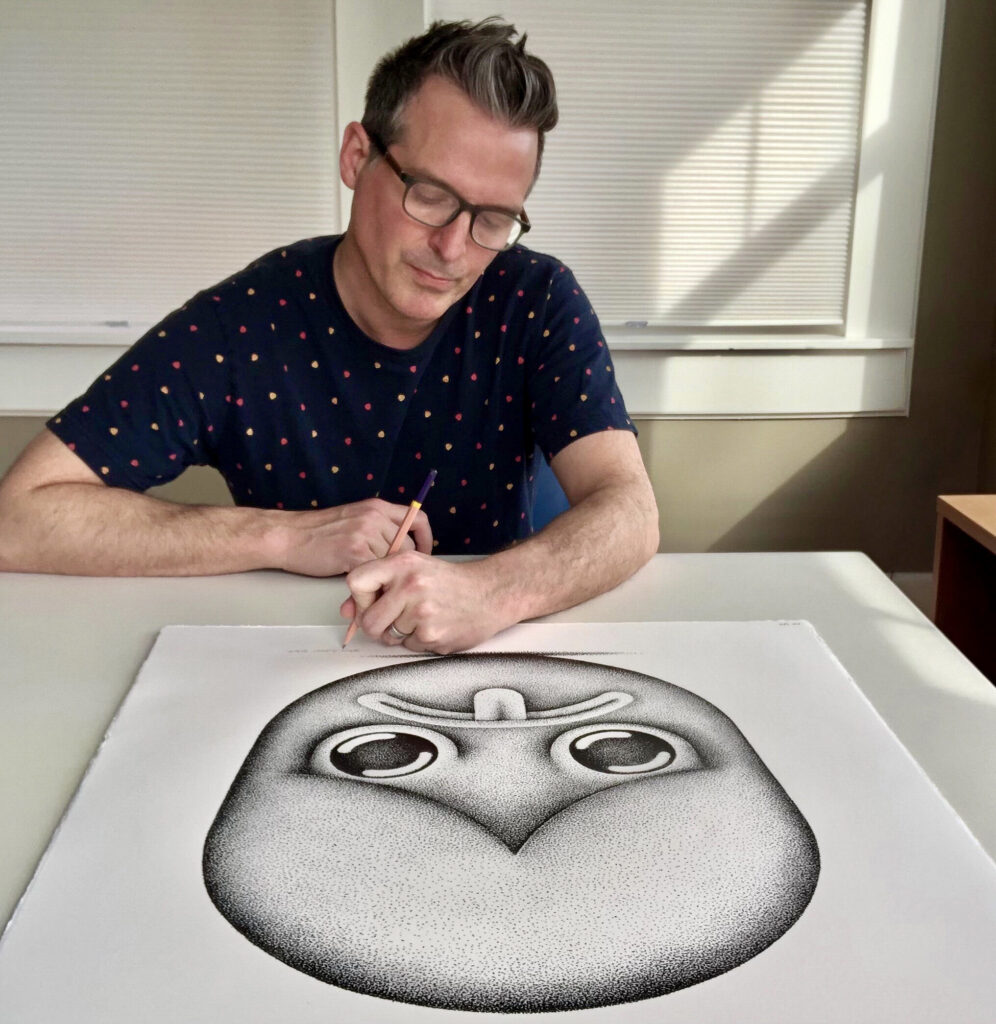
He draws through a magnifying glass, inches from the surface, building images from obsessive layers of dots and marks and lines that accumulate slowly, painstakingly, into something that feels almost impossibly alive.
He is warm, funny, deeply disciplined, and has been doing this with remarkable dedication for decades. And he still measures success the way his mentor, the late art critic Dave Hickey, taught him to, not by the shows or the sales, but by whether, at the end of it all, he can say he has had a life in the arts. We think he already can. But we have a feeling the best is still ahead.
Let’s get to know Aaron through our conversation with him. Trust us, you are going to want to.
Q1. Aaron! Can you take us back to how it all began for you, those early moments in childhood when art first felt like something special?
Recently, I went through some of my mother ‘s things and found the letter that my second-grade teacher had written to my parents recommending art classes. It was really great to see that she had kept it and to read those words after all these years. My favourite part is where he explains that they should make sure to encourage my creativity by having lots of paper and pencils on hand at all times! And, yes, I can picture the classroom and the drawing to this day.
Q2. You were born in the Allegheny Mountains of western Pennsylvania in 1972, but you didn’t stay there. You’re described as “the youngest in a tribe of restless people” who wandered through Michigan, Ohio, Nevada, and numerous Texas towns. Tell us about that nomadic childhood.
My father worked in operations in the electronics industry (he was an early employee of Apple, among others), so as his career developed, he moved us to new places in search of opportunities. My siblings and I would get plunked into whatever public schools were available. Looking back, it’s clear to me that art was a coping mechanism. It gave me a world of my own to escape into, as well as a source of consistency.
Just like today, I would work on drawings for days or weeks and I looked forward to coming home from school and resuming where I left off. Drawing was also an icebreaker. Being the new kid in school could be lonely. I learned that if I drew something in class and left it within view of my classmates, they would often go, “Whoa. That’s cool!” Art, above all else, is a social activity. It connects us.
Q3. You work primarily with archival ballpoint pen and acrylic. The ballpoint pen is such a humble, everyday tool. What drew you to it?
I started using ballpoint pens when I was in elementary school. I entered an art contest in Texas and needed to draw some wildflowers. I used some colored pencils, but when it came time to shade, I didn’t like the look of the black pencil on top of the other colors, so I tried a ballpoint pen. I’ve used them every since, largely because they are always around, but also because I got pretty good with them.
I liked the rich gradations I could achieve and also enjoyed how impressed my grandmother would be when I showed her what I did and then revealed that it was ballpoint pen. I guess when you’re young, and drawing, a lot of your enjoyment comes from improving and wowing your family.
Now, as a professional artist, I still believe your main goal should be to satisfy yourself, then your friends and peers and lastly, any part of the general public you can reach. You should aspire to building community, essentially expanding that group of friends and peers who connect to your work. Ballpoint pens are so relatable. Everyone has used one. That can be a way for new viewers to connect with my work.
Q4. Ballpoint pens can skip, blob, or run out mid-stroke. How do you deal with those imperfections? Do they become part of the piece, or do you fight against them?
Luckily, the pens I use apply pretty cleanly and consistently. Still, I do sometimes have to incorporate mistakes, maybe by covering the area with a shadow, erasing it out (if it’s a light enough mark), or, rarely, painting over it with white gouache. I work hard to keep the paper as clean as possible, so I always have a barrier sheet between my hand and the paper, and any area I’m not working on is covered and protected. Honestly, I’ve had very few problems over the years.
This is partly because my process is pretty slow and methodical, so I’m not rushed or moving quickly. The worst situation I ever had was when I accidentally spilled coffee over half of my drawing. I usually don’t allow myself to have drinks near my drawings, but that day I did, and, of course, I knocked it over. I immediately thought, “Um, ok, this drawing is over.” I sat there for a while, though, and eventually I sucked it up, took a breath, and decided to go in and very carefully paint out the stains and the piece turned out just fine.
Q5. The obsessive dots and marks you layer in. What does that process feel like? Are you in a flow state, or is it more like a meditation?
This is a question I get a lot, maybe more than any others. My answer depends entirely on whether I’m ahead or behind the deadline for that particular drawing. If I feel I have lot of time, then I enjoy the act of making all those little dots. I draw through a magnifying glass, so I am literally inches away from the surface, listening to podcasts or music with my headphones. I’m enveloped in my little world.
My wife or son will sometimes stand there for several minutes, trying to get my attention, not wanting to startle me, but then still ending up startling me. When I’m working on a one-person show and I feel like I’m behind, then the process can feel so slow and frustrating and I think, “Ugh. This drawing is taking forever.” Similarly, if I’ve been working long hours in the studio every day, if I then take a break for dinner, it can be very hard to talk myself into going back to making dots!
Q6. The acrylic and ballpoint pen have very different textures one smooth and opaque, one linear and transparent. How do you make them work together visually?
I use a brand of acrylic that is light bodied, super matte and somewhat self-leveling, so it goes on pretty flat. I apply it in very thin washes with small brushes until it’s opaque.
I’m always looking at the surface in raking light and working to eliminate any brush strokes, lift out any hairs or residue, etc.
Also, I’m not above sanding out any rough spots if necessary. Lastly, I protect my drawings with an archival matte spray that helps further unify the surface. I was a painter for many years, so it feels natural to incorporate acrylic into the work.
Q7. Let’s talk about the Heads series. You give all of the drawings the same title “Head” as a nod to the systematic process you use. When did this series begin, and why “Head”?
I started the Heads series in 2019. Initially, I wanted to revisit a drawing from art school that I had made of this sad, lumpy character that had a big forehead and tiny, stumpy arms. I believe that the original drawing was stippled in marker and I wanted to do something in ballpoint pen.
After making an homage to that early work, I realized that I really liked the ink and the return to stippling, as well as creating this rather sad, comical creature, so I started planning others. Sometime after, I found a stencil that was egg-shaped and decided I would try to make them all fit inside that same shape and that this would be a fun challenge.
Q8. You’ve said, “I fill it with patterns of circles and lines until a figure emerges.” At what point does the figure emerge? Is there a moment where you suddenly see WHO this Head is?
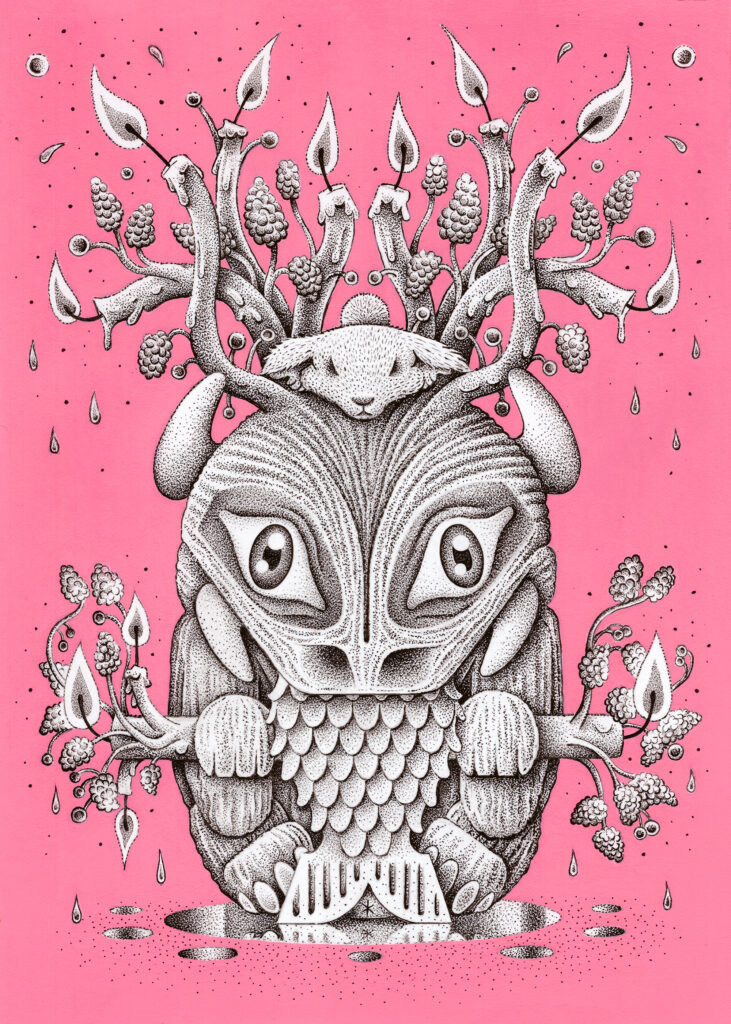
Sometimes I have a very good idea of the basic composition and the “surprises” come in the details. Other times, I only have a vague idea of what I want. It may start with an emotion, like, “I want to make a sad drawing.” Or a vibe, like, “I want this drawing to feel magical.” It might be that I have a single feature I know I want it to have, such as a forked tongue or candles for eyes.
Occasionally, I really don’t know what to do, only that I want to draw, so I set the outline and just start making shapes inside. Once I start laying down the circles and lines, they lead to ideas and the image starts to emerge. Like any work of art, I often don’t know what I have until I add the very last element.
Q9. Your work features “hard-edged shapes and synthetic colors.” What do you mean by synthetic colors? Are we talking neons, artificial hues, colors that don’t appear in nature?
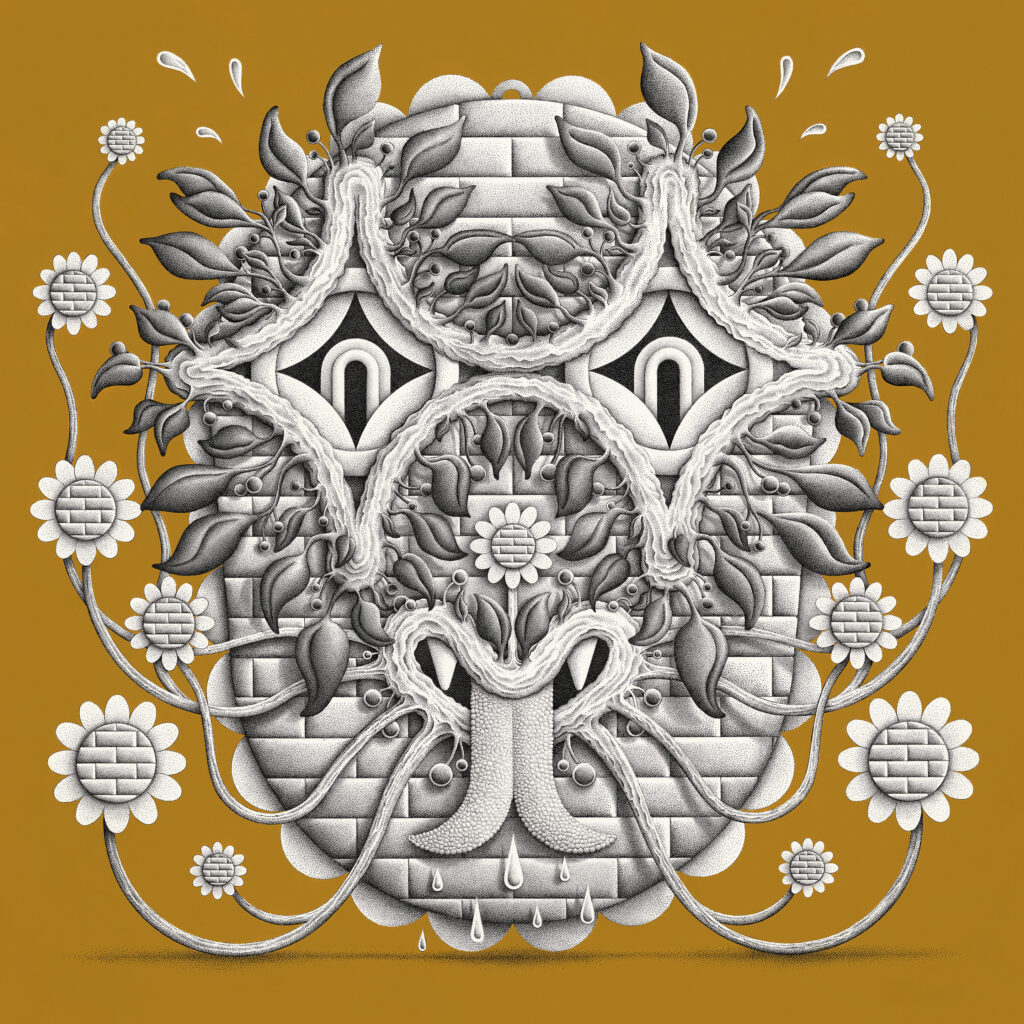
My color sensibility has always leaned towards rich, saturated colors. I blame Las Vegas, where I went to grad school, and also my fixation with riding the line between the organic world and the human-made one. I’ve always been interested in creating organic forms that still look artificial, symmetrical and highly-assembled. I think flat, bright colors reinforce the artifice.
Q10. Lowbrow art often has this irreverent, sometimes dark humor. Your titles have that quality “All Ginned Up and Nowhere to Go,” “Nothing But Serpents to Give.” Are you funny? Is there humor in the Heads?
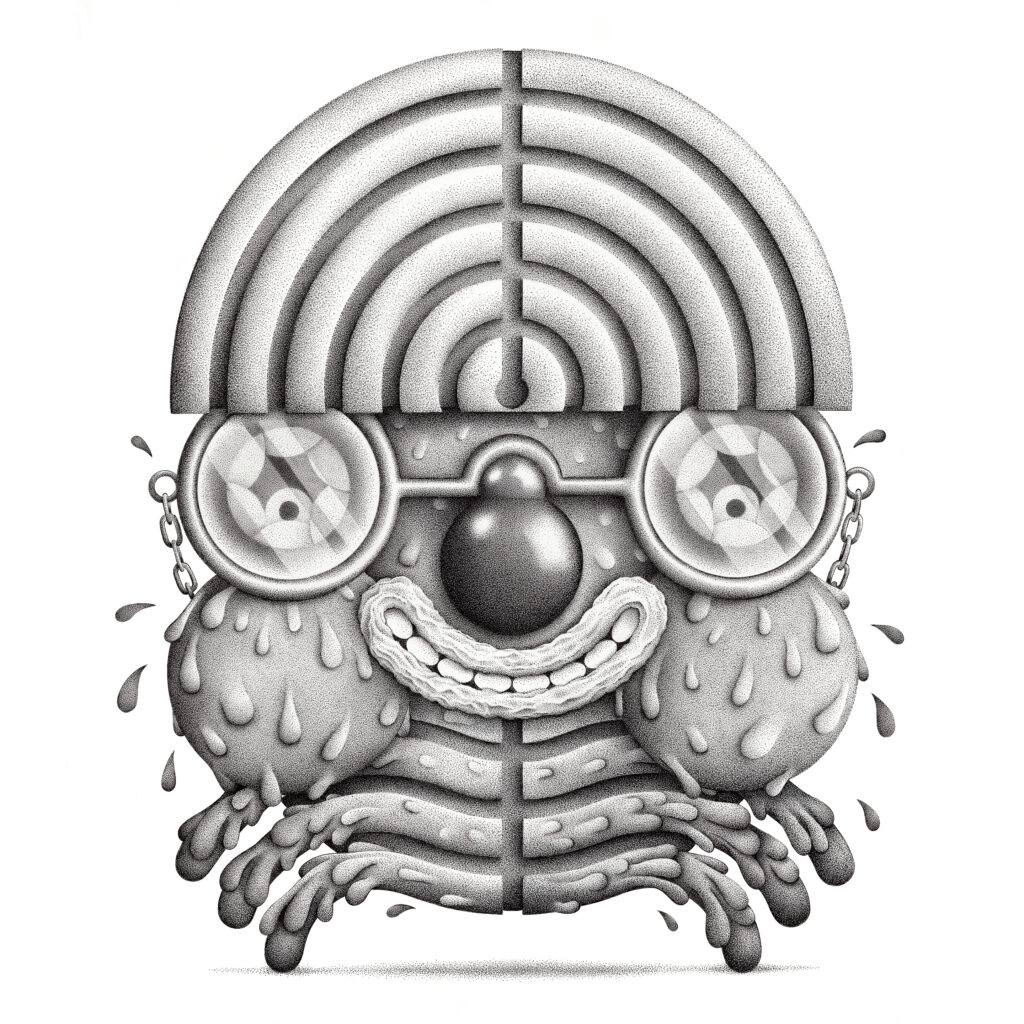
I’m glad you see humor in them. I think they’re funny. At my last one-person show, someone asked me, “Why are they always crying?” I said it’s because drawing sad characters makes me laugh.
The more they cry, the funnier I think it is! Also, tears are fun to draw. The world is a total disaster. You have to find the joy and humor in it while still knowing that it’s all just a tragedy.
Q11. You’re creating these obsessively detailed works with a wife and son around. When do you work? Are you a morning artist, a night artist?
I’ve always been very disciplined about keeping regular work hours. I typically work during the day, like a normal job, while my wife is at work and my son is at school. It’s important to me to be an engaged husband and dad.
I always think of the cautionary tale of Charles Schulz, of “Peanuts” fame, who supposedly would shut himself away in this studio to draw Charlie Brown. When his children would interrupt, we would yell, “Get out! I’m drawing kids!” That said, if it’s crunch time for a show, I work every available moment and usually well into the night. I’m lucky to have a very supportive family.
Q12. You’ve said, “I love the performative side of art and see my works as hopeful, little creatures that are full of dreams and are looking for their chance to shine.” That’s such a beautiful way to think about your work. Tell us more about that.
Honestly, art is so performative. It’s the artist putting themselves out there, “Hey, look at me. Look at what I’ve made for you. Give me your time. Give me your love.” The characters in my drawings are doing the same thing: taking the stage, asking for your attention and then laying themselves bare as they celebrate the tragedies, joys and absurdities of life.
All for you. I’ve always thought about artworks as living things. They’re our children. We make them, send them into the world and then they have to sink or swim. When I was in art school, so many professors obsessed about “the intention of the artist.” What is the artist saying? Once you finish a work, you cease to have any relationship to it, or ownership over it, and it doesn’t matter what you think it means. The relationship is now between the work and the viewer and they decide what it means.
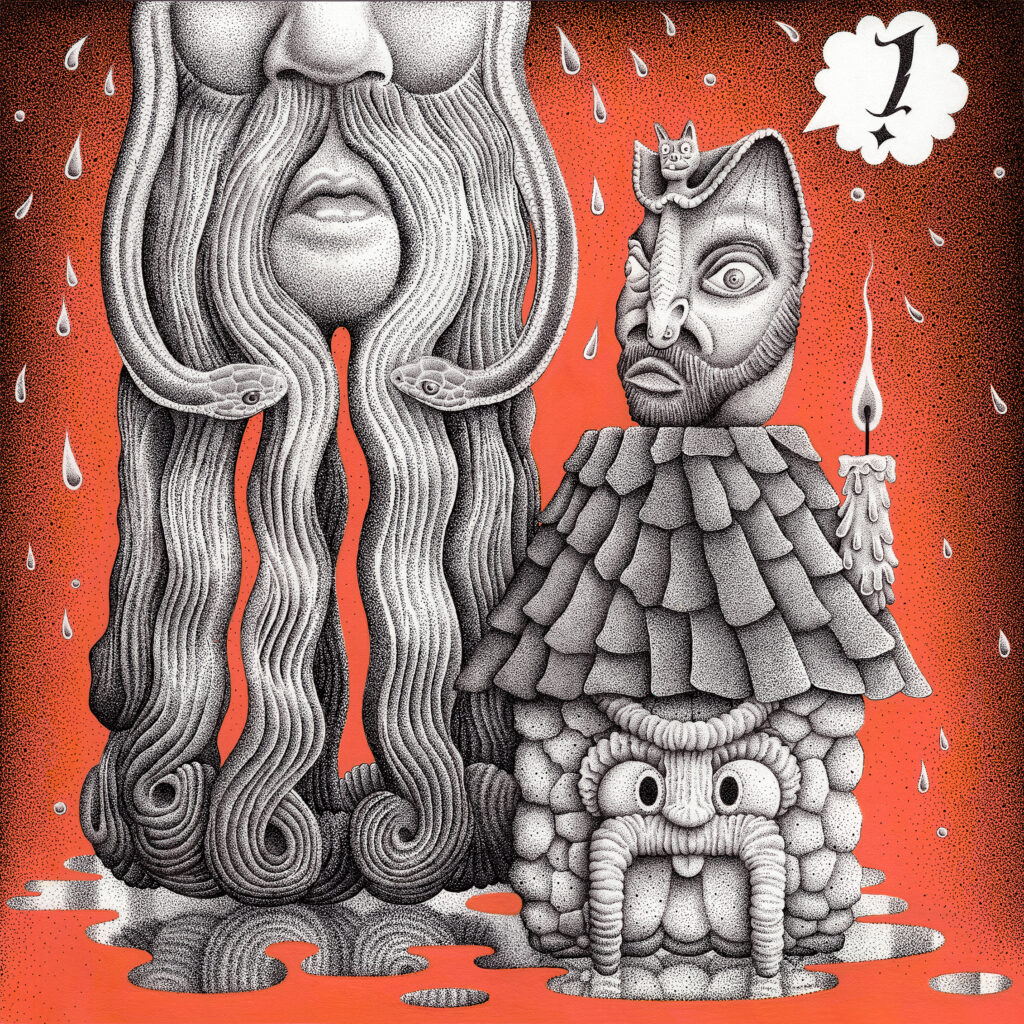
Q13. Your work is influenced by “comics, scientific illustration, mid-century abstraction and Lowbrow.” That’s an eclectic mix! Let’s start with comics—what comics shaped you?
“RAW,” “Weirdo,” “BLAB!,” “MAD,” and “Heavy Metal” were all very influential for me. Drew Friedman’s stippled comics in RAW definitely changed my life. I would just marvel over the virtuosity of his technique and his ability to imbue his figures with so much humor and emotion. I also love Basil Wolverton.
Q14. How do you synthesize all those influences? Or do they just naturally blend in your brain?
I’m a big believer in doing what you love and staying true to your interests and passions. If you’re creating from a free and open place, your influences will spill out of you. I begin every drawing with the simple goal of making something that I want to see. If after that, you want to see it, too, that’s even better.
Q15. Some of your Heads are undeniably beautiful. Some are definitely grotesque. Some are both at once. How do you decide where on that spectrum a particular Head will land?
If I look at my most successful drawings, I think they have an overall beauty but also contain surprising, discordant, or, even creepy details. At least some element of a work should defy the viewer’s expectations. For example, most of my compositions are very symmetrical. Symmetry is associated with beauty and refinement.
It conveys stability. I like to upset this system by having asymmetrical elements, unexpected bits and bobs that pop out, burst or grow. I do like to draw orifices, drips and puddles of liquid. Just like in life, those things can be beautiful or they can be grotesque!
Q16. Have you ever been tempted to break the system? To make a Head that’s rectangular, or huge, or doesn’t start with that egg?
I’m always thinking about how I can innovate and develop my current series of drawings. It’s a balance, though, because when I change them up too much, I feel like I’ve lost the thread. Sometimes I don’t even realize how I feel about a drawing until I see it on my website or in a show and I then I realize it doesn’t fit, doesn’t seem like it’s in a fluid conversation with my other work.
My main mentor in grad school, the art critic Dave Hickey, would point to the one work in your studio he liked the best and say, “Ok, now make 12 more just like it and you’ve got yourself a show.” That mentality of creating a cohesive body of work that changes gradually over time was drilled into me. That said, if I could make a giant head and not have to spend a year doing it, I would love that.
Q17. Dave Hickey wrote about beauty in contemporary art when it wasn’t fashionable. Did his defense of beauty give you permission to explore beauty in your own work?
Yes, I went to UNLV specifically to study with Dave because I had read “The Invisible Dragon” and it had such a profound impact on me. I couldn’t believe that a major art critic in the ’90s – an era of conceptual, academic, theoretical installation and video art – was saying that it was okay to make beautiful objects.
Though my work isn’t as concerned with beauty as it was in those days (when I was a sculptor), his generous, democratic perspective on art still informs everything that I do as an artist.
Q18. You’re collected, you’re exhibited, you’re featured in publications. Does that feel like success?
It’s definitely rewarding to get featured in magazines and be included in collections. As I mentioned, I really believe art is a social phenomenon and thrives from public engagement. That said, Dave Hickey always used to tell us that you can call yourself a success if, at the end of it all, you can say you’ve had a life in the arts. I aspire to a life in the arts.
Q19. If you could go back and tell young Aaron in art school one thing, what would it be?
I would tell myself that you don’t have to go to art school to be an artist. If you do, understand that its only real value is to provide you with the time and space to make art and to give you a network in which you can develop peers and forge connections that may serve you later. Also, the main thing that sets “successful” artists apart from others is their persistence. Some of my peers from school have gone on to do quite well. When you look at their careers, it’s nothing flashy or surprising, just consistent, nonstop hard work.

As our conversation with Aaron drew to a close, one thing stayed with us more than anything else. He said that what sets successful artists apart from everyone else is not talent, not connections, not luck, it is persistence. Just that. Showing up, consistently, for years and years and years, even when no one is watching, even when the deadline feels impossible, even when you have to talk yourself into going back to make dots after dinner.
That is not a glamorous answer. But it is the truest one we have heard in a long time. And Aaron’s entire life is proof of it. A child who kept drawing through nine schools and countless towns. A young artist who found a humble, everyday tool and went so deep into it that it became something no one else could do.
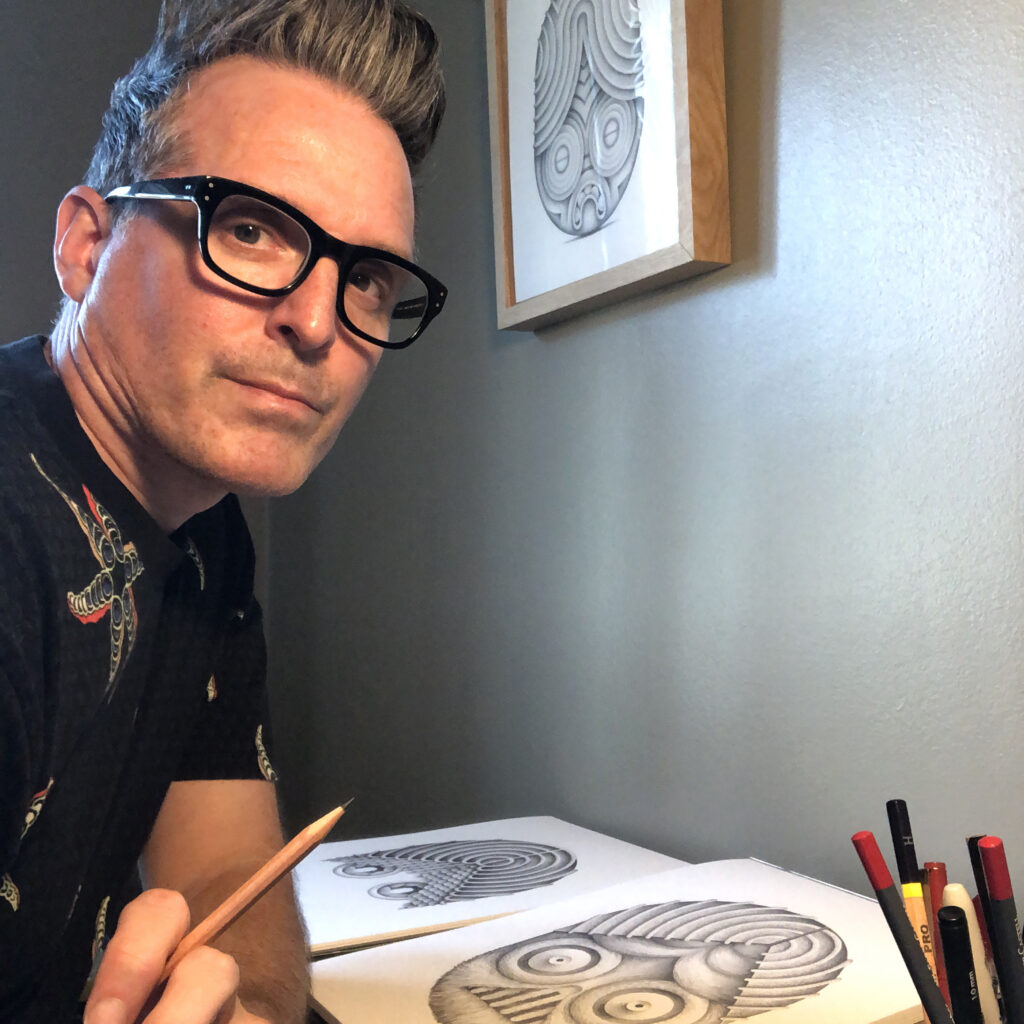
A man who still keeps regular studio hours, who still protects his paper with barrier sheets, who still loses himself behind a magnifying glass for hours at a time not because anyone is demanding it, but because this is simply who he is and what he does. The work is the life. The life is the work. And that kind of integration, sustained over decades, produces something that no amount of talent alone ever could.
And you feel that in the finished piece. There is a quality to work made with this level of devotion that simply cannot be manufactured a density, a presence, a sense that every single mark was considered and nothing was left to chance.
For those who collect with intention, who want their walls to hold something that continues to reveal itself over time, Aaron’s drawings are exactly that kind of work. The kind you discover slowly. The kind that gives you something different every time you stand in front of it, because it was built with enough depth and enough care to hold more than one moment of your life.
We think about that a lot. Especially in a world that keeps telling artists to move faster, post more, stay relevant, chase the moment. Aaron is a quiet reminder that the artists who endure are rarely the ones who followed that advice.
They are the ones who found their thing and went all the way into it. Who trusted that doing the work with honesty and consistency and care day after day, year after year was enough. Because it is. It always has been.
Follow Aaron Robert Baker through the links below. And let his hopeful little creatures find you.