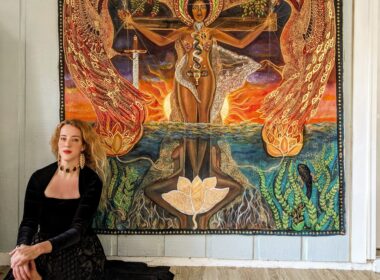

When Photography Becomes a Ritual of Care and Presence | Rizlane


For this edition of the Arts to Hearts Project, we sat down with Rizlane, a visual artist who treats photography like a rare object, crafting each piece with precision, care, and intention. She discusses her journey of transforming photography into something that feels precious and lasting, even signing her work with a genuine diamond.
We learn how her creative process is rooted in movement, ritual, and the feminine experience — and how her long-exposure photographs come together through layers of time, emotion, and transformation. Rizlane also shares what drives her choices, her collaboration with De Beers, and how she’s preparing for her debut at the Palm Beach Show. This conversation provides a closer look at how she seamlessly blends photography, storytelling, and legacy into something that leaves a lasting mark.
Rizlane is a featured artist in our book, “100 Emerging Artists 2025” You can explore her journey and the stories of other artists by purchasing the book here:
https://shop.artstoheartsproject.com/products/the-creative-process-book


Rizlane is the first artist in the world to sign fine art photography with a diamond, elevating each of her one-of-a-kind artworks into a conceptual jewel—a timeless celebration of rarity, sacredness, and divine beauty. Born in Montreal and based between Québec and the United States, she is a visual artist who redefines the photographic medium through a luxurious, ritualistic approach rooted in femininity and transformation. Her signature Tableaux-Photographiques are created through intuitive rituals of dance, where models in motion become carriers of healing and transcendence. Using long exposures and intricate post-production layering, she unveils fluid, dreamlike compositions that echo both the subconscious and the sacred.
These works, often portraying nude feminine archetypes, exist as visual mantras — poetic dialogues between body and soul, intimacy and eternity. Each piece is printed on canvas or museum-grade fine art paper, framed to the highest standards, and signed with a diamond, merging innovation with elegance, and photography with legacy. Following exhibitions in New York and the Eastern Townships featuring more than 40 diverse bodies, Rizlane’s next milestone will be her official debut at the prestigious Palm Beach Show in February 2026 — one of North America’s most exclusive events for high-end art, jewellery, and design. There, her vision of photography as a jewel will meet a global audience of elite collectors, curators, and connoisseurs.
Rizlane has been featured in several international publications, including The Visual Art Journal, The Art Seen Magazine, and the Arts to Hearts Project, and has received accolades, such as the Fine Art Photography Awards. Her work inspires a deep emotional response, inviting viewers into an introspective journey — a metamorphosis of the gaze. A visionary pioneer at the intersection of technology, spirit, and art, Rizlane transforms each photograph into a sacred relic — a rare fusion of sensuality, abstraction, and spiritual elevation. Her artistic language suggests that the body is not merely seen, but revered — as a temple, a symbol, a whisper of the divine.
1. What inspired you to start signing your photographs with diamonds, and how did the collaboration with De Beers come about?
The celebration of rarity has always been a precious pursuit in my life, not only as a form of gratitude and reverence for what we are given, but as a contemporary artistic stance. In today’s digital era, where everything can be endlessly reproduced, consumed without reflection, and scrolled through without depth, I often feel a kind of vertigo. My artworks emerge from deep energetic places within me, and I felt the need to honour them as living beings, as companions, as celestial jewels made manifest.
Photography, to me, is a sacred art form. It deserves to be printed, beautifully framed, and collected like a painting — and made as rare and revered as an authentic, singular work. I wanted to elevate this sacredness even further, to give each piece the dignity of uniqueness and the weight of presence. That’s when the metaphor of the diamond and the human came to me. Our collective fascination with the jewel — its rarity, its uniqueness, its non-replicable nature — mirrors the essence of the photographic moment. Like photography, the diamond is born of light, yet emerges from darkness — from deep within the earth, just as creation comes from within the artist.
To me, placing a diamond on the artwork is a ritual act — one that acknowledges the light, the transformation, and the invisible journey behind every image. It’s about shaping something raw into something eternal, allowing the light to refract through it in its purest form. This led me naturally to De Beers — a house renowned for its impeccable diamonds and its commitment to excellence. Their diamonds carry an internal code of authenticity, making each stone a true masterpiece. It felt like the perfect extension of my signature — placing a De Beers diamond on the “i” of Rizlane — a symbol of light, identity, and lasting value. I deeply hope to cultivate a refined and meaningful artistic partnership with De Beers — one that celebrates the union of fine art and timeless luxury.
Photography, to me, is a sacred art form. It deserves to be printed, beautifully framed, and collected like a painting — and made as rare and revered as an authentic, singular work.”
Rizlane

2. You treat photography like a rare object, similar to painting or jewellery—when did that idea first take hold for you?
An important meditation that emerges from this question is the ease of proximity in today’s world. Some might say that we’re all photographers now — after all, we carry cameras in our hands every day. But what truly defines the artist is not the tool, but the intention. To me, the power of the artist lies in the act of intention, in the ability to transmute energy into something tangible, meaningful. Creation becomes a ritual — one that demands presence, reverence, and care. When I create, I seek the perfect glass, the perfect material, the right ambience.
To treat fine art photography as a rare object is, for me, a profound gesture of respect — a form of modern-day alchemy. Like the alchemists of old, we, as creators, are the contemporary magicians. In painting, the material is visible — the brushstrokes, the texture, even the artist’s sweat. It is visceral, physical. Photography, however, has become almost intangible — pixelated, endlessly reproduced, distributed through countless technologies. In that abstraction, we risk losing its sacredness. That’s why I insist on bringing photography back into matter — through high-end printing, museum-grade framing, and ritualised presentation. Only then can it become rare, and once again stand alongside the great masters, the finest jewels, the most treasured works. Each of my pieces is born from love, and like love, it deserves to be respected and cherished.

3. Movement, drapery, and the female body are recurring themes—how do your shoots become a kind of ritual or transformation?
Whether through self-portraiture or powerful sessions with my muses, each shoot begins with a clear and fertile intention — something deeply felt and shared. It’s never just about taking a photograph; it’s about entering a sacred space. We often begin by discussing an idea, an emotion, or a memory. There is always music, incense, and a shared desire to transmute something — to understand, to release, to transform. At times, we write letters and burn them before the session, allowing that act of letting go to infuse the images with a stronger energy of renewal.
At other times, we write poems — meditations on blood, ancestry, and femininity — that echo into the night, into our dreams, reminding us of our mothers, grandmothers, and the sacred act of welcoming menstruation. One of the profound rituals I am currently undertaking is a seven-day complete water fast, a deep practice of purity and renewal. This cleansing journey fuels my creativity and spiritual clarity, allowing me to connect more intimately with the essence of the work I am about to create—the Original Code, signed with De Beers Diamond. The artwork born from this ritual will be presented for the first time at Palm Beach 2026 — a true manifestation of transformation and sacred dedication.
The drapery becomes an extension of the body — a new skin, a living veil that dances with movement and breath. It stretches the self into new shapes, embodying the transformation in real time. That movement itself becomes the intention. The female body, through its cycle, holds the power to create each month — a metaphorical birth, a divine rhythm. Honouring the woman is, to me, a way of honouring the Earth’s womb — raw, radiant, like a diamond formed under pressure. My work is a reflection of this complexity, this sacred strength — an ode to the inner landscapes that women carry, and to the rituals that awaken them.
4. Your process involves layering long exposures—how do you know when an image has reached the form you’re looking for?
This is a beautiful question — one I believe every artist loves to sit with. For me, it’s a deeply embodied feeling, much like falling in love for the first time. It’s almost like a spasm in the heart — something intuitive and visceral. There’s a quiet release, a softening of the shoulders, sometimes even a sigh… a gentle ahhh. That’s how I know the image is ready to be born. Once that feeling arises, I let the image rest — often for 24 to 48 hours — keeping it open in the background, almost as if it were a presence in the room. I observe how it speaks to me over time. Most of the time, it remains unchanged. It simply is — whole, exact, as it was meant to be. And I trust that if it resonates with me on that level, it will vibrate just as deeply with the right collector.

To treat fine art photography as a rare object is, for me, a profound gesture of respect — a form of modern-day alchemy.
Rizlane
5. You’ve called your work “Photographic-Paintings”—how do you think photography and painting are merging in your practice today?
The idea of the Photographic-Painting came to me during my first experiences printing and framing my work. Viewers would approach the piece slowly, often with hesitation, asking if it was a painting. That moment of uncertainty — that pause between media — revealed something essential. Once printed and framed, my photographic work carries the aura and energy of painting. The textures, the depth, the emotional weight — all evoke the presence of a canvas. Choosing to present my work as 1/1 editions further anchored this vision. It became clear to me: I wasn’t just creating photographs, I was creating Tableaux-Photographiques — a tribute to the timeless tradition of painting, expressed through a contemporary, sacred medium.

6. With your upcoming debut at the Palm Beach Show, how are you thinking about legacy and what you want these works to leave behind?
I want these works to leave behind the feeling of a rare treasure — a new way of treating photography within the world of luxury art, and of collecting this form of rarity. I aim for my pieces to become a solid investment, a grand contemporary value for collectors, placing my name among those contemporary artists whose work commands a fortune. I want my art to provide monetary protection for future generations, much like gold or great masterpieces. Beyond that, I want them to inspire the choice of uniqueness, to honour one’s work, and to empower artists to live from their own wealth.
In Québec, a cultural gap remains — many people are not yet ready to truly invest in art, and this willingness is lacking in the culture. I aim to establish my artistic career as a humble yet profound example of success, built on quality, authenticity, and integrity. The United States have understood the actual value of art, and for me, Palm Beach will be an enriching experience filled with love. I deeply admire collectors who know how to invest in art.

Rizlane’s work is about honouring rarity, creating from intention, and treating photography as something lasting and meaningful. Through her process, we’ve learned how rituals, movement, and the body come together in her images to express transformation and care.
Her journey highlights the importance of slowing down, being present, and treating each piece as a conversation between the visible and the unseen. She invites us to think about photography not just as an image, but as something to be held, valued, and remembered.
To learn more about Rizlane, click the following links to visit her profile.
Arts to Hearts Project is a global media, publishing, and education company for
Artists & Creatives: An international audience will see your work of art, patrons, collectors, gallerists, and fellow artists: access exclusive publishing opportunities and over 1,000 resources to grow your career and connect with like-minded creatives worldwide. Click here to learn about our open calls.