
Daniela Szabluk Transforms Feminine Emotion into Colourful Ceramic Sculpture
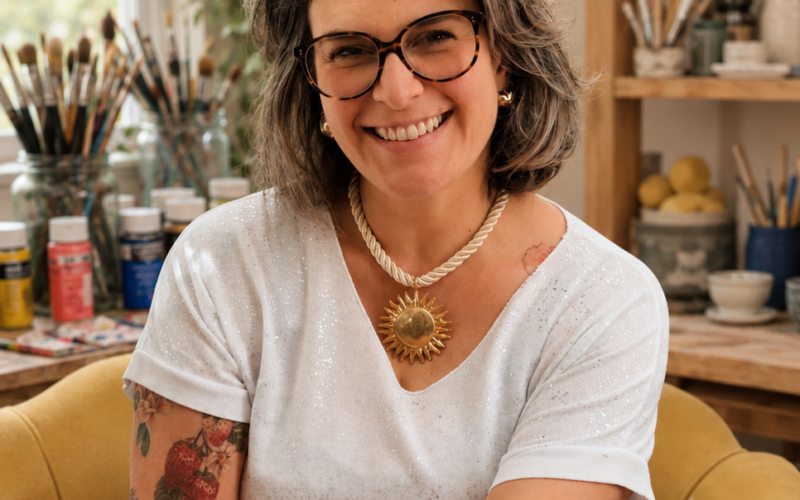
At Arts to Hearts Project, Art and Woman Edition 3 brought us artists working in every medium imaginable. Painters, photographers, mixed media artists, fibre artists. And then Daniela Szabluk’s ceramic sculptures arrived and we realised we had been thinking too narrowly about what this edition could hold.
Daniela is one of our selected artists for this edition. She is a Brazilian ceramic artist based in Warwickshire, UK. She describes herself as a curious maker, always pulled toward things that stir imagination. And that curiosity has taken her through a creative journey that started in graphic design and moved through drawing, painting, and jewellery-making before finding its home in clay, a medium she says brings all her ways of storytelling together.
She handbuilds everything. No wheel. Every curve and angle and surface shaped by her hands directly. And then she paints them. Not with subtle glazes or earthy tones that you usually see in ceramics. With bold vibrant colours that feel like they are generating their own heat.
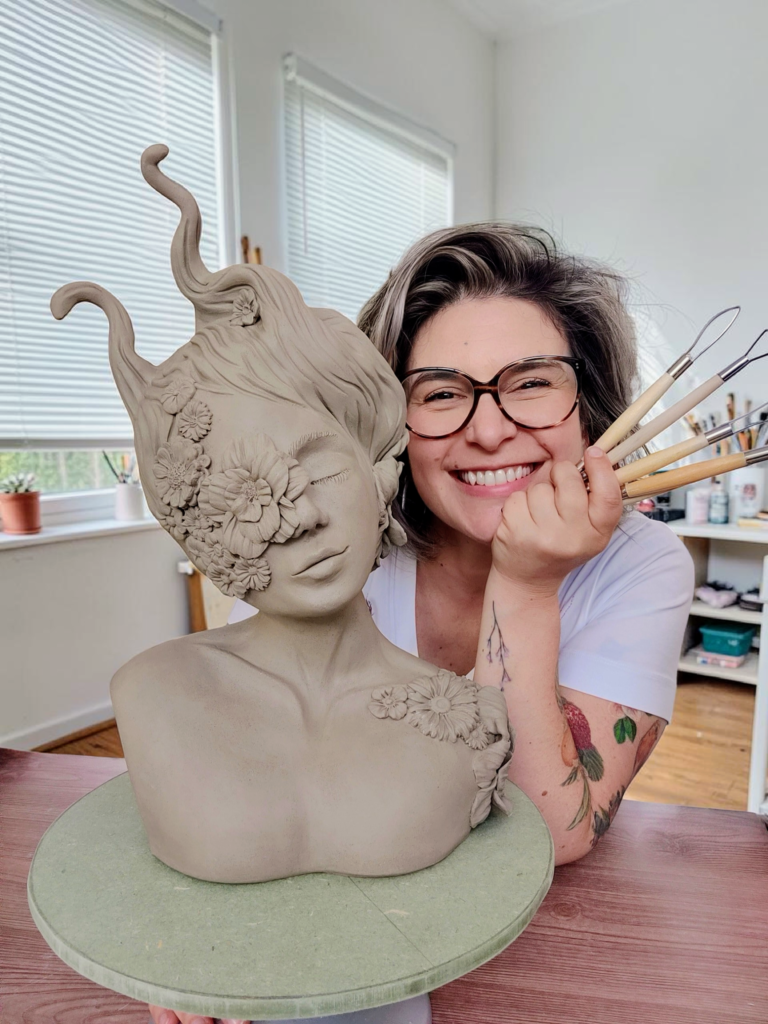
The painted surfaces turn each sculpture into something that is half figure and half landscape. A woman’s face becomes a sky. Her skin becomes weather. Her body becomes a place you can almost step into. How she combines form and colour so that the sculpture is simultaneously a person and an emotional world is something we find really remarkable.
She came to clay through a long path. Graphic design first, then drawing, then painting, then jewellery. Each medium taught her something different and when she finally found clay it became the place where all of those earlier languages could speak at the same time. Structure from design. Expression from drawing. Colour from painting. Precision from jewellery. All of it meeting in one medium that lets her sculpt and paint and tell stories in a single object.
She is Brazilian to her bones and you can feel it in everything she makes even though she has lived in the UK for years now. The warmth, the emotional openness, the boldness of her palette, the sense that colour is not something you use carefully but something you live inside. That Brazilian energy is in every piece whether she plans it or not.
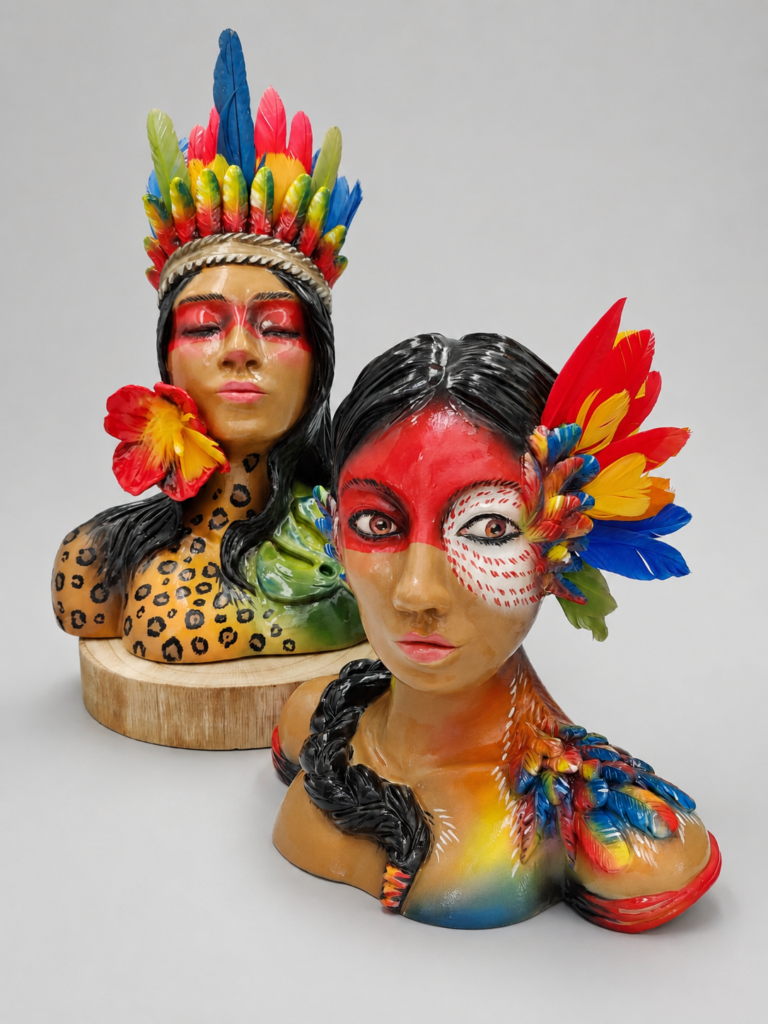
She makes work about women. About emotional complexity. About what is happening inside a person when the outside looks calm. About wildness and instinct and the kind of feminine strength that comes from the body and from the earth.
And she has a body of work inspired by Indigenous Brazilian cultures and Amazonian wildlife that explores ancestry and belonging and protection in a way that she approaches with real care and respect. Why those references matter to her and how she handles them is something she gets into during the interview.
And there is one sculpture that cost her more emotionally than anything else she has ever made. We are not going to tell you which one or why. Because the way she talks about it in the conversation is too honest and too personal to summarise.
Let’s get to know Daniela Szabluk through our conversation with her about how Brazil lives inside her sculptures, why she handbuilds instead of throwing, what storms and sunsets are doing on the surface of a ceramic face, and the one piece that cost her more emotionally than all the others.
Q1. Can you share a little about your background and how growing up in Brazil shaped your creative journey?
Growing up in Brazil gave me a very instinctive relationship with colour, emotion, and expression. I grew up in a region strongly influenced by German and Italian cultures, so there was this interesting mix of heritage, tradition, and structure — but always surrounded by vibrant Brazilian energy, warmth, movement, and emotional openness. Since I was a child, I was passionate about anything connected to art, and I was very lucky to have parents who encouraged that.
Creativity was always welcomed. I explored many different media over the years: drawing, painting, porcelain painting, jewellery, illustration, and eventually Graphic Design. Studying Graphic Design gave me a strong visual foundation. It helped me understand colour theory, composition, form, and how visual choices can communicate emotion.
But Brazil gave me something more instinctive: a love for vibrant colours, strong contrasts, dramatic shapes, and expressive energy. I don’t think my sculptures are about Brazil in a literal way, but Brazil is definitely present in them in the bold colours, the warmth, the emotional openness, and the sense of life and movement. My design background gives me structure, while my Brazilian roots give me energy. Together, they shape the way I create.
Q2. You describe yourself as a curious maker. What has been inspiring you lately outside the studio?
Right now, I think what’s stirring my imagination most is the quiet poetry of everyday life — especially nature, people, and small emotional moments. I’ve been spending more time noticing my garden, the way flowers open, birds move, light changes, and how colour appears in very ordinary places.
I’m also always observing people: their gestures, expressions, posture, and the emotions they seem to carry. I think my imagination is a lot fed by these small fragments of life. They don’t always become literal references, but they settle somewhere inside me and later return as colours, shapes, symbols, or characters in clay.
Q3. You handbuild your ceramics rather than relying on the wheel. What do you enjoy most about that process?
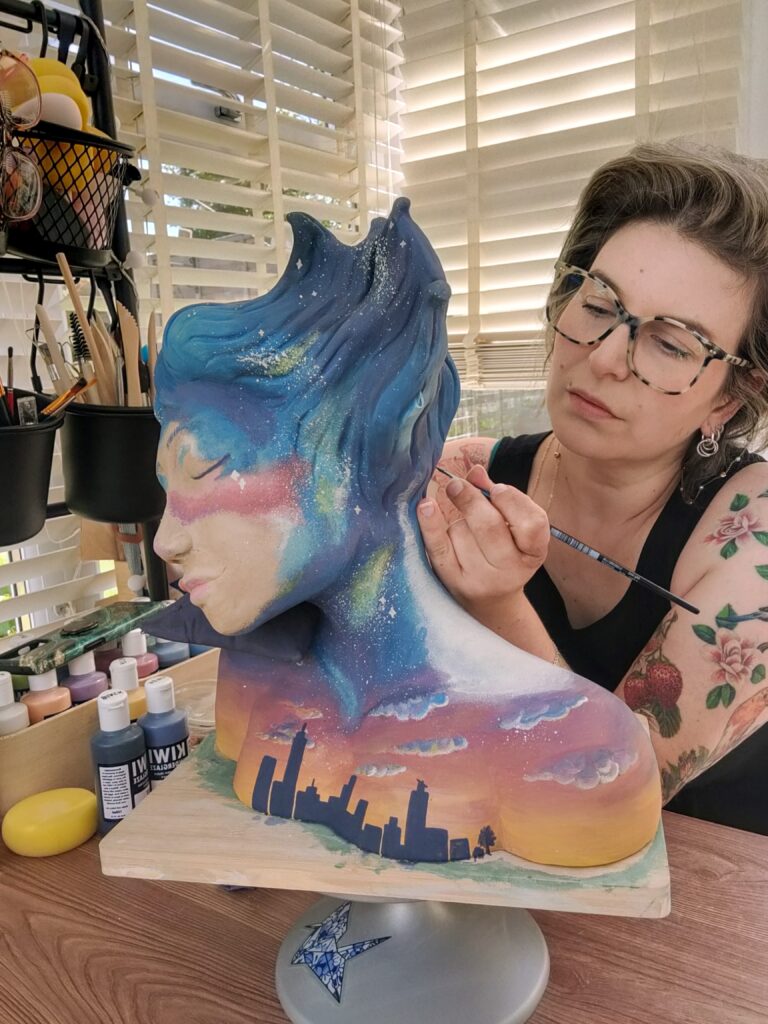
Handbuilding gives me a kind of freedom and intimacy that feels very connected to the way I create. I like the wheel, and I’m still developing my throwing skills, but for my sculptural work, handbuilding allows me to move beyond symmetry and explore more natural, organic forms. There is beauty in asymmetry — in a curve that shifts slightly, in a surface that carries small traces of the making process, in a form that feels alive rather than perfectly controlled.
Handbuilding lets me play with curves, angles, volume, and expression in a much more intuitive way. I also really love the ritual of sculpting: shaping the clay slowly, building the structure, smoothing the surface, adding details, and gradually seeing a presence emerge. It feels very physical and personal. My hands are involved in every decision, from the larger form to the smallest mark.
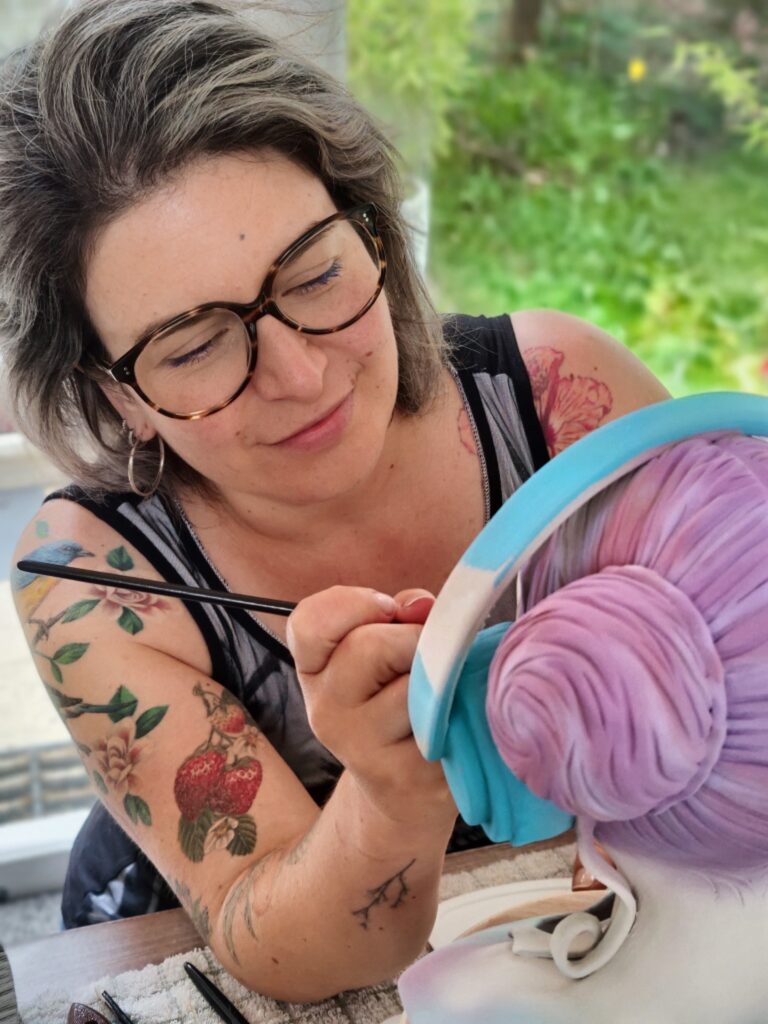
Q4. You use colour and painted marks to bring your sculptures to life. How does painting build on the story created through the form?
For me, the painting stage is not a separate conversation from the sculpting — it’s more like another layer of the same story. The form usually gives the sculpture its first emotional language: the posture, expression, curves, and presence. But the colours and painted marks deepen that language.
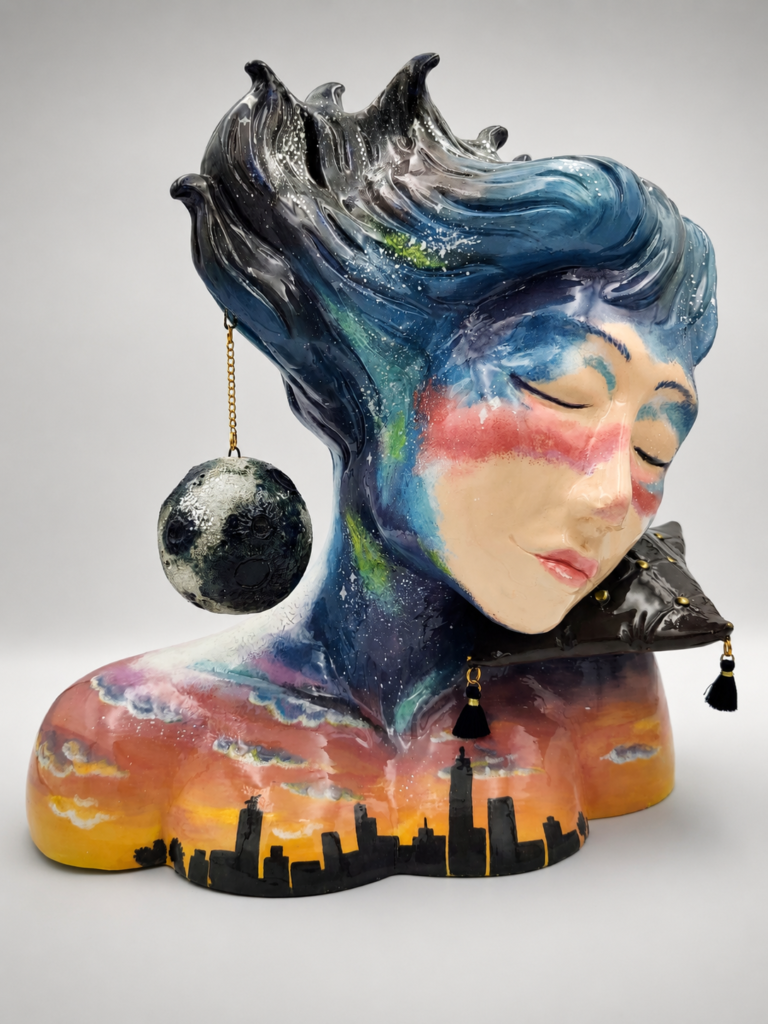
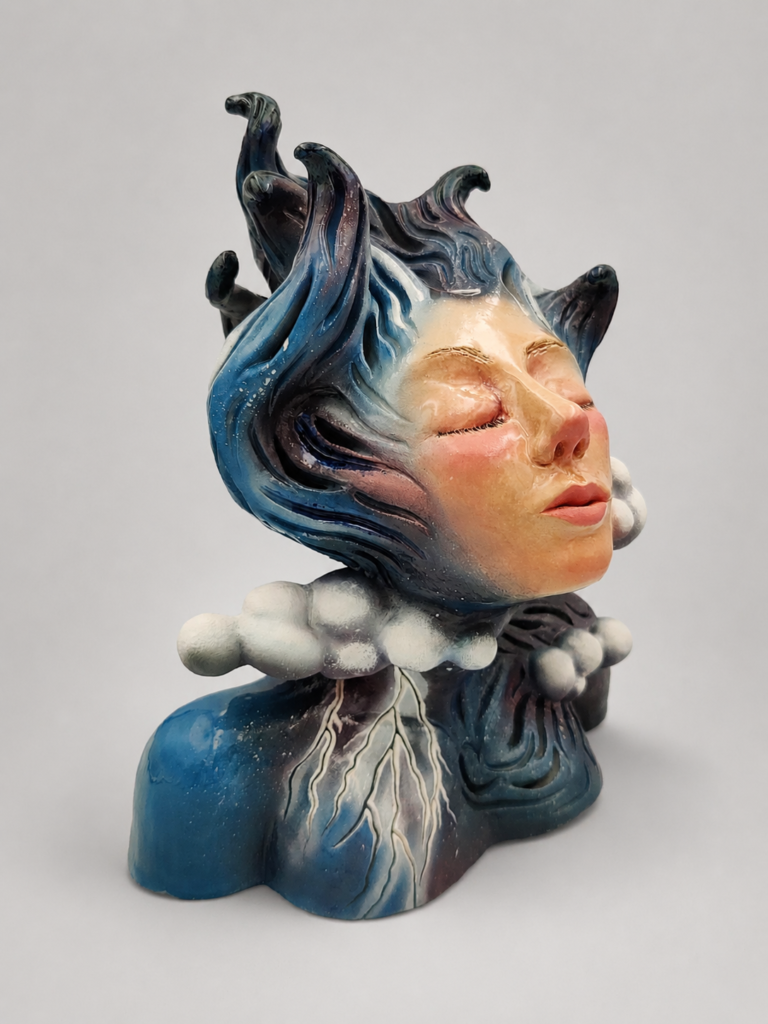
They add what may not be visible in the shape alone. Sometimes the colours reveal what is happening inside the figure — the emotional landscape beneath the surface. Clouds, lightning, rain, stars, or sunsets become symbols of memory, tension, softness, hope, or transformation.
Other times, the painting brings the external environment onto the body, as if nature and emotion are becoming one. So I see form and colour as deeply connected. They complement each other almost like body and soul. The sculpture gives the emotion a physical presence, and the painting gives it atmosphere, movement, and voice.
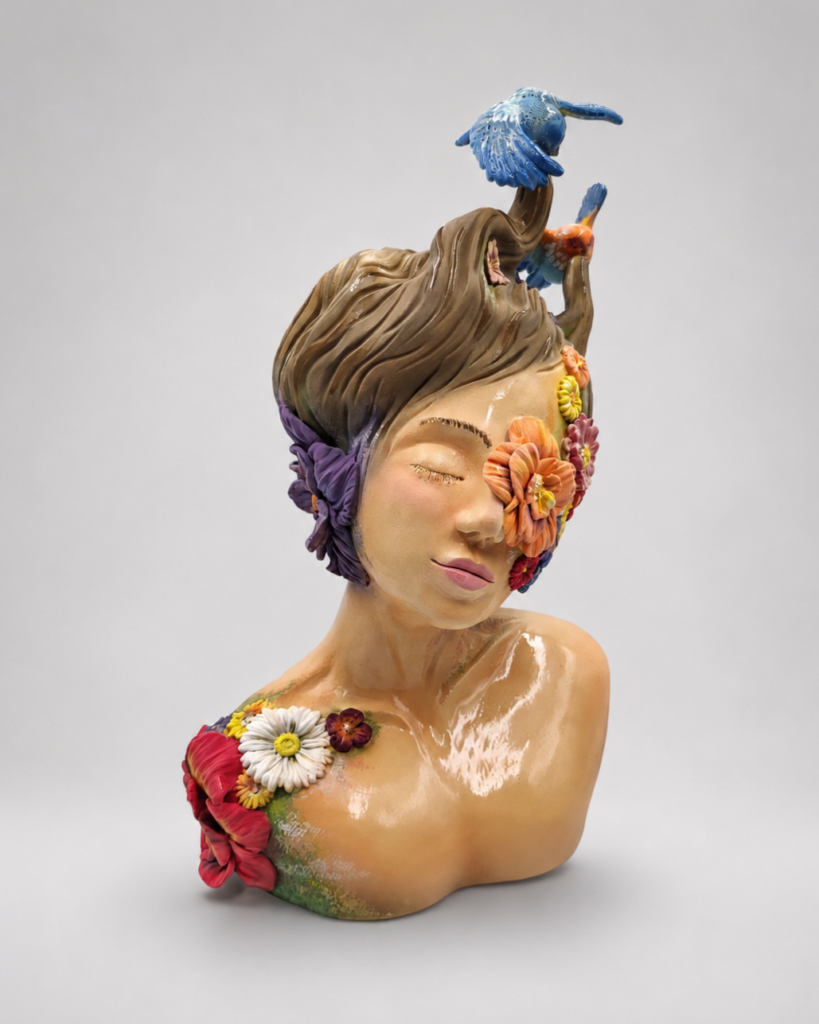
Q5. Sculptures like Storm, Celestial, and Skye each carry a distinct emotion. Do your pieces usually begin with a feeling or an image?
They usually begin with a feeling. Sometimes a visual image appears very quickly after that, but the emotional state comes first. With Storm, for example, the starting point was anger — not anger as something destructive, but as a force that asks to be recognised. From that feeling came the idea of thunder, lightning, tension, and pressure building inside the body.
With Celestial, it was more about stillness and the need for refuge — that quiet place where dreams soften the edges of a restless world. The sunset, city skyline, and moonlit atmosphere came later as ways to give that feeling a visual landscape. And with Skye, the feeling was softness, lightness, and the changing nature of our inner weather.
The clouds became a way to speak about thoughts, emotions, and the space between them. So I would say my work starts emotionally, then becomes visual, and finally becomes physical through clay. The story often reveals itself along the way.
Q6. She Is the Wild feels very different in energy. What conversations were you hoping to have through this series?
She Is the Wild is a series where I wanted to explore a different kind of feminine energy — one that is instinctive, powerful, and deeply connected to nature. The conversation I’m trying to have through this series is about strength, but not only in a loud or aggressive way. It’s about an older, more primitive kind of strength: the kind that comes from instinct, from the body, from ancestry, and from remembering that we are also part of nature.
I’m interested in that connection between the human and the animal, the emotional and the wild. The figures in this series carry feathers, animal references, bold colours, and strong expressions because I want them to feel like they belong to the earth, not apart from it. Although the energy is different from pieces like Storm, Celestial, or Grace, the starting point is still emotional. These sculptures also come from feeling — but here the feeling is more about power, protection, belonging, and wild intelligence.
Q7. You’ve described LOVE(?) as one of your most emotionally demanding pieces. What made it so personal?
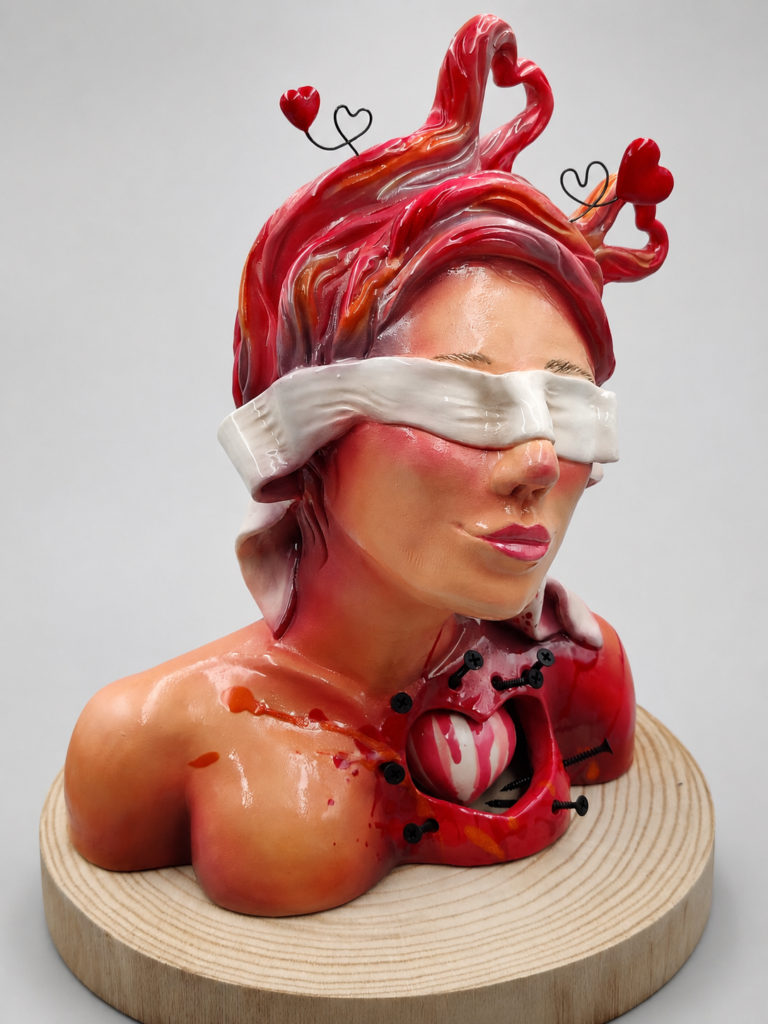
Yes — I think LOVE(?) is probably the piece that cost me the most emotionally. The concept came from very personal reflections on the things we love that can also make us suffer. Not only romantic love, but family, difficult friendships, and the complicated bonds we keep returning to because they matter to us. But it is also about passion — especially the passion of making art.
Creating something you truly love can be beautiful, but it also comes with fear, uncertainty, vulnerability, and impostor syndrome. You dedicate so much of yourself to it, and sometimes that dedication leaves marks. So LOVE(?) carries that contradiction: love as devotion, risk, pain, courage, and commitment. It is about the things we blindly give our whole heart to — even when they hurt, even when they ask a lot from us, even when they leave scars.
Q8. Colour is central to your storytelling. How do you use it to reveal what’s happening beneath the surface?
Colour is absolutely central to my storytelling. Honestly, I don’t think I would know how to create without colour — it feels like such a natural part of how I see and express the world. For me, colour is emotion. It’s an emotional mirror. In my work, colours often reflect things that are invisible: feelings, memories, tension, softness, hope, anger, transformation. They help me give shape to what is happening inside the figure, or around her, even when it cannot be seen physically. I’m also drawn to vibrant colour because it carries energy and life.
It allows the surface of the sculpture to become more than decoration — it becomes atmosphere, movement, and voice. So colour is not something I add at the end just to make the piece beautiful. It is part of the meaning. The form may hold the body of the story, but colour reveals its emotional landscape.
Q9. Which part of the process do you enjoy most: shaping the clay or painting the finished sculpture?
I genuinely enjoy both building the form and painting the surface, but they give me very different experiences. Building the form is more tactile and introspective. It’s slow, physical, and almost meditative — shaping, smoothing, adjusting, and gradually feeling the presence of the sculpture.
Painting the surface feels more visual and expressive. It’s where the emotion expands outward through colour, atmosphere, and symbolic details. It becomes less about touch and more about energy and mood.. So, in a way, what I enjoy most depends on how I’m feeling that day. Some days I need the quiet, grounding ritual of sculpting. Other days I need the colour, movement, and intensity of painting.
Q10. You draw from Indigenous Brazilian cultures and Amazonian wildlife. What do these references allow you to explore?
Those references felt important because they are part of the cultural landscape of Brazil, even if I did not grow up physically close to Indigenous communities. Brazilian Indigenous cultures are incredibly rich and diverse, comprising nearly 300 distinct peoples and more than 150 languages.
Their traditions are deeply connected to nature, and include rituals, featherwork, ceramics, body painting, storytelling, and ways of understanding the relationship between body, land, spirit, and community. Growing up in Brazil, Indigenous presence was woven into everyday life in subtle ways. Many words, place names and foods come from Tupi and other Indigenous languages and cultures.
So even when the connection was not always direct, it was still part of the world around me. In my work, I’m not trying to reproduce or claim those traditions. I’m interested in approaching them with respect, as a source of reflection on ancestry, nature, instinct, belonging, and protection. Today, Indigenous peoples in Brazil still face many challenges in keeping their traditions, lands, and ways of life alive. So for me, these references also carry a reminder of resilience, respect, and the urgent need to honour cultures that hold such deep knowledge about living with nature, rather than apart from it.
Q11. Your women are often both powerful and vulnerable. What interests you about that complexity?
Women have been represented in art in many beautiful, powerful, and meaningful ways, and I think all of those perspectives are relevant because they show different aspects of womanhood. What I’m trying to do is add my own view of that complexity. In my work, I’m interested in women as layered emotional beings — strong and vulnerable, soft and fierce, calm and stormy, connected to instinct, nature, memory, and inner landscapes.
I don’t want to present women as one fixed idea or archetype. I want to show contradiction, movement, and depth. So rather than saying something is missing, I’d say I’m contributing another voice to the conversation: one that honours emotional complexity, feminine presence, and the many inner worlds women carry.
Q12. What have your sculptures taught you about womanhood that you didn’t understand before?
I think they have taught me to understand womanhood as something deeply layered and full of contradiction. Over time — through sculpting, and also through age, adulthood, and life experience — I’ve become more aware of how many emotions can exist within us at the same time.
We can be strong and fragile, calm and full of storms, joyful and grieving, soft and powerful. Those contrasts don’t make us inconsistent; they make us human. So these sculptures have taught me to honour that complexity more openly. Womanhood, to me, is not one fixed idea. It is movement, depth, contradiction, memory, instinct, and constant transformation.
Q13. Why do you think people are reconnecting with handmade ceramics today?
I think people are reconnecting with handmade objects because so much of our lives now happens through screens, technology, and constant information. Everything moves very fast, and we are surrounded by mass-produced objects that can feel anonymous or disconnected from the human touch. Handmade work offers something different.
You can feel that someone spent time with it, made decisions, solved problems, and left something of themselves in the object. It carries presence.
Q14. Has your idea of success changed since you began building a life around art?
I don’t think my definition of success has changed much, because I’ve always believed success looks different for each person. It depends on what people value, what they believe in, and what kind of life they want to build.
For me, success is not only about big milestones. Of course, exhibitions, sales, and opportunities are wonderful — and I’m grateful for them — but I also see success in the smaller moments. Finishing a piece, learning a new technique, solving a problem, being brave enough to share my work, or seeing someone connect emotionally with something I made — those all feel like small successes.
Q15. You’ve worked across many creative mediums. What did you eventually find in clay that felt different?
Looking back, I don’t think those earlier mediums were missing something in a negative way — each one gave me something important. Graphic design gave me structure and composition, drawing and painting gave me colour and expression, and jewellery taught me detail, precision, and the beauty of small objects.
But clay allowed me to bring all of those experiences together. With ceramics, I can combine form and colour in a very physical way. The sculpture becomes both object and canvas. I can shape the body, build volume, create texture, paint the surface, and then sometimes add other materials to the final piece — like feathers, metal, cords, or found elements.
That combination feels very complete to me. Clay gives me the freedom to move between sculpture, painting, storytelling, and object-making all at once. It feels like the medium where all my previous creative languages finally meet.
Q16. Twenty years from now, what do you hope people understand about the women and emotions behind your sculptures?
I hope they understand that people are complex, deep, and layered — and that no single expression, surface, or moment can tell the whole story of who we are. A lot of my work is about the difference between what is visible and what is happening internally. Sometimes the outside may look calm, soft, beautiful, or composed, while inside there may be storms, longing, courage, grief, joy, or transformation happening all at once.
I think we often try to simplify emotions, especially women’s emotions, as if we should be one thing at a time. But I’m interested in contradiction in the way strength and vulnerability can coexist, anger and tenderness can sit side by side, and beauty can carry pain without losing its light.
So if someone encounters my work twenty years from now, I hope they feel that these sculptures honour emotional truth: the layered, sometimes messy, sometimes luminous reality of being human.
Talking to Daniela Szabluk left us thinking about something that every artist who has ever bounced between mediums needs to hear. That finding your medium is not about choosing one thing and abandoning everything else. It is about searching long enough that you find the one thing capable of holding everything you have already learned.
Daniela went through graphic design, drawing, painting, and jewellery before she found clay. And none of that was wasted. The design gave her structure. The painting gave her colour.
The jewellery gave her precision. The drawing gave her expression. And clay gave her a surface where all of those skills could work together at the same time. Form and colour and texture and storytelling all existing in one object held in two hands.
We think about that for every artist who feels scattered right now. Who has tried multiple mediums and is not sure which one is theirs. Who worries that jumping between drawing and painting and ceramics and textiles and photography means they lack focus or commitment.
Daniela’s practice says the opposite. It says every medium you try is teaching you something you will need later even if you do not know what it is yet. And when you finally find the one that fits, all those earlier experiments become the reason your work is richer than someone who only ever knew one way of making.
The other thing we carried away from this conversation is about contradiction. And specifically about how Daniela sees womanhood. Not as one thing but as many things happening at the same time. Strong and fragile. Calm and stormy. Soft and fierce. Tender and angry. All of it coexisting inside the same person without any of it being wrong or contradictory. Just human.
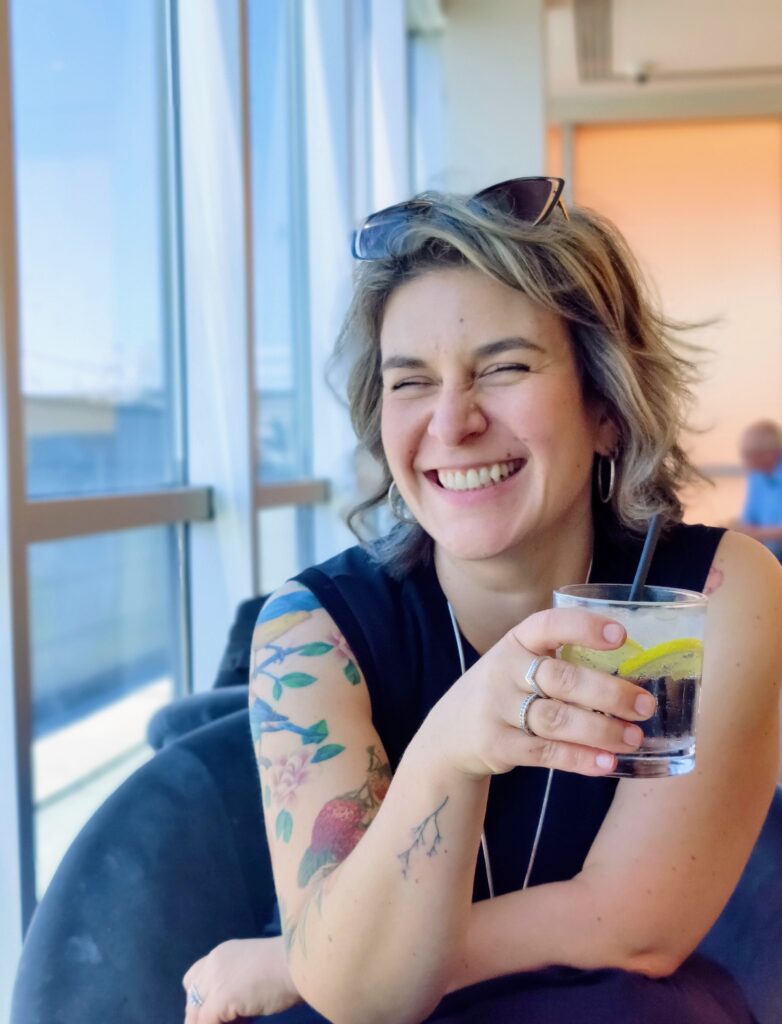
For art lovers and collectors, Daniela’s sculptures bring a presence into a room that is hard to describe until you experience it. They are physical and colourful and warm and full of life and they carry an emotional weight that only becomes more apparent the longer they are in your space.
Every piece is hand built and one of a kind. The painted surfaces hold weather and dreams and feelings that shift depending on how the light hits them. And because each sculpture is its own emotional universe, living with one means living with a companion that quietly holds space for whatever you are feeling on any given day.
Follow Daniela Szabluk through the links below and see her work for yourself.
If this edition inspired you, Art and Woman Edition 4 is now open for submissions. And we are looking for you.
If you are a woman artist working in any medium, anywhere in the world, and your practice holds something honest and meaningful and unapologetically yours, this is your invitation. What matters to us is not your CV or how many exhibitions you have had or how many followers are watching. What matters is the work itself, the story behind it, and the artist who made it. This publication exists to give women artists the kind of permanent, collector-quality visibility that their practices deserve.
Every artist in this book was once someone who decided to put her work forward and trust that it was ready. Maybe this is your moment.