






The Story Behind Girl with a Pearl Earring
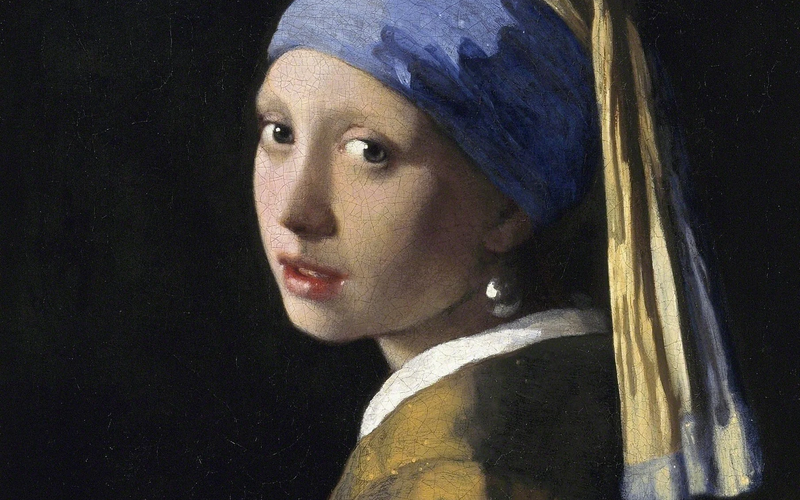
The Girl We All Recognise
The face we all recognise, the girl we cannot name, and the painting that has kept changing beneath our eyes.
We know her face.
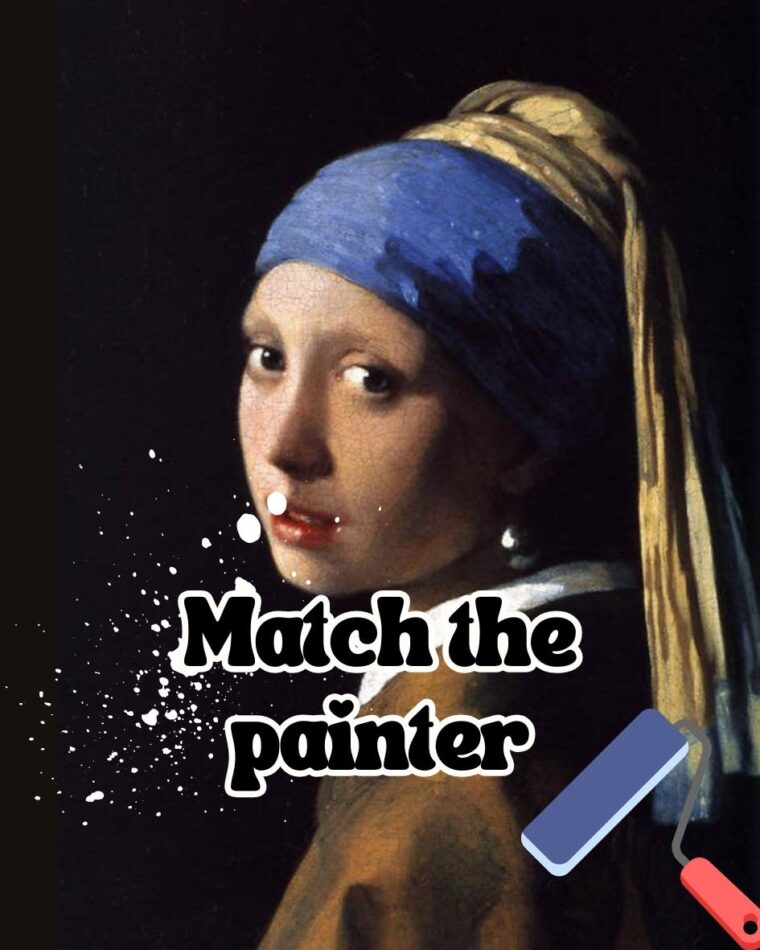
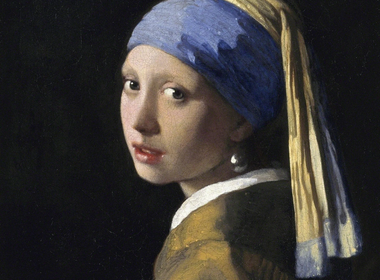
Johannes Vermeer’s Girl with a Pearl Earring has appeared on museum walls, book covers, posters and films. We know the blue wrapped around her head, the yellow beside her face, the glint at her ear. We know the way she has turned towards us.
Except we don’t know her name.
Vermeer painted her around 1665 but left behind no record telling us who she was or why she was painted. Even the assumption that she was a particular girl sitting for a portrait is something we have had to question.
For more than three centuries, we have kept looking at a face that gives us almost no information about the person behind it. The less we know, the more stories we create around her.
She May Never Have Been “The Girl”
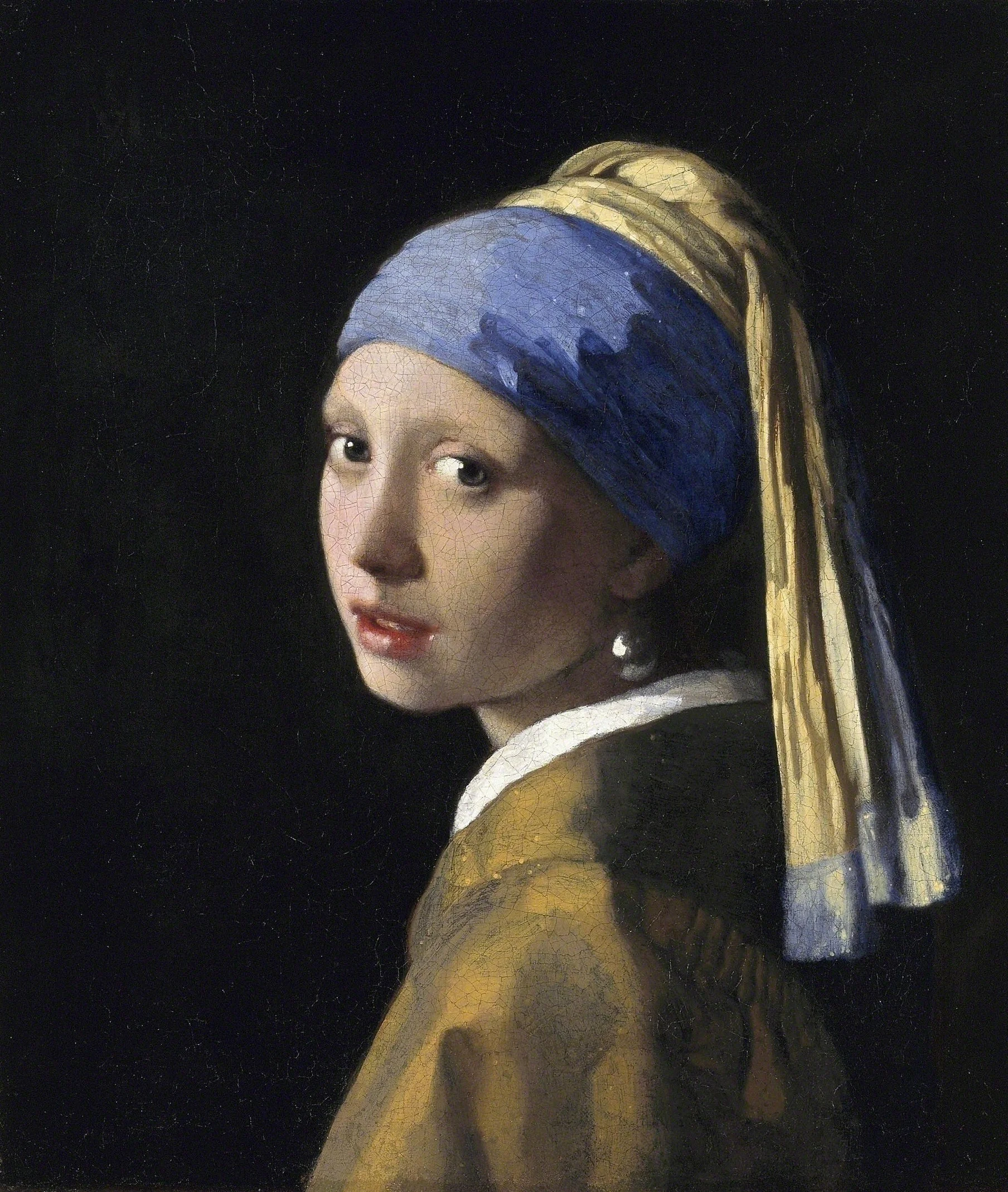
We have come to think of her as a girl whose identity was simply lost somewhere along the way. But that may not be quite the right way to look at the painting.
The Mauritshuis identifies the work as a tronie, a Dutch term for a study of a head or figure representing a particular type or character, rather than a conventional portrait. There was probably a sitter, but the purpose was not to preserve that person’s likeness. Vermeer was exploring expression, costume, light and character.
Instead of asking why Vermeer never told us who she was, we might ask whether the painting was ever meant to identify her at all.
Her blue-and-yellow head covering and oversized earring also place her outside the everyday world of seventeenth-century Delft. There is no domestic interior to explain who she is, no object that tells us what she does, no setting that gives us a story to follow.
There is a face, turned towards us, carefully constructed by an artist who knew exactly how much to reveal—and how much to leave open.
A Face Built from Almost Nothing
Take away the blue headscarf, yellow fabric and famous earring, and there is remarkably little left. There is no elaborate setting or landscape. Against the dark background, Vermeer gives us little more than a head, a shoulder and a turn of the face.
And yet, the face feels remarkably present.
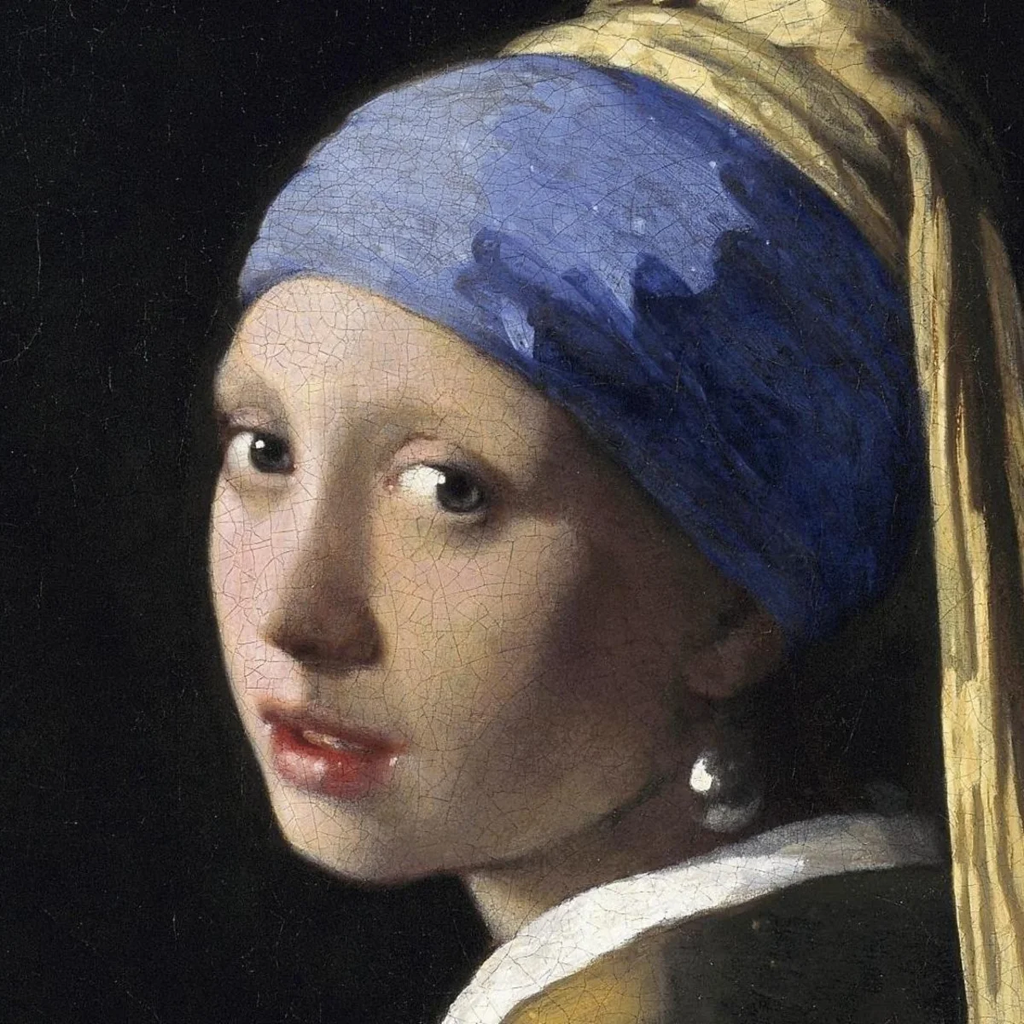
Light catches the eyes. Her lips remain slightly parted and moist. The bridge of her nose is not drawn with a hard outline; Vermeer allows light and colour to describe it instead. Her head is turned just enough to suggest movement without showing us where she has come from.
It is tempting to decide what she is thinking or feeling, but the painting doesn’t give us enough information to settle on one answer.
He doesn’t tell us what happened before this moment or what will happen next.
He leaves us looking.
The Pearl That Isn’t Really There
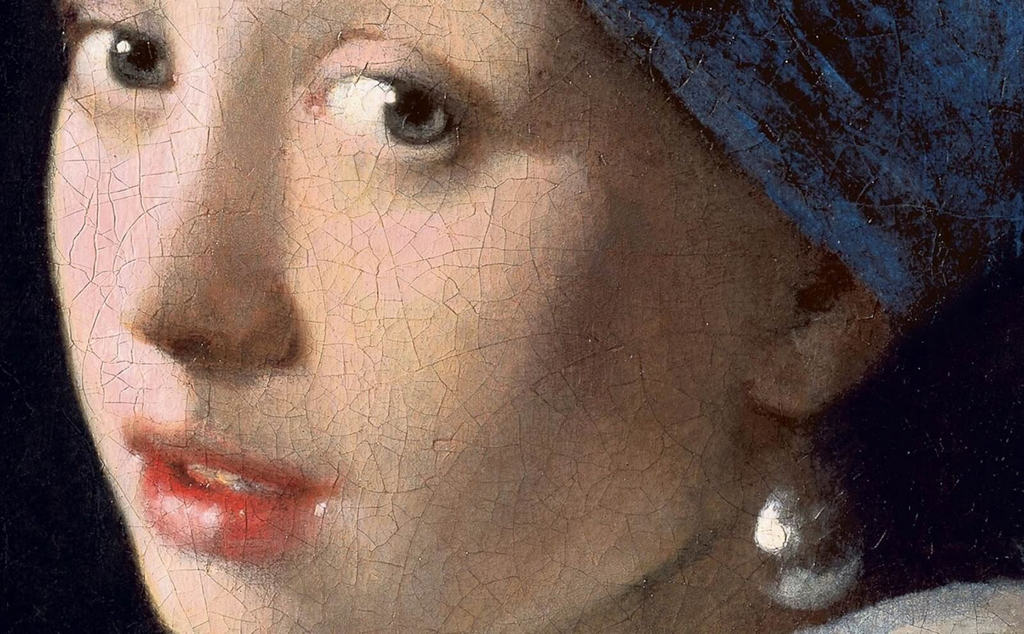
Then there is the earring.
It looks substantial enough to catch the light, yet Vermeer gives us surprisingly little to work with. There is no carefully painted outline defining the pearl, and no visible hook connecting it to the girl’s ear. Instead, the form is suggested through a few touches of paint: a pale shape, a bright highlight and a softer reflection beneath it.
The Mauritshuis notes that both real and imitation pearls were fashionable in Vermeer’s time, so we cannot say with certainty what the earring itself was made of. What we can say is that Vermeer was less interested in describing an object in detail than in creating the impression of one.
A few carefully placed marks are enough. From a distance, our eyes complete what the brush has only suggested.
Look Again: The Painting Has Changed
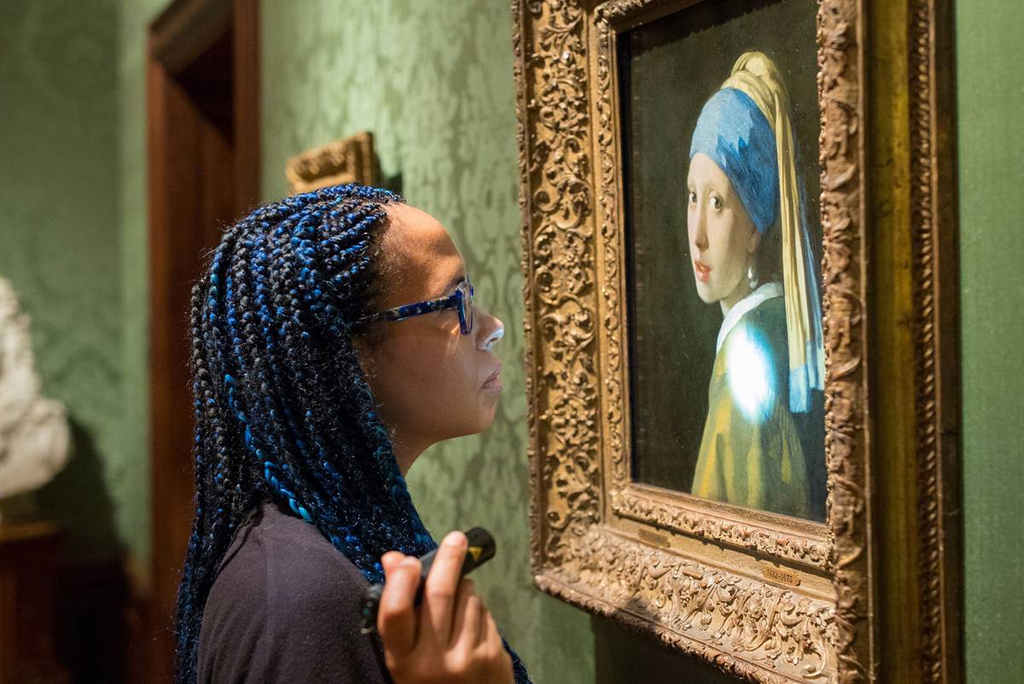
Then scientists began looking beneath the surface, and the Girl gave up a few more secrets.
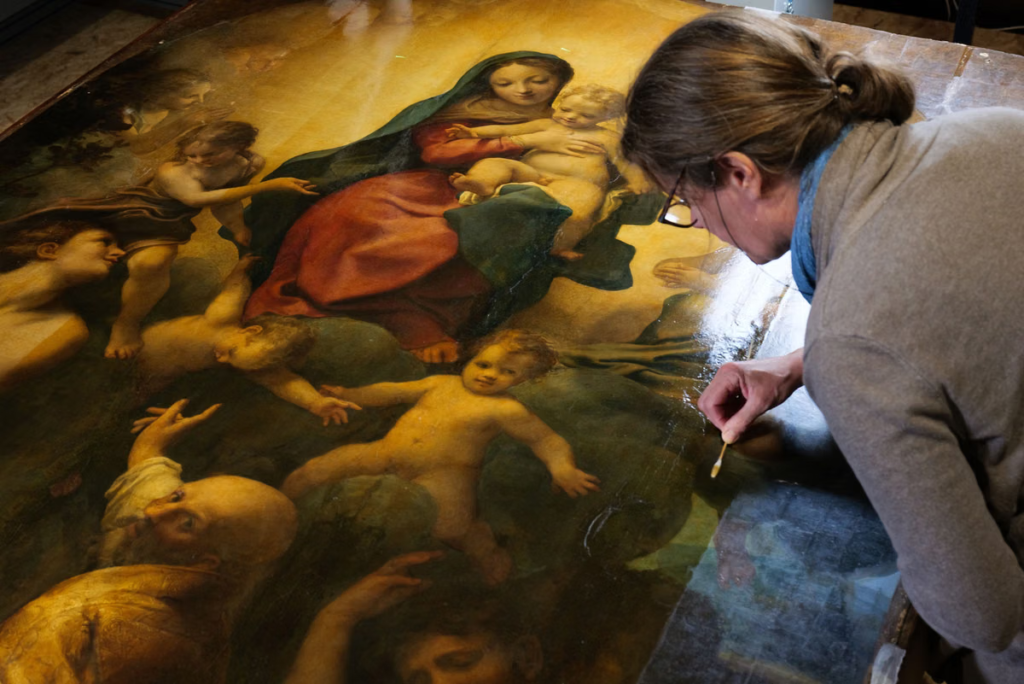
Technical examination revealed that the dark background was not always dark. Vermeer originally painted the Girl in front of a green curtain, its folds visible in the upper right. Over time, the translucent green paint changed through chemical and physical deterioration, leaving the background much darker than it once was.
Researchers also found that Vermeer changed the composition while painting. The position of the ear, the top of the headscarf and the back of the neck were shifted as he worked. Beneath the finished surface are broad, vigorous brushstrokes from the earlier stages of the painting.
And then there are the eyelashes. They are almost impossible to see normally, but microscopic and X-ray examination revealed tiny hairs around both eyes.
The Girl we see today is not quite the same painting Vermeer once saw on his easel.
The Blue Came from Half a World Away
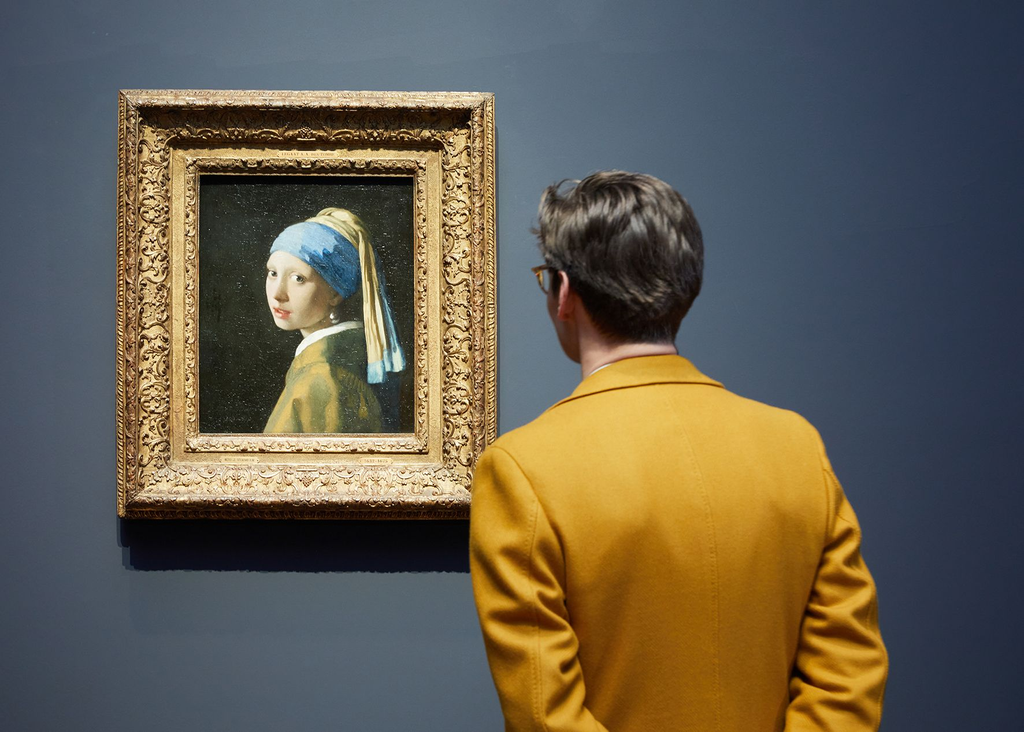
The blue of her headscarf is easy to take for granted. But Vermeer chose an extraordinarily valuable material to make it.
Technical research has identified natural ultramarine in the headscarf, a pigment made from lapis lazuli sourced from what is now Afghanistan. In seventeenth-century Europe, natural ultramarine was among the most expensive pigments available and could cost more than gold. Vermeer used it generously, including in the shadows of her yellow jacket.
The painting is surprisingly small—just 44.5 by 39 centimetres. Yet the lapis lazuli used for its ultramarine originated far beyond Europe, linking the canvas to seventeenth-century global trade.
Behind it is a material story involving distant sources, expensive pigments and painstaking preparation—all eventually reduced to colour and light.
And Then She Disappeared
For roughly two centuries after Vermeer painted her, the Girl remained largely unknown to the wider public.
By 1881, she resurfaced at an auction in The Hague. The painting was badly neglected. It caught the attention of the cultural official Victor de Stuers and collector Arnoldus Andries des Tombe, who were friends and neighbours. They agreed not to bid against one another, allowing Des Tombe to acquire it for just two guilders and thirty cents.
The Mauritshuis records two versions of how the attribution was recognised: one says De Stuers recognised Vermeer immediately; another says the painting was too dirty to identify until cleaning revealed the signature.
Des Tombe later left the painting to the Mauritshuis in his will. When the bequest took effect in 1903, the Girl had found a permanent home.
It is difficult to imagine now, but one of the world’s most recognisable images had once been an overlooked, neglected work that could be bought for a handful of coins.
Read more : Five Bookshops to Visit in Paris
The Girl Gets a Life We Don’t Actually Know
At some point, an anonymous face acquired a name.
In 1999, novelist Tracy Chevalier published Girl with a Pearl Earring, imagining the young woman as Griet, a fictional maid in Vermeer’s household. In 2003, the story became a film starring Scarlett Johansson and Colin Firth.
None of this tells us who actually posed for Vermeer. Griet belongs to Chevalier’s imagination, not to the historical record.
The story became so familiar that the girl acquired a home, a relationship with Vermeer, a voice and a life beyond the frame.
We begin with an image that refuses to explain itself, and someone else supplies the missing pieces.
The Girl had always had a face.
Now, she had a story too.
The Magdalena Theory: A New Answer, Not a Final One
One of the more recent theories comes from British art historian Andrew Graham-Dixon, who has proposed that she may have been Magdalena van Ruijven, daughter of Vermeer’s important patrons, Pieter Claesz van Ruijven and Maria de Knuijt.
Graham-Dixon connects the Van Ruijven family’s religious beliefs with the painting and suggests that it may refer to Mary Magdalene recognising the resurrected Christ. In his interpretation, the girl’s turning head, parted lips and expression echo that biblical moment.
It is an interpretation, not an established identification.
The Mauritshuis does not identify the sitter as Magdalena van Ruijven. Its research continues to describe the work as a tronie, an imaginary or idealised figure rather than a conventional portrait, and the museum says that we may never know who the girl was.
A new theory can change the way we look at Vermeer without necessarily telling us who sat for him.
Why Do We Keep Looking?
Perhaps the more interesting question is why we keep returning to her.
In 2024, the Mauritshuis commissioned neurological research using eye-tracking and brain activity measurements. Researchers found that viewers repeatedly moved their attention between the Girl’s eyes, her mouth and the pearl. The museum described this as a “sustained attentional loop”: the three points keep drawing the eye back into the painting.
Vermeer gives us a face to read, a pearl to notice and a mouth that seems almost ready to speak. Our eyes move between them, looking for the connection.
Not because it tells us everything.
Because it gives us just enough to keep looking.
The Story Behind the Story
Perhaps the story behind Girl with a Pearl Earring was never only about the girl.
It is also about everything that happened after Vermeer put down his brush: its years of obscurity, rediscovery, scientific examination and the stories people have written around a face with almost no biography of its own.
We have tried to give her a name. We have imagined her life. We have examined her pigments, her eyelashes, her background and even the tiny marks that make up her pearl. And still, the answer we want most remains out of reach.
We may never know who she was. But after more than three centuries, we know an extraordinary amount about how she was painted.
The mystery hasn’t disappeared. It has simply moved.
Explore the current open calls and submit your work: apply.artstoheartsproject.com