
The Unfiltered Creative Process of Artists Worldwide
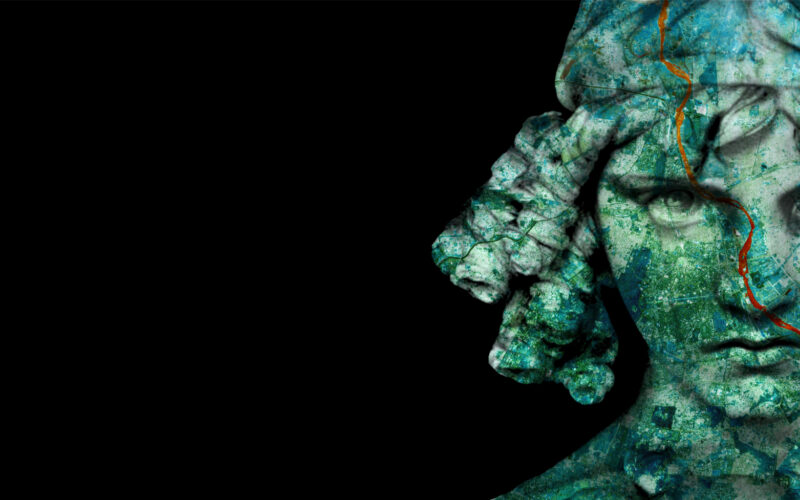
At Arts to Hearts Project, we have always been more interested in what happens before the work exists than in the work itself. The unfiltered part. The part that does not make it into the artist statement or the gallery bio or the carefully worded caption. The real creative process. The one that is messy and uncertain and completely honest in a way that finished work rarely gets to be.
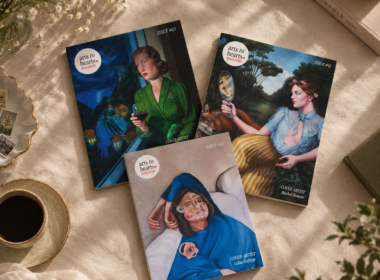
100 Emerging Artists of 2026 is a premium hardcover coffee table book bringing together 100 of the most promising artists from around the world, across every discipline, gender, and creative background. Artists whose work is bold, original, and already worth paying attention to. Artists the rest of the world is just beginning to notice.
We asked every one of them the same thing. What part of your creative process do you love most? And what part do you struggle with most? Unfiltered. Unedited. Exactly as they experienced it.
What came back was more honest than we anticipated. More raw. More real. We shared some of those answers. But there were more that deserved the same space. So we went back. Because the unfiltered creative process of an artist is never a one-time conversation. It is ongoing. And so are we.
The spark at the start. The struggle at the end. Every artist knows this gap
There is a moment at the very beginning of a creative idea that feels unlike anything else. It arrives without warning. From a memory, a piece of light, a feeling that has not quite found its shape yet. And for a second everything feels possible and alive and completely clear. And then the work begins. And the gap between that first electric moment and the finished piece is where most of the real difficulty lives.
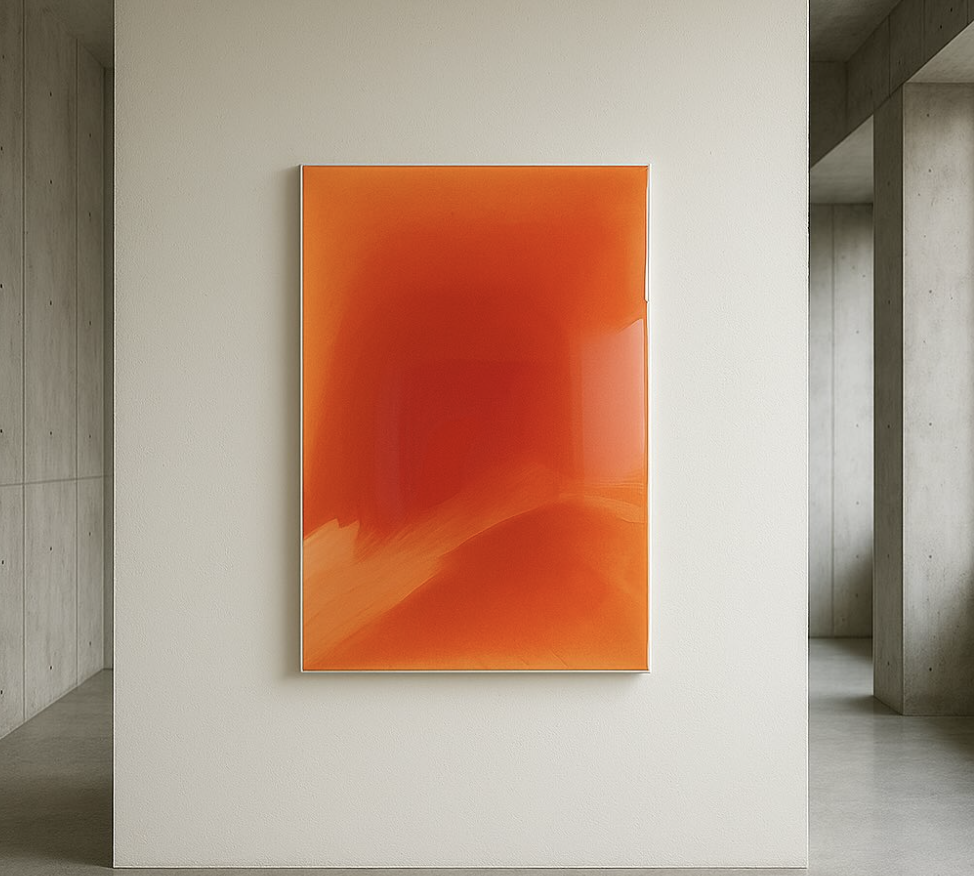
Juan Du @juandu191 knows that gap well. In her own words:
“The part I enjoy most is the very beginning the moment when an idea or image suddenly appears in my mind. It often comes unexpectedly, sometimes from a feeling, a memory, a piece of light, or even a quiet moment in daily life. That moment feels very alive to me. The most difficult part is usually finishing the work. I often struggle to decide when to stop, because I keep noticing small details and emotional changes. Letting go of a piece can sometimes be harder than starting it.
Juan Du
Letting go of a piece can sometimes be harder than starting it. That line is the one that stays. Because starting carries hope. It is open and full of possibility. But finishing means deciding. Committing to what the piece is and releasing what it could have been. And for an artist who feels everything as deeply as Juan clearly does, that is never a small thing.
The messy middle is not the problem. It is the price of getting to the end.
Every creative process has a phase that nobody talks about enough. The one that comes after the excitement of starting and before the satisfaction of finishing. Where the work looks wrong and the energy has dropped and nothing seems to be going where you hoped it would. Most people call it being stuck. Some artists have learned to call it something else. Part of the process. The necessary difficulty. The price you pay for getting to the other side.
Ibolya Nagy @ibolya.nagy.art describes it honestly:
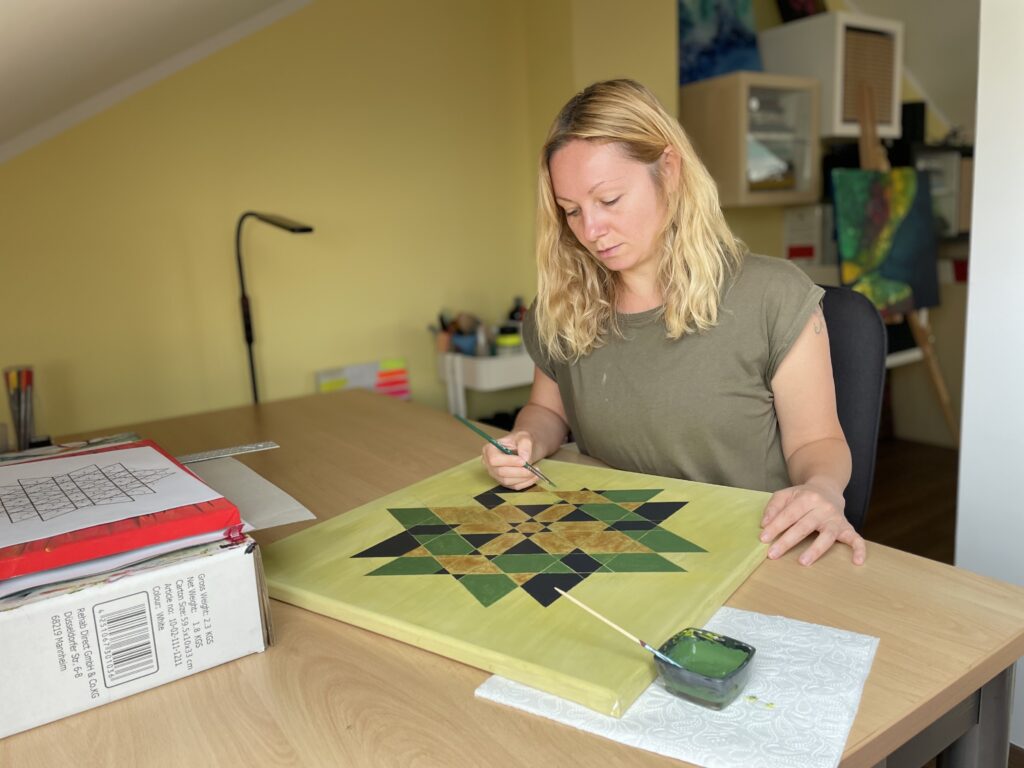
“I love the beginning — when nothing is fixed yet and I can move freely, covering the canvas, drawing into it, letting things build slowly. It’s raw, a bit chaotic, but alive. The hardest part is the ugly phase that follows. It takes trust and persistence to stay with it, even when it feels like it’s not working. It can be frustrating, but that’s also what makes it compelling. The final stage, refining and adding the last details, feels grounding again — especially when the piece becomes what I had hoped for.”
Ibolya Nagy
Especially when the piece becomes what I had hoped for. That line carries everything. Because it means the ugly phase was never the destination. It was just the way through. And Ibolya has learned to trust that. To stay in the frustrating middle with persistence and faith that the grounding moment at the end is still coming. That the piece is still becoming what it was always supposed to be. It just needs more time than the beginning made it seem.
Some art is made to be seen. Some is made to survive the making of it.
There are artists who create for an audience. Who think about the viewer from the very first mark. And then there are artists for whom the making itself is the primary act. Where the canvas is less a surface and more a space. A place to go with the things that have no other place to go. Where the work of creating is also the work of understanding. Of surviving. Of finding out what you actually feel when you finally stop trying to explain it.
Jennifer Frances @JenniferFrancesart works from exactly that place:
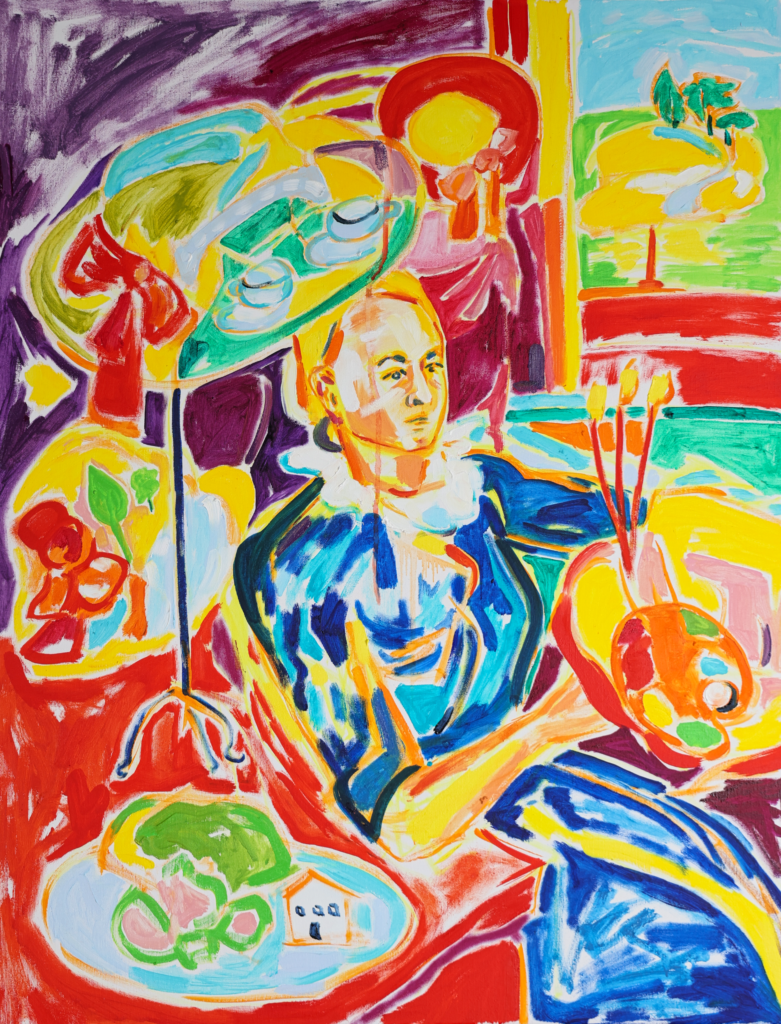
I make art to process and understand my inner world. Much of my work is rooted in mental health and emotional experience, and painting allows me to explore things that are often difficult to put into words. Through mainly portraiture, I try to create moments of honesty, vulnerability, and compassion both for myself and for others who might see themselves reflected in the work.
Jennifer Frances
There is something quietly generous about that. Making work from the most personal, difficult parts of yourself and then offering it to the world in the hope that someone might look at it and feel seen. That takes a particular kind of courage. And a particular kind of care. For yourself and for the stranger who might one day stand in front of what you made and feel a little less alone in what they carry.
Art that holds what cannot be spoken. That is one of the most important things it can do
There are things we carry that language cannot quite reach. Not because the feeling is not real but because words flatten it. Reduce it to something smaller than it actually is. And for those things, the ones that live in the body before they live in the mind, art does something that nothing else can. It holds the tension without resolving it. It makes the unnamed thing visible without forcing it to be explained.
Sofia Bianchini @sofia_bianchini_digital_artist describes her practice this way:
I make art because I feel an urgency to translate shared human conditions into a visual language. Through my process, I try to hold tensions that are often difficult to name — fragility, pressure, misalignment, loss, transformation, resilience. It is also a way of challenging myself, a continuous form of research, and, in many ways, a form of cure. Each work allows me to stay with what is unresolved, rather than escaping it. In doing so, I hope the image can become a space where others might recognise something of their own experience.
Sofia Bianchini
Most of us want to move past the hard things as quickly as possible. Sofia does the opposite. She goes toward them. Sits with them. Makes something from them. Not to fix anything. Just to make it visible. And in doing that Sofia gives someone else the chance to look at her work and feel that what they have been carrying quietly is not only theirs. Someone else felt it too. And made something from it. And that is everything.
Joy is not a small thing to give someone. Some artists have built their whole practice around it.
We talk a lot about art that challenges. Art that provokes. Art that sits with the difficult and the unresolved and asks you to do the same. And all of that matters. But there is another kind of art that does not get talked about enough. The kind that simply gives. That walks into a room and makes it feel lighter. That takes a memory or an emotion or a moment that deserved to last and turns it into something you can hold onto. That kind of art requires just as much intention. And just as much care.
Sheryl Yerro @wooden_toque creates from exactly that place:
I create art to inspire, to express messages that words often cannot, and to touch the hearts of others. Through every piece, I preserve memories, emotions, and moments that deserve to be remembered. Most importantly, I create art to help people connect, feel joy, and find meaning together
Sheryl Yerro
To help people connect, feel joy, and find meaning together. That last word is the one that stays. Together. Because Sheryl is not just making art for an individual viewer. She is making art that brings people toward each other. That creates a shared moment. A shared feeling. Something that belongs to more than one person at once. And in a world that can feel isolating and loud and difficult to navigate, that is not a small thing to offer. That is one of the most generous things arts can do.
Reading through all of these we kept stopping. Not because the answers were similar. But because every single one of them meant something real to the person behind it.
Some create because the spark at the very beginning feels unlike anything else in their day. Some because staying with the unresolved is the most honest thing they know how to do. Some to preserve the moments and the emotions that would otherwise slip away. Some because a canvas can reach the places that words have always failed to go. And some simply because giving joy to another person is reason enough to keep making things.
None of these are small reasons. And none of them are the same. But underneath all of them is the same quiet truth. That making art is never really just about the finished piece. It is about everything that made the making feel necessary in the first place. The urgency. The need. The thing that would not leave until it was made.
That is what 100 Emerging Artists of 2026 holds across every page. Not just the work. The reason behind it. Artists at the beginning of something. Still close enough to why they started to be completely honest about it. And that honesty is what makes this book worth returning to. The link is below.
Before you go. The Big Book of Mixed Media Artists 2026 closes in just a few days. A curated international collection for artists who work across mediums, experiment with materials, and create in ways that refuse to fit neatly into one category. If that sounds like your practice, this is the book for you. And the deadline is almost here. If your work belongs in it, now is not the time to think about it. Now is the time to submit.