
The Story Behind Nighthawks
The Night Hopper Turned Into a Mystery
The Story Behind is a series about famous artworks and the parts of their stories that got left out, the decisions, the arguments, the details hiding in plain sight. This is the first.
We think we know Nighthawks.
The glowing diner. The four figures. The empty street outside. The strange feeling that we have arrived in the middle of something, even though nothing seems to be happening.
But look a little longer.
Nobody is speaking. Nobody is looking at anyone else. There is no visible entrance to the diner, no clue about where these people came from, or where they are going. Even the place itself is not quite what it seems. Hopper took a real New York corner and transformed it into a scene that feels familiar and impossible at the same time.
And then there is the detail hiding in plain sight: there is a door.
It just doesn’t lead outside.
Edward Hopper finished Nighthawks in January 1942. More than eighty years later, we are still standing across the street, looking in, trying to work out what happened before we arrived.
The painting gives us the moment.
It never gives us the story.
The Scene Where Nothing Happens
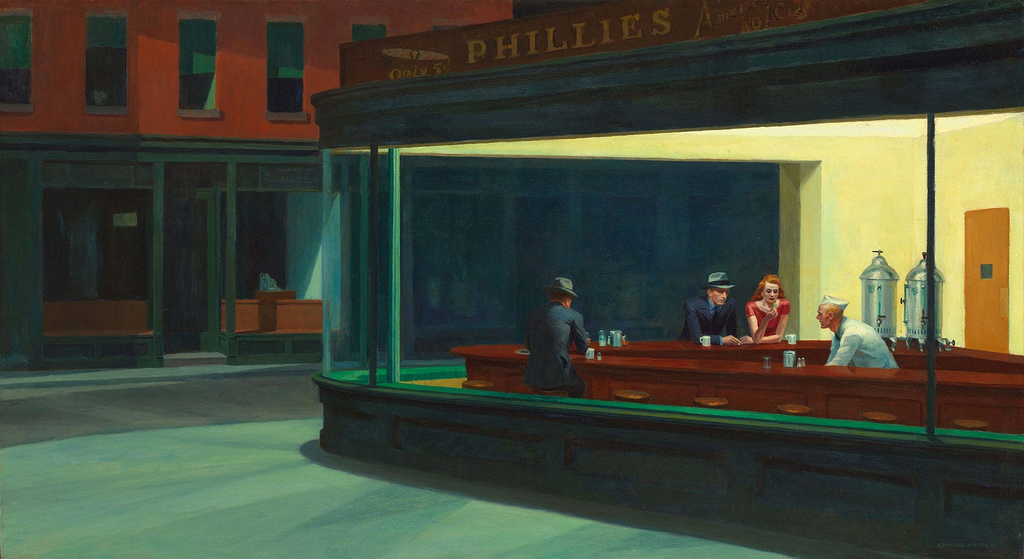
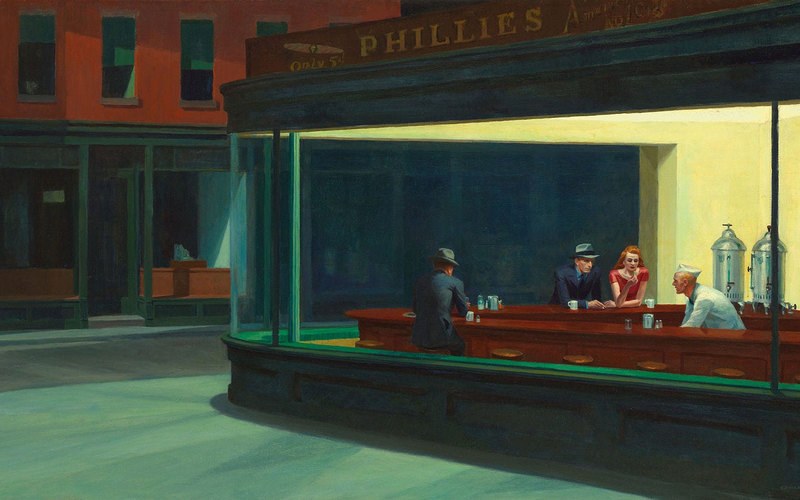
A diner burns bright on a dark corner. Four people share the space, a man alone with his back turned, a couple beside him, a server crouched behind the counter. A cigarette. Two metal urns. Empty pavement outside.
Nobody is speaking. Nobody is leaving. In any ordinary sense nothing is happening, and yet it feels like we have walked in on the middle of something.
Edward Hopper finished the painting on 21 January 1942, and gave us just enough to start asking. Who are these people? Do they know each other? What has kept them awake at this hour?
He never answers. He offers a window instead.
A Real Corner That Was Never Quite Real
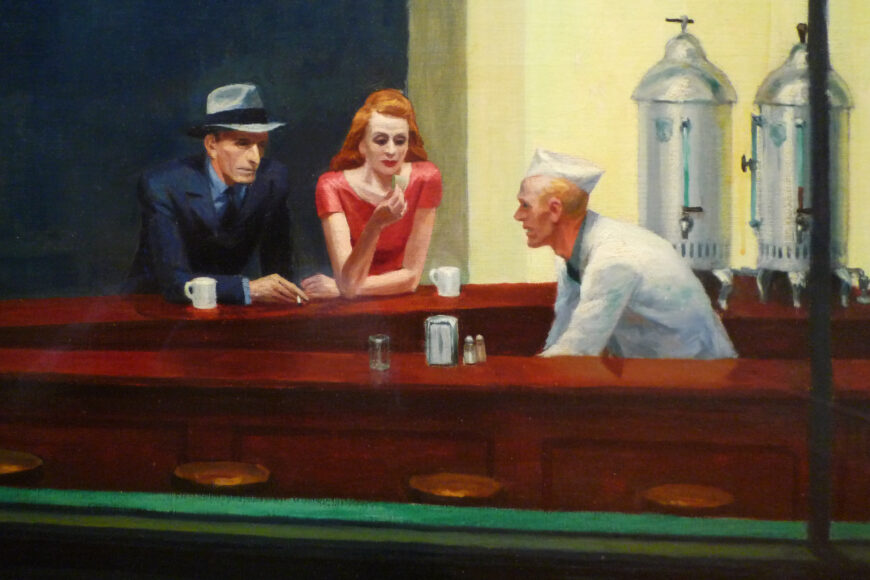
Before it became shorthand for the lonely modern city, it was a place Hopper walked past.
He said it came from “a restaurant on New York’s Greenwich Avenue where two streets meet.” He had lived in Greenwich Village most of his life, and Greenwich Avenue is one of the few streets that cuts a diagonal across Manhattan’s grid, which means sharp, unusual corners, exactly the architecture that interested him.
He did not copy it. By his own account he simplified the scene considerably and made the restaurant bigger. The Art Institute of Chicago, which owns the painting, is clear that it is not a realistic transcription of an actual place.
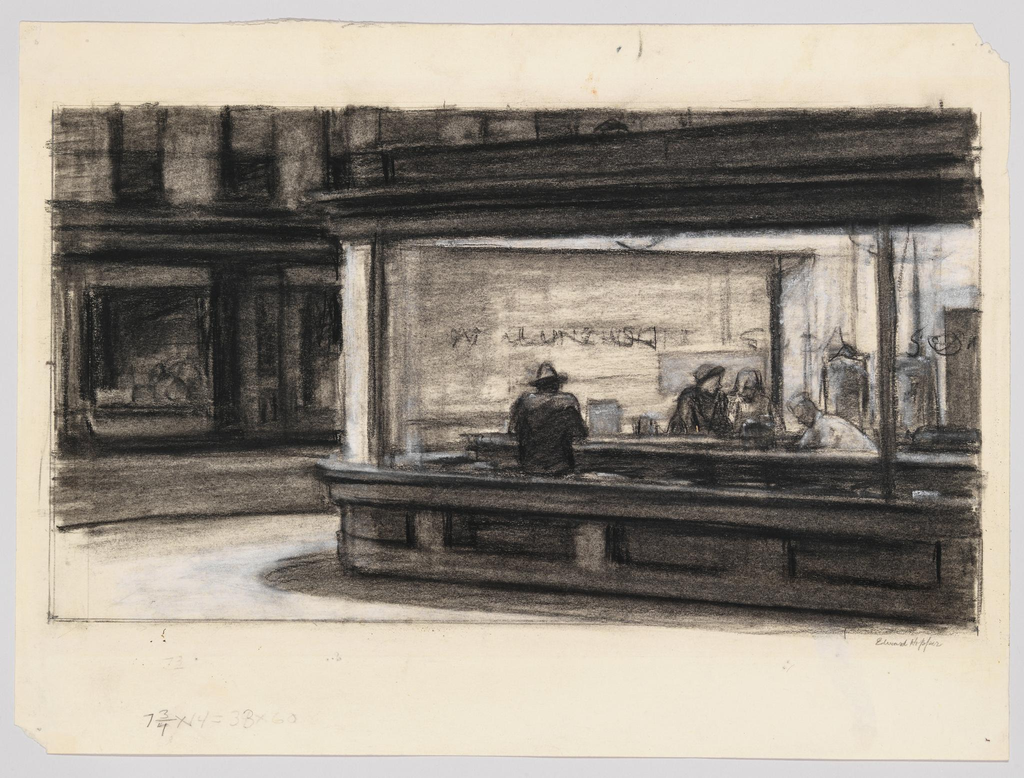
You can watch him building it. The Whitney holds a run of Study for Nighthawks drawings from 1941–42, the figures, the counter, the room. In the last of them, possibly made after he had already started the canvas, he was still shifting the perspective and still testing how hard the light inside should strike the dark outside.
The finished picture looks like something glimpsed by accident on a walk home. It was assembled.
Read more : The Strange Beauty of Cats in Art
Then Hopper Took Away the Door
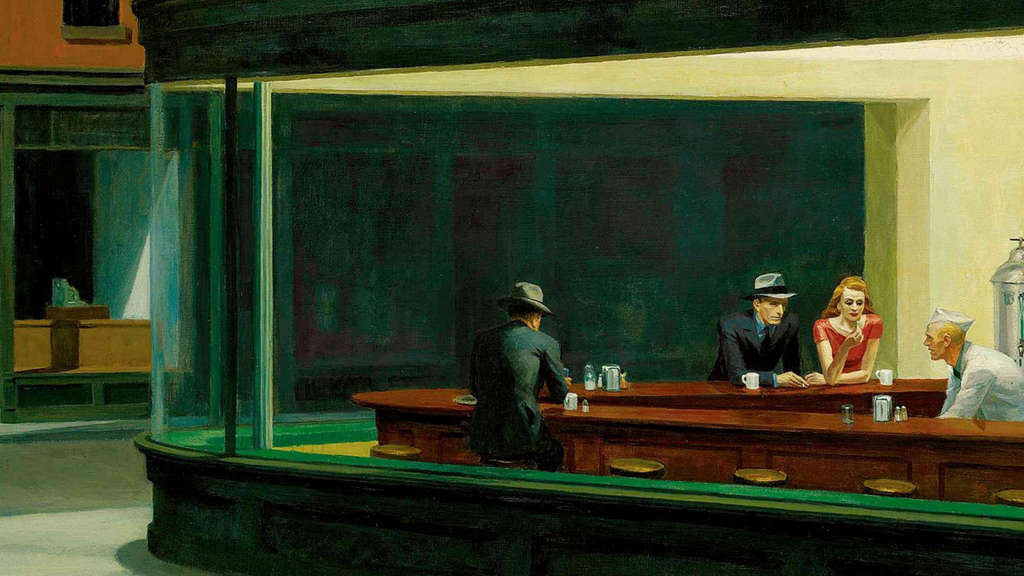
Go looking for the way in and it isn’t there. The glass wraps the corner unbroken, no street door, no handle, not even a seam where one might be. The Art Institute puts it plainly: Hopper “eliminated any reference to an entrance.”
There is exactly one door in the painting. Jo Hopper named it in her notes on the canvas, a dull ochre door at the right, leading into the kitchen.
So there is a way out of that room. It goes further in.
Try to imagine yourself at the counter and the picture quietly refuses you. You are stuck across the street in the dark, watching. The Whitney’s own commentary makes the point that the painting isolates its viewer as thoroughly as it isolates the four people inside.
The diner belongs to them. The night belongs to us.
The Strangers Were the Hoppers
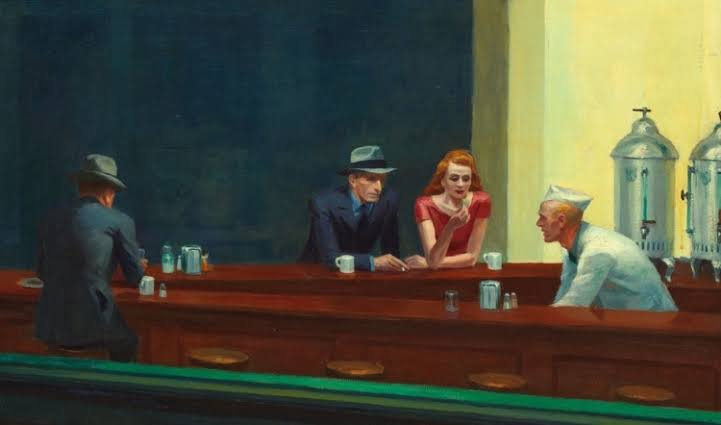
The diner is what we remember. The people are why we come back.
A man sits alone, turned away. Beside him, a woman and a man sit close with no visible sign of affection, no touch, no glance, nothing to tell us whether they arrived together or simply ended up beside one another. The server seems to be attending to them, though even that feels muted. We can describe what they are doing. We get no names, no dialogue, no reason for their being there.
One part of it is documented, and it changes the painting.
In January 1942, Josephine Hopper wrote to her husband’s sister about the picture he had just finished, a lunch counter at night, three figures. Night Hawks would be a good name for it, she thought. Then the detail: Ed had posed for both men himself, working from his own reflection in a mirror. She had posed for the girl.
The title stayed. And Jo was the one who suggested it. Her notes single out the beak-like nose on the man beside the woman, the night hawk.
So the strangers inside the diner were partly drawn from the people closest to Hopper. Yet on the canvas, they remain almost completely unknowable. They still give nothing away.
The Light, and the City That Vanished
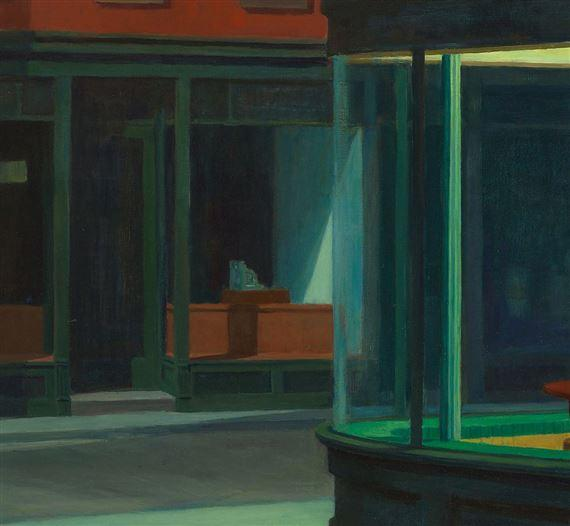
The diner is almost unnaturally bright. Its glare pushes through the glass onto the pavement, and no streetlamp competes with it, the room is the painting’s only light source. The Art Institute calls that glow eerie, closer to a beacon than a shopfront.
Part of what makes it strange is that it was new. Fluorescent lighting had only just come into commercial use in the early 1940s, so a diner lit like this looked aggressively modern in 1942. In his final preparatory drawing, Hopper worked the effect out in white chalk, testing hard artificial light against a dark street.
And the light is not flattering anyone. It is exposing them. Every face and gesture is legible through the glass while everything beyond it dissolves, no cars, no pedestrians, no noise you can imagine. The shopfronts opposite are dark, the windows above them look unoccupied. The only evidence that commerce exists at all is an old cash register through a neighbouring window and a Phillies cigar sign above the diner.
Where these people are most visible, they feel least reachable. And the city that should be holding them has simply gone.
Set it beside his earlier Early Sunday Morning, same kind of New York storefront architecture, same unnatural quiet, and the difference sharpens. That one is a city about to wake up. This one has already gone to sleep. The Whitney describes Hopper turning New York into ambiguous spaces of “mystery, anticipation, and anxiety.” This is the ambiguity at full strength.
A Still From a Film Nobody Made
The painting doesn’t simply show us a diner. It positions us in front of one, at a distance, as though we arrived after the scene began. The glass works like a camera frame.
That is not entirely a coincidence. Hopper was a devoted moviegoer, and cinema became an important part of the visual world surrounding his work, the angles, the shadows, the distant viewpoints, the view framed through windows. The Art Institute has noted the connections between these cinematic techniques and Hopper’s pictures, particularly the visual language that would become associated with film noir.
He read the same way. Hopper admired Hemingway’s short story The Killers, most of which unfolds at the counter of a diner. Art historian Gail Levin has pointed to the story as a possible connection, noting Hopper’s admiration for Hemingway and suggesting that the story’s suspense, the sense that something is about to happen, even when it never does, echoes the tension in Hopper’s paintings.
Levin has raised a second possibility. Van Gogh’s Café Terrace at Night was being exhibited in New York around the time Hopper completed Nighthawks, and Levin has suggested that the painting may have been another point of reference. Tempting. But there is no conclusive evidence that Hopper saw it or that it directly influenced Nighthawks.
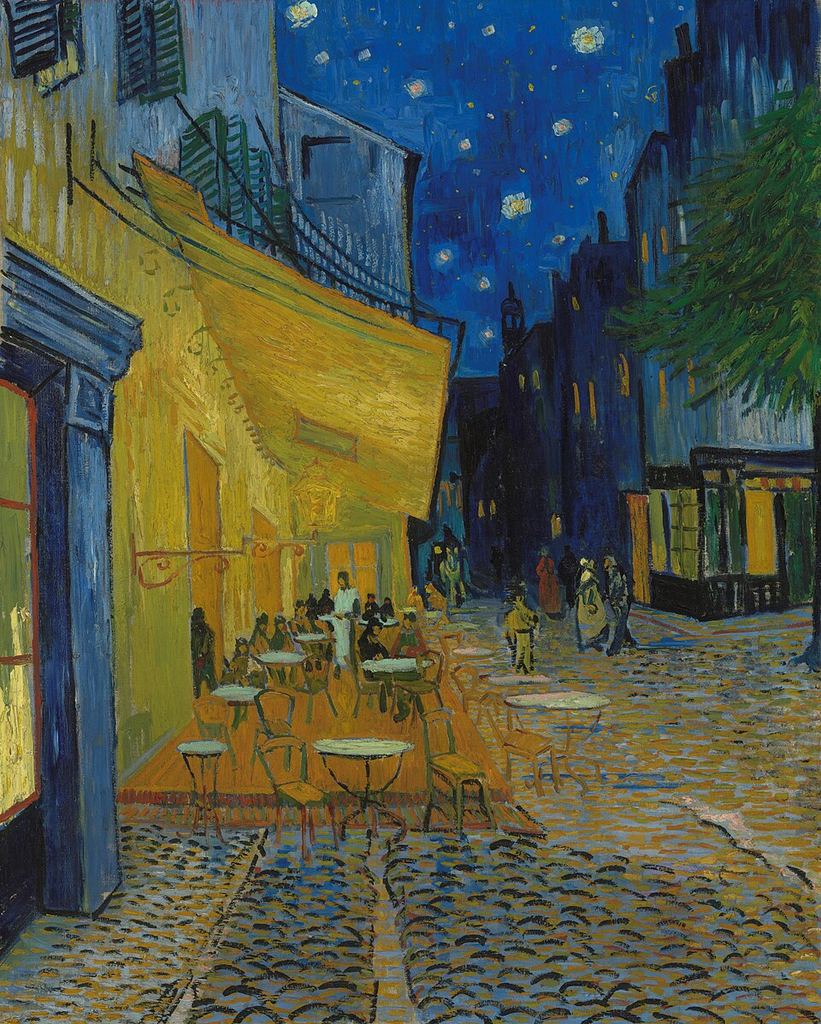
Van Gogh’s Café Terrace at Night
The influence ran the other way too, eventually. Ridley Scott later recalled keeping a reproduction of Nighthawks nearby while making Blade Runner, using it to communicate the look and mood he wanted to his production team.
So Is It Really a Painting About Loneliness?
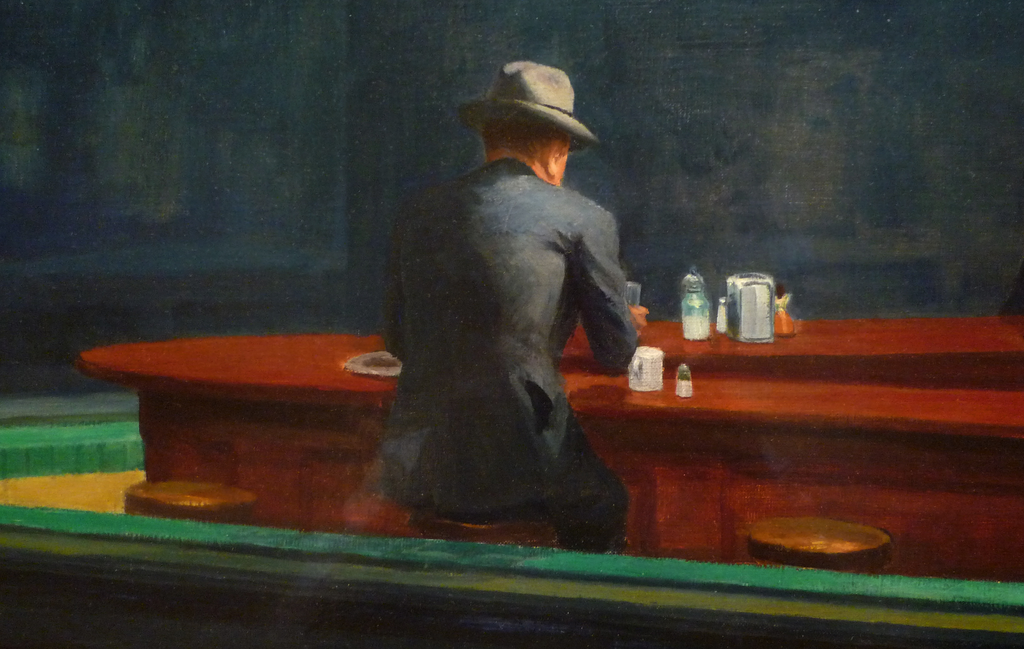
Almost nobody looks at it and thinks anything else. The Whitney describes the four figures as coming together in a late-night diner and remaining “utterly apart.”
Hopper complicated that reading himself. He resisted the idea that he loaded his pictures with symbols of isolation, and once said flatly that he didn’t see this one as especially lonely, then, elsewhere, allowed that “unconsciously, probably,” he had been painting the loneliness of a large city. Both statements survive.
That gap matters. Nobody here is visibly suffering. No argument, no tragedy, no abandonment. The figures are simply separate, and their closeness produces no intimacy at all. We are folded into it too, standing outside glass, watching people who cannot see us.
The empty street does it. The silence does it. The light does it.
Hopper never tells us these people are lonely. He leaves enough room for us to suspect it.
The Painting Never Gave Us the Ending
Within months of its completion, the Art Institute of Chicago bought Nighthawks for $3,000. It has been there ever since.
Hopper seems to have known what he had. Writing to the museum’s director, Daniel Catton Rich, in May 1942, he called it “one of the very best things” he had painted, and said he felt closer to what he was after.
What followed was almost a second life, reproduced, reimagined, parodied, borrowed, until the Art Institute could reasonably call it an icon of American culture.
None of which has answered a single question the painting raised.
We still don’t know who they are, what brought them there, what was said before we arrived, or where any of them went. And after more than eighty years of looking, the only door still leads to the kitchen.
Hopper gave us a moment, not a story.
The ending was always ours.
Explore the current open calls and submit your work: apply.artstoheartsproject.com