

Why Do So Many of Modigliani’s Portraits Have Empty Eyes?
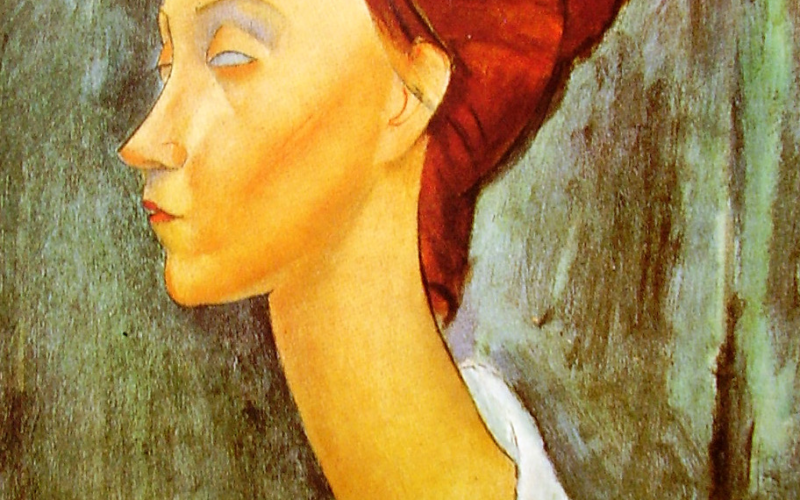
Most portraits ask you to meet the sitter’s eyes. Amedeo Modigliani’s Portraits ask you to go looking for them.
Spend time with his work and a pattern emerges: elongated necks, simplified features, almond eyes hovering somewhere between intimacy and distance. Some are pale and pupil-less. Some carry only a hint of color. Others meet you with startling clarity. Once you notice the inconsistency, one question is hard to shake, why would an artist so obsessed with the human face keep leaving its most expressive feature unresolved?
The internet has a tidy answer. Modigliani, the story goes, believed eyes were windows to the soul, and refused to paint them until he truly knew the person in front of him. It’s been repeated so often it now passes for art history.
The paintings disagree. Look at Portrait of Lunia Czechowska, the many faces of Jeanne Hébuterne, or The Little Peasant, and the “rule” starts to fall apart. Modigliani painted eyes, sometimes with real precision. He also left them blank, deliberately. So what actually decided the difference?
Sculpture might be a better place to start than romance: his years carving stone heads, his fascination with African masks and Cycladic idols, his refusal to chase a photographic likeness. Even those threads don’t fully explain why the blank faces still unsettle us a century later.
This piece draws on museum records, exhibition catalogues, and published scholarship to sort the documented from the beloved myth, and to ask what’s actually happening in those eyes.
Why Did He Leave So Many Eyes Blank?
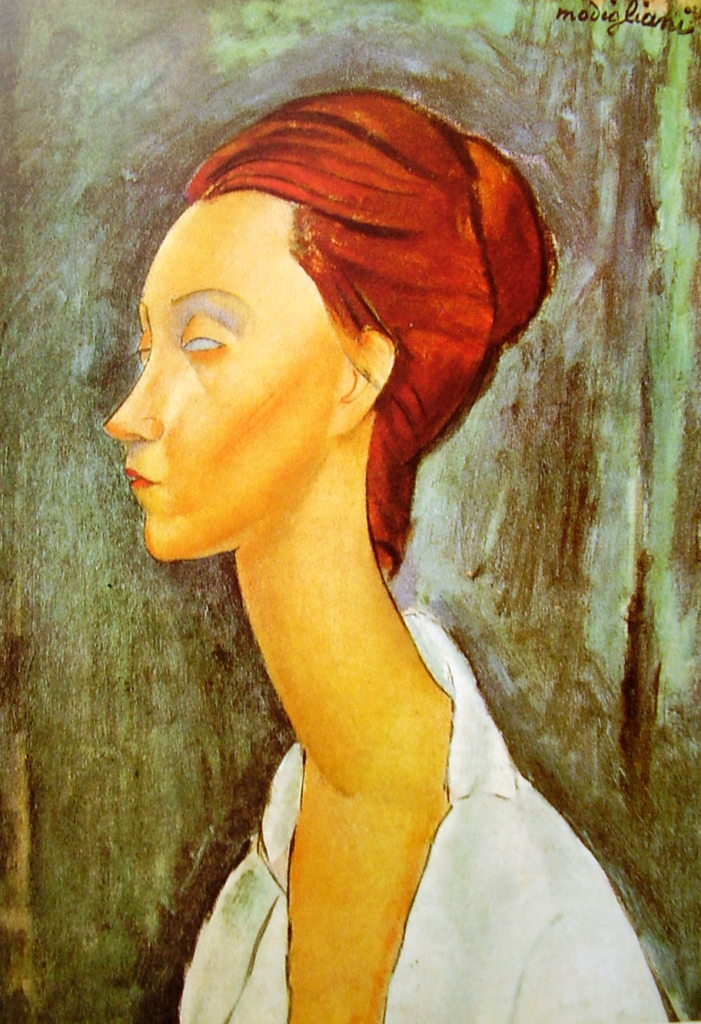
Spend a few minutes with Modigliani’s portraits and the pattern is unmistakable. Portrait of Lunia Czechowska (1919). The many studies of Jeanne Hébuterne. Portrait of Chaïm Soutine (1916). Same elongated features, same graceful necks, and eyes that often look unfinished. Pale and pupil-less in one, a single dark iris in another, startlingly present in a third.
At first it looks like carelessness, eyes are usually the last thing a portraitist adds, the detail that brings a face to life. But Modigliani returned to this visual language again and again. The missing pupils weren’t an oversight. They became a signature.
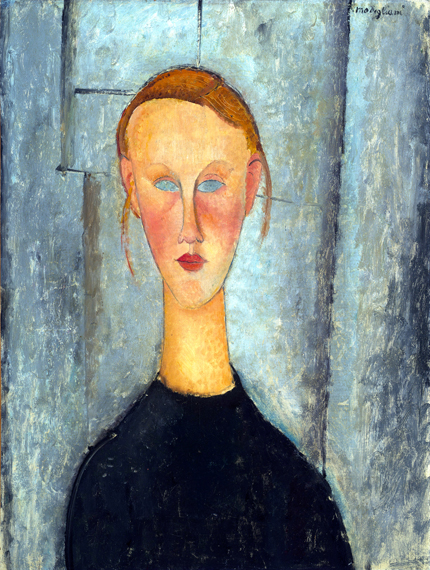
Take Lunia Czechowska: her face is calm and luminous, but her pale eyes resist you. They don’t read as empty, exactly, more like an invitation to search for something the painting won’t hand over. Set that beside Girl with Blue Eyes (1918), where the sitter’s vivid gaze anchors the whole composition, and one thing becomes obvious: Modigliani knew exactly how to paint expressive eyes. He just didn’t always choose to.
Historians point to a few explanations, African masks, Cycladic sculpture, a broader disinterest in photographic likeness. But one story has drowned out all the others: that Modigliani only painted the eyes once he understood a sitter’s soul.
It’s a lovely idea. It’s also, on closer inspection, hard to prove.
Did He Really Say “When I Know Your Soul, I Will Paint Your Eyes”?
Few lines are as inseparable from Modigliani as this one. It shows up under Instagram posts, in documentaries, in casual conversations about portraiture, treated as settled fact.
It’s also surprisingly hard to source. Unlike quotes historians can trace to letters or interviews, there’s no widely accepted primary source for this one. It survives mostly as anecdote, passed down by people who knew him. That doesn’t make the sentiment false. It just means treating it as documented fact is a stretch.
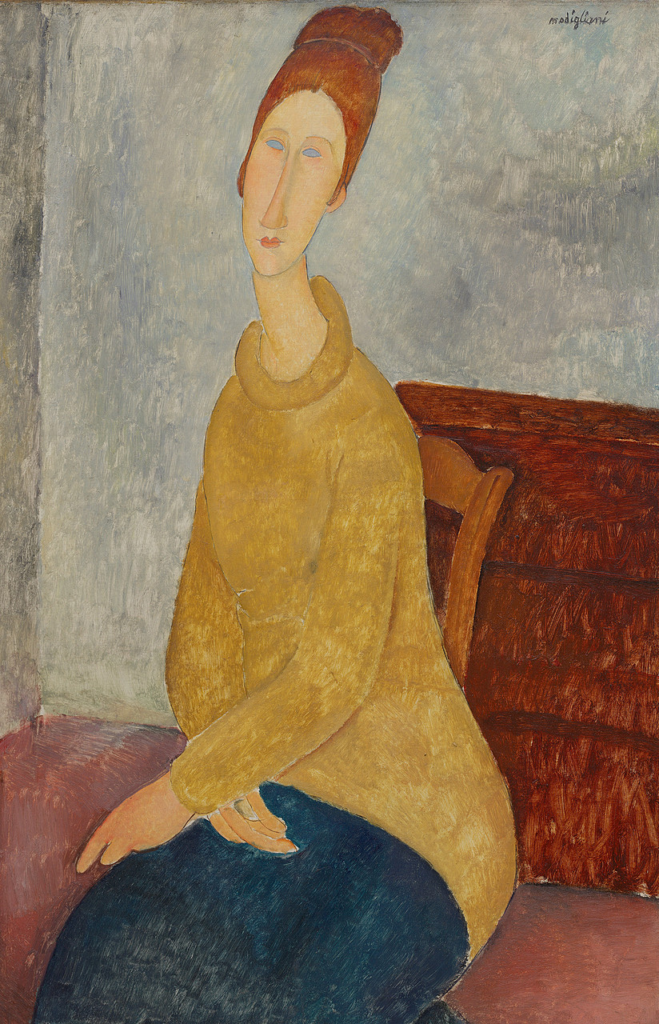
The story usually attaches itself to Jeanne Hébuterne, who appears in more than twenty of his paintings. But her portraits don’t back it up. In Jeanne Hébuterne with Hat and Necklace (1917), her eyes are soft, almost featureless. In Jeanne Hébuterne Seated (1918), they stay elongated and restrained. By Jeanne Hébuterne in a Yellow Sweater (1919), they’re noticeably more defined. If Modigliani were following a fixed rule about a soul he’d come to know, why would his rendering of the same woman keep changing?
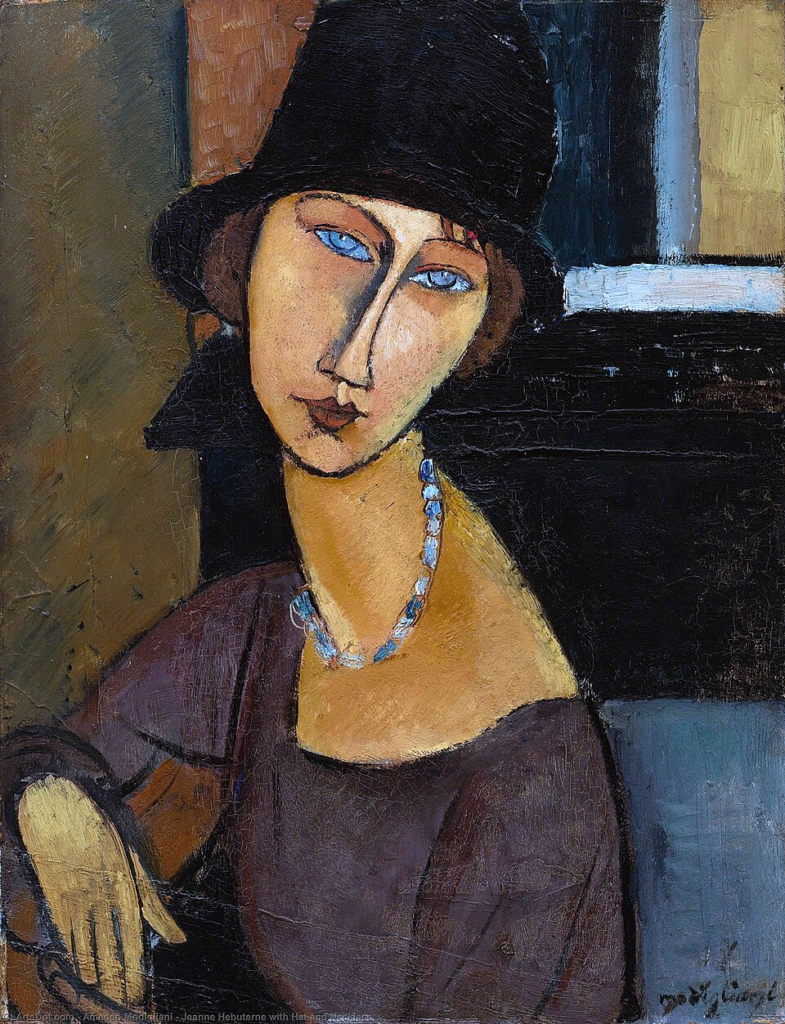
Widen the frame and the rule breaks down further. Soutine’s eyes, in his 1916 portrait, are dark and hold your attention. Lunia Czechowska’s don’t. The difference looks less like a formula and more like an artist adjusting to the mood of each sitting.
Which raises the second half of the myth, the one about Jeanne being the only person whose eyes he ever really painted.
Was Jeanne Hébuterne the Only One?
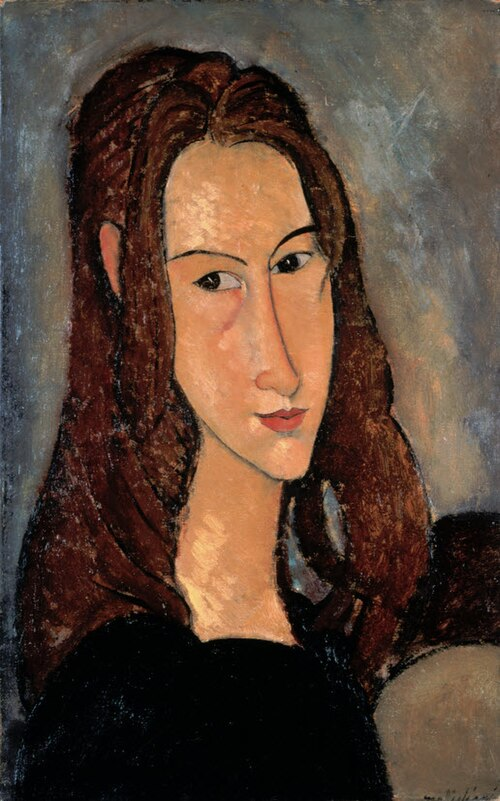
This is the quote’s favorite sequel: that Jeanne, his muse, his partner, the mother of his daughter, was the only sitter whose eyes Modigliani ever fully painted. It’s a good story. It also doesn’t survive contact with the paintings.
Jeanne appears in more than twenty works between 1917 and 1920, and no two treat her eyes the same way, soft and simplified in one, elongated and restrained in another, more defined by 1919. If she were truly the only person he’d come to “know,” you’d expect consistency. Instead you get variation.
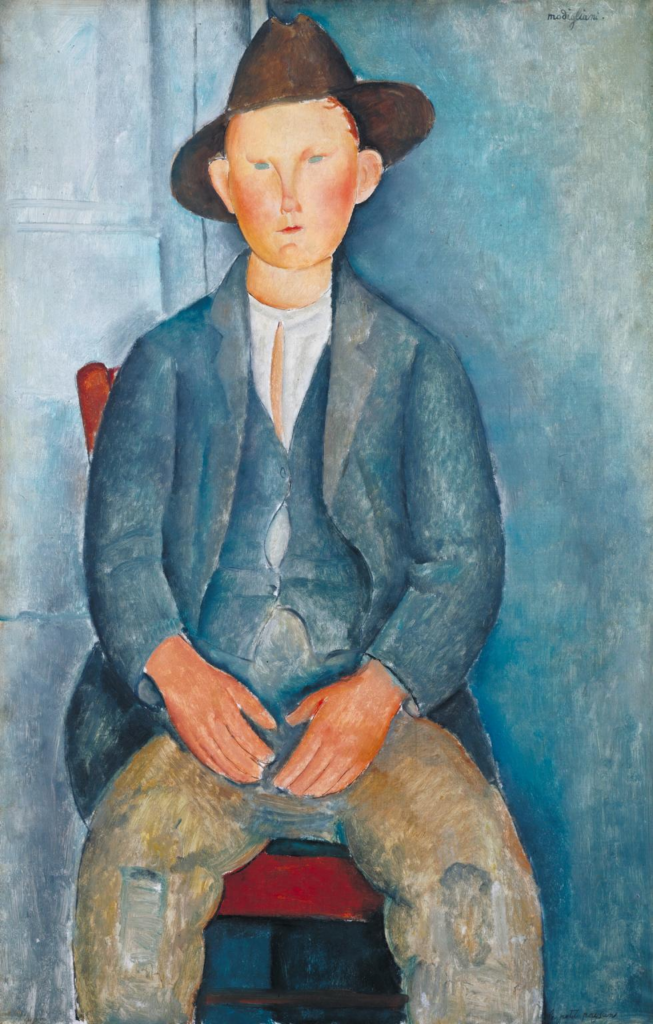
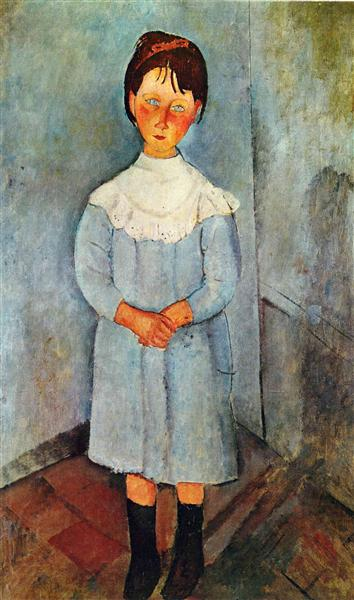
And she wasn’t the only sitter who got careful treatment. Soutine’s eyes carry real intensity. The Little Peasant (1918) has vivid blue eyes that command the frame. Little Girl in Blue (1918) does the same. Modigliani clearly had no trouble painting a full, expressive gaze when a portrait called for one.
The real story here might be better than the myth. Jeanne wasn’t exceptional because she was the only person he painted with open eyes, she was exceptional because he kept returning to her, again and again, tracing small variations across the last years of his life. That’s not a symbolic gesture. That’s an evolving relationship, made visible in paint.
So if it wasn’t the soul, what was it?
If Not the Soul, What Was It?
Look past the mythology and the eyes start to look less like personal symbolism and more like a deliberate visual language, built from a few specific influences.
Sculpture is the biggest one. In Paris, Modigliani grew fascinated with Cycladic marble figures, prehistoric sculptures reduced to little more than a nose and shallow, almond eyes. That same stripped-down quality shows up in Lunia Czechowska’s timeless, almost placeless face.
African masks were the other major influence, widely collected and exhibited in Paris in the early 1900s. Unlike European portraiture, these weren’t built to imitate reality, their stylized eyes and geometric forms carried spiritual and ceremonial weight. You can feel that in Portrait of Pablo Picasso (1915), where the face reads as sculptural form rather than likeness.
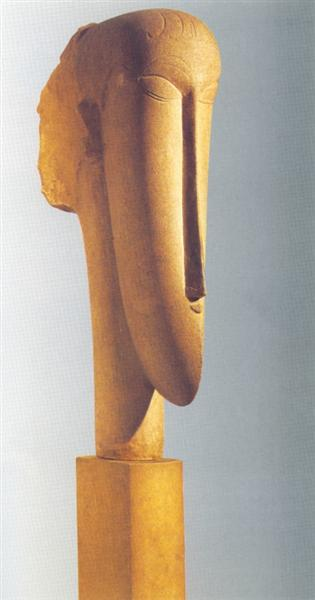
Then there’s the fact that Modigliani spent 1909 to 1914 mostly not painting at all, carving limestone heads instead. Head (1911–12) already shows the elongated face and hollow eyes that would define his later portraits. Stone can’t rely on color or fine detail for expression; it has to work through shape alone. When Modigliani went back to canvas, he brought that sculptor’s logic with him, visible in the calm geometry of Portrait of Moïse Kisling (1915).
None of this drains the eyes of emotional weight. If anything, the ambiguity might be the whole point, leaving space for the viewer to finish what the painting won’t.
Which explains why these portraits still feel so unsettling, more than a century on.
Why the Blank Eyes Still Get Under Your Skin
Here’s the real mystery: not why Modigliani painted blank eyes, but why we can’t stop looking at them.
Most portraitists lead you straight to the eyes, for centuries, they’ve carried the emotional information. Confidence, grief, tenderness, suspicion: your brain reads a glance in a fraction of a second. Modigliani interrupts that instinct. Stand in front of Lunia Czechowska and you find yourself hunting for an expression that never quite arrives.
There’s a simple psychological reason this works: the brain doesn’t like unresolved information. An unfinished melody lingers. An unanswered question keeps circling. A painting that withholds a gaze does the same thing, it pulls your imagination in to finish the job.
A face can hold more than a likeness. Sometimes it carries a memory, a relationship, or an entire moment that would otherwise disappear. We explored that idea in Before They Became Memories, They Were Just Ordinary Days, a look at eight paintings that find meaning in the seemingly insignificant moments of everyday life, from children in the water to two people simply walking home. Read: Before They Became Memories, They Were Just Ordinary Days
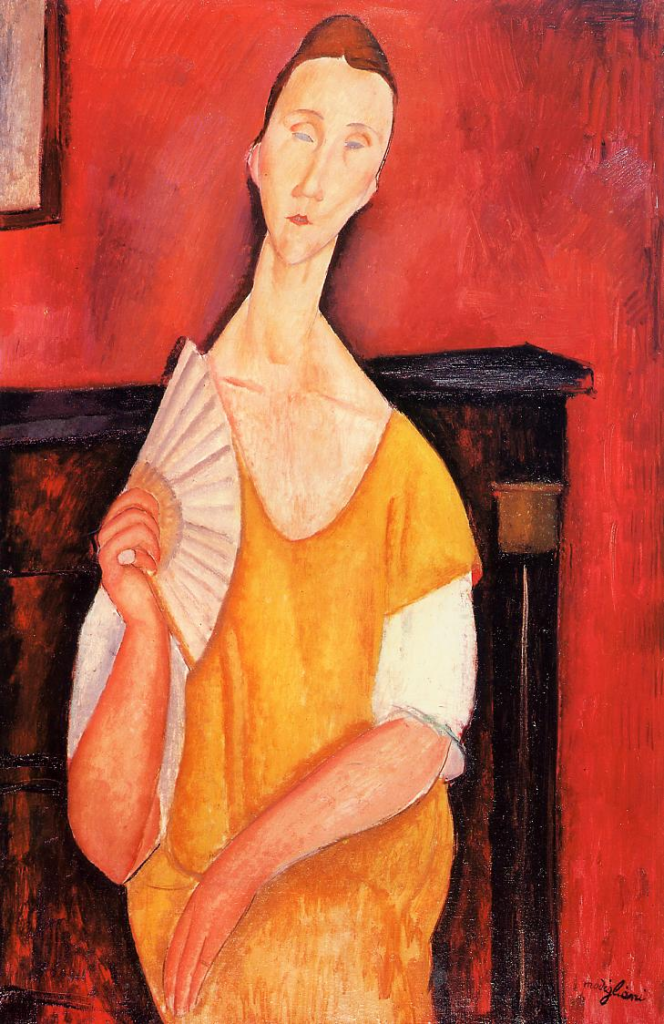
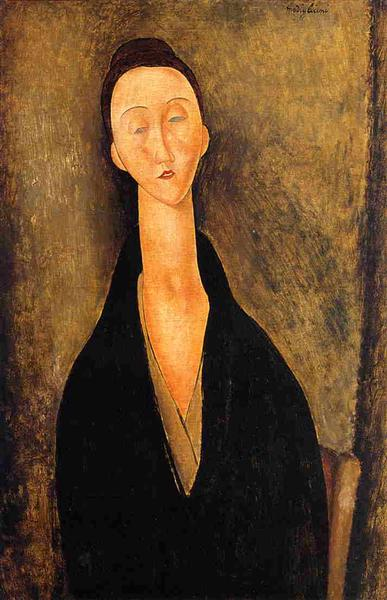
His occasional departures make this even clearer. The Little Peasant‘s bright blue eyes create instant connection; set beside Lunia Czechowska’s quiet blankness, it’s obvious Modigliani understood exactly how much power a gaze carries. He wasn’t avoiding the eyes because he couldn’t paint them. He was deciding, portrait by portrait, when they should speak and when silence would say more.
So What Changed, When He Did Paint Them?
There was never a fixed rule, just a range of choices. The Little Peasant‘s blue eyes anchor the whole composition and pull you straight into the frame. Little Girl in Blue does something similar: direct but calm, an emotional anchor rather than an anatomical afterthought. Soutine’s dark, restless eyes give his portrait an urgency that would vanish if they’d been left blank.
The pattern, if there is one, isn’t “eyes painted” versus “eyes withheld.” It’s Modigliani deciding, each time, how much of a sitter’s inner life the gaze should carry, sometimes everything, sometimes very little, with the rest of the face doing the work instead.
Maybe We’re Asking the Wrong Question
A century on, people are still asking why Modigliani didn’t paint the eyes. It’s a fair question, and after tracing the soul quote, the Jeanne Hébuterne myth, the sculpture and mask influences, and the psychology of an unresolved gaze, no single answer accounts for every painting. Each explanation illuminates something. None of them closes the case.
Maybe that’s not a failure of research. The most durable art rarely survives because it explains itself, it survives because it keeps generating new explanations. Modigliani’s portraits fit that mold uncomfortably well. Put Lunia Czechowska’s withholding gaze next to The Little Peasant‘s direct one, and it’s hard to believe one theory covers both.
Perhaps that’s the real achievement: turning the most familiar subject in art, the human face, into something permanently unfinished. Not an answer, but an invitation.
So next time you’re standing in front of a Modigliani, you’ll probably do what everyone does: look at the eyes first. Just try asking a different question than “why are they missing.”
Ask what he wanted you to see beyond them.
Editor’s Note
Every face tells a story.
Perhaps that is what makes faces so fascinating. We look at one and immediately begin searching for something beyond what we can see, a memory, a feeling, a personality, a story. Modigliani spent much of his career exploring that space between what a face reveals and what it leaves unsaid, reminding us that a painting doesn’t have to tell us everything to make us want to know more.
At Arts to Hearts Project, we’re interested in the faces being created and reimagined by artists today. Our 101 Art Book: Faces Edition brings together artists exploring the faces in their own ways, through expressions, identities, memories, relationships, and perspectives that cannot always be put into words.
Every face tells a story. What story does yours tell?