


Why Do These Paintings Look Like They’re Judging You?
Have you ever walked past a painting and felt as though it was looking back at you?
Not in the cliché sense of eyes that seem to follow you around the room, but in a far stranger way. A woman raises an eyebrow as if she’s silently judging your choices. A group of strangers pauses their conversation the moment you arrive. A bride looks trapped in a decision she can’t escape. An artist stops painting just long enough to acknowledge your interruption. Suddenly, you’re no longer standing outside the artwork, you’ve become part of it.
The greatest painters understood something that still fascinates psychologists today: humans are instinctively drawn to faces. We search for meaning in every glance, every expression, every subtle shift in posture. A single look can make us feel welcomed, questioned, admired, or deeply uncomfortable. Even when we know a painting can’t possibly respond to us, our brains can’t help but invent a story.
That’s why certain artworks refuse to stay silent. They challenge us, invite us in, and sometimes even make us squirm. Whether it’s through a knowing smirk, an unreadable stare, or a room full of people who seem to have noticed your arrival, these paintings blur the line between observer and subject. They remind us that looking at art has never been a one-way conversation.
Here are eight remarkable Paintings look like they’re judging you and that don’t just ask to be admired, they make you wonder if they’ve been watching you all along.
1. A Cheerful Party by Franz von Defregger
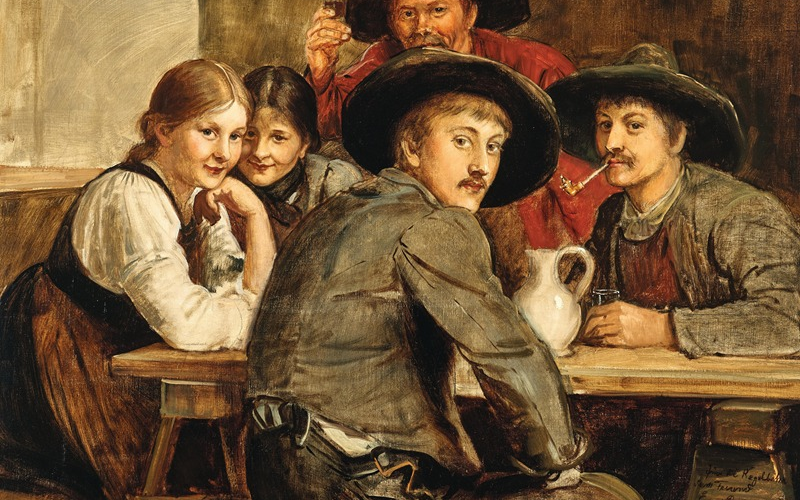
You know that awkward feeling when you walk into a room and every conversation suddenly stops? A Cheerful Party captures exactly that moment.
At first glance, Franz von Defregger’s lively tavern scene looks warm and inviting. Three friends gather around a simple table with wine, bread, and conversation. But within seconds, something shifts. Every face has turned toward you. The woman on the left wears the faintest hint of a smirk, the woman in the middle studies you over the rim of her glass, and the man stares with unmistakable suspicion. It no longer feels like you’re looking at a painting, it feels as though you’ve interrupted a private moment.

That unsettling effect is precisely what makes the work so memorable. Defregger, celebrated for his genre scenes of Tyrolean village life, understood that storytelling didn’t require dramatic action. Sometimes, a single glance could carry an entire narrative. Instead of showing what happened before or after this scene, he freezes the exact second when an unexpected visitor appears. The painting never explains who that visitor is, leaving our minds to invent the missing story. Are they amused by us? Curious? Annoyed? Or do they know something we don’t?
Psychologists call this our instinct for reading faces. Humans are wired to search for intention in another person’s expression, even when there may not be one. Defregger quietly exploits that instinct. The longer you look, the more convinced you become that these strangers are passing judgment, or at least silently assessing the newcomer standing in the doorway.
Perhaps that’s why A Cheerful Party feels surprisingly modern. More than a century after it was painted, its collective stare has the same energy as walking into the wrong room, joining the wrong conversation, or realizing everyone has just noticed you. Some paintings invite you in. This one makes you wonder whether you were ever supposed to enter at all.
2. The Unequal Marriage by Vasili Pukirev

Few paintings make viewers as uncomfortable as The Unequal Marriage. The longer you look, the more it feels like everyone in the room is silently asking the same question: Do you see what’s happening here?
Painted in 1862 by Russian artist Vasili Pukirev, the scene depicts the wedding of a visibly elderly groom and a very young bride. On paper, it’s a marriage ceremony. In reality, it feels more like a quiet tragedy. The bride lowers her eyes, her pale face drained of joy, while her delicate hand reaches forward almost mechanically to exchange the ring. Beside her stands the groom, decorated with medals and status, seemingly oblivious to the emotional weight of the moment unfolding around him.
But what makes this painting unforgettable isn’t just the couple, it’s everyone else. The guests don’t celebrate. They don’t smile. Their expressions are tense, uneasy, even disapproving. Some look away in discomfort, while others appear to watch with restrained sadness. You begin scanning every face, searching for someone who might stop the ceremony, yet no one does. Their silence becomes part of the story.
Pukirev wasn’t simply documenting a wedding; he was criticizing a social reality. In nineteenth-century Russia, marriages between wealthy older men and young women were not uncommon, often driven by financial necessity or family pressure rather than affection. By turning a familiar social practice into an emotionally charged narrative, he transformed a single ceremony into a powerful statement about power, choice, and inequality.
What makes The Unequal Marriage so enduring is that it doesn’t tell us how to feel, it places us inside the church and leaves us to wrestle with our own emotions. We aren’t passive viewers standing outside the scene. We become reluctant witnesses, caught between the bride’s quiet despair and the crowd’s helpless acceptance. More than 160 years later, the painting still has the remarkable ability to make us feel like we’ve arrived just in time to witness something that should never have happened, yet somehow no one can bring themselves to stop.
3. The Reluctant Bride by Auguste Toulmouche

Every wedding portrait promises happiness. The Reluctant Bride does the exact opposite.
Painted by French academic artist Auguste Toulmouche in the late nineteenth century, the scene captures a bride surrounded by friends and attendants as they prepare her for one of the most celebrated days of her life. Yet nothing about her expression suggests excitement. Dressed in an elegant white gown that glows against the richly decorated room, she sits motionless, her eyes fixed somewhere beyond the people around her. While one companion whispers gently into her ear and another clasps her hand in reassurance, the bride remains emotionally distant, as though she’s already carrying the weight of a decision she cannot escape.
It’s this quiet resistance that gives the painting its extraordinary power. There are no tears, no dramatic gestures, and no obvious conflict. Instead, Toulmouche relies on subtle body language. The bride’s rigid posture, unfocused gaze, and detached expression speak louder than any theatrical display of emotion. We instinctively begin asking questions the painting never answers. Is she frightened? Doubting her choice? Mourning the life she’s is about to leave behind? Or is she simply overwhelmed by the enormity of the moment?
Unlike The Unequal Marriage, which openly critiques an unfair union, The Reluctant Bride is more psychologically ambiguous. It reminds us that weddings, despite their beauty and celebration, have always carried complicated emotions. Behind the elaborate dresses, flowers, and rituals lies a deeply personal transition, one filled with uncertainty, expectation, and the fear of stepping into an unknown future.
Perhaps that’s why the painting continues to resonate today. Nearly everyone has experienced a moment when the world expected them to feel joyful while their emotions told a different story. Toulmouche captures that universal feeling with remarkable restraint. Instead of painting a reluctant bride, he paints hesitation itself. And in doing so, he reminds us that the most powerful emotions in art are often the ones left unspoken.
4. Helen of Troy by Frederick Sandys

Some paintings don’t need dramatic action to hold your attention. Sometimes, one glance is enough.
Frederick Sandys’ Helen of Troy is built almost entirely around a look, a look so sharp, so controlled, that it feels as though Helen has already formed an opinion about you before you’ve even had the chance to speak. She doesn’t smile or invite you into the painting. Instead, she meets your gaze with an expression that is impossible to read completely. Is it confidence? Defiance? Boredom? Or simply the quiet certainty of someone who knows the effect she has on everyone around her?
That mystery is exactly what fascinated Victorian artists. Sandys, a leading figure associated with the Pre-Raphaelite movement, wasn’t interested in painting Helen as merely the legendary beauty whose face “launched a thousand ships.” Instead, he created a woman whose power lies not just in her appearance but in her presence. Every detail, the richly embroidered fabrics, the gleaming jewelry, and her perfectly composed posture, reinforces the idea that Helen is entirely aware of the stories told about her, yet remains untouched by them.
What makes the painting feel so modern is its emotional restraint. Today, we often associate a raised eyebrow or a sideways glance with skepticism, amusement, or silent judgment. Helen’s expression carries that same ambiguity. The longer you study her face, the more your interpretation changes. One moment she seems amused by you; the next, she appears distant, almost impossible to impress. The painting refuses to settle into a single emotion, forcing the viewer to do the work of decoding it.
That uncertainty is precisely why Helen of Troy continues to captivate audiences. Rather than telling us who Helen is, Sandys lets her expression remain unresolved. We become participants in the myth, projecting our own assumptions onto a woman who has been interpreted for thousands of years. In the end, the painting poses a quiet challenge: perhaps the real mystery isn’t what Helen is thinking, it’s why we’re so desperate to know.
5. Artist at Work by Johann Baptist Reiter

There are paintings that welcome your attention, and then there are paintings that make you feel as though you’ve arrived at exactly the wrong moment. Johann Baptist Reiter’s Artist at Work belongs firmly in the second category.
The scene is deceptively simple. A painter pauses in the middle of his work, brush still in hand, turning away from his canvas to meet the viewer’s gaze. It’s a fleeting interruption, but one loaded with personality. His expression isn’t warm or inviting. Instead, it carries a quiet impatience, as if he’s silently asking, “Can I help you?” or perhaps, “Do you mind?” It’s a look that feels startlingly familiar, one we’ve all seen from someone deeply absorbed in their work.
That instant of interruption is what gives the painting its remarkable realism. Reiter, an Austrian painter celebrated for his portraits and genre scenes, had a gift for capturing ordinary human behavior rather than idealized perfection. Instead of portraying the artist as a romantic genius lost in inspiration, he presents him as a real person whose concentration has been broken. The brush hasn’t been set down, the work isn’t finished, and yet here we are, intruding on the creative process.
There’s also something quietly clever about the composition. As viewers, we’re used to observing paintings from a safe distance, invisible to the people inside them. Reiter flips that expectation. Suddenly, it feels as though the artist has noticed us standing there. The usual relationship between observer and subject is reversed, making us unexpectedly self-conscious. Instead of studying the painter, we become aware of studying ourselves.
Perhaps that’s why Artist at Work feels so contemporary. In an age of behind-the-scenes videos, studio tours, and creative livestreams, we’re fascinated by watching artists at work. Yet Reiter reminds us that creativity isn’t always a performance. Sometimes it’s private, interrupted only by an unexpected visitor. And with one perfectly timed glance, he transforms an ordinary studio scene into an encounter that feels uncannily personal, as though we’ve just opened the wrong door and been caught in the act of looking.
You’re right. The previous opening falls into the same pattern (“Some paintings…”), and it loses momentum. This one should feel fresh from the very first sentence. Here’s a stronger, more editorial opening for the section.
6. Jealousy by Margitay Tihamér

What happened just before this moment?
It’s the first question that comes to mind when you stand before Margitay Tihamér’s Jealousy. No one is arguing. No dramatic confrontation unfolds. Instead, the painting captures the quiet aftermath of something left unsaid. A young woman stands in a blooming garden, her elegant dress and composed posture suggesting calm, yet her expression tells another story. Her gaze drifts beyond the edge of the canvas, fixed on something, or someone, we’ll never see. That single unanswered glance transforms an otherwise peaceful scene into a mystery.
Hungarian painter Margitay Tihamér had a remarkable talent for suggesting emotion without spelling it out. Here, every detail invites speculation. Is she watching someone leave? Has she just witnessed a betrayal? Or is the entire drama unfolding only in her imagination? The painting refuses to offer answers, making the viewer an active participant in the story. We instinctively begin searching for clues, trying to reconstruct the invisible narrative hidden just beyond the frame.
The title, Jealousy, quietly guides our interpretation, but it never confines it. Instead, it sharpens our attention. Suddenly, her distant expression feels heavier, her silence more meaningful. We start noticing how often jealousy exists not in dramatic outbursts but in lingering looks, imagined scenarios, and questions that never receive an answer. It’s an emotion built as much on uncertainty as on fact.
That is what gives this painting its enduring appeal. Long before psychological thrillers and slow-burning dramas became popular, Tihamér understood that mystery is often more powerful than revelation. By withholding the moment that caused her reaction, he leaves us to invent it ourselves. Every viewer arrives at a different conclusion, carrying their own experiences into the scene. In the end, Jealousy doesn’t simply depict an emotion, it quietly exposes how eager we are to fill in the blanks whenever a story feels incomplete.
7. Las Meninas by Diego Velázquez

Who, exactly, is looking at whom?
That question has puzzled viewers for more than 350 years, and it’s what makes Diego Velázquez’s Las Meninas one of the most fascinating paintings ever created. At first, it appears to be a simple portrait of the young Infanta Margaret Theresa surrounded by her attendants, a loyal dog, and members of the Spanish court. But within moments, the painting begins to unravel your certainty. Almost every figure seems aware of your presence. Some look directly out of the canvas, others glance toward the artist himself, and suddenly you realize you may not be the observer at all, you may be the subject.
Velázquez cleverly places himself inside the painting, standing before a towering canvas with brush in hand. Behind him, a mirror reflects the faces of King Philip IV and Queen Mariana, hinting that they are standing precisely where we are. That single detail changes everything. The space occupied by the viewer becomes the royal viewpoint, making us feel as though we’ve stepped into the middle of an unfolding scene. Rather than simply looking at history, we become part of it.
The result is one of art’s greatest visual puzzles. Is this a royal portrait? A self-portrait? A painting about painting itself? Scholars have debated its meaning for centuries, yet its brilliance lies in refusing to settle on a single answer. Every glance inside the composition seems carefully choreographed, pulling the viewer into an intricate web of relationships where seeing and being seen are equally important.
Perhaps that’s why Las Meninas still feels astonishingly modern. Long before cameras, cinema, or interactive media blurred the line between audience and subject, Velázquez was already experimenting with perspective in ways that continue to surprise us today. He reminds us that looking is never a one-sided act. Every time we study this masterpiece, it quietly turns the experience back on us, asking a question that remains just as unsettling now as it was in the seventeenth century: What if the painting has been watching you all along?
8. The Ambassadors by Hans Holbein the Younger
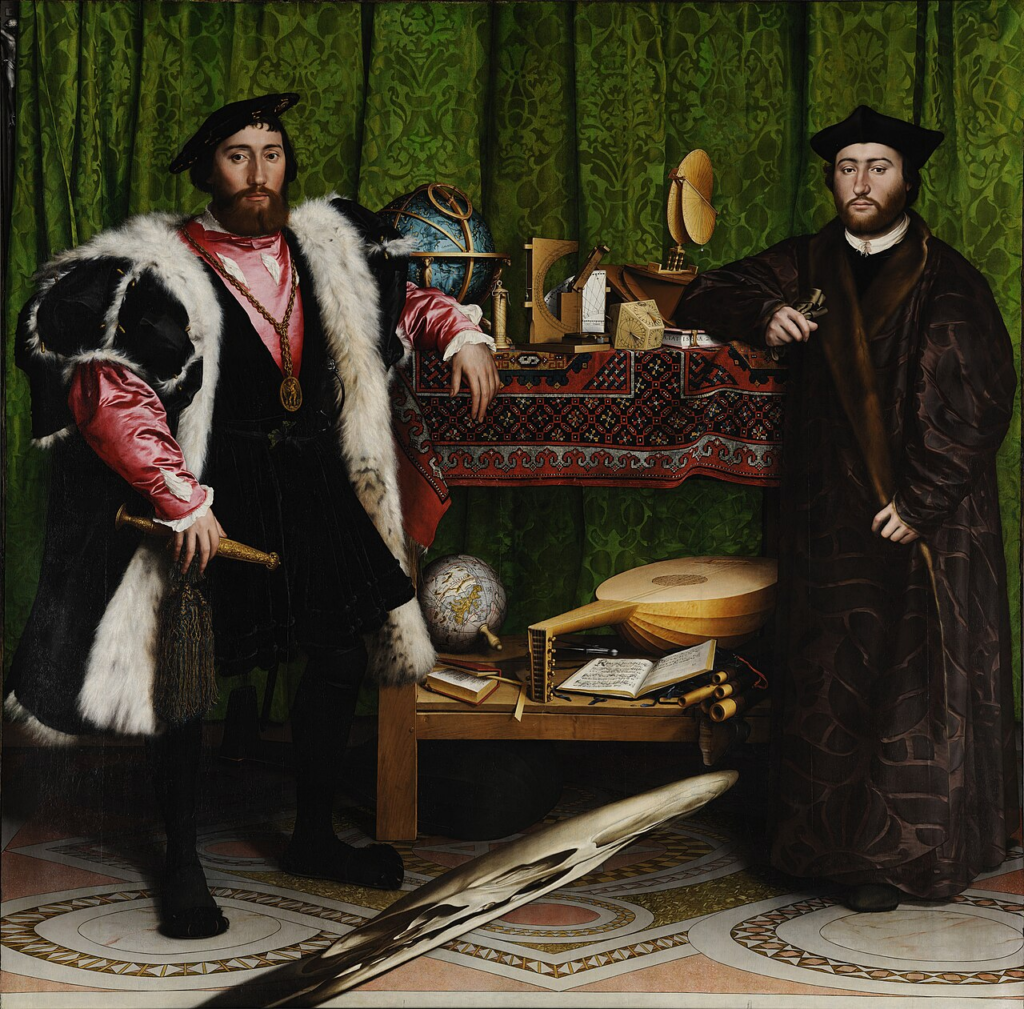
At first, The Ambassadors feels like a celebration of wealth, knowledge, and power. Then you notice something strange.
Standing side by side, the two richly dressed men meet the viewer with calm confidence, surrounded by objects that speak of their status and intellect. Scientific instruments, globes, musical tools, luxurious fabrics, and finely bound books fill the composition, each one carefully painted to showcase the Renaissance world’s fascination with discovery and learning. It seems like the perfect portrait of success, until your eyes drift toward the long, distorted shape stretched across the bottom of the painting.
It looks like a mistake. Or perhaps a smudge. But walk to the side of the painting, and the mystery suddenly resolves into a human skull.
Hans Holbein the Younger wasn’t simply showing off his technical brilliance, although the illusion remains one of the greatest examples of anamorphic perspective in Western art. He was making a profound statement about the fragility of life. However accomplished, educated, or influential these men appear, death waits quietly in the same room, visible only to those willing to change their perspective. It’s a reminder that beneath every achievement lies a truth no one can escape.
Yet it’s the ambassadors themselves who make the experience feel deeply personal. Their unwavering expressions suggest they already understand what the viewer is only beginning to discover. They stand with remarkable composure, almost as if they’re waiting for us to notice the painting’s hidden secret. Once we do, the portrait transforms from an elegant display of prestige into something far more unsettling.
That is the enduring brilliance of The Ambassadors. It doesn’t reveal its most important message immediately; it asks us to earn it. By rewarding curiosity, Holbein turns every viewer into an active participant, proving that sometimes the greatest mysteries in art aren’t hidden in the background, they’re hiding in plain sight, waiting for someone willing to look a little differently.
There’s a reason these paintings still stop us in our tracks centuries after they were created. It’s not just their beauty or technical brilliance, it’s their uncanny ability to make us feel involved. A raised eyebrow, an unreadable expression, a room full of silent faces, or a gaze that seems to follow us across the gallery can transform us from passive observers into participants in someone else’s story.
Perhaps that’s why these works continue to resonate in an age of endless images. While photographs capture a split second, these paintings invite us to linger, question, and imagine. They don’t reveal every answer. Instead, they leave space for curiosity, asking us to interpret the emotions, relationships, and mysteries hidden beneath the surface. Every viewer brings a different perspective, which means the story changes slightly each time someone stands before the canvas.
Maybe these paintings aren’t judging us after all.
Maybe they’re simply waiting for us to reveal something about ourselves.
Which painting made you feel the most watched?
If these paintings reminded you how artists have transformed something as simple as a glance into an unforgettable story, you’ll probably enjoy seeing how they’ve done the same with nature. Our feature on 7 Paintings That Capture the Beauty of Rain explores masterpieces that turn quiet showers, dramatic storms, and fleeting moments of rainfall into works of extraordinary beauty. It’s another reminder that some of art’s most powerful stories are told without a single word.