






8 Paintings That Will Remind You of Someone You Miss
Some paintings tell us exactly what’s happening. Others leave us searching for answers.
A woman reads a letter, but we never learn who sent it. A traveler sits alone in a hotel room, lost in thought. A figure looks toward a distant home without taking another step. Across centuries of art history, some of the most unforgettable works are built around a single question: Who, or what, is missing?
Artists have long understood that absence can be more powerful than presence. Instead of painting dramatic reunions or emotional goodbyes, they captured the moments in between, the waiting, the remembering, the silence after someone has left. These are paintings where longing becomes the real subject, even if it never appears on the canvas.
Whether inspired by mythology, personal heartbreak, literature, or everyday life, these works reveal that missing someone isn’t limited to romance. It can be the ache of losing a loved one, the distance between two people, the weight of memory, or even the longing for a life that can no longer be reclaimed.
The eight artworks in this collection span nearly four centuries, yet they speak the same emotional language. Each one reminds us that sometimes the most moving stories in art aren’t about the people we see, but the ones we don’t and someone you miss.
1. Girl Reading a Letter at an Open Window (c. 1657–1659) by Johannes Vermeer
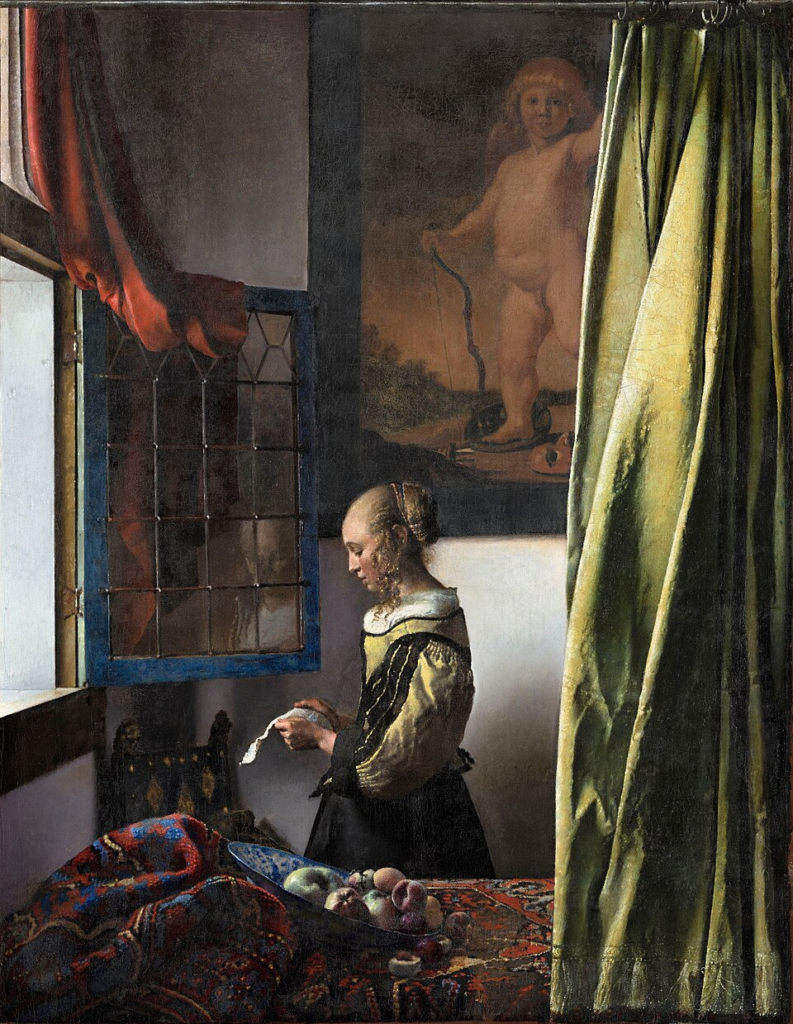
Long before instant messages and video calls, a single letter could carry weeks of hope, uncertainty, and longing. Johannes Vermeer’s Girl Reading a Letter at an Open Window captures that quiet moment when someone’s entire world seems to rest inside a folded piece of paper. The painting doesn’t reveal who wrote the letter or what it says, yet centuries later, viewers still find themselves imagining the story unfolding beyond the canvas. That mystery is precisely what makes it one of art history’s most enduring portrayals of emotional anticipation.
Painted around 1657–1659 during the Dutch Golden Age, the work reflects Vermeer’s remarkable ability to transform ordinary domestic moments into scenes of profound emotional depth. A young woman stands alone beside an open window, absorbed in reading a letter. Soft daylight filters into the room, illuminating her face while leaving much of the narrative untold. For many years, scholars believed the painting represented a simple, private moment. However, a major restoration completed in 2021 revealed a hidden painting of Cupid hanging on the back wall—an image that had been deliberately painted over centuries after Vermeer completed the work. Its rediscovery confirmed that the letter was almost certainly connected to love rather than business or family affairs, fundamentally changing how audiences understand the painting.
Every object within the composition quietly reinforces its emotional themes. The open window suggests a connection between the private interior and the distant outside world where the letter originated. The bowl of ripe peaches and apples, symbols often associated with love and temptation in Dutch painting, hints at romantic affection. Even the woman’s posture, completely absorbed in the page before her, speaks to the fragile vulnerability of waiting for someone who is far away.
What makes this painting so moving is that Vermeer never shows the person being missed. Instead, he paints the silence they leave behind. The artwork reminds us that longing is often found not in dramatic farewells but in the quiet moments spent rereading someone’s words, hoping distance will soon come to an end. It is this remarkable ability to paint absence rather than presence that makes Girl Reading a Letter at an Open Window one of the most timeless artworks ever created about missing someone.
2. The Separation (1896) by Edvard Munch
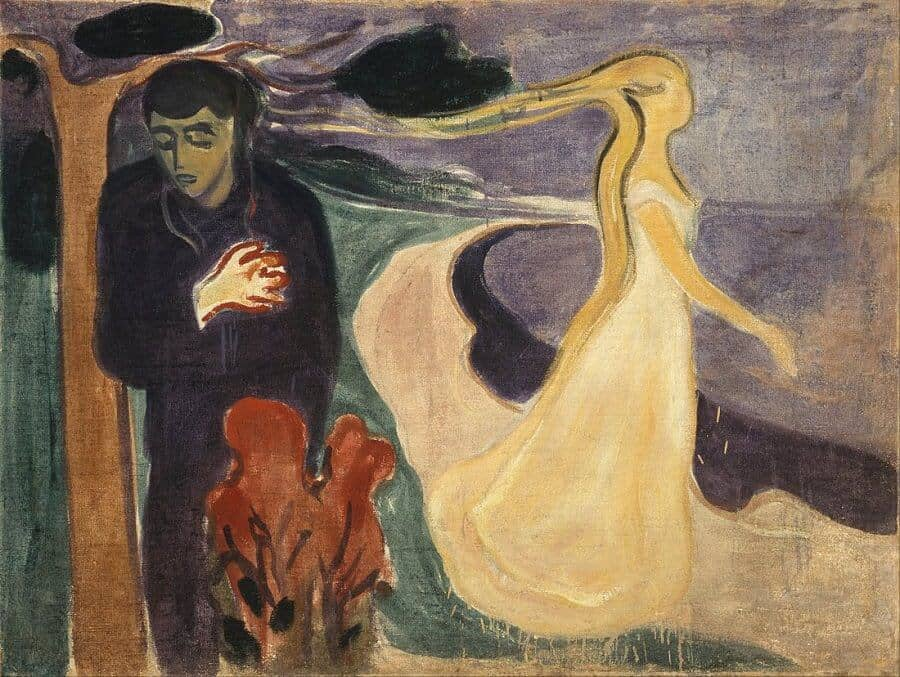
There are few artists who understood heartbreak as intimately as Edvard Munch. While many painters depicted lovers together, Munch was more interested in what happened after they parted. The Separation doesn’t show an argument or a farewell, it captures the devastating emotional aftermath, when someone has already left, but their absence continues to consume every thought. It’s a painting about the invisible wound that separation leaves behind, one that feels as real today as it did more than a century ago.
Painted in 1896, The Separation emerged during one of the most emotionally turbulent periods of Munch’s life. His work was deeply influenced by his own experiences with illness, loss, anxiety, and failed relationships, themes that would define much of his career. Rather than painting the world as it looked, Munch sought to paint the world as it felt. This philosophy made him one of the pioneers of Expressionism, a movement that prioritized emotion over realism.
In the painting, a man stands in the foreground with his head bowed, clutching his chest as if trying to contain a pain that cannot be healed. From his heart flows a striking ribbon of red that stretches toward a woman dressed in white, who walks calmly away toward the sea. She appears distant and almost ghostlike, emphasizing that while she has physically left, she remains emotionally tied to him. The swirling shoreline and darkened landscape mirror his inner turmoil, turning nature itself into an extension of his grief.
Unlike traditional depictions of romantic loss, Munch offers no dramatic gestures or comforting resolution. The woman never looks back, and the man cannot follow. Instead, the painting lingers in the unbearable space between memory and reality, the place where love has ended, but longing refuses to disappear.
What makes The Separation so unforgettable is its honesty. Anyone who has experienced the end of a meaningful relationship recognizes that heartbreak is rarely loud. More often, it settles quietly into the body, making absence feel almost physical. Munch gives that invisible ache a shape and a color, transforming emotional pain into one of the most powerful visual expressions of missing someone ever painted.
3. The Armour of Lancelot (1860s) by Arthur Hughes
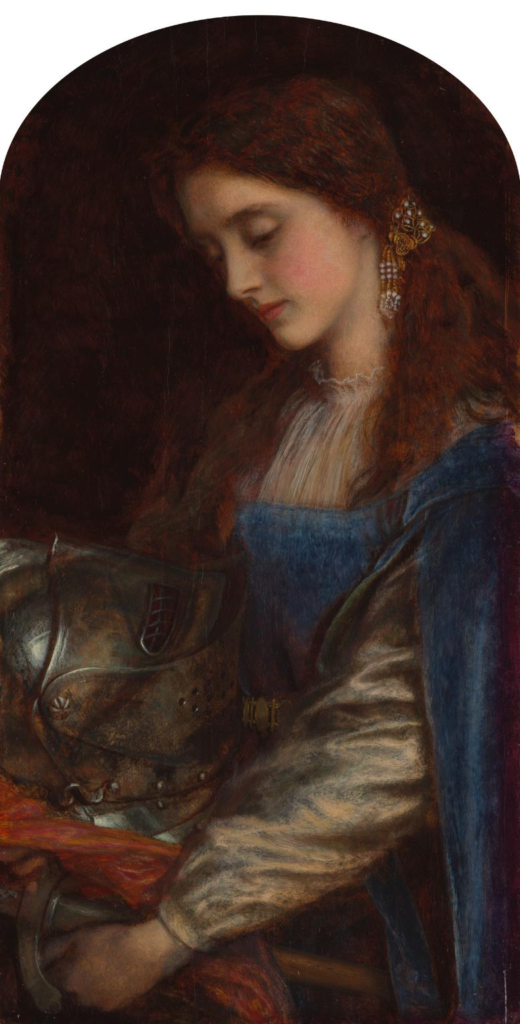
Sometimes, the strongest reminder of a person isn’t their presence, it’s what they’ve left behind. An empty chair, a forgotten letter, a piece of clothing hanging untouched. In Arthur Hughes’s The Armour of Lancelot, absence is conveyed through something even more powerful: a suit of armor. Without ever showing Sir Lancelot himself, Hughes creates a deeply emotional portrait of longing, proving that love can be felt most intensely in the spaces someone no longer occupies.
Arthur Hughes was one of the leading artists associated with the Pre-Raphaelite movement, a group of nineteenth-century British painters known for their meticulous detail, luminous colors, and fascination with medieval literature and legend. Like many of his contemporaries, Hughes drew inspiration from the Arthurian tales popularized by poets such as Alfred, Lord Tennyson. Rather than illustrating scenes of heroic battles, however, Hughes focused on the quieter emotional moments that unfolded behind them.
In The Armour of Lancelot, Queen Guinevere is shown kneeling beside Lancelot’s abandoned armor. Her gaze is lowered, and her gentle touch suggests that the cold metal has become the closest thing she has to the man she loves. The armor dominates the composition, standing as both a symbol of Lancelot’s legendary courage and a poignant reminder of his absence. Rich textiles, carefully rendered flowers, and the warm glow of the interior contrast with the lifeless steel, emphasizing the divide between human affection and the demands of duty. Every carefully painted detail invites the viewer to linger, much like Guinevere herself lingers in memory.
The painting draws its emotional power from the tragic love story at its heart. Lancelot and Guinevere’s relationship was defined by devotion, secrecy, and separation, making their story one of the most enduring tales of impossible love in Western literature. Hughes doesn’t depict the lovers together. Instead, he paints the longing that remains when only memories, and symbols of someone once present, are left behind.
Even without knowing the Arthurian legend, the emotion is unmistakable. We’ve all held onto an object that suddenly seemed more precious because it belonged to someone we missed. In The Armour of Lancelot, Hughes reminds us that sometimes the things people leave behind carry their presence more powerfully than words ever could.
4. Lachrymae (1894–1895) by Frederic Leighton
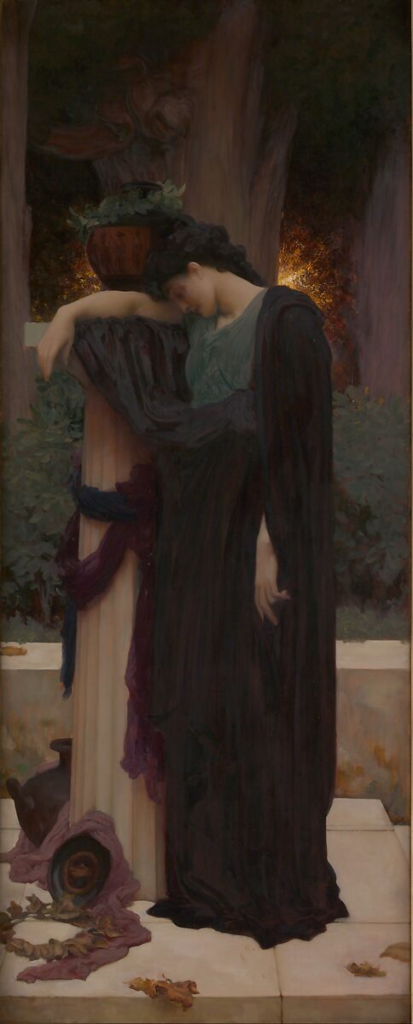
Grief doesn’t always arrive with tears. Sometimes it appears as silence, a bowed head, or the quiet weight of a memory that refuses to fade. Frederic Leighton’s Lachrymae captures that deeply personal kind of sorrow, not the dramatic heartbreak often seen in art, but the kind that lingers long after everyone else has moved on. It is a painting that understands how missing someone can become a private ritual, carried quietly within us.
Completed between 1894 and 1895, Lachrymae was one of the final masterpieces created by Frederic Leighton, one of Victorian Britain’s most celebrated artists. The title comes from the Latin word for “tears,” immediately setting the emotional tone of the work. Rather than depicting a specific historical or literary event, Leighton created a universal meditation on mourning, inviting viewers to bring their own experiences of love and loss to the painting.
A solitary woman dressed in flowing black robes leans against a marble structure, her head lowered in contemplation. Beside her rests a wreath of orange blossoms, traditionally associated with purity and love, while the marble monument suggests remembrance and permanence. The muted color palette, classical architecture, and carefully balanced composition create an atmosphere of stillness, where every detail encourages reflection rather than spectacle. Unlike many Victorian paintings that dramatized sorrow, Leighton chose remarkable restraint. There are no visible tears, no desperate gestures, and no obvious narrative. Instead, emotion is conveyed through posture, silence, and the space surrounding the figure.
This quiet approach is precisely what makes Lachrymae so enduring. Missing someone is often an invisible experience. It happens in moments when we pause unexpectedly, revisit old memories, or find ourselves thinking about someone who is no longer beside us. Leighton transforms that intimate emotional landscape into something timeless, suggesting that grief doesn’t always ask to be witnessed, it simply asks to be felt.
More than a century after it was painted, Lachrymae continues to resonate because it reminds us that love leaves traces long after a person is gone. In its silence, the painting says something profoundly human: that remembrance itself can become an act of devotion, and that sometimes the deepest emotions are the ones we never speak aloud.
5. The Lady of Shalott (1888) by John William Waterhouse
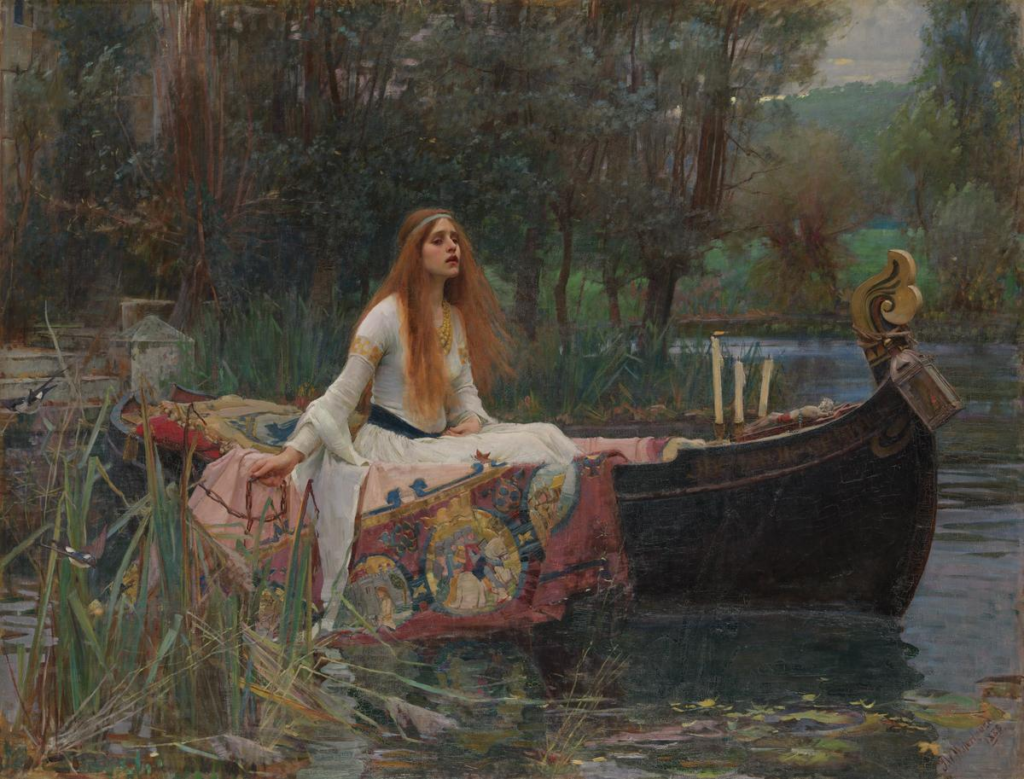
Some of the most heartbreaking stories in art are not about losing someone, they’re about never having the chance to truly be with them. John William Waterhouse’s The Lady of Shalott captures that fragile moment between hope and farewell, when love feels close enough to touch but remains forever out of reach. Inspired by Alfred, Lord Tennyson’s famous poem of the same name, the painting transforms a medieval legend into one of the most poignant visual expressions of longing ever created.
Painted in 1888, this masterpiece became one of Waterhouse’s defining works and a celebrated example of the later Pre-Raphaelite movement. The story tells of the Lady of Shalott, a mysterious woman cursed to live in isolation on an island near Camelot. Forbidden from looking directly at the outside world, she can only experience life through reflections in a mirror while weaving what she sees into an endless tapestry. Everything changes when she catches sight of Sir Lancelot. Unable to resist, she turns to look at him directly, breaking the curse. Knowing her fate is sealed, she steps into a small boat and drifts toward Camelot, where she dies before ever reaching the man she longed for.
Waterhouse chooses to depict this final, unforgettable journey. The Lady sits alone in the boat, wrapped in a flowing white gown that symbolizes innocence and sacrifice. Beside her rests the richly woven tapestry she has spent years creating, now trailing into the water as she leaves behind the only life she has ever known. Three candles stand near her, two already extinguished, one still burning faintly, serving as a powerful reminder that life is slipping away. The crucifix at the bow of the boat and the autumn landscape surrounding her deepen the sense of inevitability, turning the river into both a physical and emotional passage.
Although rooted in myth, the painting speaks to a universal feeling. The Lady’s greatest sorrow isn’t simply that she dies, it is that she spends her life yearning for a connection she is never allowed to fully experience. Waterhouse captures the heartbreak of loving from afar, of watching life unfold just beyond your reach, and of carrying hope even when the ending is already written.
More than a century later, The Lady of Shalott continues to resonate because it reminds us that some of the deepest forms of longing are born not from what we had, but from what we almost did. It is a masterpiece about love interrupted by fate, where absence begins long before goodbye is ever spoken.
6. At Eternity’s Gate (1890) by Vincent van Gogh
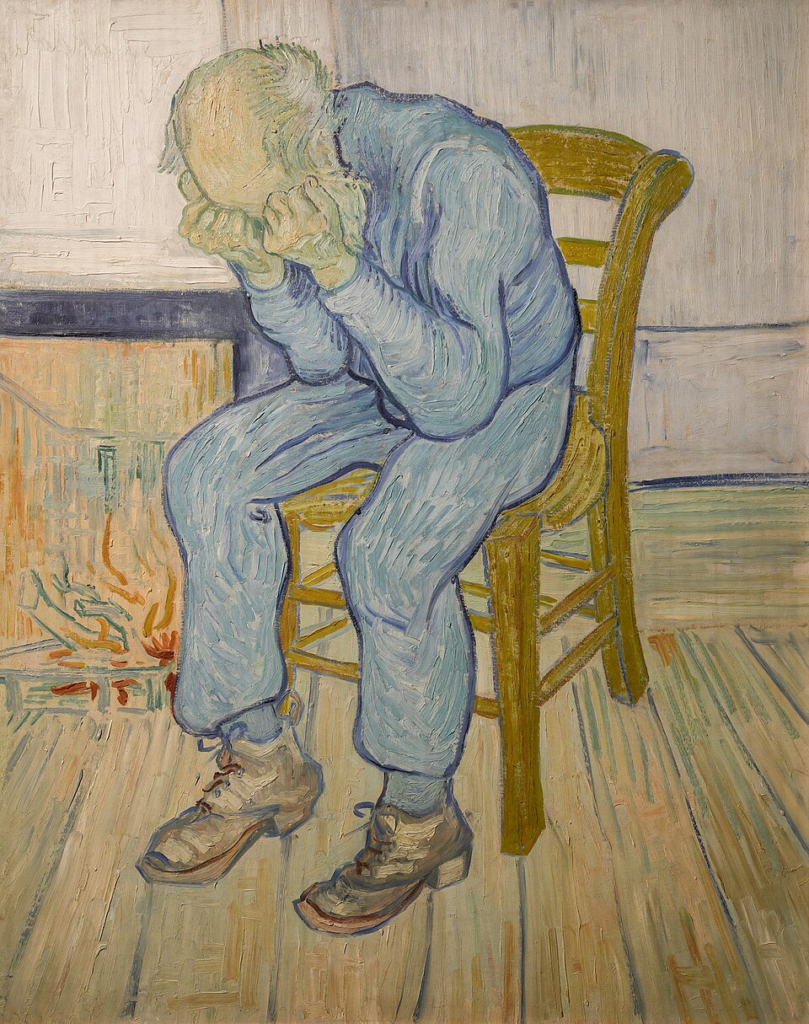
Not every kind of longing is directed toward another person. Sometimes, what we miss is a sense of peace, belonging, or the version of ourselves that once felt whole. Vincent van Gogh’s At Eternity’s Gate captures that quiet, overwhelming despair with extraordinary compassion. It is one of those rare paintings that speaks to anyone who has ever felt isolated, not because they were physically alone, but because they carried an absence that no one else could see.
Painted in May 1890, just a few months before Van Gogh’s death, At Eternity’s Gate belongs to the final chapter of the artist’s life. During this period, Van Gogh was living at the Saint-Paul-de-Mausole asylum in Saint-Rémy-de-Provence, where he continued to paint despite ongoing struggles with his mental health. The work was inspired by an earlier lithograph he had created while living in the Netherlands, depicting an elderly war veteran named Adrianus Jacobus Zuyderland. Rather than producing a faithful portrait, Van Gogh transformed the figure into a universal symbol of human suffering, making the painting less about one individual and more about the emotional burdens we all carry.
The elderly man sits hunched forward in a simple wooden chair, his elbows resting on his knees as his face disappears into his clenched hands. His posture says everything words cannot. The vibrant blues of his clothing contrast sharply with the warm yellows of the chair and fireplace, creating a visual tension between comfort and despair. There are no dramatic gestures or visible tears, only an overwhelming stillness that allows viewers to project their own experiences onto the scene.
Although the painting is often associated with grief and old age, its emotional reach extends far beyond either. It speaks to the loneliness that follows loss, the exhaustion of carrying memories, and the quiet ache of longing for comfort, connection, or someone who is no longer there. Van Gogh understood that absence takes many forms, and here he paints it not through an empty room or a distant figure, but through the weight of a body that seems almost too tired to move.
More than 130 years later, At Eternity’s Gate continues to resonate because it reminds us that missing someone isn’t always about waiting for their return. Sometimes it is about learning to live with the space they leave behind. In giving shape to that invisible burden, Van Gogh created one of the most profoundly human images of longing in the history of art.
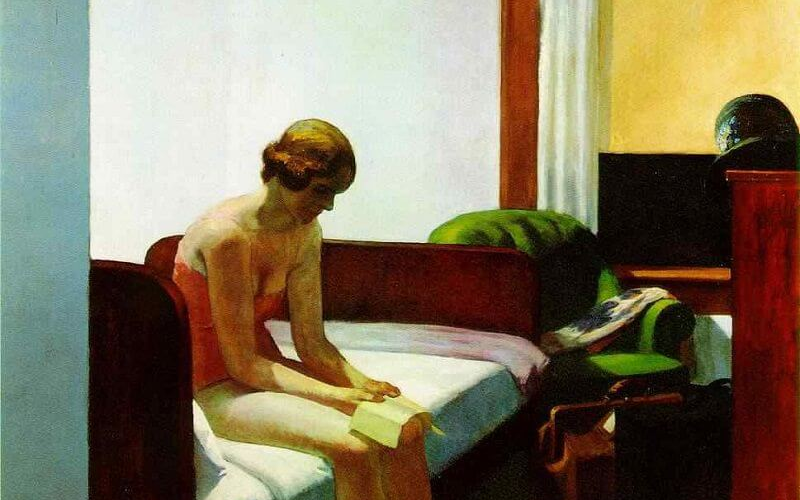
7. Hotel Room (1931) by Edward Hopper

There is a particular kind of loneliness that exists even when the world around us is busy. It isn’t caused by silence or distance alone, it comes from realizing that, despite being surrounded by people, you still feel disconnected from the one person you wish were there. Edward Hopper understood this feeling better than almost any twentieth-century artist. His painting Hotel Room transforms an ordinary interior into a quiet meditation on solitude, making it one of the most relatable portrayals of emotional absence in modern art.
Painted in 1931, Hotel Room reflects Hopper’s lifelong fascination with moments of isolation hidden within everyday life. Throughout his career, he painted gas stations, cafés, city streets, and anonymous interiors, often focusing on figures caught in introspective moments. Unlike artists who relied on dramatic storytelling, Hopper trusted silence. His paintings rarely explain what has happened or what will happen next, leaving viewers to construct their own narratives. This ambiguity has made his work remarkably timeless, allowing each generation to find its own emotions reflected within his scenes.
In Hotel Room, a woman sits alone on the edge of a neatly made bed, dressed for travel yet seemingly unable to move forward. She studies a small piece of paper, perhaps a letter, a ticket, or a note, while her suitcase rests open nearby. Nothing in the painting confirms her story, yet every detail suggests transition. The unfamiliar hotel room, the packed belongings, and the quiet concentration on the paper evoke the emotional uncertainty that often accompanies departures and arrivals. Hopper deliberately leaves the moment unresolved, inviting us to wonder whether she has just said goodbye, is waiting for someone, or has realized they will never come.
The room itself becomes part of the narrative. Its clean lines, sparse furnishings, and cool light emphasize emotional distance rather than comfort. Hopper’s restrained composition reminds us that loneliness doesn’t always appear dramatic. Often, it reveals itself in temporary places, in hotel rooms, train stations, airports, and unfamiliar cities, where memories seem louder than the present moment.
What makes Hotel Room so enduring is its universality. Nearly everyone has experienced a moment of sitting alone in an unfamiliar place, replaying conversations, rereading messages, or wishing someone else occupied the empty space beside them. Hopper never tells us who the woman is missing because he doesn’t need to. By leaving her story unfinished, he allows it to become ours. The painting is a quiet reminder that sometimes the deepest feeling of missing someone isn’t expressed through tears, but through the silence that fills a room after they are gone.
8. Christina’s World (1948) by Andrew Wyeth
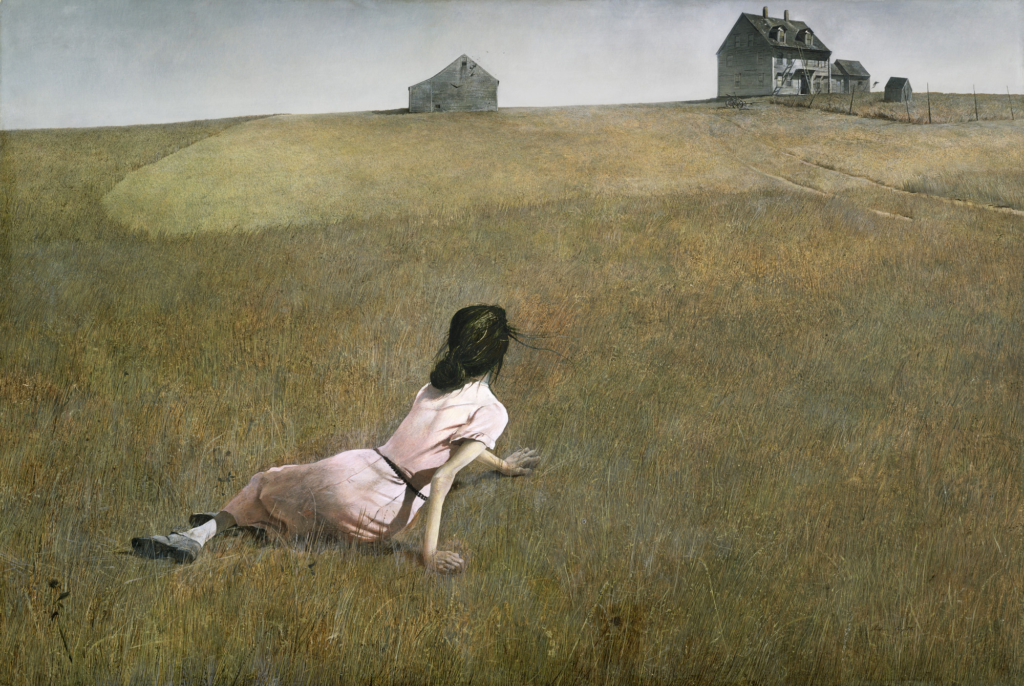
Not all longing is directed toward a person. Sometimes, it is tied to a place we cannot reach, a life we wish we could return to, or a future that always seems just beyond our grasp. Andrew Wyeth’s Christina’s World is one of the most quietly powerful paintings ever created because it captures this feeling without relying on dramatic gestures or obvious emotion. At first glance, it appears to be a peaceful rural landscape. The longer you look, however, the more it reveals itself as a portrait of determination, vulnerability, and an aching sense of distance.
Painted in 1948, Christina’s World was inspired by Anna Christina Olson, a woman from Cushing, Maine, who lived with a degenerative muscular condition that left her unable to walk. Rather than using a wheelchair, Christina chose to move across the landscape by pulling herself along the ground with her arms. Wyeth, who spent many summers near the Olson family farm, was deeply moved by her resilience. Instead of focusing on her disability, he painted a moment that reflects her unwavering desire to reach the farmhouse stretching across the hill before her.
The composition is deceptively simple. Christina lies in a vast field of dry grass, her body turned toward the distant farmhouse, barns, and outbuildings perched on the horizon. Her pink dress stands out against the muted browns and golds of the landscape, making her appear both fragile and determined. The enormous stretch of open land between her and the house becomes the emotional center of the painting. It is not merely a physical distance but a metaphor for every goal, memory, or relationship that feels painfully out of reach.
Although Christina’s World is not traditionally viewed as a painting about missing someone, it resonates deeply with the experience of longing. The farmhouse can be seen as a symbol of belonging, comfort, or connection, something visible yet frustratingly distant. Wyeth intentionally leaves the story open-ended, allowing viewers to interpret what Christina is reaching toward. That ambiguity is one reason the painting has remained one of the most beloved works in American art.
What makes Christina’s World such a fitting conclusion to this list is that it expands our understanding of absence. Missing someone isn’t always about waiting for their return. Sometimes it is about yearning for a place, a moment, or a version of life that feels forever beyond our reach. Wyeth reminds us that longing is not defined solely by who is missing, but by the hope that continues to pull us forward despite the distance.
Looking at these paintings together, one thing becomes clear: artists rarely paint absence directly. Instead, they paint the spaces it leaves behind, the unopened letter, the empty room, the distant house on a hill, the figure who keeps looking toward someone who never appears. In doing so, they transform deeply personal experiences into something universally human.
Although these artworks span nearly four centuries and emerge from different cultures and artistic movements, they are connected by the same quiet emotion. Whether it’s Vermeer’s woman absorbed in a letter, Munch’s portrait of heartbreak, Hopper’s solitary traveler, or Wyeth’s determined Christina reaching toward the horizon, each reminds us that longing is one of the few experiences that transcends time. The details may change, but the feeling remains strikingly familiar.
Perhaps that’s why these paintings continue to resonate long after they were created. They don’t offer answers or tidy endings. Instead, they acknowledge something many of us know all too well: that love, memory, and absence often coexist. Missing someone doesn’t always fade with time, it simply changes shape, becoming part of who we are and how we remember.
And maybe that’s the quiet power of great art. It doesn’t erase loneliness or loss. It reminds us that someone, somewhere, felt it too, and found a way to turn that invisible emotion into something we can still see, centuries later.
Which of these artworks captures the feeling of missing someone most deeply for you?
If stories hidden beneath the surface of art fascinate you, you might also enjoy our recent feature on the art world’s most famous forgery scandals, where masterpieces, deception, and million-dollar mysteries collide. Read it here: https://artstoheartsproject.com/art-worlds-biggest-forgery-scandals/