







Why Kawase Hasui Is Still the Master of Rain, Snow, and Silence
What if the most unforgettable part of a painting wasn’t the landscape, but the weather itself?
Most artists use rain to heighten a story, snow to suggest winter, or a sunset to frame a beautiful view. For Kawase Hasui (1883–1957), however, weather was never just a backdrop. It was the story. A passing shower could evoke quiet resilience, fresh snowfall could transform a familiar temple into a place of deep contemplation, and the fading light of dusk could make an ordinary riverside feel timeless. Long before photographers chased the perfect golden hour or filmmakers used rain to heighten emotion, Hasui had already mastered the art of turning the changing skies into powerful visual experiences.
Widely regarded as one of the leading figures of Japan’s shin-hanga (“new prints”) movement, Hasui revitalized the centuries-old tradition of woodblock printing by combining its craftsmanship with a fresh sensitivity to light, atmosphere, and perspective. Working closely with publisher Watanabe Shōzaburō and a team of master carvers and printers, he created more than 600 woodblock print designs over four decades. His travels took him across Japan, from bustling cities and quiet canals to mountain villages, remote shrines, and rugged coastlines, always searching for fleeting moments that most people would simply pass by.
What made Hasui extraordinary wasn’t his choice of subject but his way of seeing. He rarely painted grand historical events or crowded urban scenes. Instead, he found beauty in the ordinary: a lone figure crossing a bridge during a sudden downpour, lantern light shimmering across a canal after dark, untouched snow settling over temple rooftops, or the soft colours of evening dissolving into still water. His prints don’t merely document places; they preserve the atmosphere that surrounded them. Looking at his work, you don’t simply observe rain—you almost hear it. You don’t just see snow, you sense the hush that follows it.
That remarkable ability to transform fleeting moments into lasting emotion is exactly why Kawase Hasui Is Still the Master of Rain, Snow, and Silence. Today, his prints are held in prestigious institutions including the Metropolitan Museum of Art, the British Museum, the Museum of Fine Arts, Boston, and the Smithsonian, while collectors continue to prize his original editions for their extraordinary craftsmanship and emotional depth. In 1956, just one year before his death, the Japanese government recognized his immense contribution to the nation’s cultural heritage by naming him a Living National Treasure.
Nearly a century after many of these works were first published, they continue to feel surprisingly contemporary. In an age of constant movement and endless distractions, Hasui’s quiet landscapes invite us to slow down, notice the shifting light, and appreciate the beauty hidden in moments that often go unnoticed. His genius lay in proving that weather isn’t simply something we experience, it is something we remember.
These eight extraordinary prints reveal why Kawase Hasui remains one of history’s greatest masters of atmosphere, transforming rain, snow, twilight, and moonlight into timeless works of art.
1. Evening Shower at Imai Bridge (1932)
The Print That Made Rain the Main Character

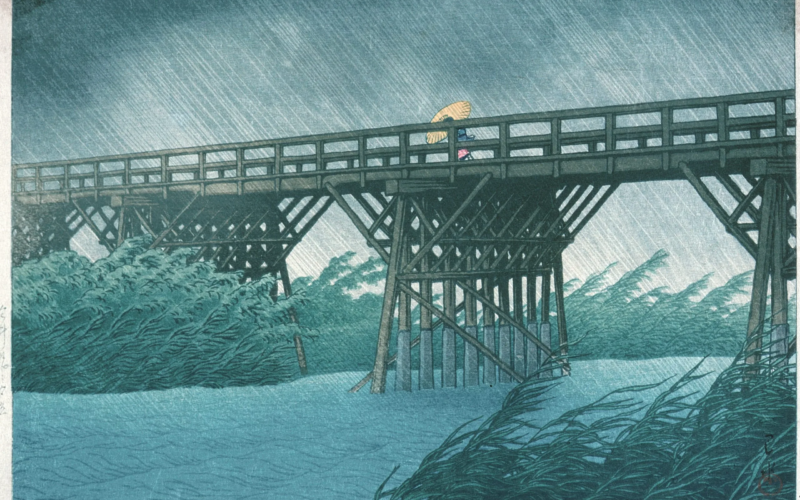
Rain has appeared in art for centuries, but few artists have made it feel as immediate and immersive as Kawase Hasui. Among his many celebrated landscapes, Evening Shower at Imai Bridge (1932) stands as one of the finest examples of his ability to transform an ordinary moment into something deeply atmospheric. Created as part of his acclaimed One Hundred Views of New Tokyo series, the woodblock print doesn’t rely on dramatic action or crowded streets. Instead, it invites viewers into a fleeting moment where weather quietly takes control of the scene.
At first glance, the composition appears deceptively simple. A solitary woman walks across Imai Bridge, clutching an umbrella as heavy rain slants across the sky. Yet the more you look, the more carefully orchestrated every detail becomes. The rain isn’t rendered as thick streaks or theatrical torrents; instead, delicate diagonal lines cut across the print, creating the unmistakable sensation of wind driving the shower sideways. The bridge itself acts as a visual guide, drawing the eye toward the lone figure while emphasizing the openness of the surrounding landscape. Rather than overwhelming the scene, the rain becomes its rhythm, shaping every movement and every emotion.
What makes this print extraordinary is Hasui’s understanding of human vulnerability against nature. The woman isn’t portrayed as heroic or desperate; she simply continues walking, leaning slightly into the wind with quiet determination. That understated gesture transforms her into someone almost anyone can relate to. We’ve all experienced that unexpected downpour, the instinctive tilt of an umbrella against a gust of wind, and the quiet resolve to keep moving despite the weather. Hasui captures that universal experience with remarkable restraint.
Color plays an equally important role. The muted blues and greys create an atmosphere of dampness and cool air without relying on bright contrasts. The darkened sky feels heavy, while the reflective surfaces below subtly suggest streets and wooden planks slick with rain. Instead of painting individual puddles or emphasizing dramatic reflections, Hasui allows tonal gradations to do the work, creating the illusion of moisture and movement. This delicate handling of color was one of the hallmarks of the shin-hanga movement, which combined traditional Japanese woodblock techniques with a sophisticated understanding of Western light and perspective.
The print also reflects a turning point in Japanese art. During the early twentieth century, Japan was rapidly modernizing, yet Hasui consistently chose moments of quiet observation over scenes of industrial progress. Even in his One Hundred Views of New Tokyo series, the city often appears contemplative rather than bustling. Here, the bridge becomes less a landmark than a stage where weather briefly eclipses architecture, reminding viewers that nature remains the most powerful presence in any landscape.
Perhaps that is why Evening Shower at Imai Bridge continues to resonate nearly a century later. It doesn’t ask us to admire an impressive storm; it asks us to remember what it feels like to stand inside one. In Hasui’s hands, rain is no longer just a meteorological event, it becomes emotion, memory, and atmosphere all at once. It is an unforgettable introduction to an artist who spent his career proving that the most ordinary weather could produce the most extraordinary art.
2. Arakawa River in May Rain (1932)
When Spring Rain Feels Like a Whisper
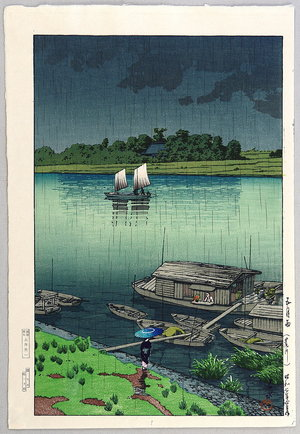
Not all rain arrives with thunder and urgency. Sometimes it drifts quietly across the landscape, softening every edge until the world feels suspended between earth and sky. That quiet transformation is beautifully captured in Arakawa River in May Rain (1932), one of Kawase Hasui’s most lyrical interpretations of spring. While many of his famous rain scenes are defined by dramatic weather and determined figures battling the elements, this print offers something entirely different: the gentle intimacy of rainfall that seems to slow time itself.
At first glance, the composition appears almost minimalist. The broad river stretches calmly across the foreground while the distant shoreline dissolves into a delicate haze. There is no dramatic architecture demanding attention, nor any crowded streets bustling with activity. Instead, Hasui allows the rain to blur the boundaries between water, land, and sky. The effect is remarkably subtle. Rather than depicting each raindrop individually, he suggests rainfall through softened contours, muted colours, and atmospheric perspective, encouraging viewers to feel the moisture in the air rather than simply see it.
The season is just as important as the weather. May rain in Japan has long been associated with renewal, fresh greenery, and the quiet arrival of early summer. Hasui embraces this seasonal mood with restrained greens, cool greys, and soft blues that gently transition into one another. The landscape feels alive, yet never exuberant. Everything appears calm, as though nature has paused to absorb the rainfall.
This sensitivity to seasonal atmosphere became one of Hasui’s defining strengths. Throughout his travels across Japan, he sought out moments that many artists overlooked, mist rolling over rivers, clouds gathering before dusk, or rain settling over familiar landscapes. Rather than presenting nature as grand spectacle, he portrayed it as something quietly transformative. His training in both traditional Japanese aesthetics and Western approaches to light allowed him to capture these fleeting transitions with extraordinary delicacy.
There is also a profound emotional quality to the print. Unlike the lone figure confronting the storm in Evening Shower at Imai Bridge, Arakawa River in May Rain contains little narrative. The landscape itself becomes the storyteller. Its quietness invites contemplation, allowing viewers to project their own memories onto the scene. Perhaps it recalls a riverside walk after rain, the scent of damp earth in spring, or simply the rare pleasure of watching weather unfold without interruption.
Nearly a century after it was created, the print remains a reminder that Hasui understood weather not merely as something we observe but as something we inhabit. In his hands, even the gentlest rainfall becomes capable of reshaping an entire landscape, and the emotions we associate with it.
3. Snow at Ueno Kiyomizudō (1929)
The Masterpiece That Shows What Silence Looks Like
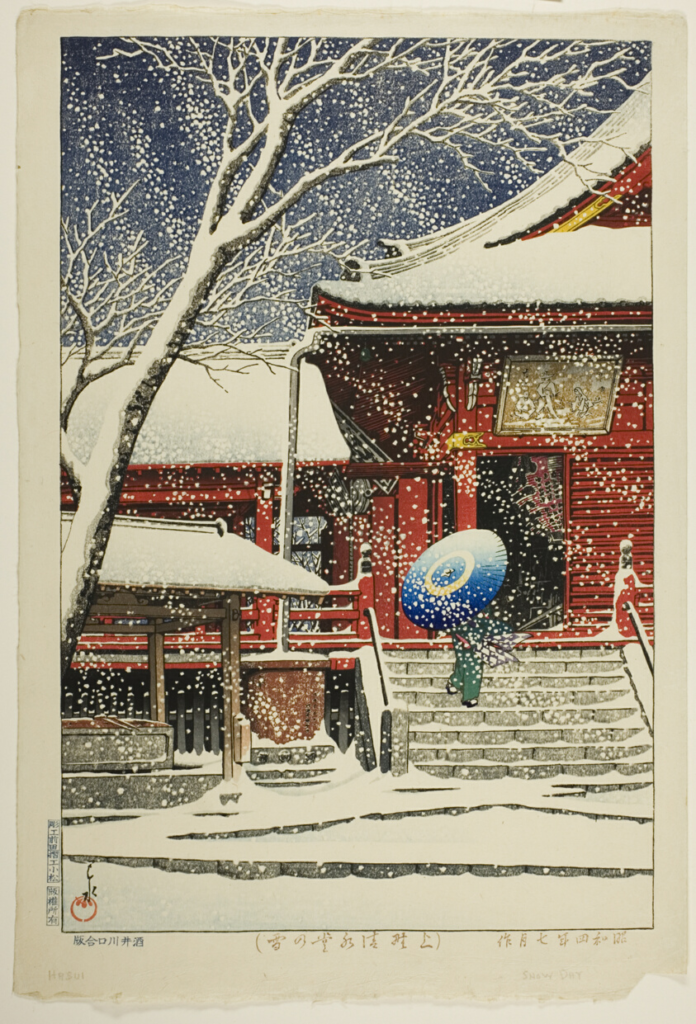
Few artists have painted snow as something more than a season. For Kawase Hasui, snow became a language of stillness, reflection, and quiet wonder. Among his many winter landscapes, Snow at Ueno Kiyomizudō (1929) is often regarded as one of his most celebrated achievements because it captures something remarkably difficult to depict: not simply how snow looks, but how it changes the entire atmosphere of a place.
The print portrays Kiyomizudō Hall, one of the historic buildings within Tokyo’s Ueno Park, gently blanketed in fresh snow. Instead of presenting the temple as an imposing monument, Hasui allows it to settle naturally into its surroundings. The architecture emerges softly from the winter landscape, while snow-covered trees and open pathways create a composition that feels both expansive and deeply intimate. There is no sense of urgency here. Every element appears to pause, as though time itself has slowed beneath the weight of freshly fallen snow.
One of the first things viewers notice is the extraordinary use of colour, or rather, the deliberate lack of it. Snow is rarely pure white in Hasui’s world. Instead, he builds the landscape with delicate layers of cool blues, pale greys, muted violets, and soft ivory tones. These subtle gradations give the snow remarkable depth and texture, suggesting shifting daylight and crisp winter air without overwhelming the eye. The gentle blue shadows stretching across the ground create a sense of dimension while reinforcing the quiet chill that seems to linger over the entire scene.
What truly elevates this print is Hasui’s understanding of negative space. Large areas of untouched snow occupy much of the composition, allowing the viewer’s gaze to wander without distraction. Rather than filling every corner with detail, he embraces emptiness as an expressive element, a principle closely aligned with the Japanese aesthetic concept of ma, where space itself becomes meaningful. The result is a composition that feels meditative, encouraging viewers to slow down and absorb the stillness rather than simply observe it.
Unlike many Western winter landscapes that celebrate dramatic storms or harsh weather, Hasui chooses the calm that follows. There are only a few tiny figures moving quietly through the temple grounds, their presence emphasizing the vast silence around them. They remind us that life continues, but gently, almost respectfully, beneath the snowfall. The temple itself becomes more than a historical landmark; it transforms into a place of contemplation where nature and architecture exist in perfect harmony.
Technically, Snow at Ueno Kiyomizudō also demonstrates the extraordinary craftsmanship of the shin-hanga movement. Producing such seamless tonal transitions required multiple carved woodblocks, carefully layered pigments, and exceptional precision from the printers working alongside Hasui and publisher Watanabe Shōzaburō. Every soft shadow and subtle highlight reflects the collaborative artistry that defined shin-hanga printmaking at its finest.
Nearly a century after it was first published, this print continues to captivate viewers not because it depicts a famous temple, but because it captures an emotion that feels universally familiar. Anyone who has stepped outside after fresh snowfall knows the feeling: the softened sounds, the slower pace, the strange sense that the world has briefly fallen quiet. That is the moment Hasui preserves forever. In Snow at Ueno Kiyomizudō, winter isn’t simply a season, it becomes an experience, proving once again that Kawase Hasui’s greatest masterpiece was never weather alone, but the atmosphere it created.
4. Night Rain at Kawarako, Ibaraki (1947)
When Darkness Makes the Rain Feel Even Louder
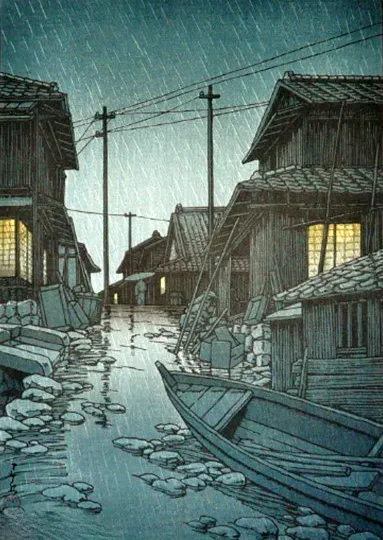
If Evening Shower at Imai Bridge captures the urgency of a sudden storm and Arakawa River in May Rain celebrates the quiet rhythm of spring showers, then Night Rain at Kawarako, Ibaraki (1947) reveals an entirely different side of Kawase Hasui’s artistic genius. Here, rain doesn’t dominate the landscape through movement or force. Instead, it becomes inseparable from darkness itself, transforming an ordinary lakeside village into a scene suspended somewhere between reality and dream.
Created just two years after the end of the Second World War, this print belongs to Hasui’s later body of work, a period that many scholars believe carries an even greater sense of reflection and emotional restraint. Rather than filling the composition with dramatic action, Hasui invites viewers into an almost deserted nighttime landscape. A modest wooden building stands quietly beside the water while soft lights glow from within, their reflections stretching gently across the rain-darkened surface below. The surrounding hills dissolve into deep blue shadows, making it difficult to distinguish where land ends and sky begins. Everything is softened by the rain.
One of the most remarkable aspects of this print is Hasui’s command of colour. Unlike many Western night scenes that rely heavily on black, Hasui constructs darkness through layers of indigo, navy, charcoal, and muted violet. These carefully graded tones create extraordinary depth while preserving subtle details that gradually emerge the longer one looks. The rain itself is barely visible, yet its presence is unmistakable. The glistening water, softened edges, and luminous reflections convince the viewer that the entire landscape has been soaked by an evening shower.
The print also demonstrates the technical brilliance of the shin-hanga movement. Achieving these velvety gradients required extraordinary collaboration between designer, carver, and printer. Multiple woodblocks were used to layer pigments with remarkable precision, allowing smooth transitions between darkness and light that would have been impossible with a single impression. Hasui worked closely with publisher Watanabe Shōzaburō and his team throughout the printing process, refining colours until they matched the atmosphere he had witnessed during his travels.
Perhaps what makes Night Rain at Kawarako so unforgettable is its emotional ambiguity. There is no obvious story unfolding before us. No dramatic event interrupts the silence. Instead, the scene invites quiet contemplation. The glowing windows suggest human presence without revealing it, while the rain creates a gentle barrier between the viewer and the landscape. It is this sense of distance that gives the print its haunting beauty. Rather than asking us to observe the rain, Hasui allows us to experience the solitude that often accompanies it.
Nearly eighty years after it was first published, Night Rain at Kawarako remains one of Hasui’s finest demonstrations of atmosphere. It reminds us that the most powerful landscapes are not always those filled with spectacular scenery, but those that capture the quiet emotions we rarely have words for. In Hasui’s hands, darkness and rain become less about weather and more about reflection, memory, and the profound stillness that arrives after the world has gone to sleep.
5. Clearing After Snowfall on Mt. Fuji (1932)
The Quiet Beauty of a World After the Storm
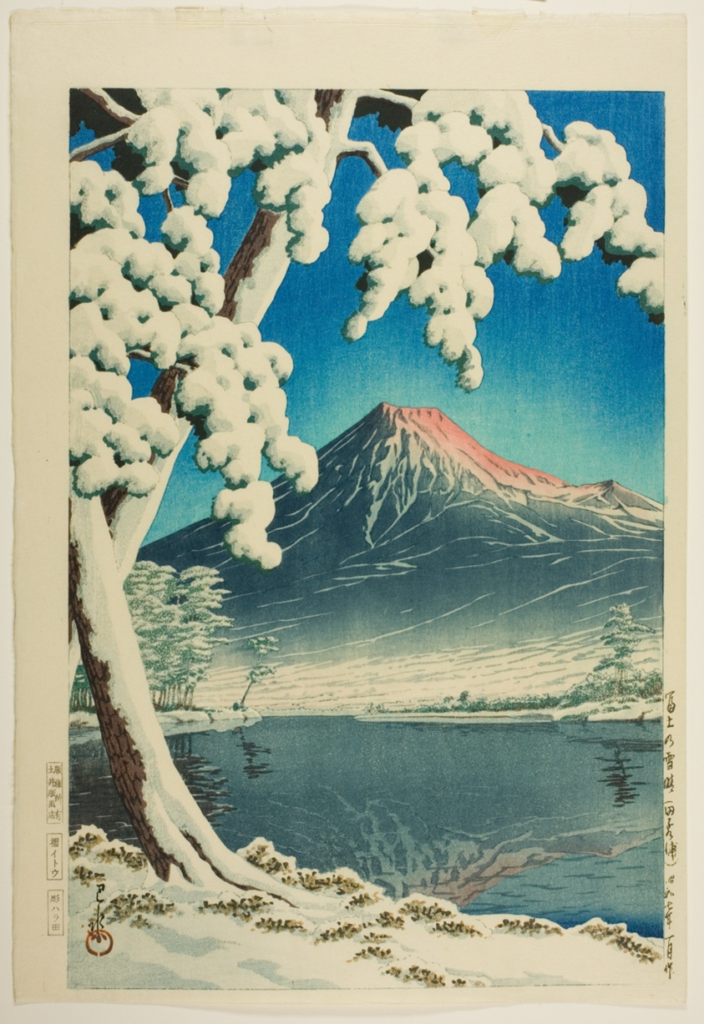
While many artists are drawn to the drama of storms, Kawase Hasui was often more interested in what came afterward. Clearing After Snowfall on Mt. Fuji (1932) perfectly captures that fleeting moment when nature seems to pause between winter’s fury and the return of calm. Instead of depicting snow actively falling, Hasui focuses on the remarkable stillness that follows, a moment when the sky begins to brighten, fresh snow reflects the returning light, and even the air feels cleaner. It is a landscape defined not by movement, but by quiet renewal.
At the heart of the composition stands Mount Fuji, Japan’s most iconic mountain and one of the country’s most enduring cultural symbols. For centuries, artists from Hokusai to Hiroshige depicted Fuji as a monument of permanence, strength, and spiritual significance. Hasui continues this tradition but approaches it with a distinctly modern sensitivity. Rather than making the mountain dominate the entire composition, he allows it to emerge naturally from the winter landscape, its snow-covered peak blending harmoniously with the surrounding sky. The effect is gentle rather than grand, inviting contemplation instead of awe.
One of the print’s greatest strengths lies in its treatment of light. Snow is often thought of as simply white, but Hasui understood that fresh snowfall is filled with subtle colour. Pale blues, soft greys, muted lavenders, and delicate creams create the illusion of sunlight slowly returning after a storm. These carefully layered pigments give the snow extraordinary depth, preventing it from appearing flat or lifeless. The crisp air becomes almost tangible, and viewers can easily imagine the faint crunch of footsteps across untouched ground.
The composition also demonstrates Hasui’s remarkable sense of balance. Trees, rooftops, and distant hills gently guide the eye toward Mount Fuji without overwhelming the landscape. Every element contributes to a feeling of harmony. There is no unnecessary detail or dramatic flourish. Instead, Hasui allows negative space and carefully measured proportions to create a rhythm that mirrors nature itself. This quiet elegance reflects the principles of Japanese aesthetics, where restraint often carries greater emotional power than spectacle.
Unlike many of his rain-soaked city scenes, Clearing After Snowfall on Mt. Fuji contains almost no suggestion of struggle or hardship. Instead, it speaks of resilience through tranquillity. After every storm comes clarity; after every snowfall, the world appears briefly transformed. Hasui captures that universal experience with remarkable tenderness, reminding us that some of nature’s most profound moments occur not during extraordinary events, but immediately after them.
Viewed today, the print feels almost timeless. It offers more than a beautiful winter landscape, it captures the emotional relief that follows uncertainty, the hope carried by returning light, and the quiet optimism of a world beginning again. It is perhaps one of Hasui’s most uplifting works, proving that his true mastery lay not only in painting weather itself, but in revealing the emotions hidden within its changing moods.
6. Dusk at Itako (1932)
The Masterpiece That Proves Weather Isn’t Always Rain or Snow
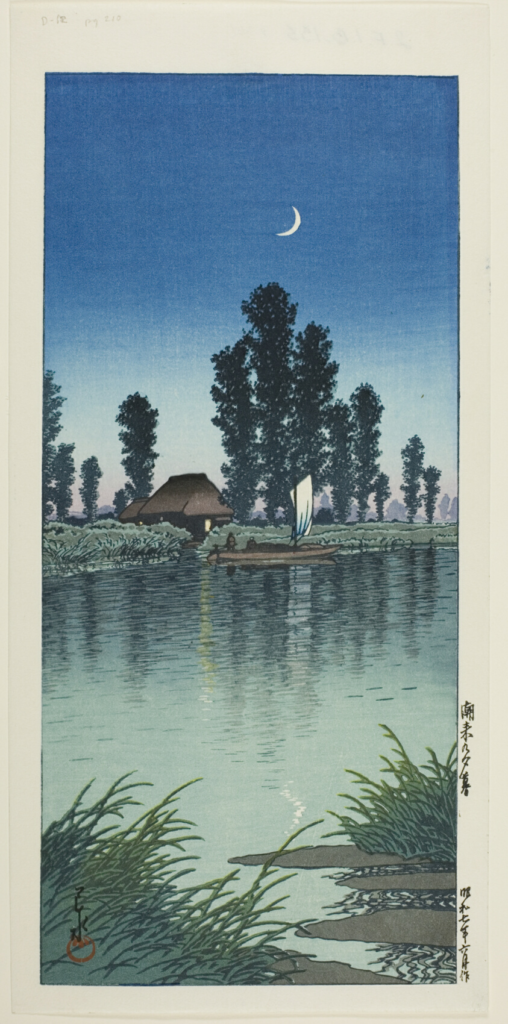
Not every weather story begins with dark clouds or falling snow. Sometimes, the most profound transformation happens as daylight quietly slips into evening. In Dusk at Itako (1932), Kawase Hasui reminds us that the atmosphere isn’t created solely by dramatic weather, it can emerge from something as subtle as fading light. This remarkable print demonstrates why Hasui was often called the master of atmosphere rather than simply the painter of rain or snow. Here, the weather is calm, but the air itself seems alive with change.
Located in Ibaraki Prefecture, Itako has long been known for its waterways, traditional wooden boats, and quiet canals that connected surrounding villages. Rather than depicting the town as a bustling centre of activity, Hasui chooses one of the day’s most fleeting moments. The sun has disappeared below the horizon, leaving behind a soft, luminous sky where shades of pale gold gradually dissolve into lavender, blue, and deepening indigo. Water mirrors these colours almost perfectly, turning the canal into a second sky and blurring the boundary between land and reflection.
One of the first things viewers notice is the extraordinary stillness. The boats rest gently against the shoreline, untouched by waves or wind. The buildings stand quietly in the distance, their forms simplified into elegant silhouettes. There are few, if any, visible figures to distract the eye. Instead, Hasui allows empty space to become the emotional centre of the composition. This restraint reflects the Japanese aesthetic concept of ma, where absence is treated as an essential part of the artwork rather than empty background. The silence between objects becomes just as meaningful as the objects themselves.
Colour is the true protagonist here. Throughout his career, Hasui became renowned for his ability to render transitional light, the brief moments at sunrise, sunset, and twilight when colours shift almost imperceptibly. Achieving these delicate gradations required extraordinary skill from the printers working within the shin-hanga tradition. Layer after layer of transparent pigments were applied to create seamless transitions that make the sky appear almost luminous. Rather than presenting a flat landscape, Hasui creates an atmosphere that feels breathable, as though the evening air itself has settled over the water.
Unlike many landscape artists who sought dramatic landmarks, Hasui found beauty in ordinary places transformed by extraordinary light. Dusk at Itako is not remembered because of an iconic building or famous monument. It endures because it captures one of the most universal experiences imaginable: watching the world slow down as day quietly becomes night. It is a moment everyone recognises, yet few artists have portrayed with such emotional precision.
Seen alongside his celebrated rain and snow scenes, this print reveals the remarkable breadth of Hasui’s vision. He understood that weather is more than precipitation, it is the changing quality of light, the shifting colours of the sky, the stillness of water before darkness arrives, and the emotions these moments awaken within us. Dusk at Itako is therefore not only one of his most beautiful landscapes but also one of the clearest expressions of the philosophy that defined his life’s work: that the atmosphere surrounding a place can often tell a deeper story than the place itself.
7. Gosaibori Canal, Niigata (from Souvenirs of Travel II)
The Night Scene That Turned Moonlight Into a Mood
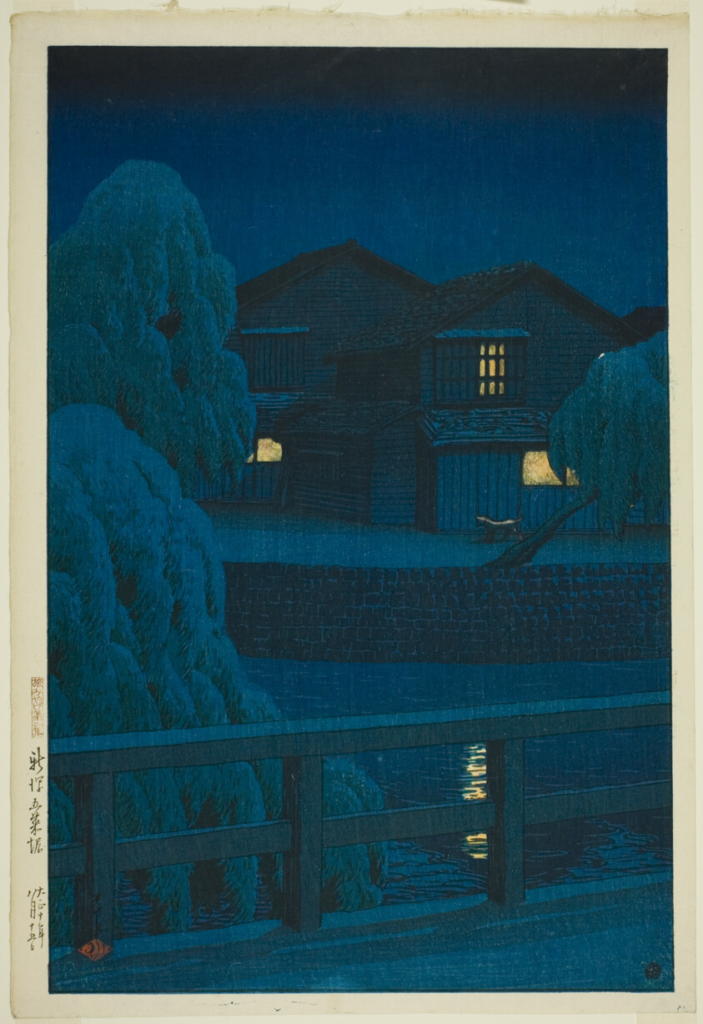
If rain revealed Kawase Hasui’s mastery of movement and snow showcased his gift for silence, then Gosaibori Canal, Niigata demonstrates perhaps his greatest achievement of all: his ability to paint light after sunset. Long before photography could faithfully capture the subtle glow of moonlit canals and shimmering reflections, Hasui had already mastered the art of making darkness feel luminous. This print isn’t simply a night scene, it is an invitation into one of the quietest moments imaginable, where the world seems to exist only in reflections, soft light, and still water.
The Gosaibori Canal, located in the coastal city of Niigata, was once an important waterway lined with warehouses, merchant houses, and boats that connected the city to the Sea of Japan. Rather than emphasizing its commercial significance, however, Hasui transforms the canal into an almost dreamlike landscape. Buildings fade into deep blue silhouettes while the water below becomes the true focal point, catching every glimmer of light from nearby homes and lanterns. The reflections stretch gently across the surface, creating the illusion that the canal itself is quietly glowing from within.
One of the most remarkable aspects of this composition is its restrained colour palette. Hasui relies almost entirely on varying shades of indigo, midnight blue, charcoal grey, and muted violet, interrupted only by the warm amber glow of lanterns reflected in the water. These small pockets of light become emotionally significant precisely because they are so scarce. Instead of overpowering the darkness, they gently soften it, reminding viewers that even the quietest night contains warmth and life. This careful balance between darkness and illumination became one of Hasui’s artistic signatures and distinguished his work from many earlier landscape printmakers.
Technically, scenes like this were among the most demanding works produced within the shin-hanga movement. Creating such smooth transitions between dark and light required extraordinary precision from the printers, who layered transparent pigments through multiple carved woodblocks. The subtle gradation across the sky, the soft reflections on the canal, and the velvety richness of the surrounding architecture were all achieved through painstaking craftsmanship. While Hasui conceived the design, its final beauty depended upon the remarkable collaboration between artist, publisher, carver, and printer, a hallmark of shin-hanga production.
Beyond its technical brilliance, Gosaibori Canal, Niigata speaks to one of Hasui’s deepest artistic interests: solitude without loneliness. There are few visible figures, yet the illuminated windows and boats suggest quiet human presence just beyond our view. The scene feels lived in, but never crowded. It encourages contemplation rather than observation, asking viewers to slow down long enough to appreciate the beauty of an ordinary evening.
Among Hasui’s many atmospheric masterpieces, this print stands as a reminder that weather is not always defined by rain or snow. Sometimes it is the cool air after sunset, the gentle shimmer of reflected light, or the profound stillness that settles over a sleeping city. In those fleeting moments, Hasui found a kind of poetry that continues to resonate with viewers around the world, proving that darkness, when treated with sensitivity, can be every bit as expressive as daylight.
8. Beach Shed at Himi, Etchū Province (from Souvenirs of Travel II)
The Coastal Storm That Shows Nature at Its Most Powerful
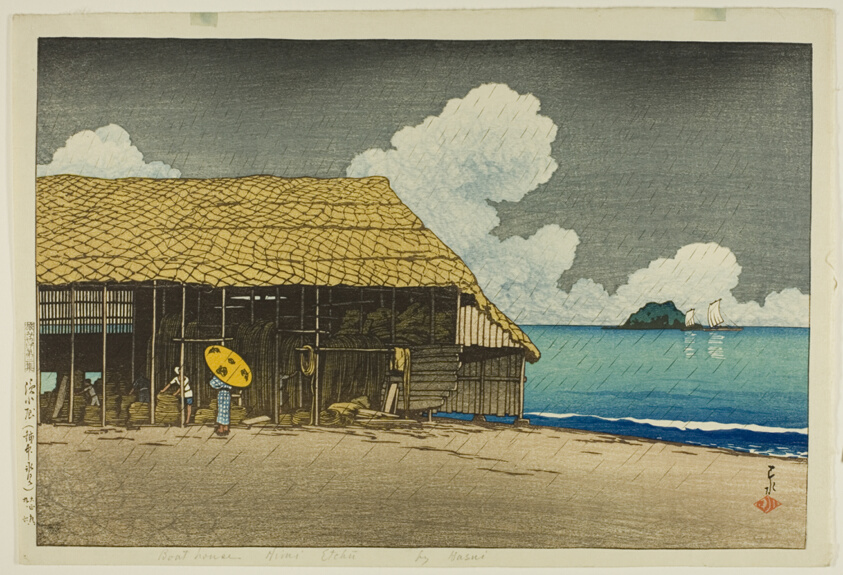
Kawase Hasui is often celebrated for his quiet temples, snow-covered villages, and rain-soaked streets, but some of his most compelling works reveal a different side of his artistic vision. Beach Shed at Himi, Etchū Province, from his celebrated Souvenirs of Travel II series, demonstrates that atmosphere doesn’t always arrive gently. Here, the weather is restless, the sea feels unpredictable, and the landscape carries an unmistakable sense of resilience. Rather than inviting viewers into peaceful contemplation, Hasui immerses them in the raw relationship between people and the natural world.
Set along the rugged coastline of present-day Toyama Prefecture, the composition is striking in its simplicity. A modest wooden shed stands near the shore, weathered by years of exposure to salt air, rain, and strong coastal winds. Beyond it, the sea stretches toward the horizon beneath a sky heavy with gathering clouds. The water is far from calm; subtle ripples and shifting tones suggest a restless tide, while the muted sky hints that rain has either just passed or is about to arrive. Unlike many landscape artists who would dramatize such a scene with crashing waves or violent storms, Hasui chooses restraint. The tension lies not in spectacle but in anticipation.
That sense of anticipation is what gives the print its emotional depth. The empty shoreline feels as though it has been briefly abandoned, leaving only the small structure to face the changing weather. Yet rather than appearing fragile, the shed becomes a quiet symbol of endurance. It has weathered countless storms before and will continue to stand long after this one passes. This understated resilience echoes throughout much of Hasui’s work, where ordinary buildings and familiar places become silent witnesses to nature’s changing moods.
Colour plays a crucial role in establishing the atmosphere. Soft greys, deep blues, and earthy browns dominate the composition, creating the cool, damp feeling often associated with Japan’s coastal climate. There are no bright accents competing for attention. Instead, Hasui relies on subtle tonal shifts to suggest moisture in the air, the weight of low clouds, and the constant dialogue between sea and sky. The restrained palette allows viewers to almost feel the cool wind blowing in from the water, proving once again that Hasui’s true subject was never architecture or landscape alone, it was the invisible atmosphere surrounding them.
This print also reflects Hasui’s lifelong commitment to travel. Carrying sketchbooks across Japan for decades, he sought out places that revealed the country’s extraordinary diversity, from mountain temples to bustling canals and remote fishing villages. Coastal communities like Himi offered him an entirely different vocabulary of weather: sea mist, ocean winds, changing tides, and skies that could transform within moments. By including these landscapes in his work, Hasui expanded the visual language of shin-hanga, showing that beauty could be found not only in famous landmarks but also in overlooked corners shaped by everyday life and the elements.
As the final artwork in this collection, Beach Shed at Himi, Etchū Province brings together everything that made Kawase Hasui extraordinary. Rain, snow, twilight, moonlight, and now the restless coast all reveal the same artistic truth: weather is never just a backdrop. It changes how we see a place, how we move through it, and how we remember it. More than six decades after his passing, Hasui’s landscapes continue to remind us that some of the world’s most unforgettable moments are not defined by grand events, but by the quiet conversations between light, season, and the ever-changing sky.
Kawase Hasui Didn’t Just Paint the Weather – He Painted How It Felt
Long before weather forecasts appeared on our phones or cameras could instantly capture a passing storm, Kawase Hasui was preserving something far more difficult to record: the emotions that weather leaves behind. His prints are not remarkable because they depict rain, snow, moonlight, or dusk with technical precision, although they certainly do. They endure because they capture the quiet, deeply human experiences that accompany those moments.
Across these eight works, weather becomes much more than a backdrop. In Evening Shower at Imai Bridge, rain speaks of resilience. Arakawa River in May Rain transforms a spring shower into a meditation on renewal. Snow at Ueno Kiyomizudō and Evening Snow at Terashima Village reveal how winter can be both silent and comforting, while Clearing After Snowfall on Mt. Fuji reminds us that beauty often emerges after hardship. As daylight fades in Dusk at Itako and moonlight settles over Gosaibori Canal, Niigata, Hasui proves that atmosphere can be just as powerful as any dramatic landscape. Finally, Beach Shed at Himi, Etchū Province reminds us that nature is not always gentle, it is resilient, ever-changing, and quietly humbling.
Perhaps that is why Hasui’s work continues to resonate across generations and cultures. Although he travelled throughout Japan in the early twentieth century, the emotions embedded in his landscapes feel universal. You don’t need to have walked across an old Tokyo bridge or visited a snow-covered temple to understand them. Anyone who has paused to watch rain collect on a window, listened to the hush after fresh snowfall, or stood outside as evening slowly replaced daylight has already experienced the world Hasui painted.
His genius also lies in what he chose not to include. There are rarely crowds, dramatic narratives, or overwhelming displays of colour. Instead, he leaves space for silence, reflection, and memory. Every empty street, quiet canal, and softly glowing lantern invites us to slow down and notice the fleeting moments that usually pass unnoticed. In an increasingly fast-paced world, that quiet observation feels more valuable than ever.
More than six decades after his death, Kawase Hasui remains one of the defining voices of the shin-hanga movement and one of Japan’s greatest landscape artists. His woodblock prints continue to inspire museum visitors, collectors, illustrators, filmmakers, and anyone who believes that art has the power to make us feel rather than simply see.
Because in the end, Kawase Hasui wasn’t painting storms, snowfall, or sunsets.
He was painting the moments when the world grows quiet enough for us to truly notice it. Which of these Kawase Hasui prints made you pause the longest?
And if you’re fascinated by the emotions hidden within great works of art, you might also enjoy exploring how artists have captured feeling through something even more intimate, the human gaze. Read our article, The 8 Most Haunting Stares Ever Captured in Art, and discover the unforgettable faces that continue to captivate viewers across centuries.