


What X-Rays Revealed About the Secret History of Famous Paintings
For centuries, paintings have guarded their secrets well.
Museum visitors admire the finished masterpiece hanging on the wall, rarely imagining that another artwork, a forgotten portrait, or an abandoned idea might be hiding just beneath its surface. Yet thanks to advances in X-ray imaging, infrared reflectography, and hyperspectral scanning, art historians can now do something once thought impossible: look through layers of paint without touching the canvas itself.
What X-Rays revealed about the secret history of famous paintings has transformed the way conservators and historians study art. Hidden self-portraits, forgotten masterpieces, abandoned compositions, and even clues about artists’ creative decisions have all come to light through these remarkable technologies.
Beneath famous masterpieces lie lost paintings, hidden self-portraits, experimental sketches, and even clues to artists’ personal lives. Some discoveries have brought forgotten works back into public view after more than a century. Others have revealed how celebrated artists such as Vincent van Gogh, Leonardo da Vinci, and Pablo Picasso changed their minds while creating works we thought we knew inside and out.
These technologies offer more than a glimpse beneath the paint. They allow us to step into the artist’s studio, witnessing moments of revision, hesitation, and experimentation that were never intended for public eyes. Every scan peels back another layer of history, proving that even the world’s most studied artworks can still surprise us.
From hidden self-portraits to long-lost masterpieces, here are ten astonishing discoveries that X-rays uncovered beneath some of history’s most famous paintings.
1. When an X-Ray Revealed What Could Be Van Gogh’s Earliest Self-Portrait
Painting: Head of a Peasant Woman (1885)
Artist: Vincent van Gogh
X-Ray Discovery: A hidden self-portrait believed to be Van Gogh’s earliest known self-portrait
Discovery Announced: 2022
Imagine discovering a brand-new work by Vincent van Gogh more than a century after his death, not in an attic or private collection, but hidden behind a painting that had been hanging in plain sight all along.
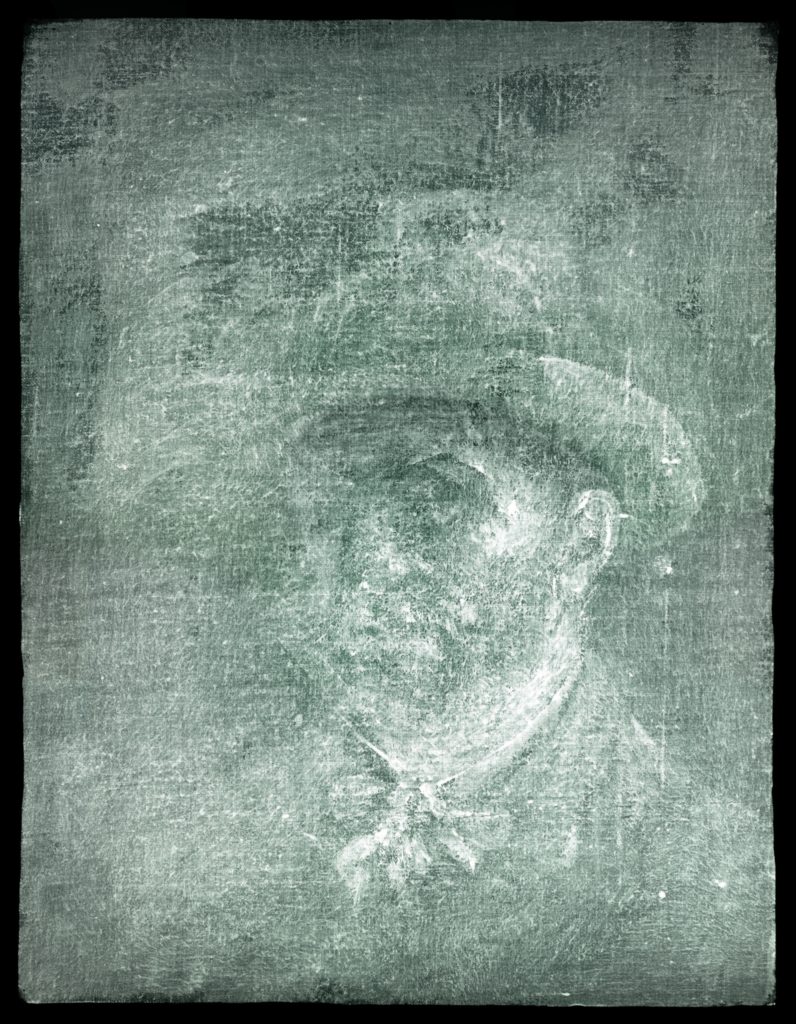
That is exactly what happened in 2022 when conservators at the National Galleries of Scotland were carrying out a routine X-ray examination of Van Gogh’s Head of a Peasant Woman (1885). Instead of simply studying the painting’s condition, they uncovered something astonishing beneath the canvas: the image of a bearded man wearing a brimmed hat and neckerchief, unmistakably resembling Van Gogh himself.
The discovery was particularly exciting because scholars believe it could be the artist’s earliest known self-portrait. Before moving to Paris in 1886, Van Gogh was still developing his style and had limited access to materials. Like many artists of his time, he often reused canvases to save money, painting new works over older ones when supplies were scarce.
What makes this hidden portrait so fascinating is that it offers a rare glimpse into a formative chapter of Van Gogh’s life. Long before the vibrant sunflowers and swirling night skies that made him famous, he was already studying his own face, experimenting with light, expression, and identity. The X-ray allows us to witness a moment that was never meant to be seen again.
More than a technical discovery, the hidden image reminds us that masterpieces are not always single stories. Sometimes they are layered histories, carrying traces of an artist’s doubts, experiments, and forgotten beginnings. In Van Gogh’s case, one routine scan revealed that a painting we thought we knew still had a secret left to tell.
Did You Know?
Researchers are still exploring whether it might be possible to safely reveal more of the hidden portrait without damaging the painting above it, a challenge that highlights both the promise and the limitations of modern conservation technology.
2. A Lost Masterpiece by Helen Saunders Was Hiding Beneath Another Artist’s Painting
Painting: Praxitella (1921)
Artist: Wyndham Lewis
X-Ray Discovery: Atlantic City (c. 1915), a long-lost painting by Helen Saunders
Discovery Announced: 2019
Not every hidden discovery belongs to a household name. Sometimes, X-ray technology helps recover artists who have been overlooked by history itself.
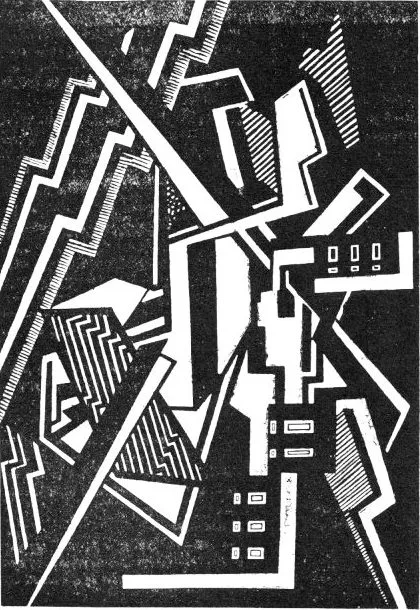
For nearly a century, Atlantic City (c. 1915), a vibrant abstract composition by Helen Saunders, was believed to be lost. Saunders was one of only two women associated with the Vorticist movement, a bold British avant-garde group that blended the energy of modern industry with the fragmented forms of Cubism. Yet despite her contributions, much of her work disappeared from public view over time.
The painting resurfaced in an unexpected place. In 2019, researchers examining Praxitella, a 1921 portrait by Wyndham Lewis, noticed unusual cracks and inconsistencies across the surface. Curious about what might lie underneath, they turned to imaging technology. What emerged was the long-lost Atlantic City, hidden beneath the later portrait for almost 100 years.
The discovery was remarkable for more than just its mystery. Unlike many hidden paintings that reveal sketches or abandoned ideas, this was a fully realized artwork by another artist entirely. Suddenly, a piece of art history that had been considered lost was back in the conversation.
For historians, the find offered valuable insight into Saunders’s career and the role women played within early twentieth-century modernism. For viewers, it serves as a reminder that some of art’s greatest discoveries are not always about uncovering famous names, they can also be about restoring forgotten voices.
Today, Atlantic City stands as a powerful example of how technology is helping museums and researchers recover stories that traditional art history left behind. In some cases, an X-ray does more than reveal a hidden image; it helps rewrite the historical record itself.
Did You Know?
Helen Saunders was one of the very few women featured in BLAST, the influential magazine that became the voice of the Vorticist movement. Yet much of her work remained unseen for decades, making the rediscovery of Atlantic City especially significant.
3. Georges Seurat Secretly Painted Himself Into the Scene – Then Painted Himself Out
Painting: A Young Woman Powdering Herself (1889–90)
Artist: Georges Seurat
X-Ray Discovery: A hidden self-portrait believed to depict Seurat himself
Discovery Announced: 2014
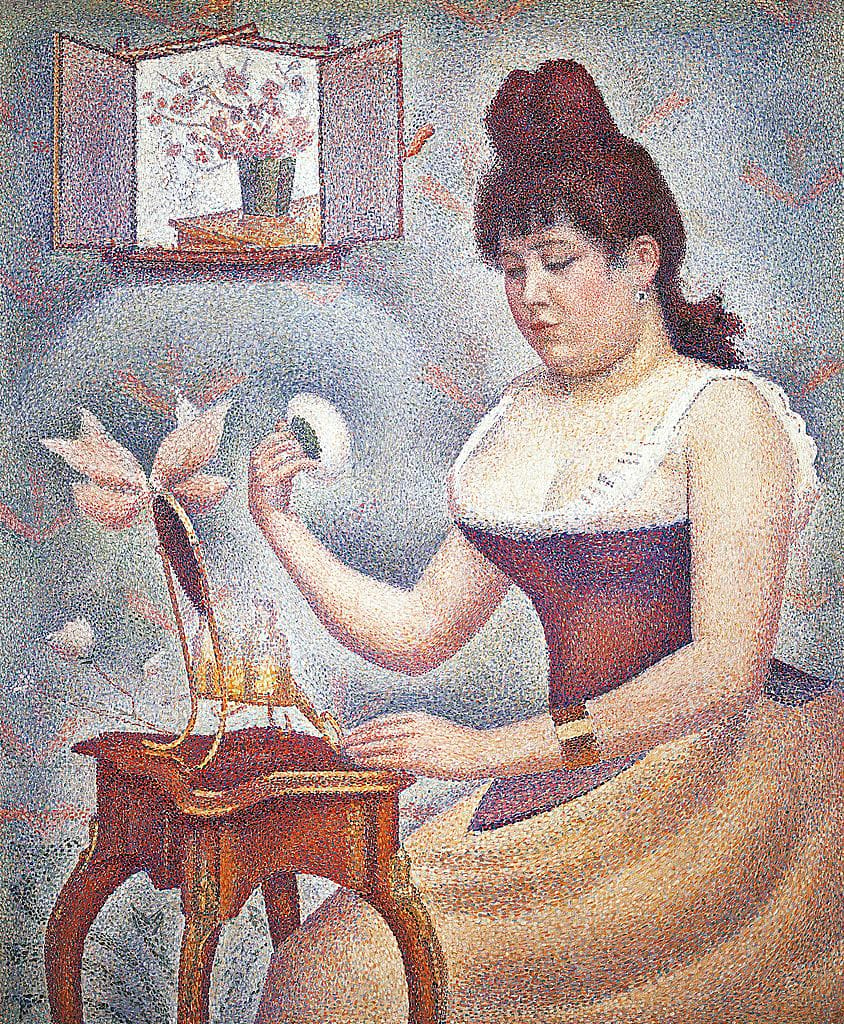
When we think of hidden paintings, we often imagine forgotten portraits or abandoned sketches. But sometimes what lies beneath the surface feels far more personal.
In 2014, researchers studying Georges Seurat’s A Young Woman Powdering Herself (1889–90) made an intriguing discovery. X-ray analysis revealed that a small mirror visible in the painting today was not part of Seurat’s original composition. In its place was the face of a man peering into the scene, believed to be the artist himself.
The painting depicts Madeleine Knobloch, Seurat’s model, companion, and the mother of his child. Yet during his lifetime, their relationship remained largely hidden from the public. Historians believe that Seurat may have initially included his own reflection as a playful acknowledgment of their private connection before later deciding to remove it.
Why the change? No one knows for certain. Some scholars suggest that Seurat wanted to make the painting more suitable for exhibition. Others believe he wished to keep his personal life out of public view. Whatever the reason, he replaced his own image with a window, effectively erasing himself from the final version.
What makes this discovery so captivating is how human it feels. Beneath the technical analysis and scientific imaging is a glimpse of an artist making decisions, second-guessing himself, and carefully controlling what the world would see. The X-ray doesn’t just reveal a hidden face—it reveals a moment of hesitation.
More than a century later, technology has allowed Seurat to quietly step back into the painting he once chose to leave behind. It’s a reminder that every artwork is the result of countless choices, and sometimes the most revealing ones are the choices that never made it to the finished canvas.
Did You Know?
Seurat completed A Young Woman Powdering Herself just a year before his death at the age of 31. Despite his short career, he became one of the most influential figures in modern art, pioneering the Pointillist technique that transformed painting at the end of the nineteenth century.
4. A Hidden Portrait Beneath Goya’s Painting May Tell a Political Story
Painting: Portrait of Don Ramón Satué (1823)
Artist: Francisco Goya
X-Ray Discovery: An unfinished portrait of a high-ranking French official, possibly connected to Joseph Bonaparte’s administration
Discovery Announced: 2011
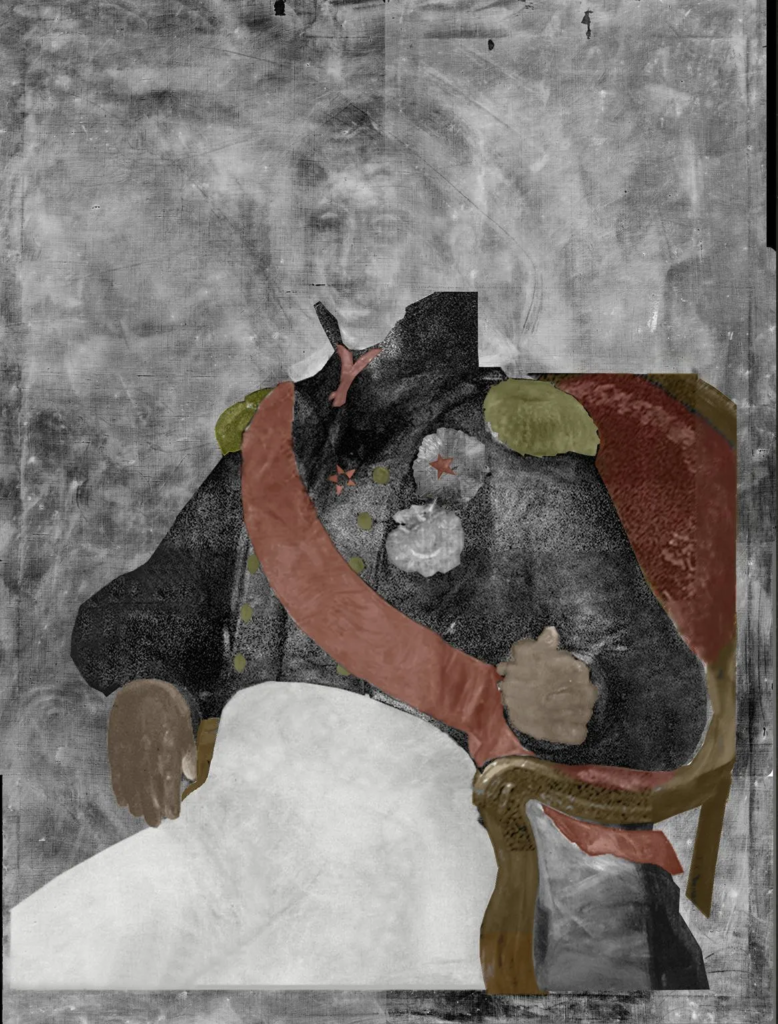
Some hidden paintings reveal artistic experiments. Others uncover mysteries that reach far beyond the artist’s studio.
For years, art historians suspected that Francisco Goya’s Portrait of Don Ramón Satué (1823) concealed an earlier work beneath its surface. In 2011, advanced X-ray imaging finally confirmed their suspicions. What emerged was not a sketch or unfinished study, but the partially completed portrait of another man entirely.
The hidden figure appears dressed in the uniform of a high-ranking French official, complete with the outline of a prestigious medal pinned to his chest. Although researchers have not been able to identify him with complete certainty, some believe the sitter may have been connected to the French administration that governed Spain during the Napoleonic era. One theory even suggests that the figure could have been linked to the circle of Joseph Bonaparte, Napoleon’s brother and the former King of Spain.
If true, the discovery adds a fascinating layer of political intrigue. Spain’s relationship with French rule was deeply contentious, and after the French were expelled, public associations with the occupation became increasingly sensitive. Repainting the canvas may have been more than a practical decision, it could have been an effort to distance the artwork from a controversial moment in history.
What makes this discovery especially compelling is that it transforms the painting into a historical document. Beneath the visible portrait lies evidence of shifting loyalties, changing political realities, and a period of upheaval that shaped an entire nation.
Thanks to modern imaging technology, we are no longer looking at a single portrait. We are looking at two stories occupying the same canvas, one visible, the other hidden for nearly two centuries.
Did You Know?
Goya lived through some of the most turbulent decades in Spanish history, including war, political revolution, and the French occupation of Spain. Many of his works reflect the uncertainty and violence of the era, making the discovery beneath this portrait all the more intriguing.
5. Leonardo da Vinci’s Earlier Vision Was Hidden Beneath a Masterpiece
Painting: The Virgin of the Rocks (1491–99; completed c. 1506–08)
Artist: Leonardo da Vinci
X-Ray Discovery: An earlier underdrawing revealing a different arrangement of the Virgin, the Christ Child, the infant John the Baptist, and the angel
First Detected: 2005
Revealed in Greater Detail: 2019
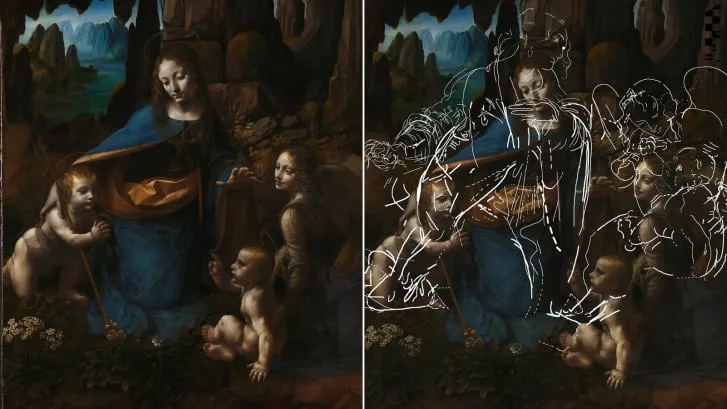
Few artists are studied as intensely as Leonardo da Vinci. Yet even after centuries of research, technology is still uncovering new secrets hidden within his work.
One of the most fascinating examples comes from The Virgin of the Rocks, a painting Leonardo worked on during the late fifteenth century. For years, scholars knew that traces of an earlier composition existed beneath the finished image. But it wasn’t until advances in imaging technology allowed researchers to look deeper that the hidden design began to emerge with remarkable clarity.
Using techniques including X-ray fluorescence scanning and hyperspectral imaging, conservators at the National Gallery uncovered detailed underdrawings that revealed a significantly different arrangement of figures. In Leonardo’s original concept, the infant Christ and the angel occupied different positions, suggesting that the artist reconsidered the composition before arriving at the version we know today.
The discovery offers a rare opportunity to witness Leonardo’s creative process in action. Rather than seeing him as a master who simply executed perfect ideas, we encounter an artist who experimented, revised, and refined his work through trial and error. The hidden sketches show him searching for the strongest arrangement, adjusting relationships between the figures, and carefully constructing the visual harmony that defines the finished painting.
Perhaps that’s what makes discoveries like this so captivating. They remind us that even history’s greatest geniuses worked through uncertainty. Behind every masterpiece lies a series of decisions, corrections, and possibilities that viewers were never meant to see.
Today, thanks to modern imaging technology, we can stand a little closer to Leonardo’s studio than ever before. The hidden drawings beneath The Virgin of the Rocks reveal not just an abandoned composition, but a glimpse into the mind of one of art history’s most celebrated innovators.
Did You Know?
The underdrawing was first detected in 2005, but improvements in imaging technology over the following decade allowed researchers to recover far more detail, demonstrating how new scientific tools continue to transform art historical research.
6. Degas Accidentally Left a Clue to a Hidden Portrait
Painting: Portrait of a Woman (1876)
Artist: Edgar Degas
X-Ray Discovery: A hidden portrait of the model Emma Dobigny
Discovery Announced: 2016
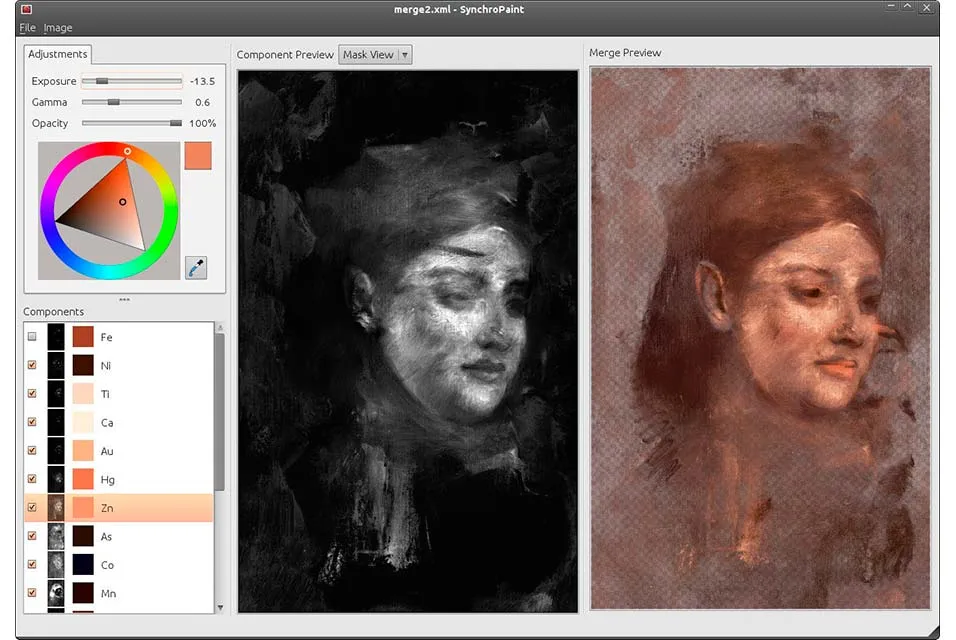
Most hidden paintings stay hidden because artists deliberately covered them. Edgar Degas’s secret portrait, however, had been quietly revealing itself for decades.
The mystery lay beneath Portrait of a Woman (1876), a work long held in the collection of the National Gallery of Victoria. Over time, conservators noticed something unusual: faint outlines and discolorations seemed to be emerging through the surface paint. It was as if another image was trying to make its way back into view.
The explanation was surprisingly simple. Degas had painted the visible portrait over an earlier work, but he used relatively thin layers of paint. As the materials aged, traces of the original image began to bleed through, hinting at the presence of another figure beneath. Art experts had noticed the phenomenon as early as the 1920s, but it wasn’t until advanced scanning technologies were employed in 2016 that researchers could properly investigate what was hidden below.
What emerged was a striking portrait of Emma Dobigny, one of the most sought-after models in Paris during the nineteenth century. Through digital reconstruction and scientific imaging, researchers were able to recover details that had been concealed for nearly 140 years, effectively bringing the forgotten portrait back to life.
Unlike many discoveries on this list, Degas’s hidden painting wasn’t found in a single dramatic moment. Instead, it slowly surfaced over generations, leaving clues that conservators and scientists eventually pieced together. The result feels almost archaeological, as though researchers were excavating a work of art layer by layer.
The discovery also highlights an important truth about paintings: they are living objects. As materials age, crack, fade, and shift, they sometimes reveal stories that were never intended to be told. In this case, time itself became part of the investigation, helping uncover a portrait that had been quietly waiting beneath the surface all along.
Did You Know?
Emma Dobigny was a favorite model among several leading artists of her era, including Degas and Pierre Puvis de Chavannes. Her rediscovered portrait offers a rare glimpse into the face that appeared in numerous artworks of nineteenth-century France.
7. A Missing Magritte Painting Was Found Scattered Across Four Different Canvases
Painting: La Pose enchantée (The Enchanted Pose, 1927)
Artist: René Magritte
X-Ray Discovery: Fragments of the lost painting were identified beneath multiple later Magritte works, allowing researchers to digitally reconstruct much of the missing composition
Discovery Announced: 2016
Unlike the other examples in this list, this discovery was made across several paintings rather than a single canvas.
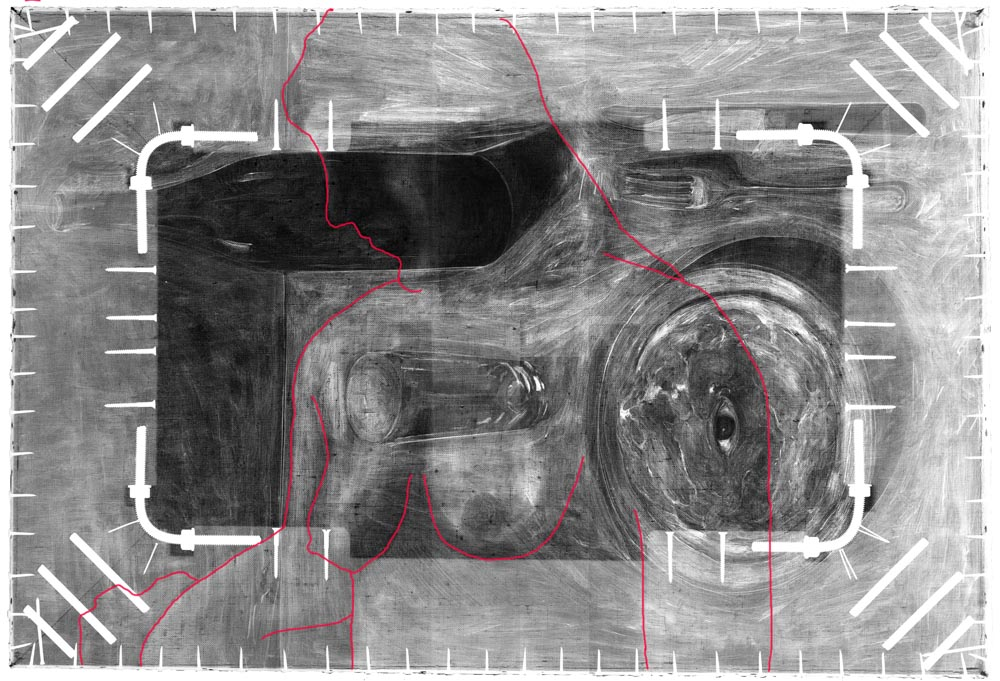
Some hidden paintings are accidental discoveries. Others feel more like detective stories. The case of René Magritte’s La Pose enchantée (The Enchanted Pose) is firmly in the second category.
For decades, art historians knew the painting existed. Created in 1927, La Pose enchantée appeared in old photographs and exhibition records before mysteriously disappearing. No one knew what had happened to it. It was one of the art world’s most intriguing missing works—a painting that seemed to have vanished without a trace.
The breakthrough came in 2016 during a routine examination of one of Magritte’s later paintings. Conservators noticed that the colors visible around the edges of the canvas did not quite match the composition on the surface. Curious, they turned to X-ray imaging. What appeared beneath was astonishing: a fragment of the long-lost La Pose enchantée.
As researchers expanded their investigation to other Magritte works, more pieces began to emerge. Eventually, they realized that the missing painting had not disappeared at all. Magritte had cut the canvas into sections and reused the pieces as supports for later artworks, effectively hiding fragments of one painting inside several others.
The discovery solved a mystery that had puzzled scholars for decades. More remarkably, it demonstrated how modern technology can recover artworks even when they no longer exist in their original form. Through X-rays and digital reconstruction, researchers were able to reunite pieces that had been separated for nearly a century.
There is something wonderfully fitting about this revelation. Magritte, after all, built his career on illusion, mystery, and the unexpected. Decades after his death, one of his greatest puzzles turned out to be hidden in plain sight, embedded within the very paintings hanging on museum walls around the world.
Did You Know?
Many artists reused canvases to save money, but Magritte’s decision to cut up an entire finished painting and recycle it into multiple works is exceptionally unusual. Without X-ray technology, the fate of La Pose enchantée might never have been solved.
8. X-Rays Revealed a Hidden Self-Portrait by Artemisia Gentileschi
Painting: Saint Catherine of Alexandria (1618–20)
Artist: Artemisia Gentileschi
X-Ray Discovery: A hidden self-portrait beneath the finished painting
Discovery Announced: 2019

Not every hidden painting changes what we know about a work of art. Sometimes, it changes what we know about the artist behind it.
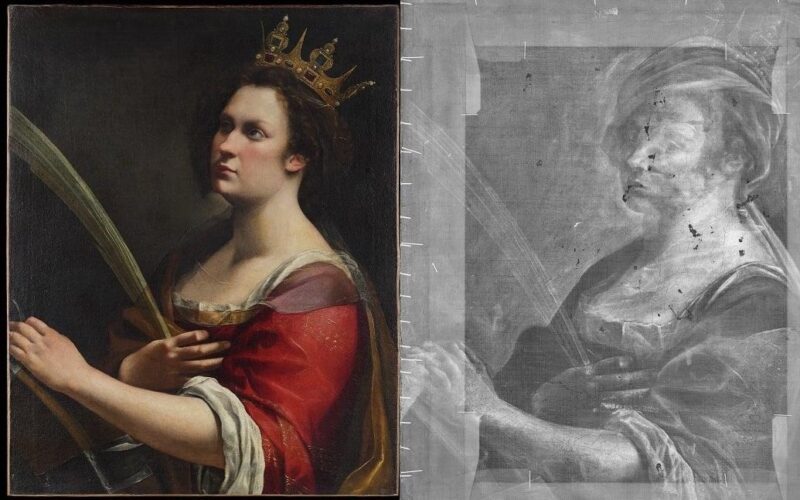
In 2019, researchers examining Artemisia Gentileschi’s Saint Catherine of Alexandria made an extraordinary discovery beneath the visible painting. X-ray imaging revealed another image hidden below the surface, a self-portrait by the artist herself. For centuries, it had remained concealed beneath layers of paint, invisible to scholars and museum visitors alike.
The hidden figure differs noticeably from the saint seen in the finished work. Rather than looking away, the woman turns directly toward the viewer. She also wears a distinctive turban, creating a more personal and intimate image than the final composition. Researchers believe the discovery sheds light on Gentileschi’s working process, suggesting that she adapted and reused preparatory designs while developing new versions of her paintings.
For art historians, the find was especially meaningful because Gentileschi occupies a unique place in art history. Working in the seventeenth century, she built a remarkable career in a field overwhelmingly dominated by men. Today, she is celebrated not only for her technical brilliance but also for creating powerful female figures who challenged conventional portrayals of women in art.
The hidden self-portrait offers something rare: a direct encounter with the artist herself. It allows us to see how Gentileschi may have inserted elements of her own identity into her work before transforming the image into something new. In a sense, the X-ray reveals a conversation between the artist and her subject, frozen beneath the paint.
More than four hundred years after it was created, the concealed portrait reminds us that paintings often preserve traces of decisions, revisions, and personal stories that never reach the final canvas. Thanks to modern technology, one of the most important women artists in history is still finding new ways to surprise us.
Did You Know?
Artemisia Gentileschi frequently used her own features as inspiration for biblical and mythological figures. As a result, scholars continue to discover fascinating connections between her self-image and the heroines she painted throughout her career.
9. Picasso Painted Over Another Artist’s Landscape, But He Couldn’t Completely Erase It
Painting: The Crouching Beggarwoman (1902)
Artist: Pablo Picasso
X-Ray Discovery: A hidden landscape believed to depict the Parc del Laberint d’Horta, possibly painted by Santiago Rusiñol
Discovery Announced: 2018
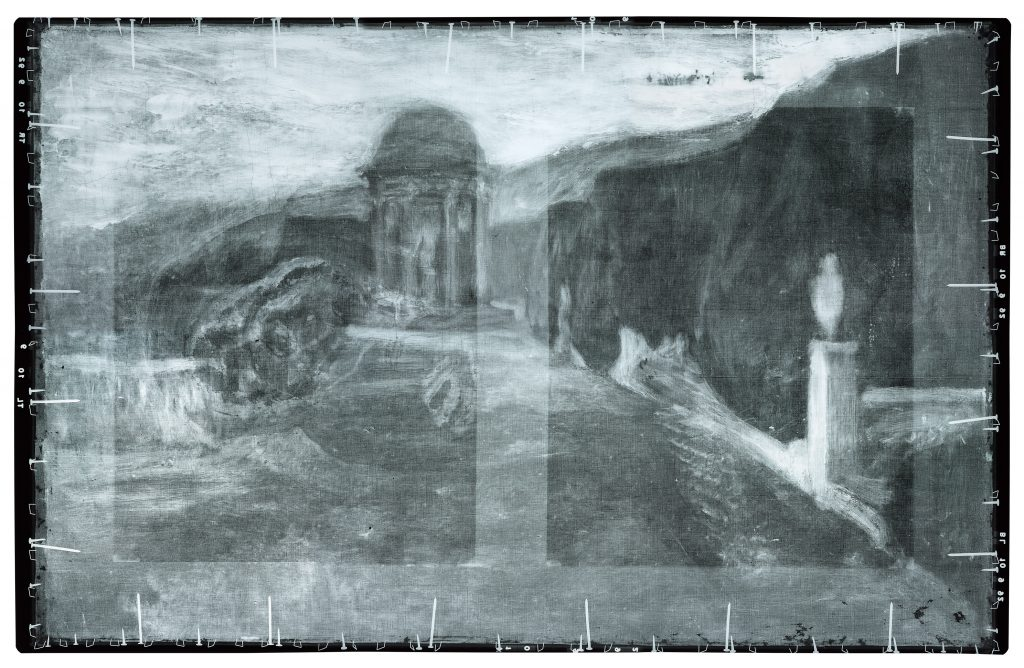
Pablo Picasso spent his career reinventing art. But one of the most fascinating discoveries about his work came not from what he painted, but from what he painted over.
In 2018, researchers studying The Crouching Beggarwoman (1902), a painting from Picasso’s celebrated Blue Period, uncovered evidence of an entirely different artwork hidden beneath the surface. X-ray imaging revealed the remains of a landscape painting, complete with rolling hills and natural scenery that had little in common with the melancholy figure occupying the canvas today.
The hidden landscape is believed to depict the Parc del Laberint d’Horta in Barcelona. While scholars cannot say with absolute certainty who painted it, many suspect it may have been the work of Santiago Rusiñol, a well-known Catalan artist whose landscapes were popular during Picasso’s youth. If true, Picasso wasn’t just reusing a canvas, he was painting directly over another artist’s completed work.
Yet despite covering the original image, Picasso may have unconsciously borrowed from it. Researchers noticed that the gentle curves of the landscape’s hills seem to echo the shape of the crouching woman’s back. It’s a subtle connection, but one that suggests the earlier painting may have influenced the composition that emerged above it.
The discovery also sheds light on Picasso’s circumstances at the time. During his Blue Period, the young artist often struggled financially and frequently reused materials. A blank canvas was a luxury, and painting over existing works was sometimes the most practical option.
What makes this hidden image so compelling is that it reveals an unexpected collaboration across time. Beneath one of Picasso’s most emotionally powerful paintings lies another artist’s vision, partially erased, yet still present. More than a century later, X-ray technology has allowed both stories to coexist once again, reminding us that art history is rarely as straightforward as it appears.
Did You Know?
Researchers first suspected there was something hidden beneath The Crouching Beggarwoman in the early 1990s after noticing unusual textures and colors peeking through cracks in the paint. It took decades of technological advances before the landscape could be properly visualized.
10. A Hidden Face Beneath a Rembrandt Took Decades to Reveal
Painting: Old Man in Military Costume (c. 1630)
Artist: Rembrandt van Rijn
X-Ray Discovery: A concealed portrait of an unidentified man beneath the visible painting
First Detected: 1968
Reconstructed Through Advanced Imaging: 2013
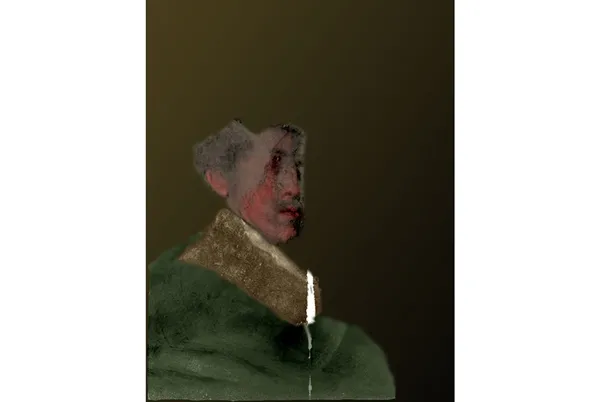
Some discoveries happen overnight. Others take generations.
For more than half a century, experts studying Rembrandt’s Old Man in Military Costume suspected that something was concealed beneath the visible painting. Early scans conducted as far back as the 1960s hinted at the presence of another image, but the technology available at the time could not provide a clear answer. The secret remained frustratingly out of reach.
The challenge was unusually complicated. Rembrandt had used similar pigments in both the visible painting and the hidden one, making it difficult for traditional X-rays to distinguish between the different layers. For decades, researchers could only see vague traces and shadows, enough to suggest another portrait existed but not enough to understand what it looked like.
As imaging technology improved, conservators finally began to piece together the mystery. By analyzing the chemical elements present in the paint, researchers reconstructed the image of a hidden male figure buried beneath the surface. Traces of mercury suggested rosy, vermilion-colored cheeks, while copper-based pigments indicated that the sitter may have been wearing a green cloak. What had once been an indistinct silhouette gradually became a recognizable portrait.
Unlike some discoveries that uncover entirely different paintings, this find highlights something equally fascinating: the patience of scientific investigation. The hidden portrait was never truly invisible, it simply took decades for technology to catch up with curiosity.
In many ways, the story mirrors the experience of art history itself. Each generation brings new tools, new questions, and new ways of seeing. What once appeared to be a finished painting is now understood as something far more complex: a layered object carrying traces of decisions, revisions, and forgotten images beneath its surface.
For Rembrandt, a master celebrated for his ability to reveal character and emotion, it seems fitting that one of his own paintings would spend centuries guarding a secret face of its own.
Did You Know?
The first indications of a hidden portrait beneath Old Man in Military Costume were detected in 1968. Yet it wasn’t until advances in imaging and pigment analysis decades later that researchers could begin visualizing the concealed sitter with any real clarity.
Every masterpiece has a visible story. Thanks to X-rays and other advanced imaging technologies, we’re discovering that many have a hidden one too. Beneath layers of paint lie abandoned compositions, forgotten portraits, lost artworks, and even clues to artists’ personal lives. What was once considered impossible, to look through a painting without damaging it, has become one of the most exciting tools in art conservation.
These discoveries remind us that art history is not fixed. With every technological breakthrough, museums and researchers gain new ways to revisit familiar works and uncover secrets that have been waiting for centuries. The next great revelation may not come from a newly found painting at all, it may already be hanging on a gallery wall, quietly keeping its story hidden beneath the brushstrokes.
Question for readers:
If you could use an X-ray to look beneath any famous painting in the world, which artwork would you choose?
If this article reminded you that some of the most fascinating discoveries come from slowing down and looking a little closer, you might also enjoy our piece, Find Beauty in Doing Nothing, which explores how embracing moments of stillness can help us reconnect with creativity, presence, and the quiet beauty often overlooked in our fast-paced lives.