
Why this artist uses hands instead of faces to express human emotion ┃Veronika Leslie

At Arts to Hearts Project, every publication we create has a purpose behind it. Our magazines, our artbooks, our awards, they all exist because we believe artists deserve spaces that take their work seriously and tell their stories with care.
Art and Woman is one of those spaces. It was born from the belief that women artists need a publication that does not just include them but centres them. Their voices, their experiences, their ways of seeing the world. We are now on our third edition and with every one the work gets more personal and more honest and more willing to sit in the quiet places.
Veronika Leslie is one of our selected artists for Art and Woman Edition 3. And honestly she made us rethink what power looks like in a drawing.
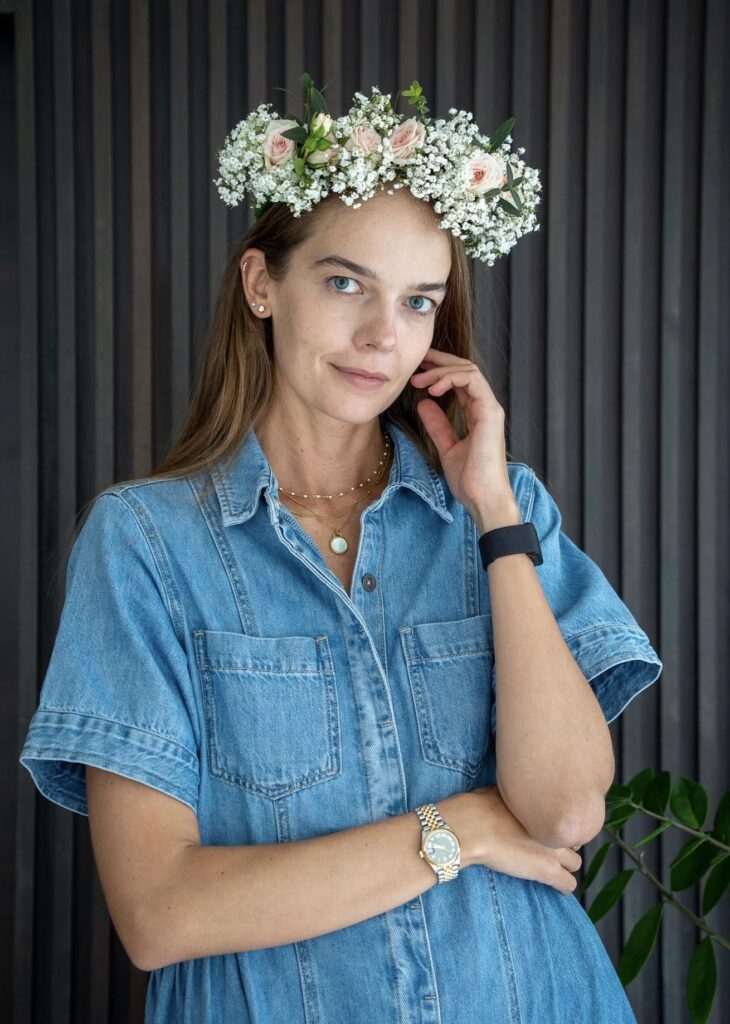
Because her work is not powerful in the way people usually mean that word about art. It is not bold or confrontational or visually intense. It is powerful the way a whisper can be powerful when everyone else in the room is shouting.
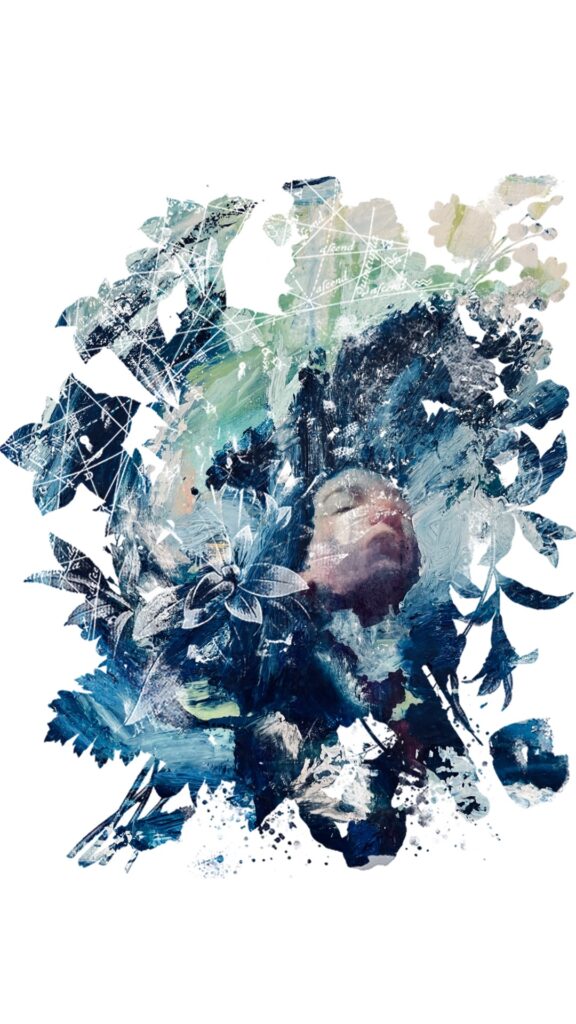
She works in charcoal and pencil. Black and white. Nothing else. And the drawings are so quiet and so still that you find yourself leaning in closer without deciding to. Your body just moves toward them.
She draws women whose faces and hands carry something you recognise from your own life even though you cannot name what it is. They are not portraits of specific people. They are portraits of feelings. Of moments. Of the kind of presence that exists between two people when one of them is paying very close attention.
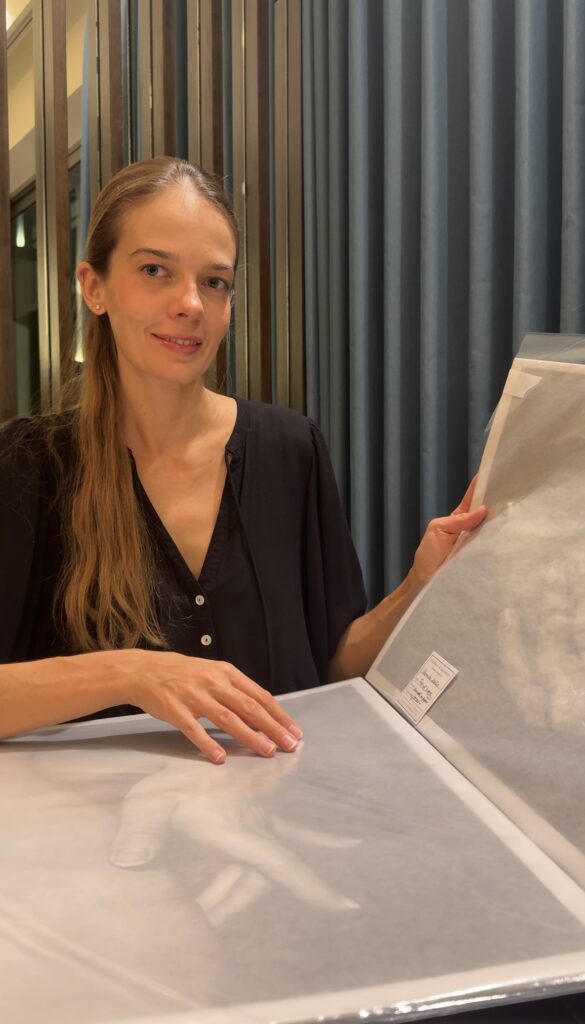
Veronika creates that feeling with nothing but charcoal on paper is something we are still thinking about. Her path to this work came through many different lives. Modelling and travelling across Europe. Then motherhood in Singapore.
Then drawing as the thing that finally slowed everything down enough for her to hear what was inside her. That journey shaped the sensitivity you feel in every mark she makes.
And the way she builds her drawings, slowly, patiently, pulling light out of darkness layer by layer, her figures look like they are emerging from somewhere very deep. Like memories you forgot you were carrying until someone drew them out of you.
Let’s get to know Veronika as we speak about her minimalist approach to art, the quiet language of hands, how travel shaped her perspective, and why portraiture is always about something beyond the individual.
Q1. Can you share your background and how your journey led you toward this emotionally driven approach to portraiture and drawing?
As a child I was trained in art school, but my artistic voice truly began to form later through life experience. Before focusing fully on art, I worked as a model and traveled across Europe and other parts of the world, constantly surrounded by creative people from different cultures and disciplines.
Those years gave me a deeper sensitivity to human emotion, presence, and the stories people carry within themselves. After becoming a mother and moving to Singapore, drawing became something much more personal for me – a way to slow down, observe, and reconnect with inner emotions that are often difficult to express in words.
Q2. You’ve spoken about the raw beauty of charcoal and pencil, what keeps drawing you back to these mediums?
Charcoal and pencil feel like the most honest mediums for me because they strip everything down to emotion, light, and presence. There is something deeply human in black and white – without the distraction of color, the focus shifts entirely to feeling, gesture, and atmosphere.
I’m especially drawn to the way charcoal allows forms to slowly emerge from darkness, almost like memories surfacing into light. My works often feel to me like old photographs: intimate, nostalgic, imperfect, yet emotionally powerful. I want to capture something felt but difficult to explain in words, and charcoal or pencil helps me with that more than other mediums.
Q3. Your series is called “Whispers of Life” a meditation on growth, unity, and letting go. What inspired that series?
This series was inspired by my own live transformations and experiences. It grew from a desire to express those inner experiences visually rather than verbally.
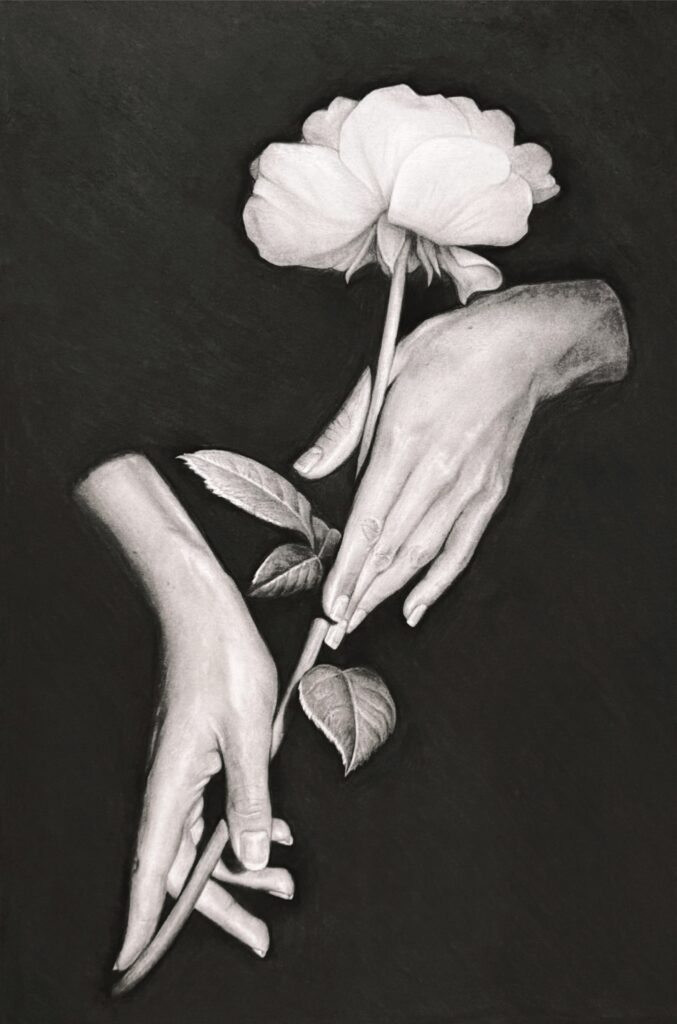
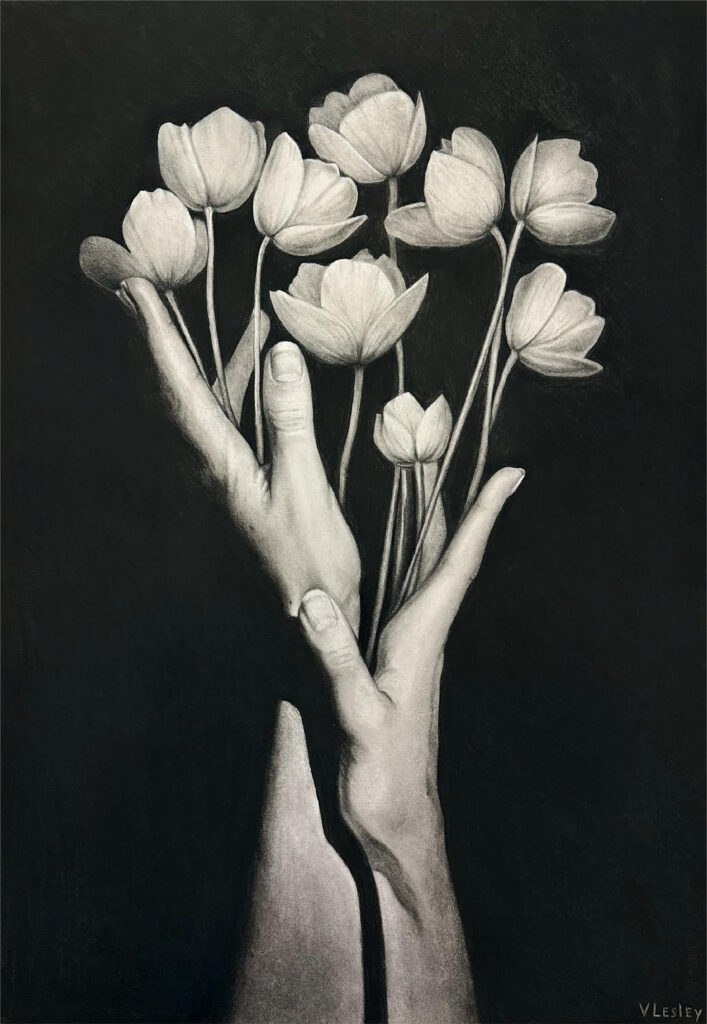
I use symbolism such as hands, flowers, fabric, and subtle gestures to represent themes of connection, vulnerability, healing, letting go, and becoming. Each work is intentionally open emotionally, so viewers can bring their own memories and feelings into it.
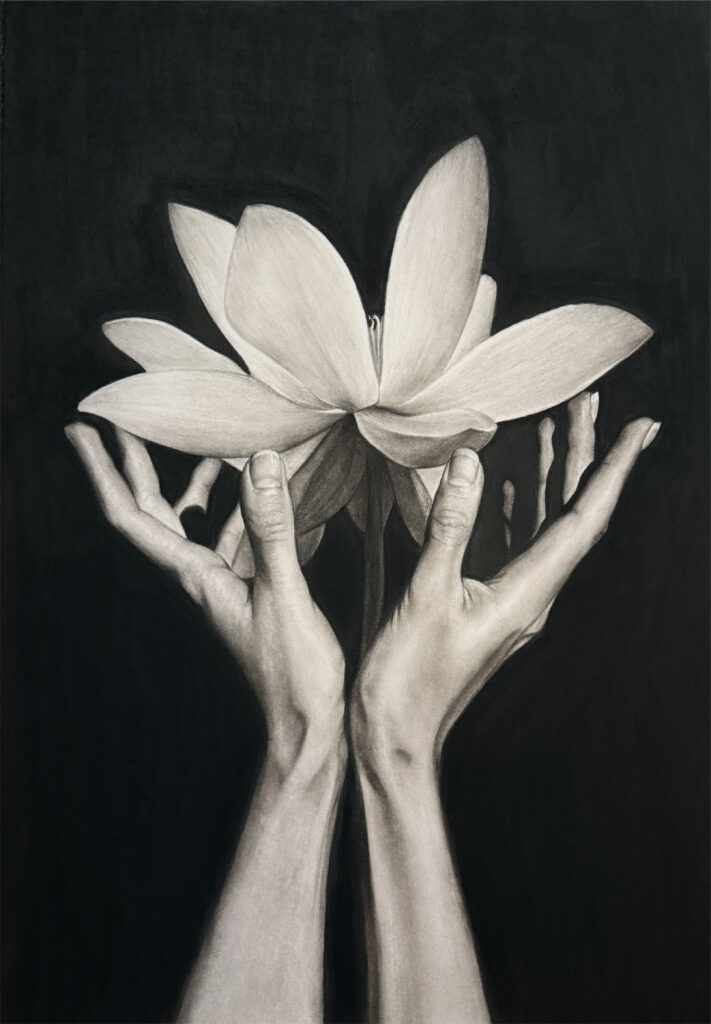
Q4. You describe hands as the body’s most expressive instrument, what can they reveal that faces cannot?
I think a face can perform or hide feelings, but hands tend to hold tension, tenderness, hesitation, longing, or care almost unconsciously. A small gesture the way fingers touch fabric, hold a flower, or reach toward another person can communicate intimacy and vulnerability without needing words or even direct eye contact.
Q5. Your work is highly realistic yet deeply atmospheric how do you balance technical precision with emotional depth?
For me, realism is not the final goal but a tool to create feelings. Precision helps me slow down and observe, but I try not to let technique overpower feeling. I often leave parts softened, obscured, or emerging from darkness because emotion lives in what is suggested, not only in what is fully revealed.
The atmosphere comes as much from light, silence, and the space around the subject as from the details themselves.
Q6. Charcoal can feel both delicate and unforgiving how do you approach layering and texture within your drawings?
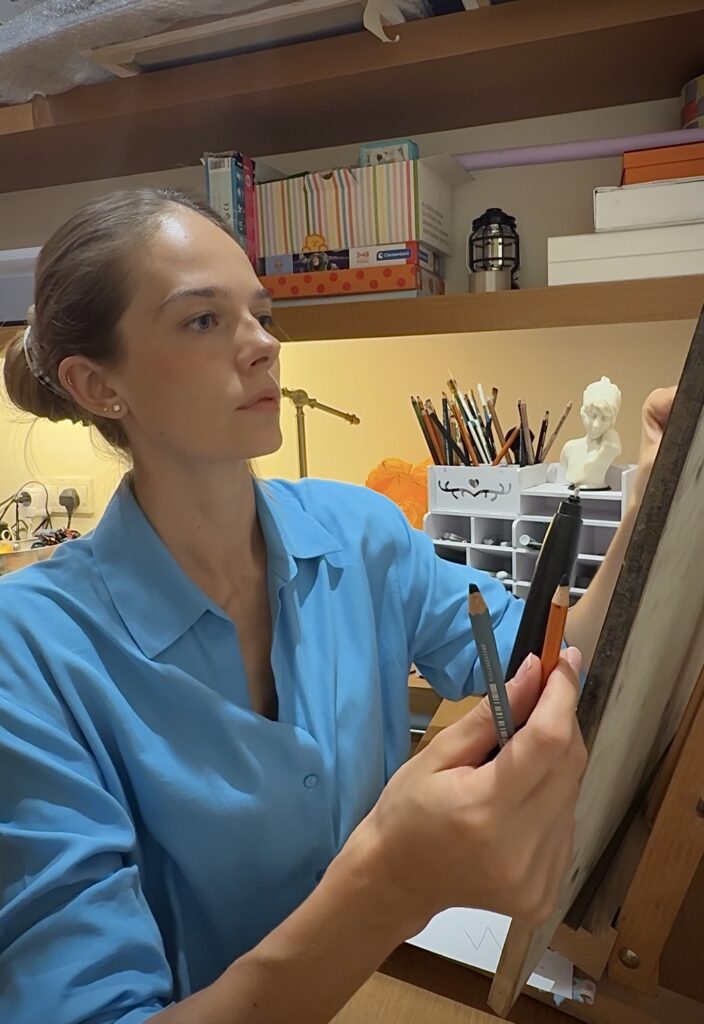
I approach charcoal slowly and patiently, building many subtle layers rather than forcing contrast too quickly. Especially my dark backgrounds can be sometimes difficult. I’m interested in textures that feel almost breathable — soft skin, fabric, hair, shadows dissolving into darkness.
Charcoal has a fragile quality that I actually embrace because it mirrors the emotional vulnerability I want the work to carry. I use erasure as much as drawing, allowing light to emerge gradually from the surface rather than simply placing it there.
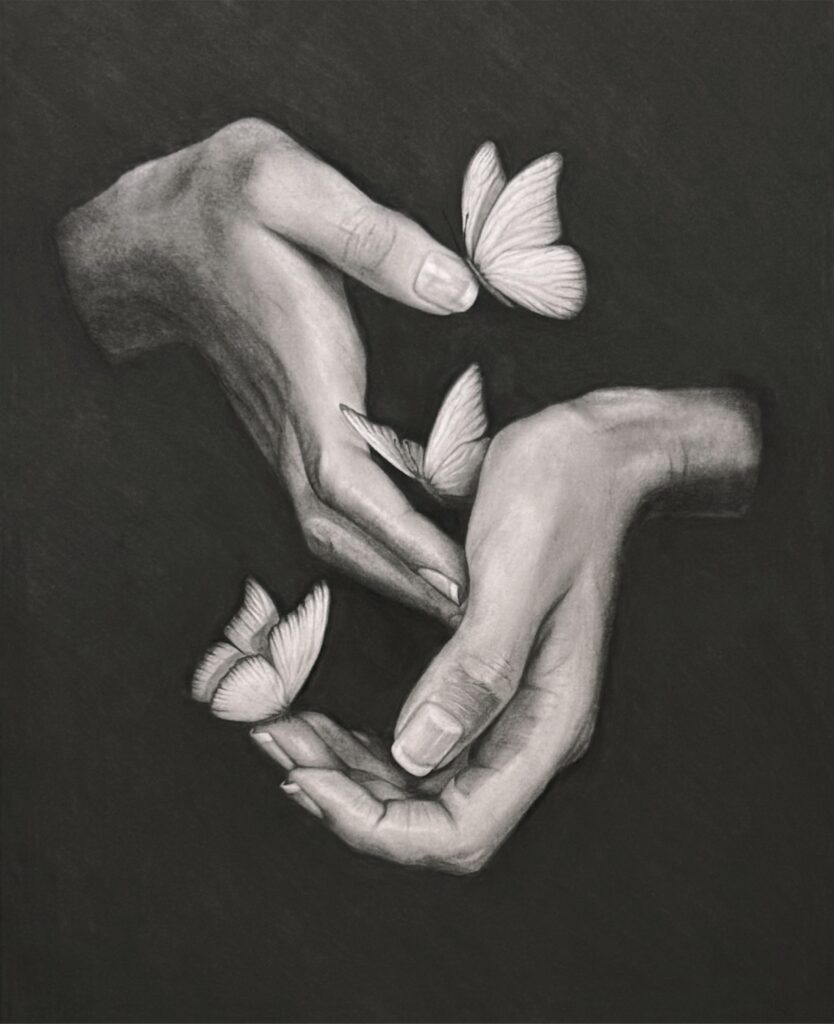
Q7. When someone experiences your work, do you hope they connect more with the subject itself or with the emotion the portrait creates?
I hope they connect first with the feeling. The figures in my drawings are personal, but I want the emotional atmosphere to remain open enough that viewers can see part of themselves in it. I’m less interested in describing a specific person than in creating a quiet moment of recognition — something intimate, familiar, or emotionally unresolved that stays with the viewer after they leave the work.
Q8. In a contemporary art world, what does drawing still offer you as a form of expression?
In a fast digital world, charcoal drawing feels almost like a form of quiet resistance — it requires patience, observation, and physical connection with the surface. Every mark records time, pressure, and movement in a way that feels deeply human to me. It allows me to create spaces of stillness where emotion can unfold gradually rather than instantly.
Q9. Portraiture can feel deeply personal for both artist and subject, does that sense of vulnerability shape the way you work?
In my work, yes, it does influence. I do not make, let’s say, classic portraits; they are always somewhat different from what people usually imagine when they say the word “portrait”. My mother always said to be careful when drawing someone’s portrait, as you can take someone’s soul.
Of course, it’s a way of saying, so I picture in my work not one person but rather a multitude created in one, so you don’t feel that you look at a portrait of some person on the wall by a story, and this story can be yours.
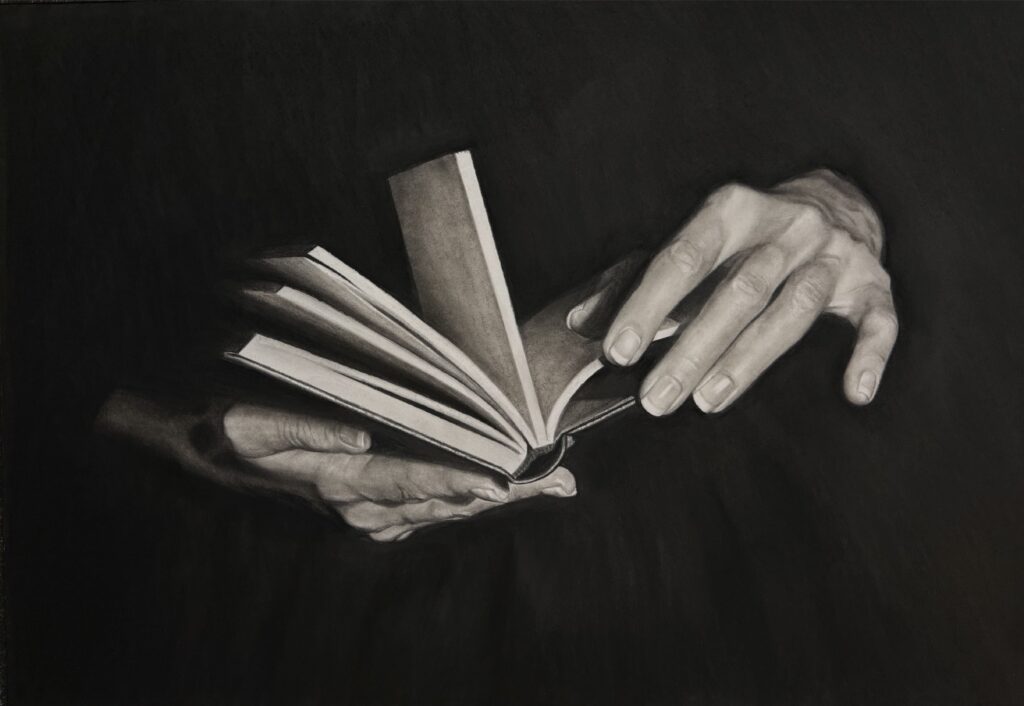
Q10. Each title is evocative: “Gentle gift,” “Silent bloom,” “Between The Lines,” “Unwritten story.” Where do these phrases come from?
Because my works don’t have direct meaning but rather symbolism or hidden text, for example, a flower is not a flower but a symbol of strength or care, a book – a life story that we hold in our souls. I choose titles that briefly express the first feeling of the drawing, so the viewer can create and reflect on their own story.
Q11. Looking back at your earlier work, how has your relationship with drawing and portraiture evolved over time?
In my earlier career, I was using a lot of color and movement. I was practicing more nature drawings, and portraits were for my study works. But later, I found incredible power in figurative drawing.
Movement, strength, power, or quiet, soft feeling – all of them could be expressed through this type of drawing. And ever since that time, I have continued to evolve in my approach to capturing fleeting moments through portraiture and figurative art.
Q12. What advice would you give to artists who want to pursue realistic drawing while still creating work that feels emotionally alive?
I want to suggest being as true to yourself as possible. The learning curve can be difficult, and you may feel all over the place. That’s why you should always ask yourself whether what you do resonates with the message you want to send to the viewer.
It should not be just a clean picture with nice edges and bright light, but emotions and feelings that find their home on the paper.
As our conversation with Veronika came to a close, the thing that stayed with us had nothing to do with charcoal or technique or how she builds her surfaces. It was simpler than that. It was about what happens when someone chooses quiet in a world that does not reward it.
Because we live surrounded by noise. Loud art, loud opinions, loud colours, loud everything. And most of us have gotten so used to it that we have forgotten what it feels like to just be still with something. To look without analysing. To feel something without immediately needing to post about it or explain it or turn it into a take.
We have lost the muscle for sitting with things quietly and letting them land on their own time. Veronika’s work gave us that back for a few minutes. And honestly that felt like a gift we did not know we needed.
Something else came up for us too while we were thinking about this conversation. About generosity in art. Because there is a version of being an artist where you control everything. You decide what the viewer sees and feels and understands. You build the meaning in and you make sure nobody misses it.
And that is valid. But there is another version where you build something with incredible care and patience and attention and then you step back and say I am not going to tell you what this is. You tell me. Bring whatever you are carrying today and the drawing will hold it for you.
That is what Veronika does. And that takes more courage than most people realise because it means accepting that your work will mean something different to every person who stands in front of it and being completely okay with that.
And honestly we just really admire what she has done with her practice. In a world full of colour and saturation and visual noise, she walked the other direction and committed fully to black and white. That is not playing it safe. That is one of the boldest things an artist can do right now. Because when you strip away colour you strip away the safety net.
There is nothing to hide behind. No vibrant palette to carry a weak drawing. No saturation to distract from a lack of depth. It is just her and the charcoal and whatever truth she is willing to put down. And the fact that her drawings hold as much feeling and presence and emotional weight as they do with nothing but light and shadow tells you everything about who she is as an artist. She does not need more. She never did.
For anyone thinking about bringing Veronika’s drawings into their home, these pieces do something to a room that is hard to describe until you experience it. They settle things. Whatever energy is bouncing around that space, her drawings quietly absorb it and give back something calmer.
You will find yourself looking at them on mornings you did not plan to and feeling something shift in you that you cannot quite name. And that feeling will be different every time because the drawings are open enough to meet you wherever you are. That is the kind of art that does not just hang on a wall. It lives there. And it earns its place a little more every day.
Follow Veronika Leslie through the links below and spend time with drawings that prove the quietest thing in the room is usually the one you cannot stop looking at.