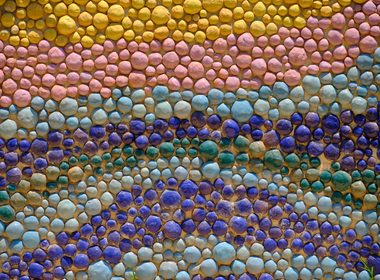
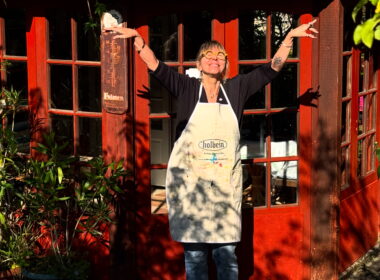

This artist combines ancient mosaic technique with delicate butterfly wings | Liudmila Evgeneva

At Arts to Hearts Project, after eleven editions of our magazine we thought we had a pretty good sense of what to expect from a new issue. Then we chose the theme This Is Me for Issue 12 and everything that came back surprised us. It is not asking artists to be impressive or conceptual or clever. It is asking them to be themselves. And what came back was some of the most personal honest work we have ever received.
Liudmila Evgeneva is one of our selected artists for this issue. And we have to tell you, her work made us stop in a way that does not happen often.
So let us tell you about Liudmila. She is a monumental artist by training. That means she learned to build work that goes inside buildings and survives there for centuries. Religious commissions. Cultural projects.
The kind of art that has to hold up against time and architecture and the weight of being looked at by people who have not even been born yet. That is where her mind was shaped. In permanence. In structure. In thinking about how something endures.
And then she started making art from butterfly wings. We know. We had the same reaction. She collects them only after the butterfly’s natural life has ended. She developed her own preservation process from scratch, multiple stages, disinfection, cryo-treatment, careful conservation.
She named it milleali. A thousand wings. And she lays them into her work the way a mosaicist lays stone. Fragment by fragment. Except these fragments do not behave like stone. They are so delicate that one wrong movement destroys them completely. There is no fixing it. Every placement has to be right the first time.
Her entire practice lives inside the tension between those two things. A mind trained for permanence working with a material that could disappear if you breathe on it too hard. She does not try to make that tension comfortable. She lets it be exactly what it is. And what comes out of it is work that none of us had ever seen before.
Her surfaces change with the light. The wings shift colour depending on the angle and the time of day. What you see in the morning is genuinely not what you see in the evening. The work keeps moving after she is done with it. It responds to the room it is in. It is alive in a way that we are still thinking about weeks later.
Let’s get to know Liudmila through our conversation with her about what it means to think in centuries and work in fragments, why she chose the most fragile material she could find, and why she believes art stops mattering the moment it becomes completely clear.
Q1. Could you share a bit about your background and how you would describe yourself as an artist to someone discovering your work for the first time?
My background is shaped by a rigorous academic background and experience working with a space in which the image is not private but exists in shared time. I came to art not through a search for style, but through the need to construct a form for that which defies simplification.
I would describe myself as an artist who works with remnants—with what remains after transformation. The world of my work is a space where fragility is not opposed to strength, but becomes its condition. It is not a world of images, but a world of states: tense, unresolved, yet held.
Q2. You are trained as a monumental artist which includes large-scale religious and cultural projects, how has that foundation shaped your creative language today?
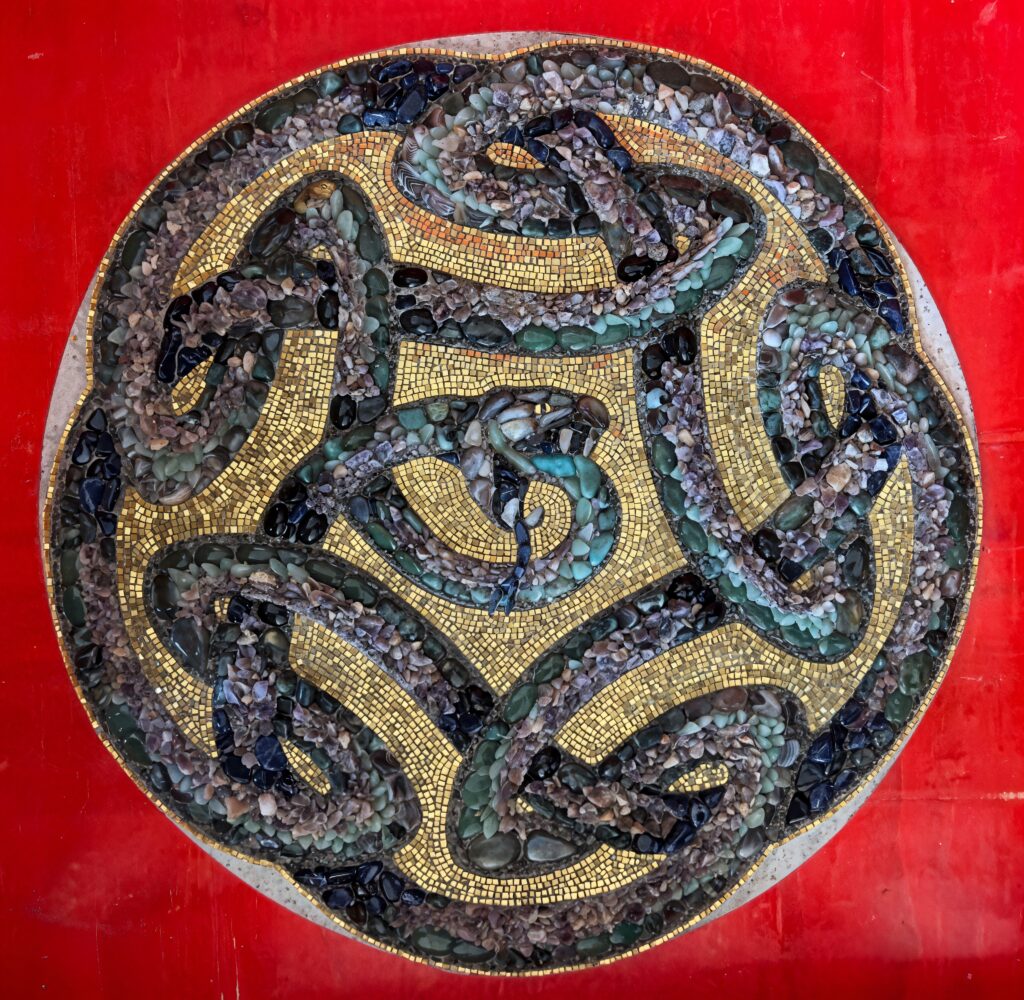
Monumental practice taught me to think not in terms of images, but in terms of structure. What matters here is not gesture, but duration; not effect, but the work’s ability to exist within architecture and time.
Even when I moved to more intimate formats, I didn’t abandon this mindset. The scale changed, but the principle remained: the work must withstand pressure—space, time, gaze. My language became more condensed, but no less demanding. I transferred the logic of monumentality to the form.
Q3. Mosaic is such a permanent and labour-intensive medium, yet your work often speaks about fragility, how do you bring those two ideas together?
I’m interested not in synthesis, but in the tension between these states. Mosaic is a language initially oriented toward duration, toward the survival of centuries. The butterfly wing is the material of extreme finitude.
I don’t try to reconcile them. I maintain their incompatibility. Permanence here doesn’t protect fragility, but makes it more visible. Fragility, in turn, undermines the idea of eternity. The work emerges from this conflict—as a form that doesn’t resolve the contradiction, but rather captures it.
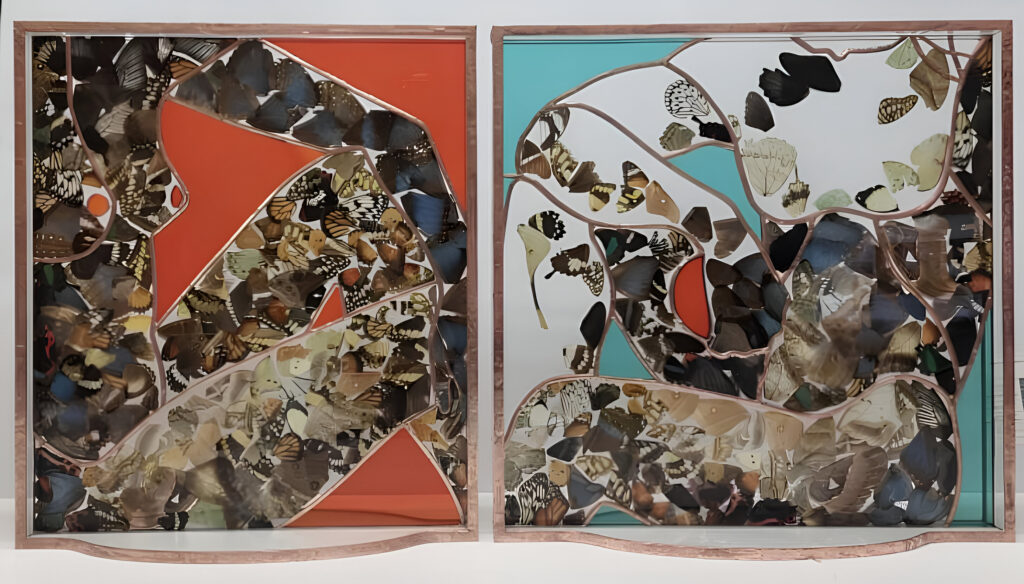
Q4. You describe butterfly wings as a kind of minimalist alphabet, how do you physically and technically translate something so fragile into mosaic or monumental work?
I work with wings collected after their life cycle has ended and have developed my own multi-stage method for conservation that allows them to be used as a painting material. It all begins with disinfection and cryotreatment, followed by several stages of direct preservation, which allow the wing to retain its pristine beauty for many years.
I called this technique “milleali“ (“thousand wings“). The further process is technically close to mosaic: it’s a sequential, almost meditative arrangement of fragments. But unlike stone, a wing doesn’t obey—it demands extreme precision.
Any pressure can destroy it. Visually, this isn’t an image of a wing, but a field of wings. A surface that vibrates between presence and disappearance. The material remains recognizable, but loses its illustrative quality and becomes structure.
Q5. You’ve said your images don’t describe the world but explore it, what’s the difference between those two approaches for you?
A painting that describes is complete the moment it is read. It conveys, records, explains. A painting that explores doesn’t provide an answer. It creates conditions in which the gaze becomes a participant in the process. In it, meaning is not predetermined, but emerges through prolonged interaction.
For me, it’s important not so much about depicting the world as it is about testing its boundaries: where it disintegrates, where it resists, where it endures.
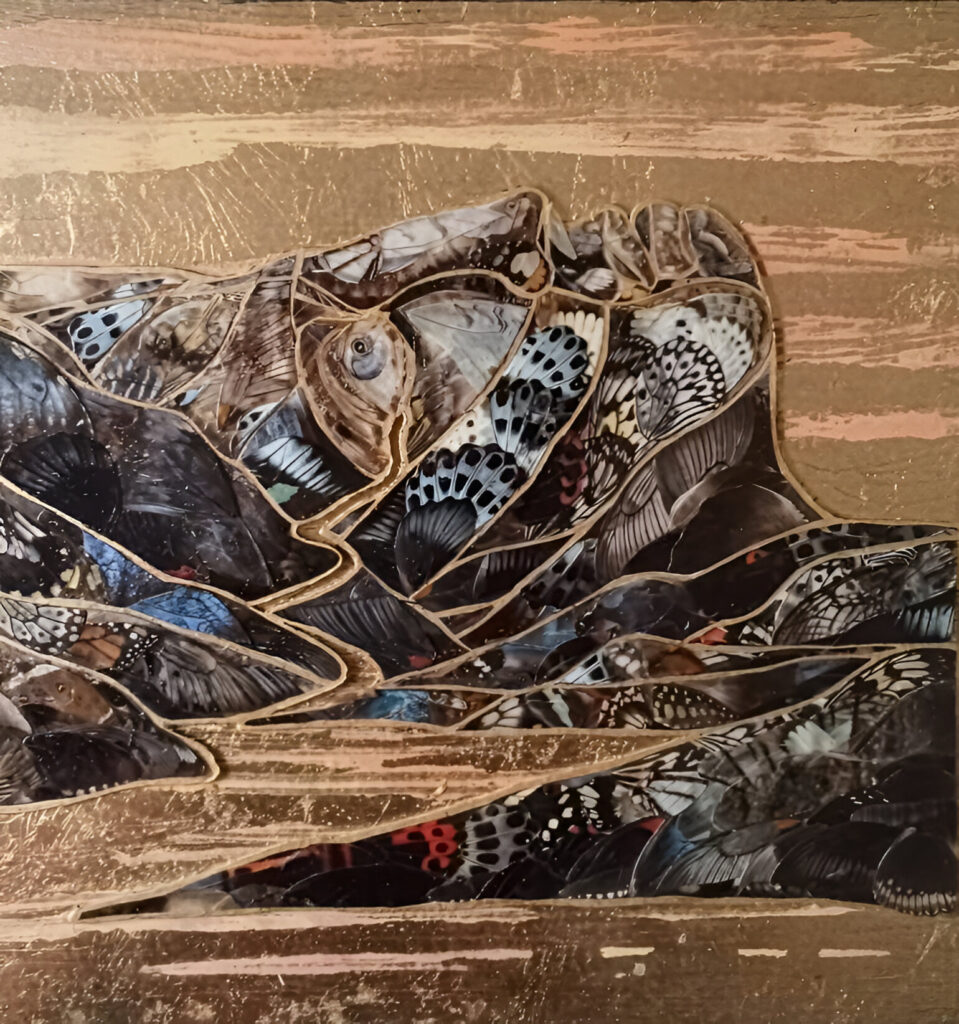
Q6. Your works feel like they emerge through accumulation and layering, can you walk us through how a piece develops?
The work is built through accumulation. No single gesture determines the result. There is repetition, adjustment, rejection, and return. Each element is insignificant in itself, but within the structure it becomes irreversible. Moreover, the optical properties of wiring surfaces are such that their color changes with the slightest change in lighting or angle.
This further creates the effect of a living, breathing work. The process requires not only a decision but also endurance—the ability to remain within the work when it is not yet fully formed. Form emerges not as an idea, but as a result of prolonged interaction with the material.
Q7. When someone lives with one of your commissioned pieces, what do you hope the image quietly leaves with them over time?
I don’t expect an immediate reaction. I’m interested in a slow impact. So that the image isn’t immediately noticed, but gradually becomes part of a person’s inner space. So that it doesn’t have to be explained, but rather accompanies.
If the work begins to change the rhythm of perception—slows the gaze, makes attention more precise—that’s enough. Art shouldn’t intrude. It should remain and act from within.
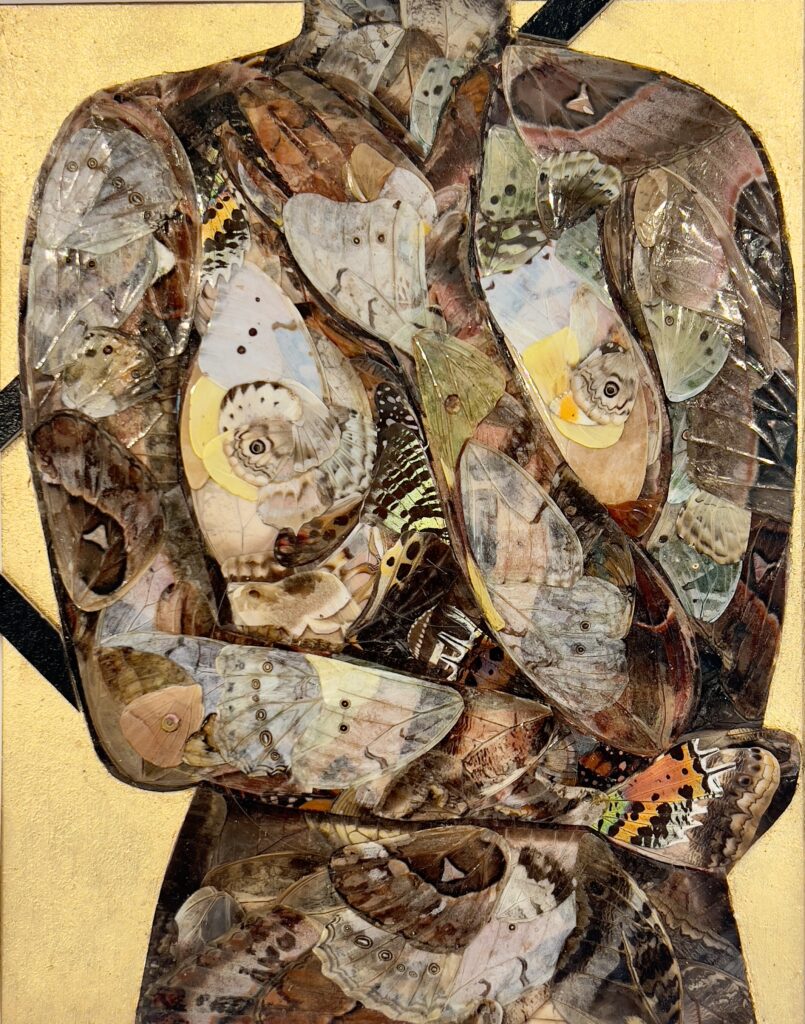
Q8. In a world that often seeks clarity and resolution, how important is it for art to remain open, ambiguous, and even uncomfortable?
Art loses its necessity the moment it becomes completely clear. Openness and ambiguity are not stylistic choices, but rather a condition of thought. If a work doesn’t allow for tension, it ceases to be a field of exploration.
Discomfort is important because it disrupts habitual structures of perception. It prevents the quick appropriation of an image. Therefore, it preserves the possibility of authentic experience.
Q9. What advice would you give to artists who want to explore deeper philosophical or conceptual territories in their work?
Don’t seek complexity—seek precision. Working with philosophical themes requires discipline, not abstraction. You must deeply master the language you work with to understand where it begins to falter. An artist must constantly think, explore, and develop, transcending the confines of a narrow professional sphere.
It’s important not only to perfect technique but also to educate themselves in wide range of fields – from philosophy and history to science and contemporary culture. True art is born where the artist’s personality is formed and imbued with inner meaning.
Only by finding their own voice, grounded in experience, knowledge, and inner honesty, can an artist begin to speak truly convincingly. And most importantly, they must actually have something to say. At the same time, it’s important to maintain a clear understanding: no matter how much you learn, you still remain in a state of ignorance.
This is not a weakness, but a source of forward movement. It is from this state that true research is born – though constant experimentation, doubt, and search. True work begins where ready-made answers disappear and where the artist finds themselves alone with the unknown, transforming it into form, image, and meaning.
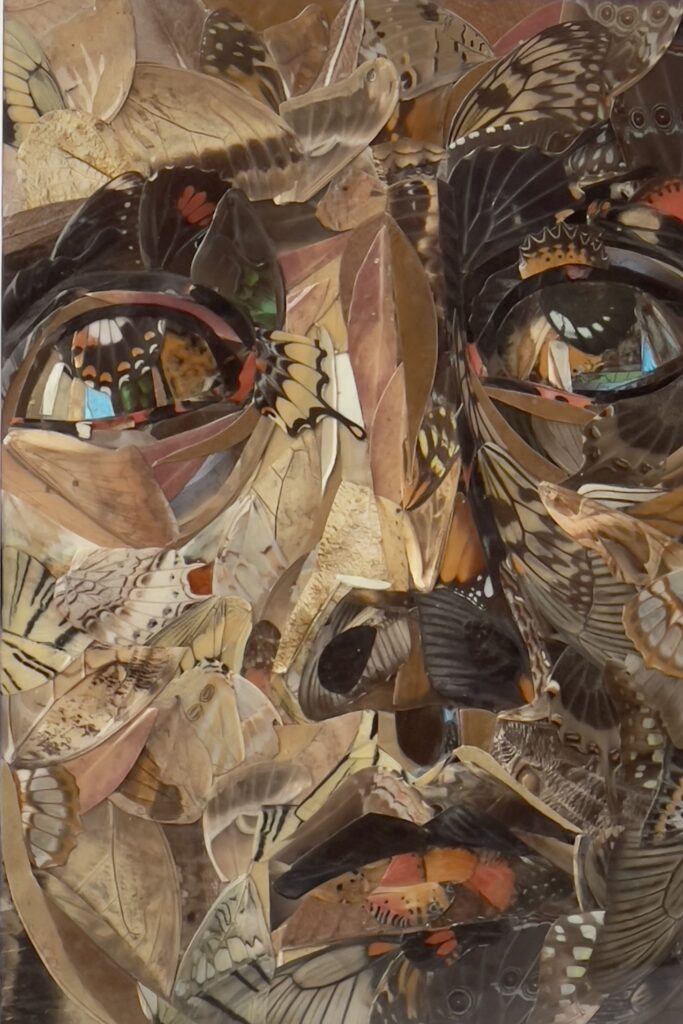
As our conversation with Liudmila came to a close, we just sat there for a bit. Not processing anything complicated. Just letting what she shared settle in.
Because talking to Liudmila makes you think about things you do not normally think about. What it means to hold something fragile without breaking it. What happens when you stop trying to resolve contradictions and just let them exist.
What kind of patience it takes to work with a material that could be destroyed by your own breath and choose to show up and do it again the next day and the day after that.
We think a lot of us could learn from that. How much of our lives do we spend rushing past the small fragile things because they do not seem important enough? Liudmila has built her whole practice on the belief that those small fragile things might be the most powerful things in the room. And her work keeps proving her right.
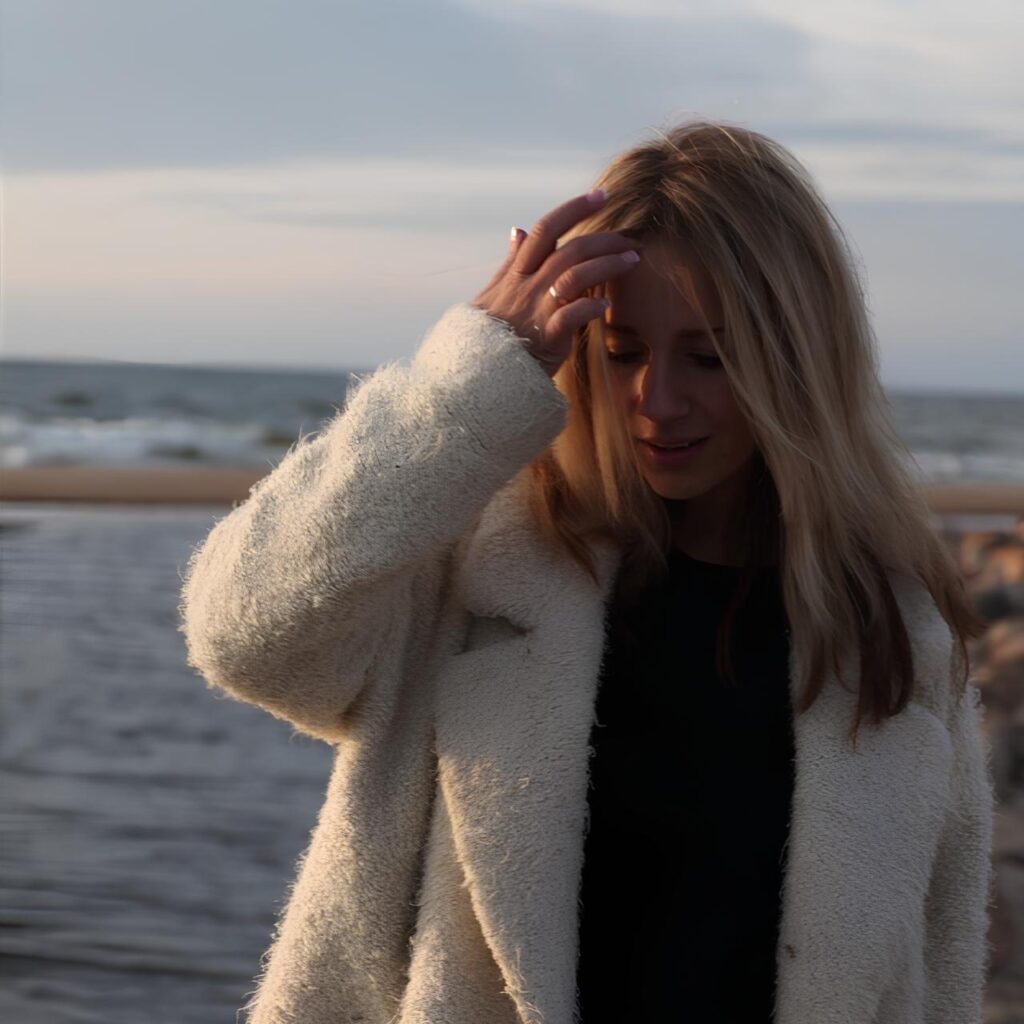
And there is something about what she does with these wings that stays with you on a human level. She takes something that has finished its life, something that would otherwise disappear into nothing, and she gives it a new existence inside something permanent. She does not bring it back to life.
She just holds it carefully and lets it be beautiful in a completely new way. We keep thinking about that as a metaphor for how we carry the things and people and moments that are gone but still matter to us.
For anyone thinking about collecting Liudmila’s work, you are bringing something genuinely alive into your space. Her surfaces shift with the light and the time of day so you are never seeing the same piece twice.
Her technique is entirely her own invention and cannot be replicated. And the depth behind every piece means it will still be showing you something new years from now. That is the kind of work worth having.
Follow Liudmila Evgeneva through the links below and spend time with someone who proves that the most fragile thing in the room can also be the most permanent.