


How Witchcraft Became One of Art History’s Darkest Fascinations
Few figures in art history have undergone as many transformations as the witch. Across centuries of European art, she has appeared as a servant of the devil, a seductive threat, a mythological enchantress, a social outcast, and eventually a symbol of feminine power and resistance. Yet these shifting images were rarely just about magic. More often, they reflected the fears, anxieties, and cultural obsessions of the societies that created them.
The history of witches in art is deeply tied to the history of control, particularly the control of women’s bodies, knowledge, sexuality, and independence. During periods of religious unrest, political instability, disease, and social change, accusations of witchcraft became a way to explain uncertainty and assign blame. Artists absorbed these fears into visual culture, creating images that both reinforced and complicated public perceptions of witchcraft. Some portrayed witches as monstrous and dangerous figures aligned with chaos and sin, while others approached them with fascination, sympathy, or even admiration.
Over time, the witch evolved from a figure of collective panic into something far more layered and symbolic. Renaissance artists used witchcraft to visualize anxieties around temptation and moral disorder, while later Romantic and Pre-Raphaelite painters became captivated by the mystery, intelligence, and emotional depth associated with magical women from folklore and mythology. By the 19th and 20th centuries, the witch increasingly emerged as a figure connected to autonomy, spirituality, and rebellion against restrictive social norms.
Tracing the witch through art history therefore reveals far more than changing artistic styles. It exposes how societies have historically imagined power, fear, femininity, and the unknown. From medieval manuscripts and Renaissance engravings to haunting Romantic paintings and feminist reinterpretations, the witch has remained one of art’s most enduring and revealing symbols.
The Birth of the Witch in Western Art
Ladies’ Champion – Martin Le France
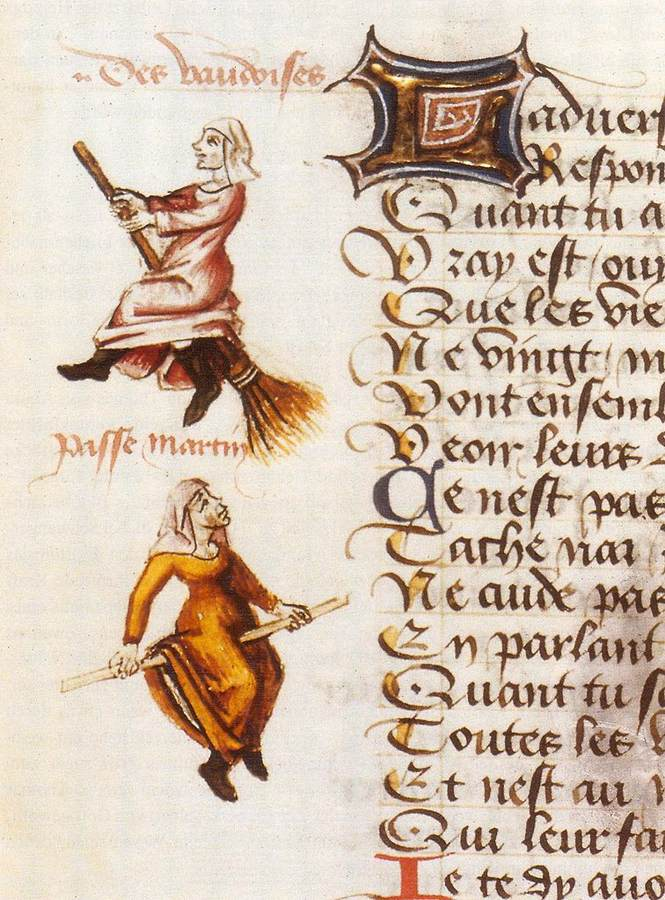
Long before the witch became one of Western art’s most recognizable figures, she existed in folklore, religious paranoia, and whispered superstition. One of the earliest known visual depictions of witches in European art appears in Ladies’ Champion, a 15th-century manuscript by French writer Martin Le France. The illumination shows two women flying through the night sky on sticks and broom-like objects, imagery that would later become inseparable from popular representations of witchcraft.
Created in 1451, the artwork predates the height of the European witch trials, making it especially significant. At this stage, the visual language surrounding witches had not yet fully solidified into the grotesque imagery that would dominate later centuries. Instead, the scene reflects a transitional moment in European thought, when superstition, religion, and fear of the supernatural were becoming increasingly entangled. The flying figures appear almost folkloric rather than monstrous, revealing how early depictions of witches emerged from a mixture of oral storytelling, rural beliefs, and religious anxiety.
The timing of the image is equally important. During the late medieval period, Europe was undergoing profound instability marked by plague, famine, political unrest, and religious upheaval. In moments of collective uncertainty, societies often searched for visible enemies to explain invisible fears. Women, particularly those who existed outside accepted social structures, became easy targets. Midwives, widows, healers, and older women were frequently associated with supernatural practices, not necessarily because of evidence, but because they occupied ambiguous positions within society.
What makes Ladies’ Champion so compelling today is how familiar its imagery still feels. The broomstick, the nocturnal flight, and the idea of women gathering in secret would become recurring motifs across centuries of European art and literature. The image captures the beginning of a visual tradition that transformed the witch into both a cultural obsession and a social warning. Even in its earliest form, the witch was never simply a magical figure, she was already becoming a symbol shaped by fear, gender, and power.
Beauty, Temptation, and Fear
The Four Witches – Albrecht Dürer
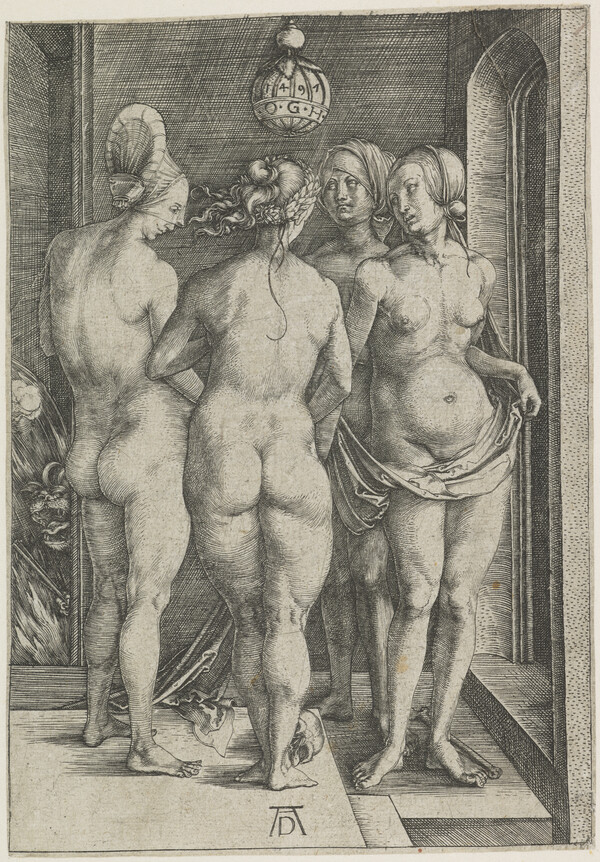
By the end of the 15th century, the image of the witch in European art had begun to change dramatically. Fear surrounding witchcraft was intensifying across the continent, fueled by religious extremism, superstition, and the growing circulation of texts that linked women to sin and demonic influence. In this atmosphere of paranoia, German Renaissance artist Albrecht Dürer created The Four Witches, an engraving that remains one of the most debated depictions of witchcraft in art history.
At first glance, the work appears almost classical in its beauty. Four nude women stand gathered in an interior space, their poses echoing the graceful arrangements of figures from Greco-Roman art. But beneath this elegance lies something more unsettling. A skull and bones rest near their feet, while a small demonic figure emerges from the shadows in the background. These details transform the scene from a study of the female body into an image charged with suspicion and moral anxiety.
What made the engraving particularly provocative for its time was its refusal to portray witches as visibly monstrous. Earlier medieval traditions often associated evil with physical deformity or age, but Dürer presented his women as youthful and attractive. In doing so, he reflected one of the central fears driving early modern witch hunts: the belief that danger could disguise itself behind beauty, seduction, and femininity. The engraving warns viewers not simply about witchcraft, but about the perceived unpredictability of women themselves.
The work also reveals how closely ideas of witchcraft became tied to the policing of female sexuality. During this period, independent women, widows, healers, and those who existed outside conventional domestic roles were increasingly viewed with suspicion. Beauty itself could be interpreted as manipulation or temptation, especially within deeply religious societies anxious about morality and social order.
Rather than depicting a supernatural event, Dürer constructed a psychological image shaped by cultural fear. The Four Witches reflects a society beginning to project its insecurities onto women’s bodies, turning femininity into both spectacle and threat. In many ways, the engraving marks the moment when the witch evolved from a folkloric figure into a deeply politicized symbol within Western visual culture.
Witches and the Collapse of Natural Order
The Witch – Albrecht Dürer
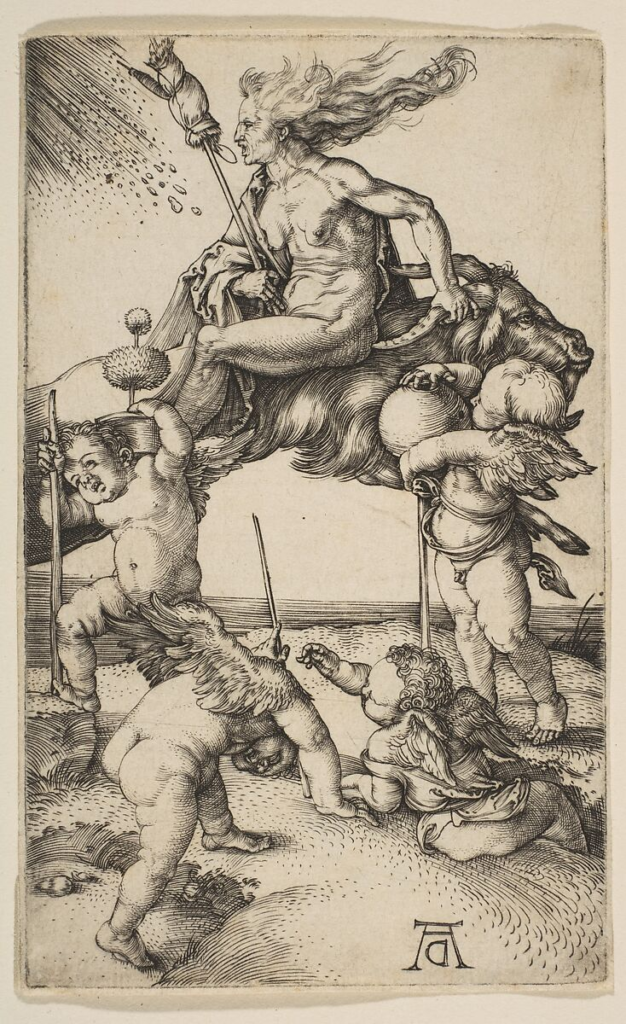
Just a few years after The Four Witches, Albrecht Dürer returned to the subject of witchcraft in an engraving that feels even more overtly symbolic and unsettling. In The Witch, created around 1500, a nude female figure rides backward on a goat while strange putti-like figures swirl beneath her. At first glance, the composition appears chaotic and almost theatrical, but every element within the scene carries cultural meaning tied to early European fears surrounding witchcraft and the supernatural.
The most striking detail is the goat. Across medieval and Renaissance Europe, goats were frequently associated with the devil, lust, and moral corruption. By placing the woman atop the animal, and positioning her backward rather than forward, Dürer creates an image of inversion, a visual disruption of the natural order. Even her flowing hair appears to move unnaturally against the direction of motion, reinforcing the belief that witches possessed the power to distort reality itself. During this period, witchcraft was often imagined not simply as magic, but as an active rebellion against divine and social order.
The smaller figures beneath the witch add another layer of symbolism. They carry objects associated with alchemy, herbal medicine, and folk rituals, practices that increasingly became linked with suspicion during the rise of witch hysteria across Europe. Knowledge that existed outside church authority was often treated as dangerous, particularly when associated with women. Herbal healers, midwives, and women practicing forms of traditional medicine could quickly become targets of accusation.
Unlike later Romantic depictions of witches as mysterious or alluring, Dürer’s image is intentionally uncomfortable. The figure does not embody elegance or empowerment. Instead, she reflects the anxieties of a society deeply fearful of disorder, temptation, and female autonomy. The witch here becomes a warning, a visual embodiment of chaos threatening both religion and patriarchy.
What makes the engraving historically significant is how clearly it helped establish the visual vocabulary of witchcraft that would continue for centuries. The goat, the broomstick imagery, nudity, supernatural motion, and association with forbidden knowledge would all become recurring motifs in European art. Through works like this, the witch evolved into a symbolic figure onto whom societies projected their deepest fears about morality, gender, and power.
Panic, Ritual, and Mass Hysteria
The Witches – Hans Baldung
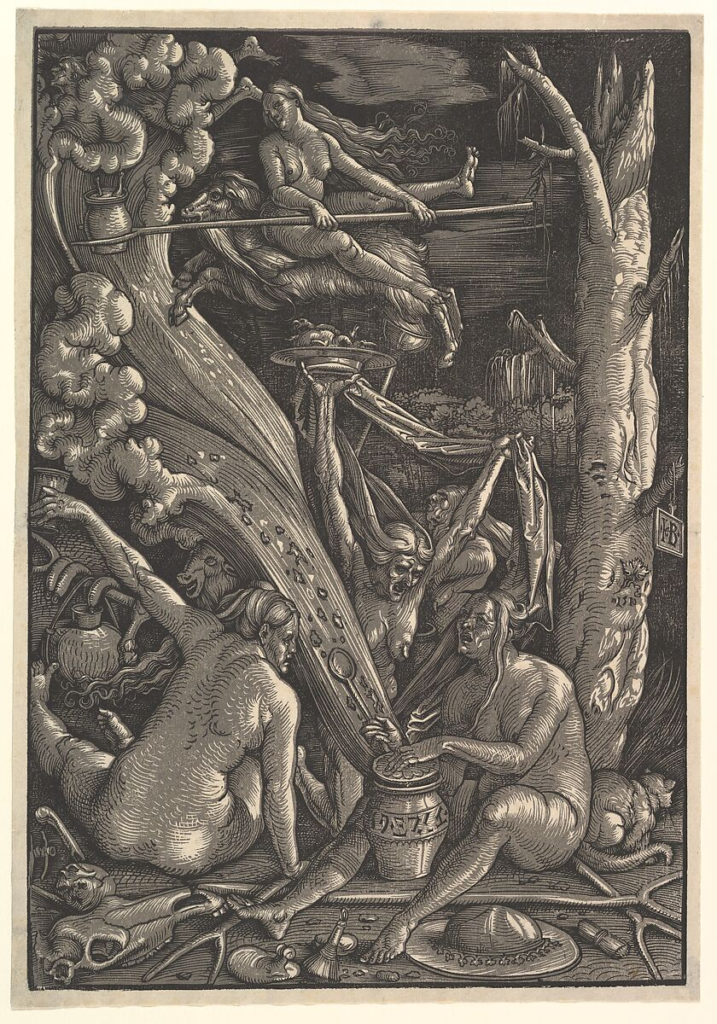
By the early 16th century, depictions of witchcraft in European art had become increasingly theatrical, frightening, and explicit. Few artists embraced this imagery more intensely than Hans Baldung, a German painter and printmaker who was deeply influenced by his mentor, Albrecht Dürer. Baldung returned to the subject of witches repeatedly throughout his career, but The Witches from 1510 remains one of his most haunting explorations of the theme.
The woodcut presents a chaotic gathering of nude women surrounded by smoke, bones, strange creatures, and ritual objects. One witch rides a goat while others crouch around a cauldron, their gestures exaggerated and animated. Tiny frogs and occult ingredients appear within the swirling steam, while dead branches and scattered bones create an atmosphere of decay and danger. Every detail contributes to a visual world where nature itself seems corrupted.
Unlike earlier medieval imagery that treated witchcraft as distant folklore, Baldung’s witches feel immediate and physical. Their bodies dominate the composition, emphasizing the growing connection between witchcraft and anxieties surrounding female sexuality. During this period, Europe was entering the height of witch-hunt hysteria, and women’s bodies increasingly became sites of suspicion. Female desire, aging, illness, infertility, and knowledge of medicine could all be interpreted through the lens of demonic influence.
The invention of the printing press played an important role in spreading these fears. Images like Baldung’s woodcuts circulated far more widely than paintings, helping standardize the visual stereotypes associated with witches. At the same time, texts such as the Malleus Maleficarum fueled paranoia by presenting women as morally weak and especially vulnerable to the devil’s influence. Art and propaganda began working together to reinforce social fear.
Yet Baldung’s work is not entirely straightforward. There is a strange fascination embedded within the image alongside its horror. The witches are threatening, but they are also commanding, energetic, and visually powerful. This tension between fear and fascination would become central to witch imagery across art history. The witch was no longer simply a cautionary figure, she had become a spectacle through which society explored its anxieties about power, temptation, rebellion, and the unknown.
The Theatre of Witchcraft
Witches’ Sabbath – Frans Francken the Younger

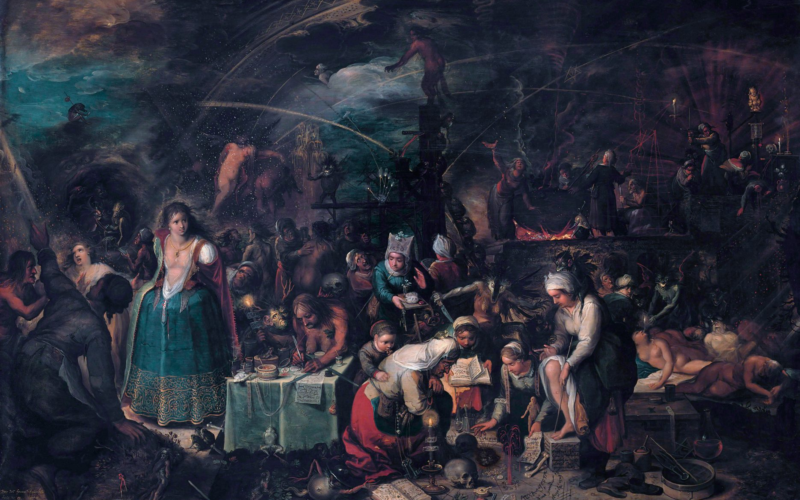
By the 17th century, the witch had become one of the most visually dramatic figures in European art. Religious conflict, superstition, and public fascination with the occult transformed witchcraft into a subject that artists could render with theatrical intensity. In Witches’ Sabbath, Flemish painter Frans Francken the Younger constructs a crowded and unsettling scene filled with rituals, demons, skeletons, and mysterious symbols. The painting feels almost cinematic in its detail, pulling viewers into a chaotic world suspended between fantasy and fear.
At the center of the composition are elegantly dressed women performing rituals around a glowing space cluttered with skulls, herbs, candles, books, and alchemical tools. Demonic creatures appear throughout the scene while terrified figures flee in the background. Francken creates a sharp contrast between beauty and horror: richly painted fabrics and graceful gestures exist alongside imagery of death and corruption. This tension was intentional. The painting reflects a society fascinated by the idea that evil could disguise itself beneath refinement, intelligence, or seduction.
The concept of the “witches’ sabbath” had become widespread in Europe by this time. According to popular belief, witches gathered secretly at night to worship the devil, perform rituals, and conspire against society. These imagined gatherings were less rooted in reality than in collective paranoia fueled by religious authorities and sensational texts. Paintings like Francken’s visualized those fears in vivid detail, reinforcing the belief that hidden threats existed beneath ordinary life.
Yet the work also reveals something deeper about Baroque art and spectacle. Rather than presenting witchcraft as purely terrifying, Francken turns it into an elaborate performance. The viewer is invited to linger over every strange object and supernatural detail. The painting becomes part horror story, part curiosity cabinet, reflecting the growing European fascination with alchemy, mysticism, and forbidden knowledge during the early modern period.
What makes Witches’ Sabbath especially significant is how it captures the contradiction at the heart of witch imagery. Society publicly condemned witches while simultaneously becoming obsessed with them. Fear and fascination existed side by side. The witch was no longer merely an enemy of religion, she had become a powerful visual symbol through which artists explored mystery, spectacle, temptation, and the darker corners of human imagination.
Mythological Women and Dangerous Knowledge
Medea – Frederick Sandys
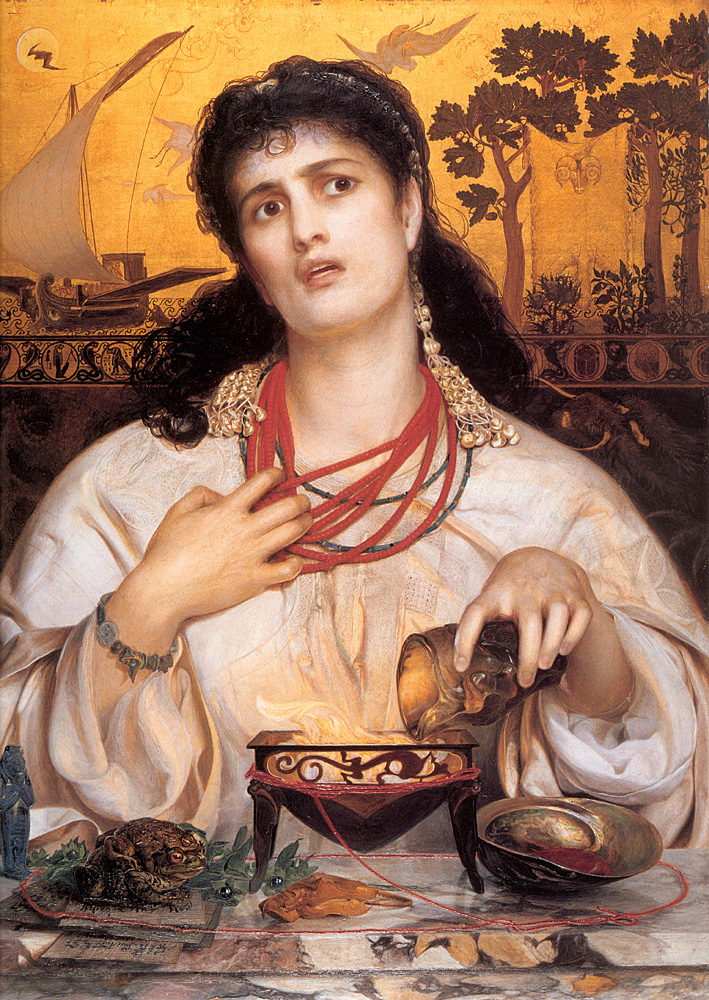
By the 19th century, depictions of witches in art began shifting away from grotesque medieval stereotypes toward something more psychologically complex. Artists associated with Romanticism and the Pre-Raphaelite movement became increasingly interested in mythological women whose intelligence, emotion, and supernatural abilities placed them outside conventional social expectations. Among the most striking examples is Frederick Sandys’ Medea, a painting that transforms the infamous enchantress of Greek mythology into a figure of haunting emotional intensity.
In Greek myth, Medea was a sorceress, healer, and granddaughter of the sun god Helios. She is best known for helping Jason obtain the Golden Fleece through her knowledge of magic and herbal potions before eventually becoming one of mythology’s most tragic and feared women. In Sandys’ interpretation, Medea is shown preparing a potion over an open flame, her expression tense and inward-looking. The painting focuses less on spectacle and more on psychological drama. Her face is illuminated with concentration and unease, suggesting a woman caught between power, desire, and desperation.
Unlike earlier Renaissance depictions that treated witches primarily as symbols of moral corruption, Sandys presents Medea as deeply human. She is not elderly or monstrous. Instead, she is intelligent, emotionally charged, and visually commanding. This reflects a broader shift within 19th-century art, where dangerous or supernatural women increasingly became subjects of fascination rather than simple condemnation.
The Pre-Raphaelites were especially drawn to women from mythology and literature who resisted social expectations. Figures like Medea, Circe, and Hecate represented forms of female knowledge and autonomy that Victorian society both admired and feared. Their power often came through intellect, ritual, or emotional intensity rather than brute force. In many ways, these women challenged traditional ideas of femininity by refusing passivity.
Sandys’ Medea reveals how the image of the witch evolved during the 19th century from a figure associated with communal panic into a symbol of inner complexity and forbidden knowledge. The painting does not ask viewers to fear Medea entirely. Instead, it invites them to confront the unsettling possibility that female power, especially intellectual and emotional power, could not be easily controlled or understood within patriarchal society.
Reimagining the Witch as Mystical Rather Than Monstrous
The Magic Circle – John William Waterhouse
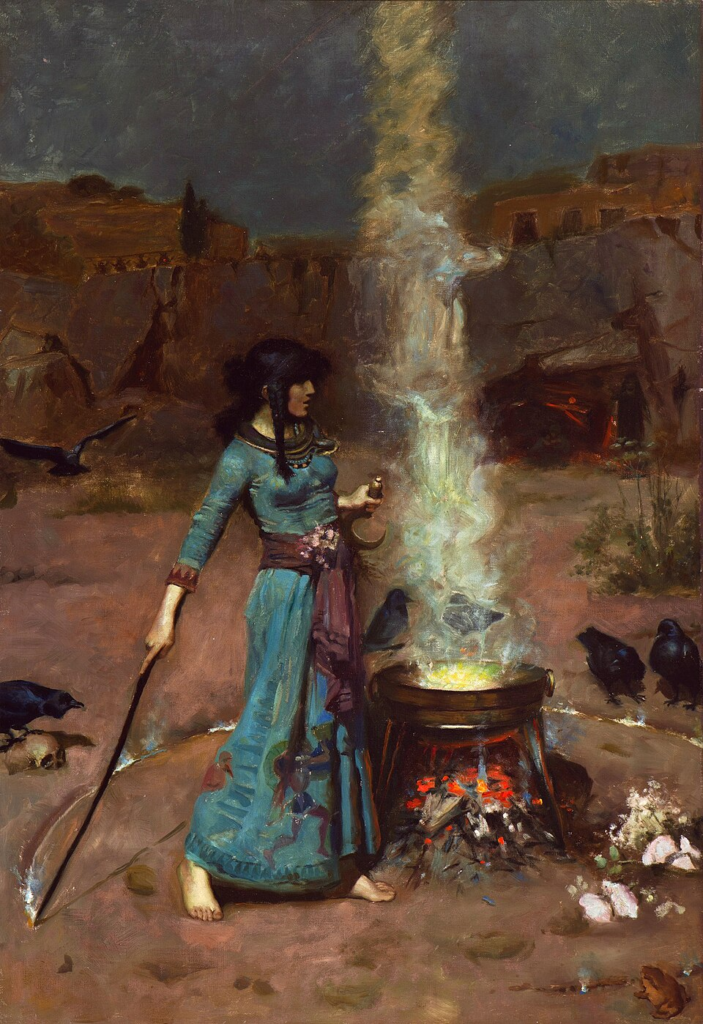
Few paintings capture the transformation of the witch in art history as beautifully as The Magic Circle by John William Waterhouse. Created in 1886, the painting belongs to a period when artists became increasingly fascinated with mysticism, mythology, ritual, and the supernatural, not necessarily as something terrifying, but as something alluring and emotionally charged. Unlike the grotesque witches of earlier centuries, Waterhouse’s central figure appears calm, intelligent, and entirely in control of her surroundings.
The woman stands before a smoking cauldron, drawing a protective circle into the earth with a long wand or staff. Ravens gather around her while a skull rests nearby in the sand. A snake coils around her neck, and ritual objects lie scattered beside her. Every element carries symbolic weight. Ravens traditionally represented prophecy and death, snakes evoked transformation and hidden knowledge, while the magic circle itself symbolized protection, spiritual power, and the boundary between the human and supernatural worlds.
Yet despite these ominous details, the painting resists portraying the witch as evil. Waterhouse renders her with dignity and composure, surrounding her with an atmosphere of mystery rather than horror. Art historians have often noted how the darker symbols — the ravens, skull, and barren landscape, remain outside the circle she creates, while the space around her feels ordered and controlled. In this interpretation, the witch is not a force of destruction but someone navigating dangerous forces with discipline and knowledge.
The painting also reflects broader cultural shifts in the late 19th century. Victorian society experienced renewed interest in spiritualism, occult philosophy, ancient mythology, and esoteric traditions. At the same time, artists increasingly portrayed women as enigmatic and psychologically complex figures rather than purely moral symbols. Waterhouse’s witch belongs to this world of fascination and ambiguity. She is neither victim nor villain, but a self-possessed figure who commands attention through intellect and ritual.
What makes The Magic Circle so enduring is its refusal to simplify the witch archetype. The painting preserves the mystery traditionally associated with witchcraft while stripping away much of the fear and hysteria that had defined earlier depictions. In Waterhouse’s hands, the witch becomes less a warning about evil and more a meditation on solitude, knowledge, power, and the human desire to understand forces beyond ordinary life.
Francisco Goya and the Horror of Superstition
El Aquelarre & Witches’ Flight – Francisco Goya
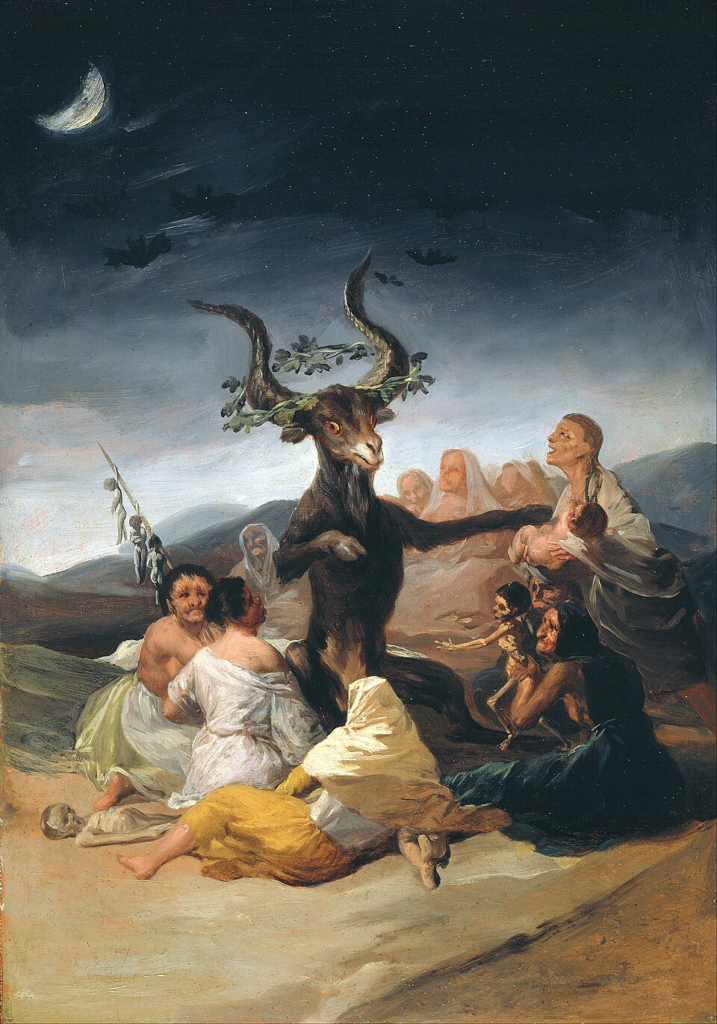
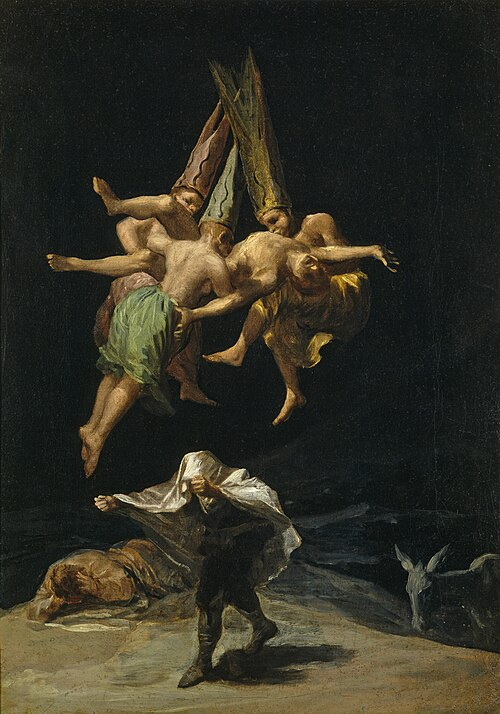
No artist explored the psychological darkness of witchcraft quite like Francisco Goya. While many earlier artists used witches to reinforce religious fears or indulge in theatrical fantasy, Goya approached the subject as a vehicle for social criticism. His paintings El Aquelarre and Witches’ Flight, both created in 1798, emerged during a period of political instability, superstition, and institutional violence in Spain. Rather than depicting witches as literal supernatural beings, Goya used them to expose the dangers of ignorance, fear, and mass hysteria.
In El Aquelarre, often translated as The Witches’ Sabbath, a towering black goat presides over a gathering of women in a dark and barren landscape. The goat, associated with the devil in European tradition, looms above the group like a distorted religious figure. Around him, women present children and offerings in an atmosphere that feels simultaneously ritualistic and grotesque. Yet the painting is less about occult practice than it is about manipulation and control. Goya understood how superstition could be weaponized by powerful institutions to maintain fear within society, particularly during the era of the Spanish Inquisition.
That anxiety becomes even more intense in Witches’ Flight. Three floating figures hover in the darkness while terrified men below shield themselves in panic. The scene is irrational and nightmarish, but that irrationality is precisely the point. Goya paints fear itself as contagious. The men are so overwhelmed by terror and belief that they become powerless, incapable of questioning what they see. The painting becomes an allegory for societies consumed by blind obedience and paranoia.
Unlike many artists before him, Goya was not interested in proving the existence of witches. He was interested in the consequences of belief. His witchcraft scenes criticize a culture where superstition justified violence, persecution, and social control. This perspective was deeply shaped by the Enlightenment, a movement that championed reason and challenged the authority of oppressive religious and political systems.
What makes Goya’s work so modern is that the real horror in these paintings is not the supernatural. It is humanity itself, its fear, cruelty, irrationality, and willingness to surrender to hysteria. Through witches, Goya revealed the psychological instability of the society around him, transforming witchcraft from folklore into one of art history’s most powerful symbols of collective fear and institutional corruption.
Reclaiming the Witch as a Symbol of Female Power
The Love Potion – Evelyn De Morgan
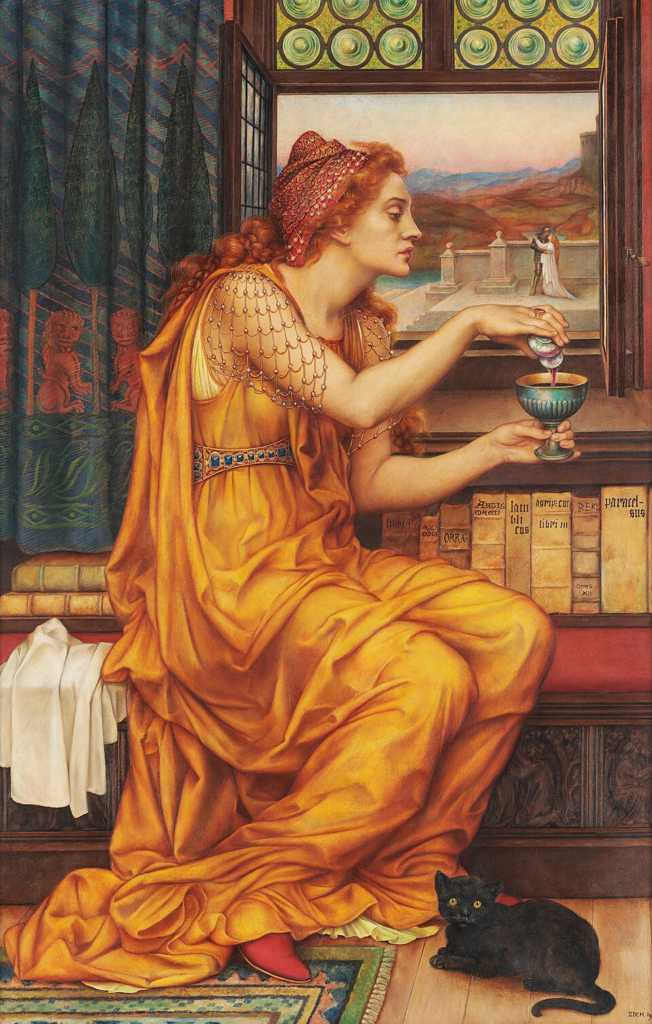
By the late 19th and early 20th centuries, the image of the witch in art had undergone a remarkable transformation. No longer portrayed solely as a grotesque servant of evil, the witch increasingly appeared as an intelligent, spiritual, and self-possessed figure. This shift reflected broader cultural changes surrounding women’s rights, spiritualism, and evolving ideas about female independence. Among the artists who helped reshape this imagery was Evelyn De Morgan, whose painting The Love Potion offers one of the most nuanced portrayals of witchcraft from the era.
The painting depicts a richly dressed woman carefully preparing a potion while a black cat sits nearby and a pair of lovers embrace in the distant background. The familiar visual symbols of witchcraft remain present, the potion, the cat, the ritual setting, yet De Morgan approaches them with unusual tenderness and dignity. Her witch is not chaotic or threatening. Instead, she appears thoughtful, composed, and deeply knowledgeable. The room surrounding her is filled with books and scholarly references, suggesting intellect and philosophical inquiry rather than danger.
This portrayal was deeply connected to De Morgan’s own life and beliefs. Associated with later Pre-Raphaelite circles, she resisted the restrictive expectations placed on women during the Victorian era and became involved in spiritualist movements that explored mysticism, symbolism, and the unseen world. Unlike earlier generations that framed female knowledge as suspicious, De Morgan reimagined magical practice as something reflective, emotional, and spiritually expansive.
The painting also marks a significant cultural shift in how women with power were represented. For centuries, women who practiced healing, herbal medicine, ritual, or independent thought had often been treated as threats to social order. By contrast, The Love Potion suggests a growing fascination with female autonomy rather than fear of it. The witch becomes a figure of wisdom and agency rather than moral corruption.
This evolving image would later influence modern feminist interpretations of witchcraft throughout the 20th century. As women increasingly reclaimed the word “witch” as a symbol of resistance and empowerment, artists and writers revisited historical depictions through a more critical lens. De Morgan’s painting sits at an important turning point within that history. It preserves the mystery traditionally associated with witches while transforming it into something far more human: a meditation on knowledge, creativity, emotion, and the possibility of female power existing outside patriarchal control.
The witch has never been a fixed figure in art history. She has continually shifted shape according to the fears, beliefs, and desires of the cultures that imagined her. In some works, she appears as a terrifying embodiment of evil and disorder; in others, she becomes intelligent, alluring, spiritually powerful, or tragically misunderstood. Across centuries of visual culture, the image of the witch absorbed anxieties surrounding religion, sexuality, knowledge, aging, and female autonomy, revealing as much about society itself as the women being depicted.
What makes these artworks so compelling today is not simply their connection to folklore or the supernatural, but the way they expose deeper social tensions. Many of the women historically accused of witchcraft occupied vulnerable or unconventional positions within society, healers, widows, midwives, intellectuals, or women who existed outside accepted domestic roles. Art often transformed those fears into dramatic visual symbols, reinforcing stereotypes while also preserving traces of fascination and unease.
Over time, however, artists began complicating the image of the witch rather than merely condemning it. By the 19th century, painters increasingly portrayed magical women as emotionally complex, knowledgeable, and self-possessed figures. This gradual shift laid the foundation for the modern reclamation of the witch as a symbol of resistance, independence, and feminine power.
Today, the witch continues to appear across contemporary art, literature, film, fashion, and popular culture because the figure still resonates so deeply. She remains a symbol of society’s relationship with fear and difference, but also of transformation and survival. In art history, the witch was never simply a supernatural character. She became a mirror reflecting humanity’s changing attitudes toward power, belief, rebellion, and the women who challenged the boundaries imposed upon them.
Did we miss one of your favorite witches from art history, mythology, or popular culture? Let us know which iconic witch still fascinates you the most.
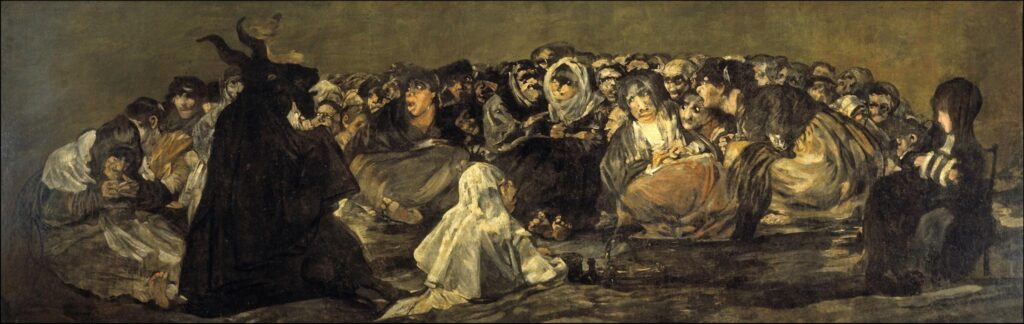
If Francisco Goya’s haunting visions fascinated you, you may also enjoy our deep dive into his unsettling late works in Goya’s Black Paintings: Darkest Art History, where we explore the fear, madness, and psychological darkness that shaped some of art history’s most disturbing images.