
Briana Hertzog’s Fantastical Oil Paintings Protect Human Creativity in the Age of AI
At Arts to Hearts, some of the most powerful art we encounter is the art that looks fantastical on the surface and carries something completely real underneath where the creature and the symbol and the carefully chosen colour are all in service of a human truth that could not have been said any other way.
Our Best of the Art World editorial was built to find exactly those artists. And today we are genuinely honoured to introduce you to one who has been quietly building one of the most distinctive and celebrated practices in contemporary narrative art.
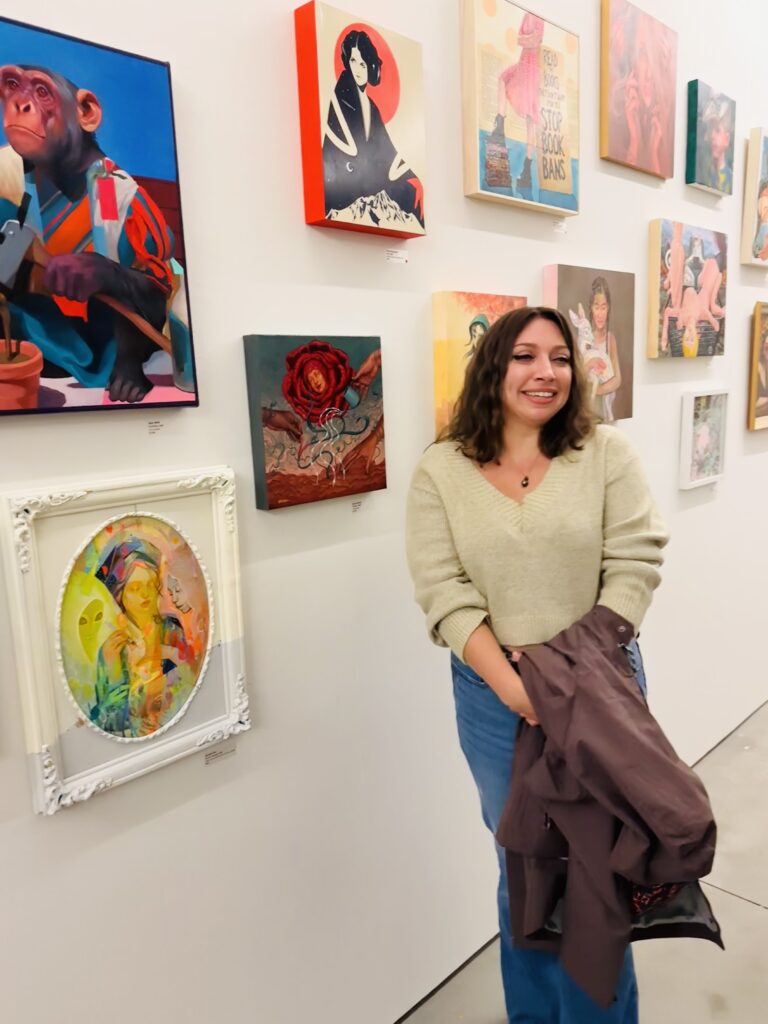
Briana Hertzog is a Virginia based painter, illustrator, and sculptor and the way she works across all three is something genuinely worth paying attention to. She received her formal education at Virginia Commonwealth University and the Illustration Academy, training under some of the finest illustrators working today.
That foundation gave her something rare, not just technical skill, but a deeply ingrained understanding of storytelling. Of how an image can carry a narrative. Of how every visual choice, from colour to composition to the smallest symbolic detail, can serve a meaning that goes far beyond what is immediately visible.
She began as a freelance illustrator, creating book covers and editorial work, and over time allowed that practice to expand into fine art in the most natural and organic way. She did not abandon illustration for painting.
She let the two inform and deepen each other until the line between them became something she no longer needed to draw. The result is a practice that is technically extraordinary, narratively rich, and completely and unmistakably her own.
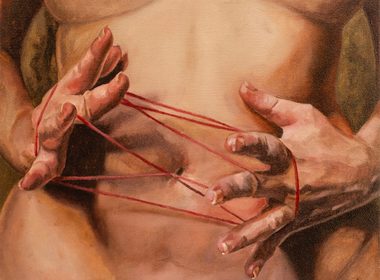
Her paintings are built across oils, digital art, and sculpture each medium approached with the same care and the same visual sensibility. She works with highly saturated, carefully balanced colour palettes that she associates with particular emotions in ways that are entirely personal rather than conventional.
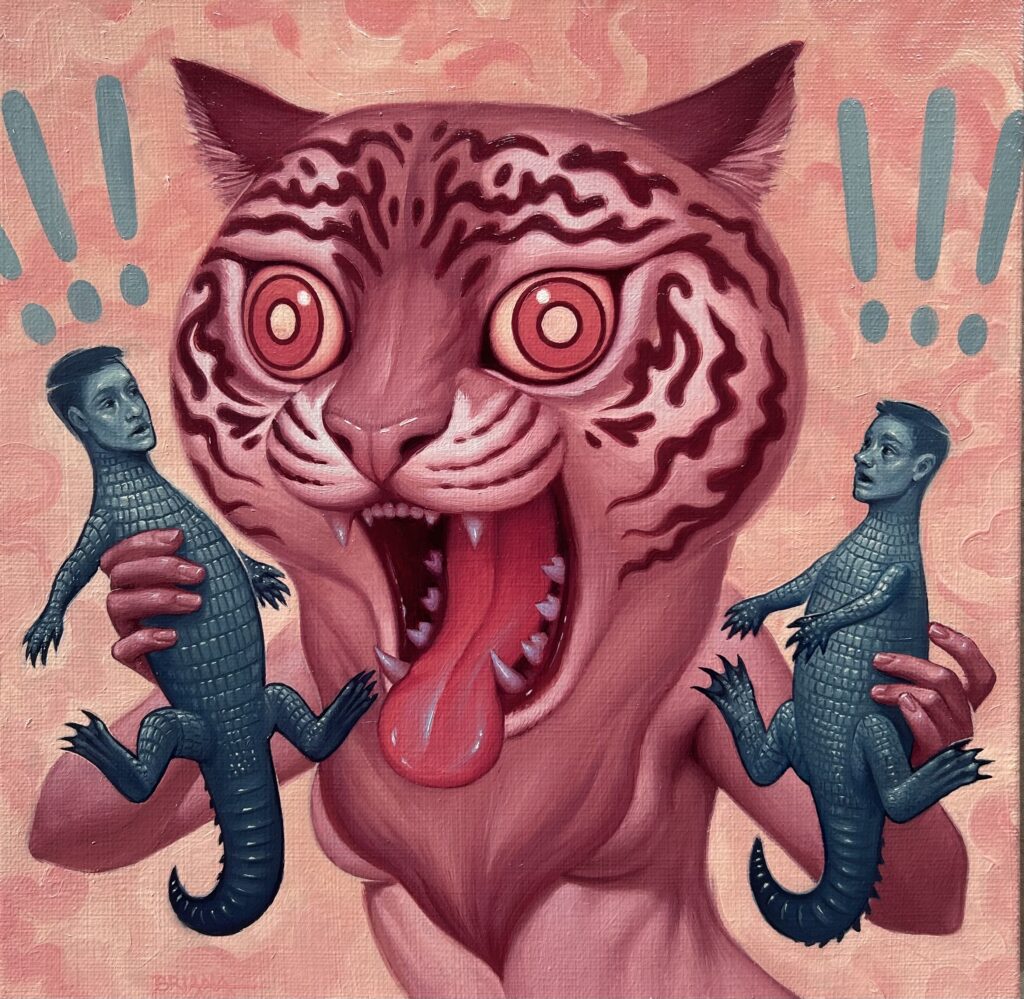
She develops her ideas digitally first, using them as a loose foundation rather than a fixed plan leaving room for the painting to breathe and evolve and surprise her as it comes to life. Her symbols are intentional but never rigid. Her characters are fantastical but never empty. In every canvas, something deeply human is at work.
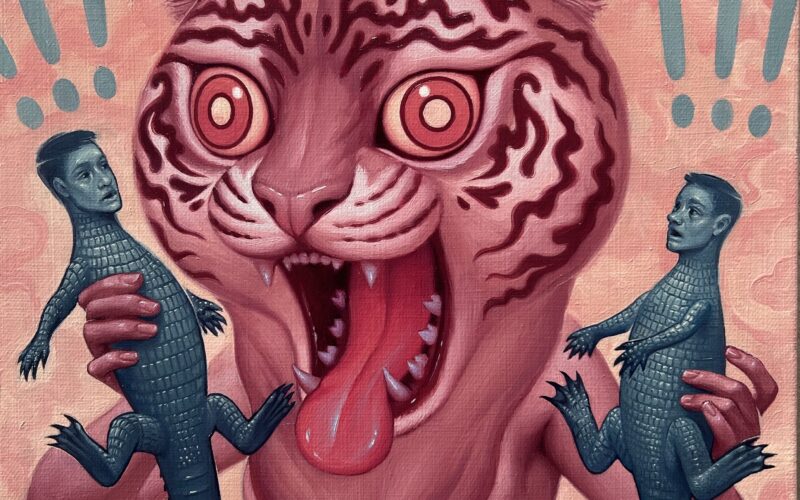
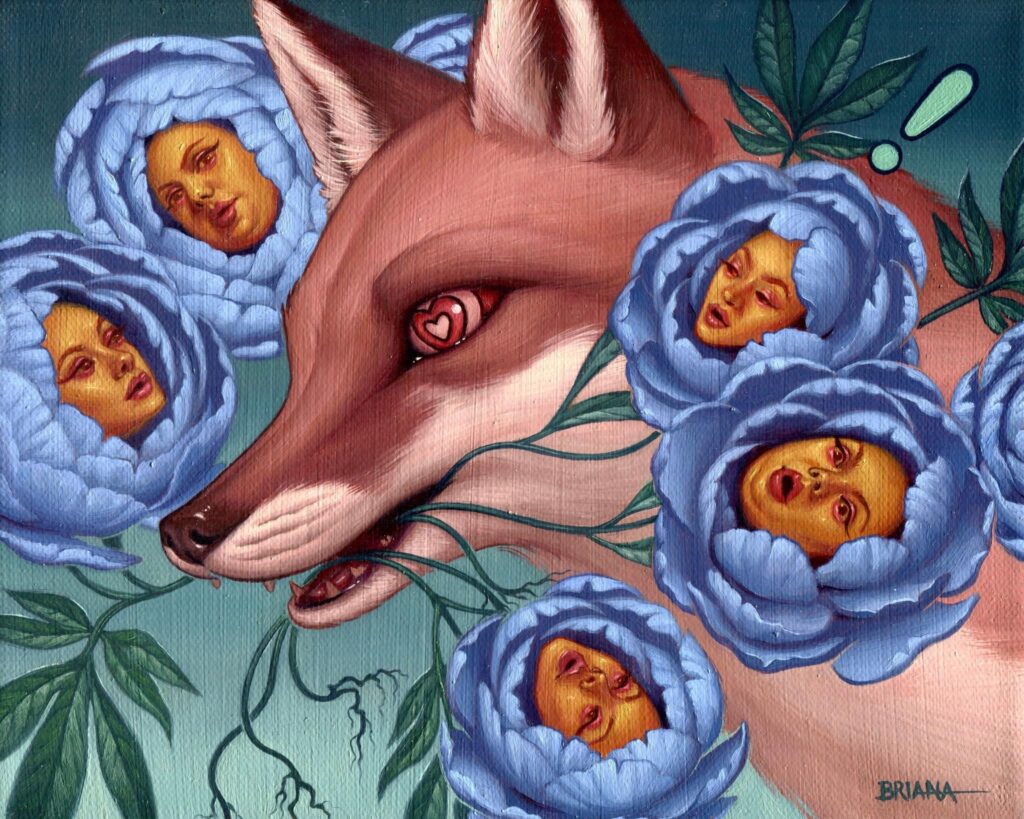
And at the centre of it all is a world she has been building for years a realm where humans, animals, and vegetation merge into singular hybrid beings, where eyes carry hearts and exclamation marks instead of pupils, where love and power and transformation and instinct all coexist in the same image without any of it feeling forced or arbitrary.
It is a world that rewards return visits. A world that keeps revealing more of itself the longer you live with it.
Let’s get to know Briana through our conversation with her and discover the world she has been building, one painting at a time.
Q1. Briana, could you share a little about your background and what first drew you to narrative painting?
I attended Virginia Commonwealth University, where I earned a BFA in Communication Arts with a focus on illustration. Many of the artists I admired were illustrators, and I was drawn to the strong technical foundation they possessed. Studying at VCU and eventually the Illustration Academy, I learned from some of the best in the field. Overtime, I began incorporating elements of storytelling and illustration into my fine art.
Q2. You work across oil painting, digital art, and sculpture. What does each medium allow you to express differently?
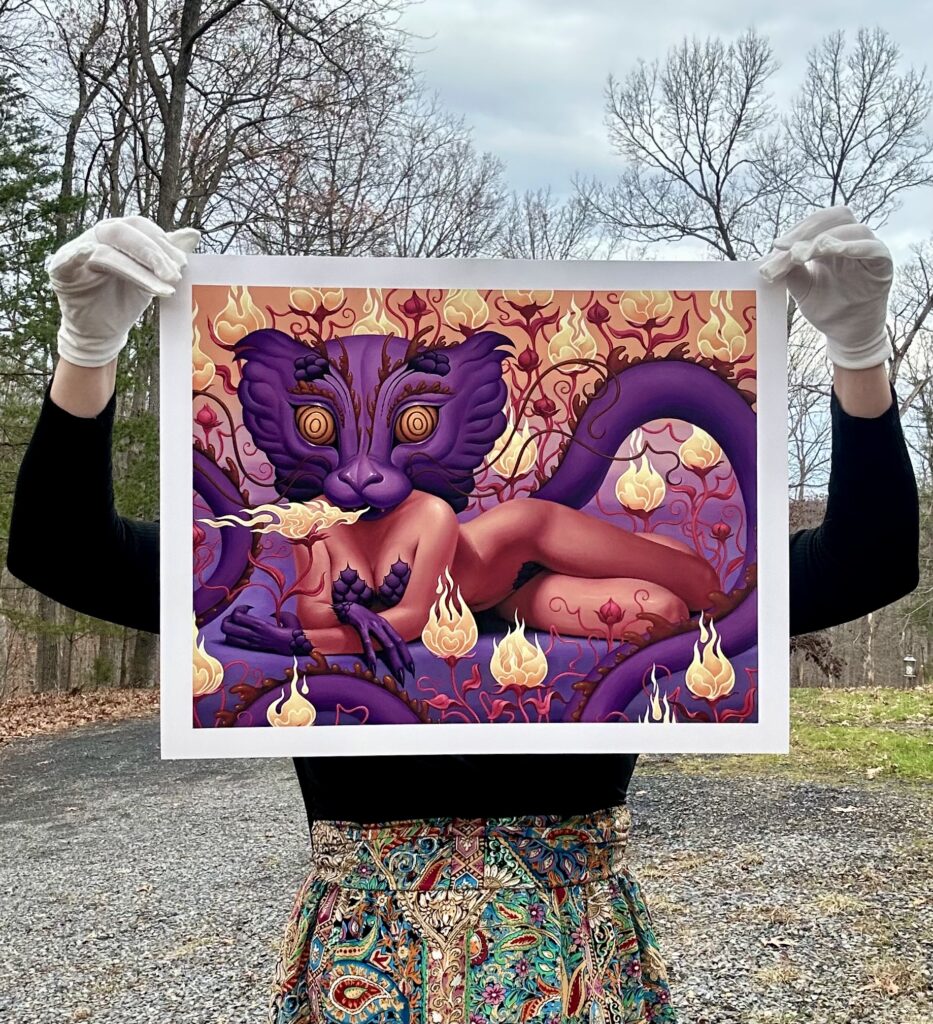
I try to I maintain a similar style between the 3 mediums. I’ve been working with oils since the age of 13, so it remains the medium with which I am most familiar. I enjoy its versatility which allows me to explore a range of techniques from line work and flat shapes to smooth and volumetric blending.
Digital art offers me all the same possibilities as oil, but I primarily use it for pieces intended for print or as a way of planning out my oil paintings. It allows me to roughly sketch a composition and play around with the color palette to give me an idea of what I want the final piece to look like. Sculpture is still a relatively new medium for me, but I’m really enjoying bringing my characters into 3D. I am continuing to explore the medium and discover ways to express my visual style.
Q3. Your paintings are filled with symbolic details. Do these symbols develop naturally, or are they planned from the beginning?
I try to keep my process dynamic so that each stage feels engaging rather than repetitive. I begin digitally on my iPad where I develop ideas, rough compositions and color palettes. From there, I use the sketch as a loose foundation for the final piece rather than transfer it directly to the canvas.
This allows some evolution to happen during the painting stage resulting in a final work that is often slightly different from the original sketch. While some of the visual choices develop in the painting stage, I tend to be intentional with my symbolism and subject matter, which remain consistent from the original concept to the final painting.
Q4. Humans, animals, and vegetation merge into single characters throughout your work. When did this world first take shape?
I began developing this world and its characters before I started exhibiting regularly in galleries, during a more experimental and portfolio building stage of my art career. What started as an exploration became a vehicle for expressing deeper ideas and emotions through the characters that inhabit this world. Over time, it has developed into a realm that I can easily access in my mind and explore ways to communicate concepts and narratives.
Q5. Your solo exhibition Gatekeepers introduced creatures that protect or guide imagined worlds. What inspired this body of work?
This body of work was solely driven by my emotional response to the introduction of generative ai into the art world. I witnessed a growing pushback from the art community bringing to light the unethical way in which ai training datasets were obtained and the use of artists’ works without their knowledge or consent. What struck me most was the hostility directed towards artists who voiced their concerns.
The term, “Gatekeepers,” was one I saw often thrown at artists, which I always found the most ironic. The majority of artists I saw online shared there processes, techniques and mediums with their audience allowing free access to anyone willing to learn. In contrast, the only gatekeeping I witnessed was from AI prompters themselves, many of whom closely guarded their prompts from others.
With my exhibition Gatekeepers, I took this intended insult and flipped it into an act of protection. If I could be a gatekeeper, I would be proud to protect the work of artists and the value of human creativity from a world that is constantly trying to exploit them.
Q6. How did Inner Wild build on the ideas explored in Feral Garden? Did your thinking about instinct change?
I approached Inner Wild focusing slightly more on the exploration of the human of instinct. My interest was in exploring the potential tension between what we should do versus what we are naturally compelled to do. The work explores the emotional and cognitive dissonance that can arise between our instinctual nature and learned behaviors.
Q7. Love, power, and transformation appear throughout your work. Why do these themes continue to inspire you?
All of these themes translate into very real human emotions, many of which are very personal to me. They reflect experiences and feelings I have confronted at significant points in my life and have influenced who I am and who I continue to become. My works are very personal, in some ways more personal than I am even consciously aware of.
Q8. Your colour palettes are highly saturated but carefully balanced. How do you choose colours that support a story?
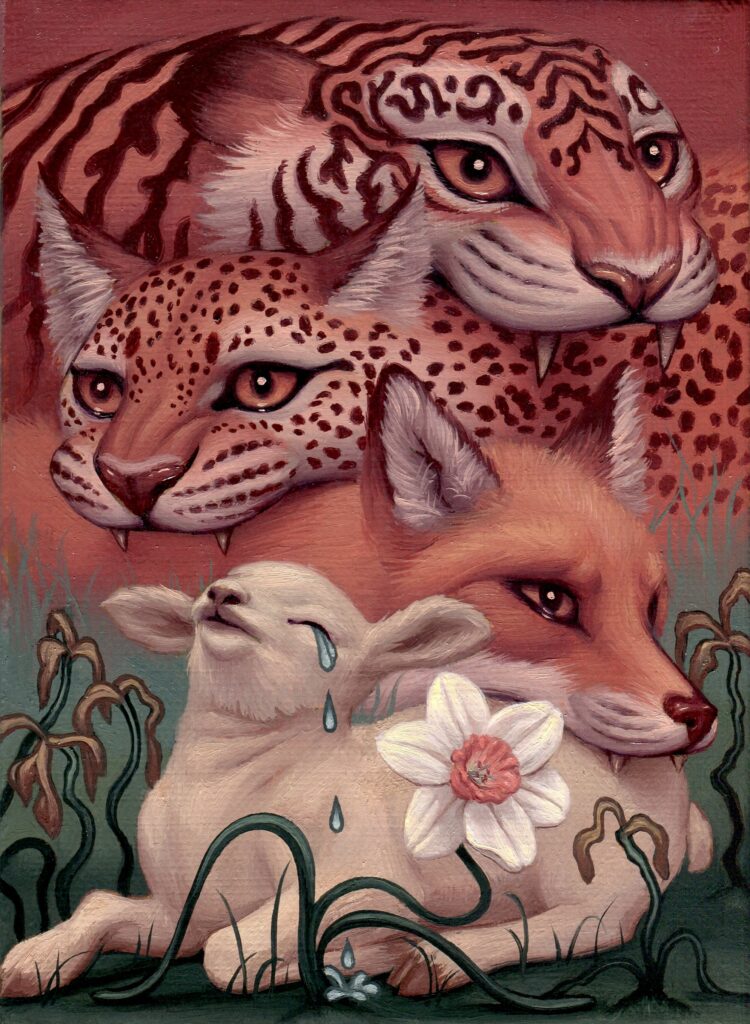
When developing an idea for a painting, color is one of the first elements that comes to mind. I tend to subconsciously associate certainly colors with particular moods and emotions. These are more personal associations rather than conventional color symbolism. I often work with limited color palettes, which helps create a sense of cohesion and unity.
Q9. Your illustrations have appeared on book covers and in magazines. How has commercial work shaped the artist you are today?
My commercial work often centers on visual storytelling and the use of visual metaphors to amplify text. For a while, I maintained a strict distinction between commercial illustration and fine art, viewing them as two separate and incompatible practices. Eventually, I recognized that this separation was more of a mental limitation than an actual one.
I reminded myself that art can be anything you want it to be. Incorporating elements of illustration into my work is what I think gives my work its distinguishable characteristics.
Q10. Your characters often have expressive eyes that draw viewers in. What role do facial expressions play in your storytelling?
I tend to use the eyes very expressively in my characters: giving them hearts, stars, exclamation marks, and so on. Through symbolic depictions of the eyes, I’m able to give animal characters very human-like emotions.
Q11. Fantasy can explore real human experiences in unique ways. What can imagination express that realism cannot?
The human mind is complex and capable of far more than we realize. Exploring human creativity opens up a world of deep emotional connections that are often unseen or forgotten. Viewing creative works can also spark those same emotions in the viewer. Aside from the emotional response, the act of exercising human creativity is something I find inherently beautiful and awe-inspiring.
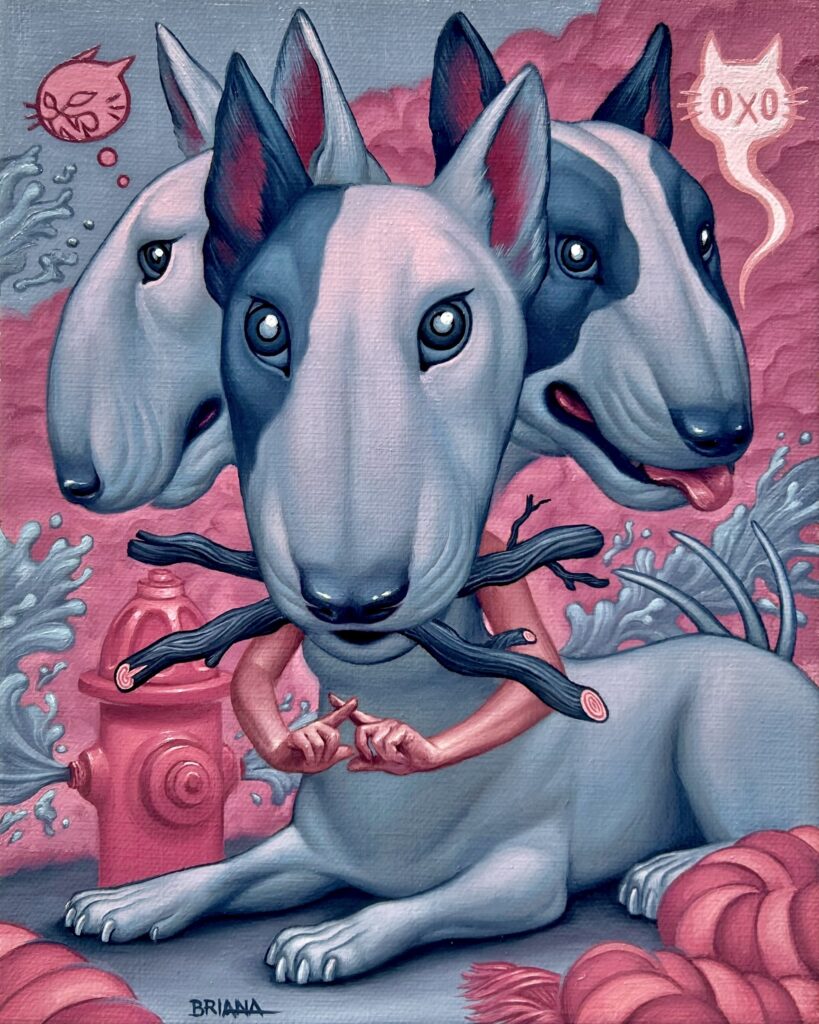
Q12. Many collectors return to your work for its recurring characters and symbols. How do you expand this world without repeating yourself?
I’ve always had mixed feelings about the way repetition is treated in the art world. On one hand, it is almost rewarded as a display of cohesiveness and recognition. On the other hand, I’ve always felt exploration and the inevitable change that comes with it, is an important part of being an artist. I also find it extremely difficult to create the same piece more than once. Even my preparation sketches can differ considerably from my final works.
I like to leave some of the “figuring out” part to the final execution, allowing the process to remain open and responsive rather than feeling as though I’m simply reproducing something I’ve already made. At the same time, I do want to maintain a level of familiarity within my work by revisiting similar characters and ideas, allowing them to evolve naturally over time.
In that way, repetition becomes more about returning to something familiar and seeing what more I can discover about it, but also allows my work to remain recognizable.
Q13. How has your definition of success changed as your creative practice has grown?
My definition of success has definitely change over the course of my art career. I am now achieving things I could only have dreamed about a few years ago: things that seemed so distant, that reaching them felt like it would have taken ages. If you asked me then whether accomplishing those things would make me feel successful, I probably would have answered, “yes.”
Today, however, I think of success differently. I’ve come to realize that achievement alone doesn’t necessarily equate to the feeling of success. To me, success is having the freedom to pursue what I love without being weighed down by the burdens of financial insecurity or lack of time. Success now seems like maintaining a life that allows me to do what I love without stress rather than just reaching a certain destination.
Q14. What advice would you give artists creating imaginative worlds and developing their own visual language?
My advice would be to strop creating what you think you’re supposed to create, or creating in a way you think you should create. Remove the audience from your mind. Creating is an opportunity to be completely selfish. Don’t worry about purpose or intent. Create as honestly and truthfully you can.
There are NO rules. You are allowed to do whatever you want. For too long, my own mind held me back from creating. Thoughts like, “This isn’t good enough,” “This isn’t how you’re supposed to paint,” or “People won’t like this,” constantly crept into my thought process. I was so focused on whether or not the work was good, acceptable, or understandable that I inhibited my work flow.
Give yourself permission to make strange or imperfect art. This will allow you the freedom to explore your ideas and discover something completely your own.
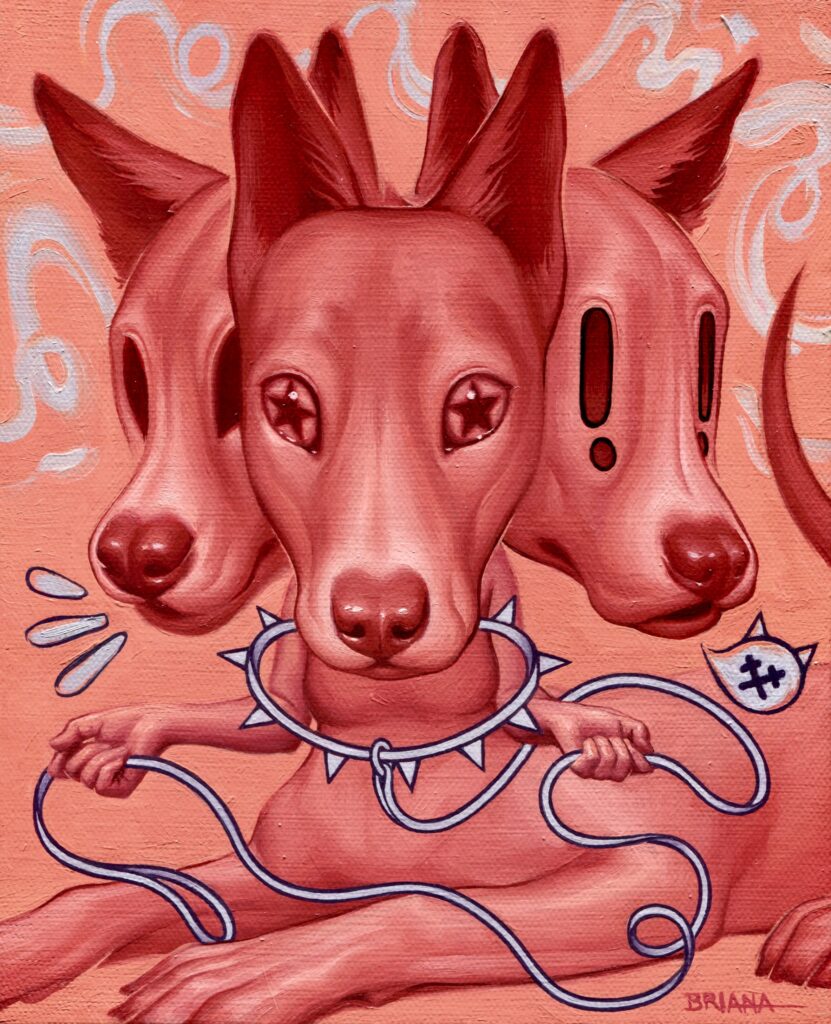
One of the things we kept thinking about after our conversation with Briana was something she said about what it really means to create freely that creating can be an opportunity to be completely selfish. To take the audience out of your mind. To make something as honestly and truthfully as you can, without constantly wondering whether it is good enough, acceptable, or understandable to anyone else.
It sounds simple. In practice, it is one of the hardest things to actually do. Because the noise is always there. The pressure to be understood, to be marketable, to make work that fits neatly into a category, finds its audience quickly, performs well on social media all of it is real. And without even realizing it, an artist can begin responding to that noise instead of listening to the quieter voice that tells them what they actually want to make.
Briana has found her way through that noise. And the practice she has built on the other side of it a world of hybrid beings, symbolic eyes, strange creatures, and carefully held human truths feels like the result of an artist giving herself genuine permission to follow the work wherever it wants to take her.
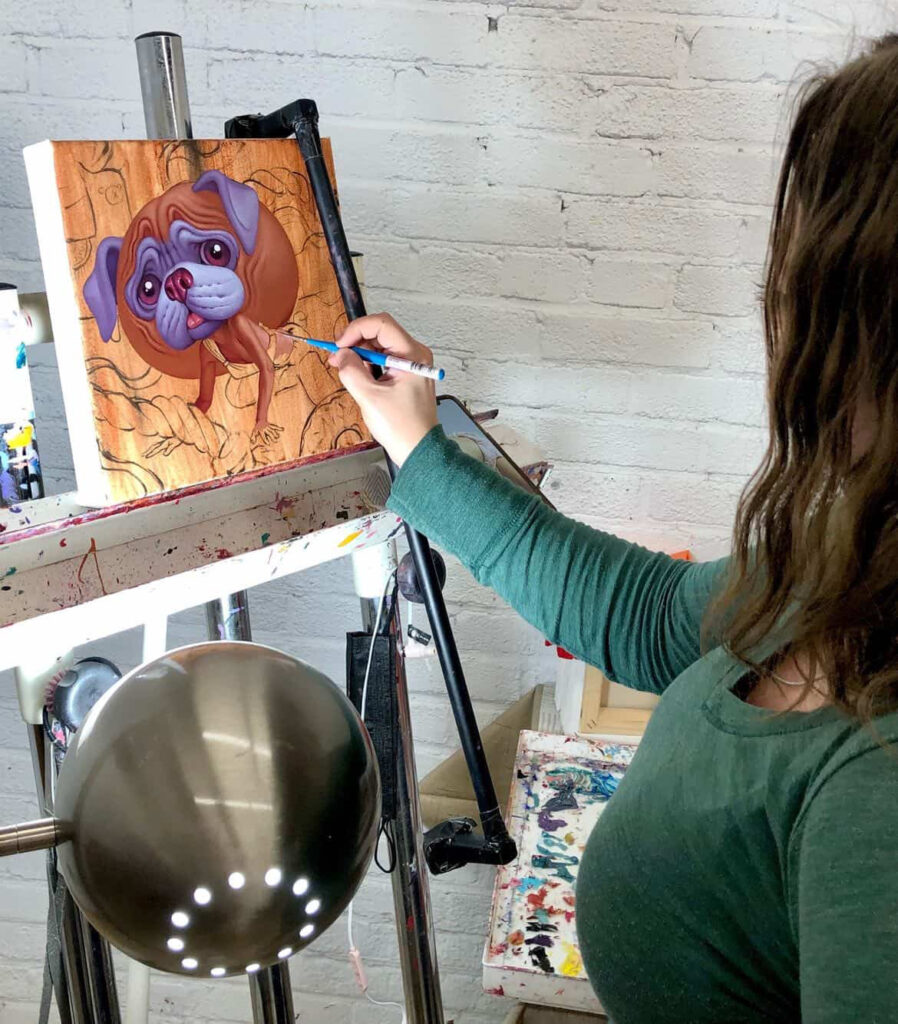
What we love about Briana’s work is that she has never seemed in a hurry to leave this world behind. She has spent years returning to these characters, these strange little details, these familiar symbols, and somehow they keep giving her something new to work with. Instead of constantly looking for the next idea, she has stayed curious about the one she already had and allowed it to grow with h
That kind of commitment creates something that no shortcut can replicate. Work with genuine depth. Work that gives you something back the longer you live with it. And for those who collect with genuine feeling who want their walls to hold something made from a place of real creative freedom, something original and lasting Briana’s paintings offer exactly that.
They are the kind of paintings that reveal a little more of themselves each time you return to them. The kind that can feel different on different days because they were created with enough personal truth to leave room for more than one interpretation, more than one feeling, more than one version of the person standing in front of them. The kind of work that earns its place on a wall, and keeps earning it every morning.
Briana is building something that feels bigger than any passing conversation about what contemporary art is supposed to look like. Something personal, strange, thoughtful, and entirely her own. And we are so glad we got to share a little of that world with you.
Follow Briana Hertzog through the links below and discover what complete creative freedom can actually look like.

Comments 1