


How Indian-Art Collaborations Shaped Alisha Thakur’s Miniature-Inspired, Textured Canvases
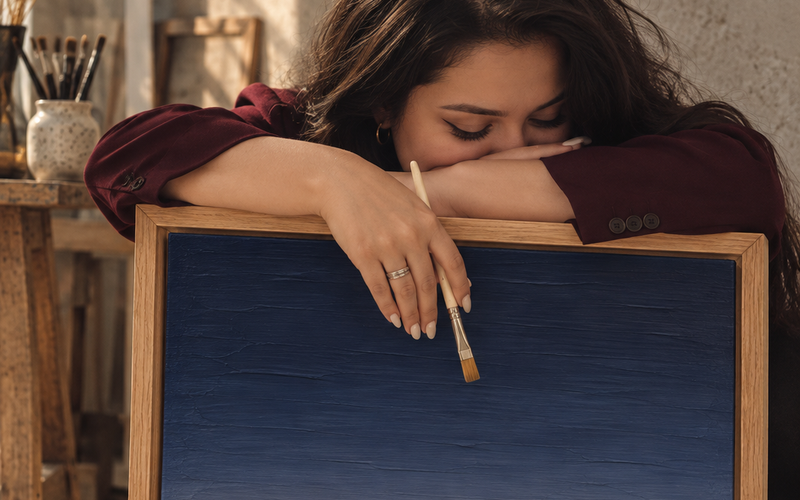
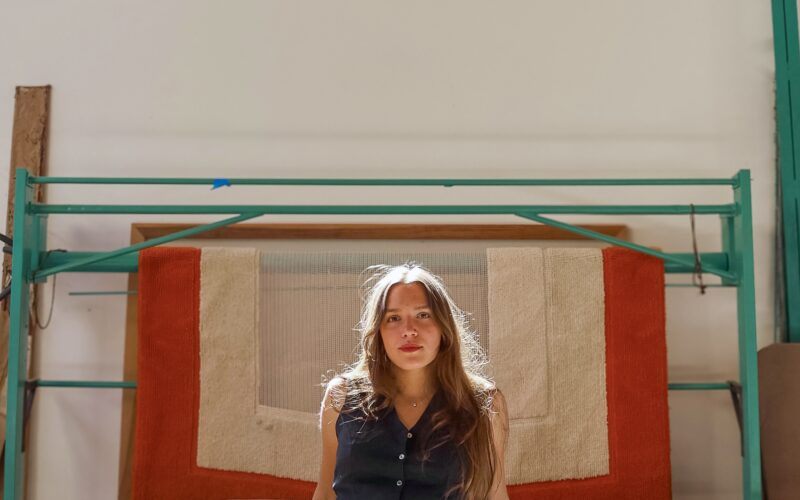
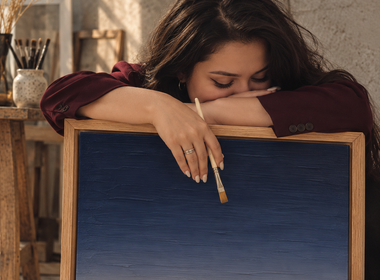
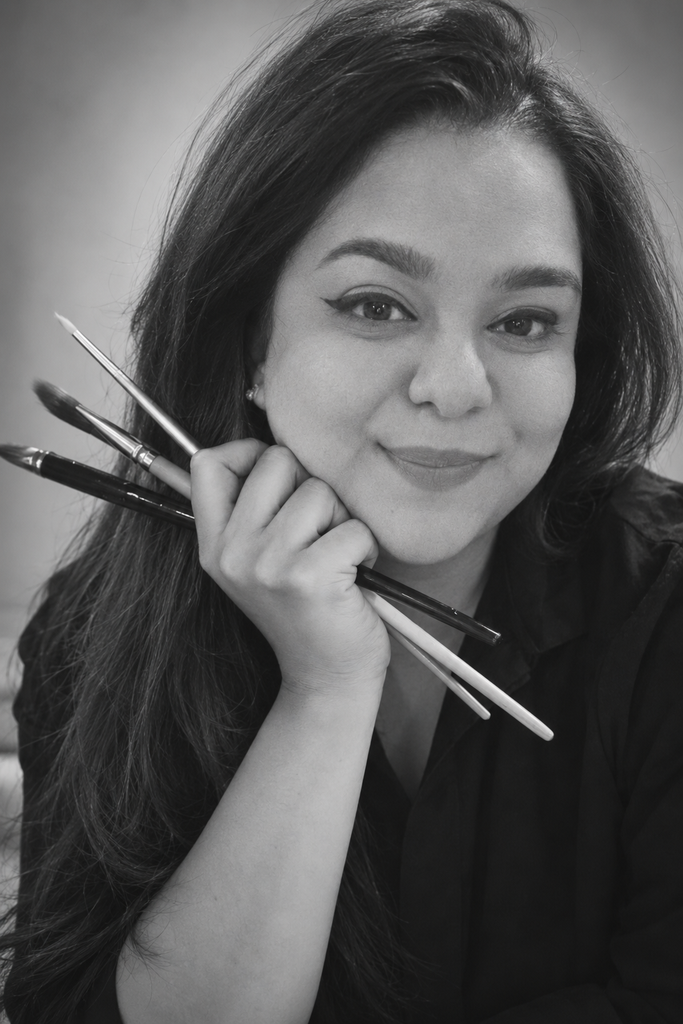
At Arts to Hearts Project, our exhibition on Artsy, Small Works, brings together artists working at an intimate scale, celebrating how much emotion, atmosphere, and meaning a small piece can hold. Among those featured is Alisha Thakur, whose quiet, colour-filled paintings invite you simply to pause and breathe.
Alisha is an Indian artist whose path to painting began somewhere a little unexpected: interior design. For years she worked with spaces, and though she loved the craft of it, she always felt something was missing, a little spark of the unexpected that could take a beautifully designed room and truly bring it to life.
She explored product, lighting, and furniture design in search of it, until she realised that the element she was chasing was art itself. Where design comes with rules and explanations, art offered her something freer, something open to interpretation that never has to justify itself, and that freedom is exactly what drew her in.
The sky is at the heart of her work. Ever since she was a child, she has found a sense of calm in watching a sunset, sitting under an open sky, or looking out over the hills, quiet moments away from the noise where she could think clearly and feel more like herself.
What fascinates her is how the same sky can look completely different every single day, always changing in colour, light, and mood, and yet still rises and sets without fail. That mix of constant change and quiet steadiness is something she keeps coming back to.
Her paintings, though, are less about recreating a landscape and more about capturing how a moment feels. For Alisha, colours carry their own emotion and identity, and rather than handing the viewer a fixed story, she lets the colours themselves be the heroes, each person free to find their own meaning within them.
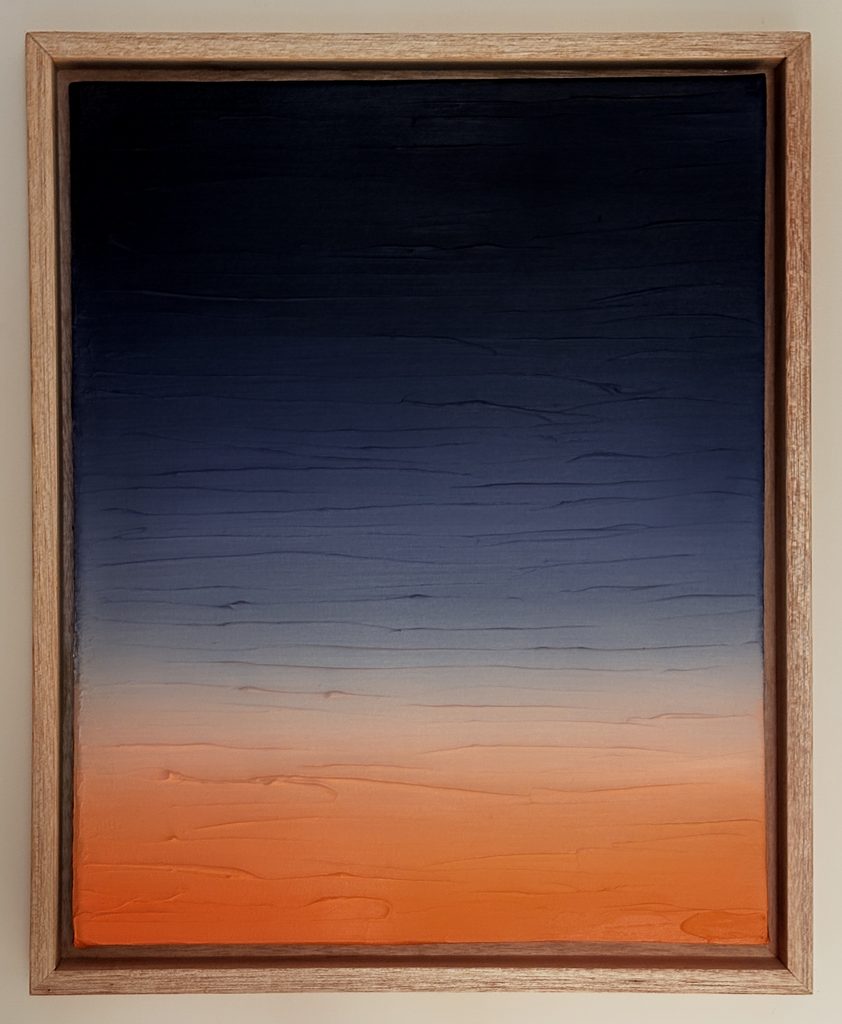
She works in gentle, gradual shifts of tone, those soft transitions where two colours meet and quietly bring out the best in one another, and she keeps her compositions minimal, often adding fine linear textures that bring a sense of rhythm and calm, a quiet order within all that fluidity.
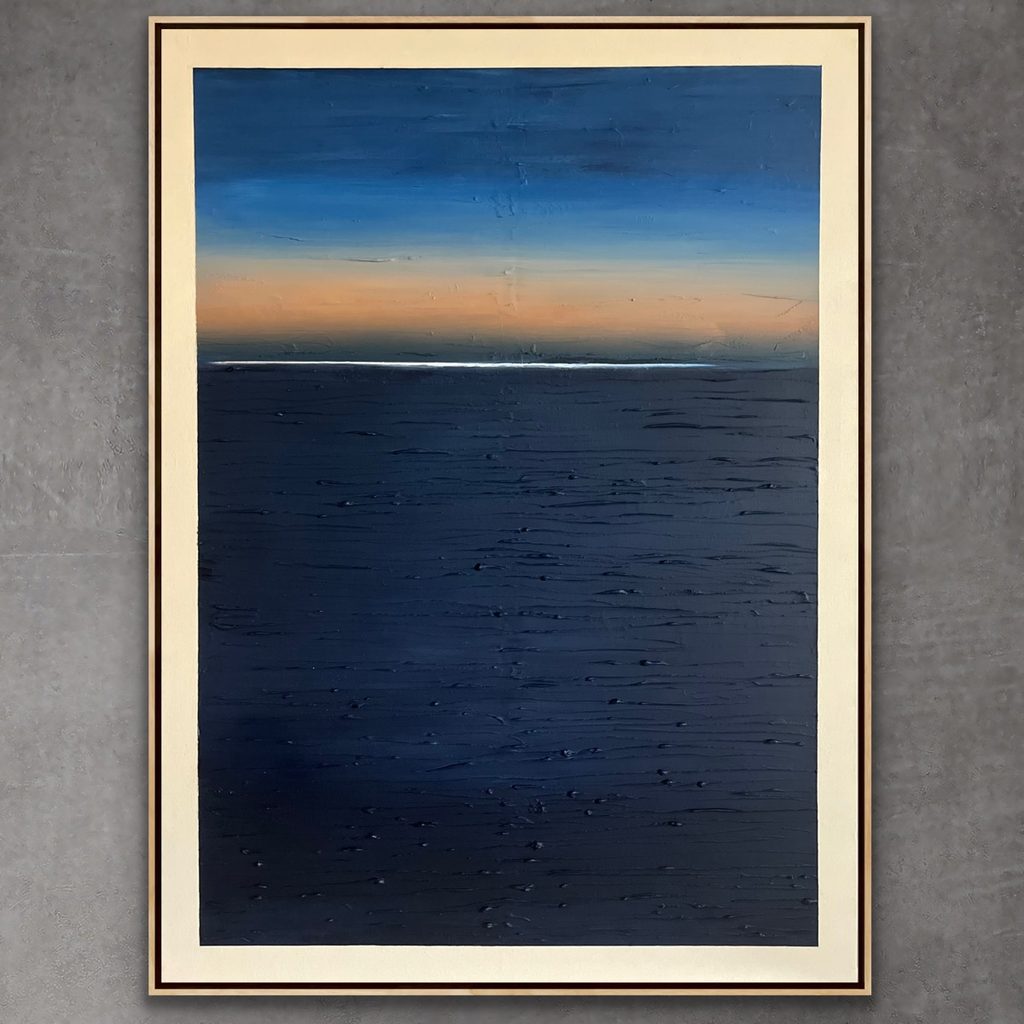
Her process is honest in a simple way: she paints in layers, over many days and many moods. A canvas she starts on a hard day might be finished when she’s in a completely different frame of mind, so a single painting ends up holding several feelings at once, changing alongside her as she works. Lately, she has even started asking how much texture a painting really needs, trying out pieces with very little, or none at all, and letting colour and tone do all the work. It’s a sign of an artist who is still curious and still growing.
Beyond her own practice, Alisha believes deeply in making art less intimidating and more human. Alongside her commissions and murals, she hosts sip-and-paint sessions under the motto “Come As You Are,” a space where anyone, whether or not they’d ever call themselves an artist, can pick up a brush, play with colour, and simply enjoy making something. For her, art was never meant to be complicated; sometimes, she says, all you need is a canvas, a few colours, and the willingness to try.
Now let’s hear from Alisha about the journey from design to art, her love of the sky, why she lets colour tell the story, and the quiet moment of pause she hopes her paintings offer.
Q1. Alisha! How did your journey in interior design lead you to develop your own creative practice?
Interior design was really the basis of everything for me, to be honest. When I was studying and eventually exploring interior design, I often felt that something was missing. No matter how well you designed a space from a functional or aesthetic point of view, there was always something that could elevate it further, something that could give it a distinct identity. I explored different avenues for that. I looked into product design, lighting design, furniture and various other disciplines.
But over time, I realised that what I was really looking for was that little element of the unexpected, that little bit of crazy that could take a well-designed space and make it truly come alive. And for me, that element was art.
I feel design comes with so many principles, explanations and guidelines, whereas art has a beautiful sense of freedom.
It’s subjective, it’s open to interpretation, and it doesn’t necessarily have to justify itself. And that’s what makes the relationship between art and design so interesting to me. They coexist in so many ways. You can see art in furniture, product design, lighting and, of course, the spaces we inhabit. It can completely transform the way you experience a space.
I think I was always curious about this one aspect of design that I hadn’t quite explored yet. And that curiosity eventually led me towards art. Interestingly, when I first started exploring art, I didn’t know what form I wanted to pursue. I wasn’t sure whether it would be painting, sculpture or something more functional. I just knew I wanted to explore that freedom of expression that I felt art offered. And somewhere along the way, that exploration developed into my own artistic practice.
Q2. What continues to draw you to changing skies, horizons, sunrises, and sunsets?
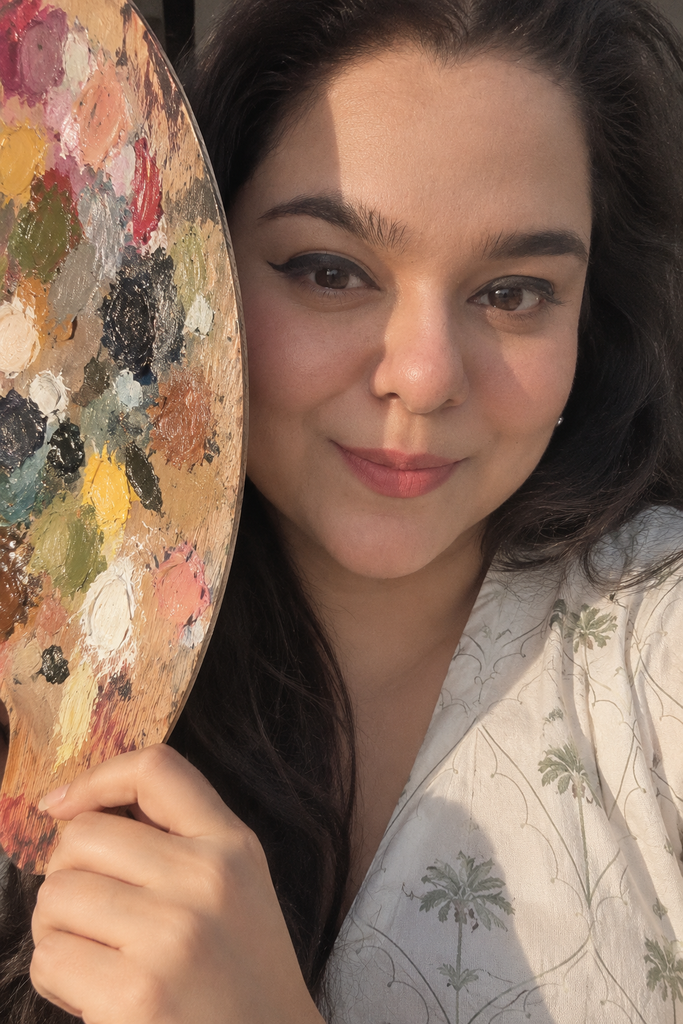
I think I’ve always been someone who finds a lot of joy in watching a sunset by the beach. Even as a child, I found myself gravitating towards those quiet moments in nature. I’ve always felt that nature has its own way of healing you.
I grew up surrounded by people I love, and when you’re growing up around so many different personalities, sometimes you tend to overlook your own. I realised that some of my clearest thoughts would come when I was away from all that noise, whether I was sitting on my terrace, spending time by the beach on a holiday, or simply looking at the sky from somewhere in the hills.
I could think better, feel more at ease and, in a way, reconnect with myself. I even remember being able to study better as a child when I was sitting out on the terrace, under an open sky. And then, of course, there was the visual fascination. I would find myself in awe of how the same sky could look so different every single day.
The colours, the intensity, the light, the way everything shifted from one moment to another. It fascinated me that something so familiar could never really look the same twice. I think one thing that has always stayed with me is the consistency of nature.
We spend so much of our lives contemplating and worrying about things, and yet the sun continues to rise and set every single day. It happens when it’s supposed to. The process remains the same, but the colours change, the brightness changes, the atmosphere changes. There’s something very reassuring about that steadiness amidst all the constant change.
And I think that’s what continues to draw me towards these moments of transition. They give me a sense of peace, but they also remind me that change can be beautiful, and that there’s something comforting about knowing that everything has its own rhythm.
Q3. How do you translate a feeling or memory into colour, texture, and composition?
I think colours have an identity of their own. Nature is undoubtedly one of my biggest inspirations, particularly the sky. As I’ve mentioned, it’s fascinating how the same sky can look so different every day. The sun is the same, the sky is the same, yet the colours, the brightness and the entire atmosphere keep shifting.
People often refer to the sky as God’s own painting, and I genuinely believe there’s something very magical about it.
No matter how dramatic the colours or how gloomy the sky might look, there’s an inexplicable calmness that it brings with it. It makes you pause, slow down and just breathe for a moment. Regardless of how your day has been, looking at the sky somehow gives you that little space to reconnect with yourself. I think that’s also what I try to explore through my work.
I believe colours carry so much emotion within them. A particular shade of blue, for instance, can mean completely different things to different people. And rather than imposing a particular narrative on the viewer, I like allowing colours to be their own heroes. I want them to have their own identity and their own voice.
People often ask me about the story behind a particular painting, but I don’t think there’s always one definitive story. In fact, I feel every painting evolves with you. I’ve painted on days when I’ve been sad, angry or incredibly happy. And sometimes, a painting that begins on a difficult day is completed when I’m in an entirely different emotional space.
That’s something I find particularly beautiful about working in layers. The colour or layer that I put down on one day carries the emotion of that moment, but when I return to the same canvas on another day, I might respond to it completely differently. In a way, the new layers transform not just the painting but also my relationship with what I had initially put down. So, the same canvas ends up holding multiple emotional experiences.
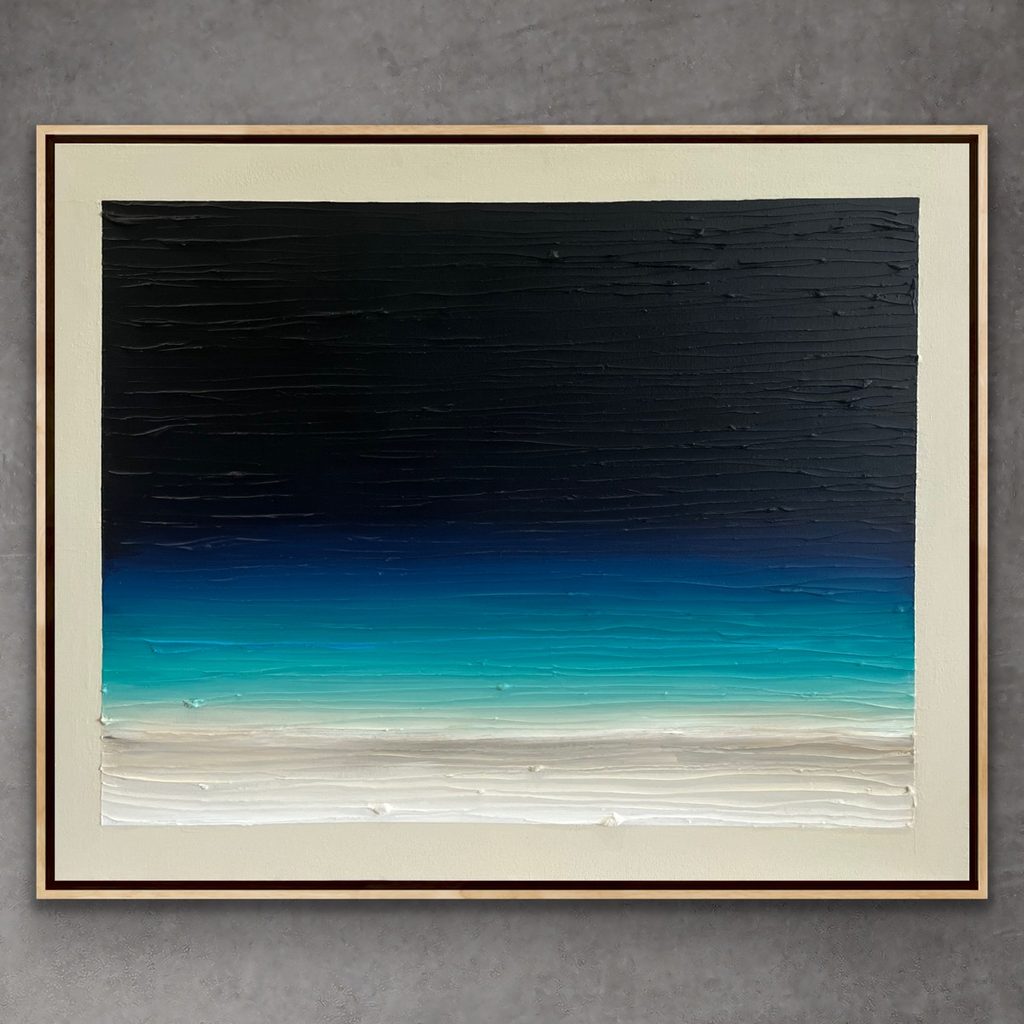
As far as the composition goes, I prefer to keep things relatively minimal. I don’t like overcrowding my paintings with too many elements. I do enjoy incorporating texture, particularly linear elements, because I feel they bring a certain sense of order to the composition.
There’s something interesting about the psychology of lines, too. I feel that when lines have a certain rhythm and uniformity, they can bring a sense of structure and calmness, even within an otherwise fluid composition. I like that balance between movement and stillness, between freedom and control.
Ultimately, I want to leave enough room for the viewer to bring their own experiences to the painting. I don’t necessarily want to tell them what to feel. I’d rather create something that allows them to feel whatever they find in it.
Q4. The horizon can represent a place or a possibility. What does it mean to you personally as an artist?
For me, the horizon is essentially a point of meeting. We look at it and assume that two elements are coming together, perhaps the sky and the earth, or the sky and the sea. But do they actually ever meet? We don’t really know. And I find that idea of infinity quite fascinating. I’ve never really looked at the horizon as a beginning or an ending. For me, its beauty lies in the magic it creates through the coming together of different elements. I often notice how the same landscape can look completely different depending on the atmosphere.
For instance, a horizon on a rainy day, when you’re looking out towards a green landscape or a forest, can make the greens appear so much more vibrant, the leaves almost shinier and more luminous. And that very same landscape under a bright sunny sky can evoke an entirely different feeling. So, the horizon isn’t necessarily changing the landscape itself, but it’s changing the way we perceive it.
It’s creating a relationship between elements, allowing each to bring out something different in the other. I think that’s something I deeply relate to in my artistic practice as well. I love the idea of colours coming together without losing their individual identities.
They don’t necessarily have to merge completely to belong together. Sometimes they simply complement, enhance and support one another. And perhaps that’s what the horizon represents to me: not a boundary where two things end or meet, but an infinite space where two elements exist in harmony, constantly bringing out the beauty in each other.
Q5. Gradual shifts in colour are central to your visual language. How do you choose a palette to express the mood of a particular work?
I think my fascination really lies in these gradual shifts. There is something about them that naturally induces a sense of calm and peace. They allow the eye and the mind to perceive colours in their individual identities, while also experiencing the beautiful harmony that emerges where two colours meet. What I find particularly interesting is that this can happen with complementary colours just as beautifully as it can with colours from the same family.
The palette may change, the combinations may vary, but the feeling of calm and tranquillity remains something I want to preserve in my work. Sometimes, vibrance can take over and create a certain visual chaos. But when you allow a gradual transition, when you give even the slightest tonal difference its own character, it creates space for the eye and mind to slow down.
You begin to perceive the different moods within a colour, and almost find a little space to breathe within the painting. That’s something I hold very close to my practice. The process usually begins with a certain intention, an inspiration, an emotion or perhaps a particular image of nature that stays with me. But as the layers and blends develop, they often take over and evolve into something I hadn’t imagined. Sometimes, the final work looks exactly as I had visualised it, almost like a sky or a moment in nature that I had stored somewhere in my mind.
But I’m perhaps even more fascinated when it doesn’t turn out that way. That’s when the colours and tones begin to communicate on their own, and the work takes on a life of its own. I find that particularly exciting because, despite this evolution, it never really loses the essence of its original inspiration.
For me, it’s that coming together of nature, emotion, intuition and the unexpected that ultimately determines the palette and the atmosphere of a work.
Q6. Texture adds a physical and emotional layer to your paintings. What role does it play in the stories you want to tell?
I feel texture has a personality of its own. It adds drama, depth and a certain physical presence to the painting.
It gives the surface another dimension and allows me to introduce a little more movement and character, while still keeping the overall composition quite controlled. I think that’s an interesting balance — allowing the drama to exist without letting it turn into chaos.
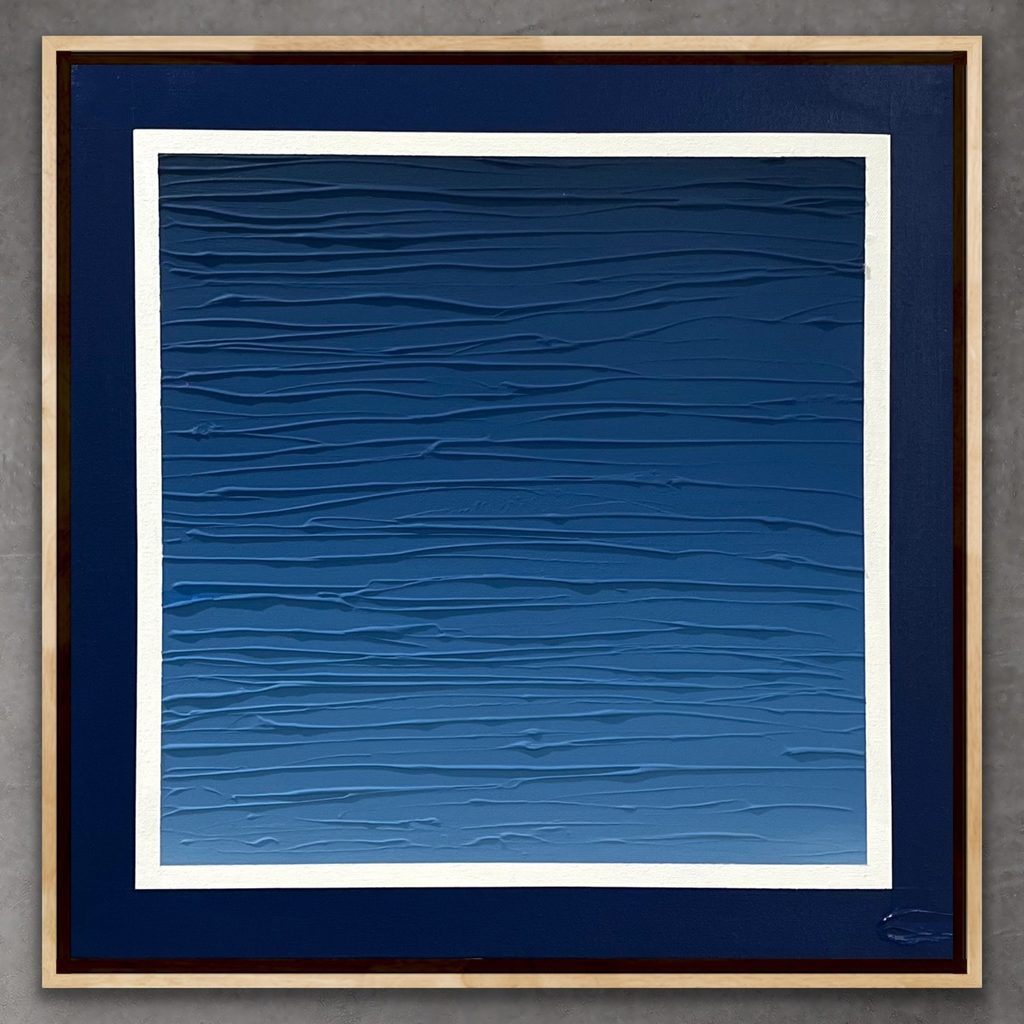
Having said that, lately I’ve also been experimenting with a few pieces that have very little texture, or sometimes none at all. I think I’m at an interesting point in my practice where I’m questioning how much texture a painting really needs. I’m almost at a crossroads where I’m exploring the possibility of taking it away completely and allowing colour, tonal transitions and the fluidity of the blends to do all the talking. And I find that equally exciting.
It’s almost like discovering a different side of my own visual language. When you take texture away, you begin to notice the nuances of colour and the smallest tonal shifts even more. I don’t think I’ve arrived at a conclusion yet, and perhaps that’s the beauty of it. I’m still discovering, experimenting and allowing my practice to evolve. I’m quite excited to see where this exploration takes me.
Q7. How do you consider the relationship between a painting and the space where it will be experienced?
I think my background in interior design has definitely shaped the way I look at art and the spaces it inhabits. I have always believed that art doesn’t exist in isolation; it becomes part of the environment, almost changing the way a space feels and is experienced.
When I approach a painting, I don’t necessarily think about matching it to a particular colour scheme or aesthetic. I think more about the feeling it can bring into a space.
Sometimes a painting can introduce warmth, sometimes calmness, sometimes a certain energy or depth that wasn’t there before. I also feel that the relationship works both ways. The environment influences how we perceive a painting. The light, the scale of the wall, the surrounding textures, even the amount of breathing space around it can change how the colours and layers reveal themselves.
My interior design background makes me conscious of proportion, balance and visual harmony, but as an artist, I don’t want my work to simply blend into its surroundings. I like the idea of it having its own identity while still belonging to the space. Ultimately, I think a painting should do more than occupy a wall. It should create a feeling, invite a pause, and perhaps become something that the space is remembered for.
Q8. How does creating commissioned work differ from painting from personal inspiration?
I think whenever I’m taking on a mural or a commissioned piece, the client is really the starting point of the entire process. I like to spend some time getting to know my clients, understanding their personalities, their preferences and, if possible, a little about their lives. I feel that when you understand a person beyond just their brief, you can create something much more personal for them.
Something that they can come home to every day, look at and feel a sense of contentment and connection with. And I think that’s incredibly important. I’m also someone who doesn’t like to put restrictions on what a client can ask me to create versus what I usually paint. My personal practice is quite minimal, colourful and largely centred around colour fields.
But when it comes to commissions, I’m open to exploring very different styles and subjects, provided I feel I can do justice to what is being asked of me. I think my background in interior design has played a huge role here because design, at its core, is very much about understanding a client’s brief, interpreting it and finding the right way to bring it to life.
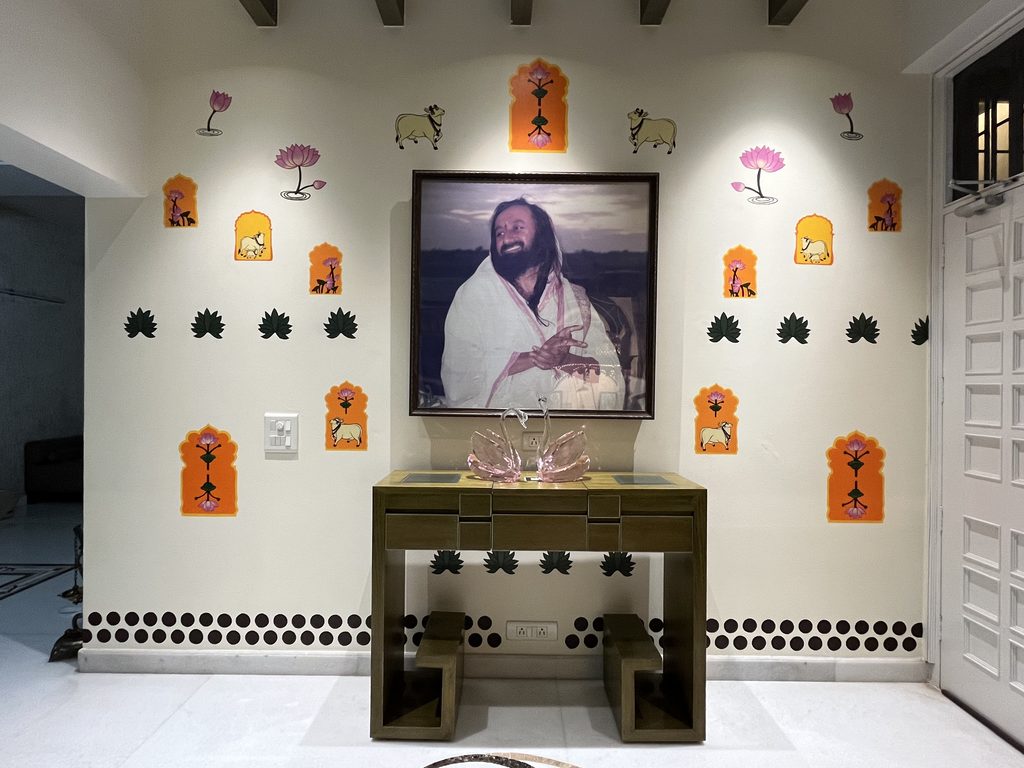
Over the years, I’ve also had the opportunity to work on commissions that are more Indian-art-oriented, and those projects have shaped me beautifully as an artist. They’ve taught me patience, helped me develop new skills and allowed me to explore artistic styles that are quite different from my own practice. In fact, that’s one of the things I find most exciting about commissions.
Every new brief brings with it an opportunity to explore something I may never have attempted otherwise, or perhaps something I’ve always wanted to explore but never quite got around to pursuing. I genuinely believe commissions are an integral part of an artist’s growth. They push you beyond your familiar language, make you discover new sides of yourself and sometimes even bring you back to ideas you may have left unexplored. And for that, I’m always grateful.
Q9. What do you enjoy about leading sip-and-paint workshops and making art more accessible?
I actually began hosting sip-and-paint experiences in 2023, although the idea had been living in my head for a few years before that. And honestly, it excites me just as much today as it did when we started. One of the biggest reasons for that is people. Ever since I stepped into the world of art, I’ve heard people around me, friends, family and even complete strangers, casually say things like, “I don’t understand art” or “I haven’t painted since I was a child.” And I think there’s an interesting disconnect there. Somewhere along the way, we’ve made art feel like something you need to understand, be trained in or have a certain sensibility for before you can approach it.
When we started ArtNest, I wanted to challenge that idea in my own little way. Our motto is Come As You Are, and that’s really what the experience is about. You can come by yourself, on a date, with your family, friends, children or whoever you choose. For those two hours, you get to step away from your everyday routine and explore a side of yourself that you may never have explored, or perhaps left behind somewhere in childhood.
You get to stand in front of a canvas, play with colours and create something entirely your own. And when I say perfection, I don’t mean perfect lines or technically flawless paintings. I mean finding your own version of joy in the process of creating something with your hands. The idea also came from something quite personal. When I’m painting alone in my studio, I often find myself having conversations with my canvas. There are so many thoughts, feelings and ideas that come up while I’m painting, and I think artists naturally crave that exchange.
Opening up the studio experience to people from completely different backgrounds and walks of life makes that exchange even more exciting. You get to share that creative space with people who may have never picked up a brush otherwise. I also feel that making art more accessible is important for a larger reason. Particularly in India, there are still so many misconceptions around art, whether it’s about collecting, understanding or even appreciating it.
People often don’t know where to begin, and that initial hesitation becomes a barrier. Through ArtNest, I want to make that first step easier. I want people to let their guard down, put aside the fear of judgement and simply experience art for themselves.
Because, ultimately, I don’t think art needs to be complicated. Sometimes, all you need is a canvas, a few colours and the willingness to let yourself explore. Art can be as simple as you allow it to be.
Q10. What have you learned about building a creative career while protecting your personal voice?
I feel it takes decades to build a career that you truly love, believe in and feel passionately about. And I don’t think that’s specific to art; it’s true of any profession. Art, however, does come with its own set of challenges, particularly in a country like India, where I’ve often seen it being perceived as a more unconventional or even luxurious career choice. Sometimes, it’s looked at as something that’s nice to have rather than something that’s essential. And I think that perception creates its own set of challenges for artists.
But having said that, I believe consistency is what really shapes you in any field. The amount of hard work you’re willing to put in, the commitment you bring to your practice and your willingness to keep showing up, even when things are uncertain, are what eventually help you grow. I don’t think art is any different in that sense.
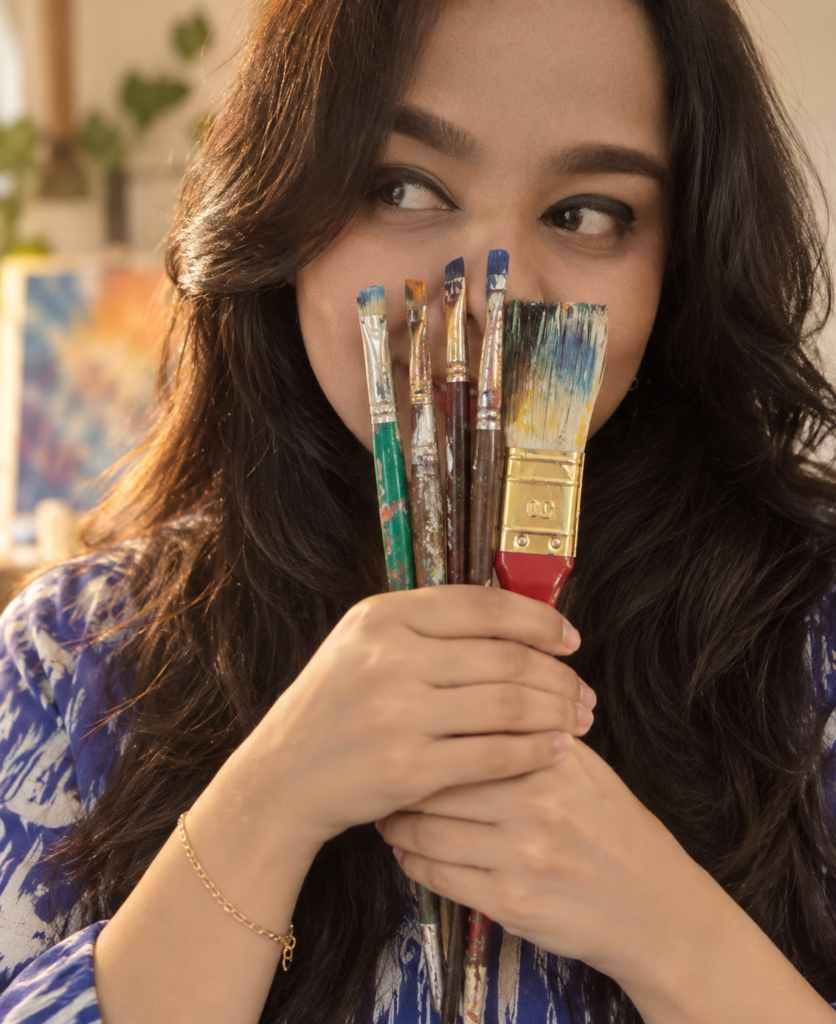
For me, being passionately in love with what you do is perhaps the biggest driving force. It’s what gets you out of bed every morning. It’s what makes your hands ache when you haven’t painted for a while. And I genuinely love that feeling. I think that kind of connection with your work is something you cannot manufacture. I’m still building, still discovering and still figuring out so many things about my practice and my career.
But one of the most beautiful parts of this journey has been the people I’ve met along the way. Through ArtNest, my commissions, my collectors and exhibitions, I’ve come across some truly wonderful human beings. And I’ve found that every interaction leaves me with something to learn or take back with me. I’m incredibly grateful for that.
I think we often measure a creative career through milestones, exhibitions, recognition or the work we put out into the world. But for me, the people I’ve connected with, the experiences I’ve gathered and the person I’m becoming through this journey are just as meaningful.
And perhaps that’s what makes this journey so fulfilling. I’m not just building a career; I’m growing alongside it.
Q11. What do you hope viewers feel or carry with them after spending time with your paintings?
I think more than anything, I want someone to feel something that is entirely their own when they stand in front of my work. I don’t necessarily want to dictate what they should see or what they should take away from it. A lot of my work comes from observing transitions, those quiet, almost unnoticeable moments where one thing seems to dissolve into another. I’m fascinated by the idea of things meeting, coexisting and constantly evolving.
And I think there’s something very human about that. We all go through transitions in life. Some are beautiful, some are uncomfortable, some are uncertain, and some happen so gradually that we don’t even realise we’re experiencing them. I think my paintings leave room for people to bring their own experiences, emotions and interpretations into those spaces. I also hope my work gives people a moment of pause.
We live such fast-paced lives, and there’s something beautiful about being able to stand in front of something without feeling the need to understand it, analyse it or arrive at a conclusion. Just allowing yourself to look, feel and exist in that moment. If someone finds calm in my work, I’d love that.
If someone finds a sense of longing, nostalgia, hope or even a completely different emotion, that’s equally beautiful to me. I think the most rewarding thing would be if someone carries a little bit of that feeling with them even after they’ve walked away from the painting.
Not necessarily a particular thought or message, but perhaps a moment of stillness, a sense of familiarity or a feeling they can’t quite put into words. I want my paintings to leave room for people to find a little bit of themselves within them. And I think that’s where the real connection between a painting and its viewer begins.
As we wrapped up our conversation with Alisha, we found ourselves thinking about how seldom, in a world this hurried, anyone is simply allowed to pause, and how quietly radical it is to make art that insists upon it.
It made us think about where contemporary art has drifted. So much of today’s art world rewards the loud and the immediate, the large-scale statement, the striking image built to stop a scroll, and in the age of AI, work that can be generated and consumed in seconds.
Against all of that noise, a quiet, contemplative painting can seem almost out of step. Yet artists like Alisha remind us that stillness has always been one of art’s deepest powers, and that the works that endure are rarely the ones that shout loudest. In a market that often mistakes spectacle for significance, choosing subtlety and calm is its own quiet act of conviction.
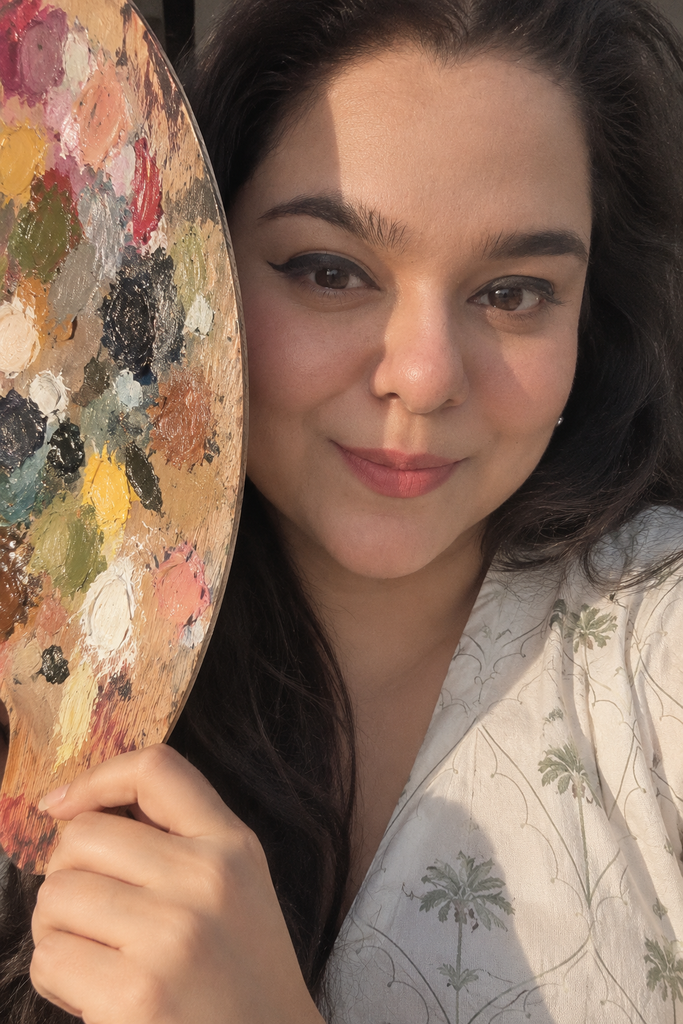
The art world has long felt like a members-only space, open to those with the right vocabulary, the right background, the right credentials, and closed to everyone else. That’s finally beginning to shift, as more and more artists throw the doors open and insist that art belongs to all of us. It’s a change long overdue, and a reminder that a painting’s true worth isn’t in how exclusive it is, but in how deeply it reaches the person standing in front of it.
For art lovers and collectors, Alisha’s work brings calm, warmth, and a quiet depth into a space. Soft, minimal, colour-led paintings built from gentle transitions of light and tone, where a sky or a horizon becomes somewhere to rest both the eye and the mind. People tend to find their own feeling reflected within them, a little different for each person. To live with one of her pieces is to keep a small, quiet moment of stillness on your wall, one that invites you, again and again, to pause, breathe, and simply be.
Follow Alisha Thakur through the links below and see her work for yourself.
This is it, just 6 days left. Submissions for the Woman Artist Award, 7th Edition are closing, and once they do, that’s it until next year.
For seven editions, this award has championed women artists across the world and given rising voices the recognition they deserve. Your work belongs in that story, but the clock is running out.
Any medium, any subject, any stage, from anywhere in the world. All that matters is your work and the voice behind it.
Don’t let this be the one you wish you’d entered. 6 days. That’s all that stands between you and your place in this edition. Submit now.