
Isabella Al-Sharif’s Luminous Paintings Turn Women into Living Mythology
At Arts to Hearts Project, each issue of our magazine begins with a single idea that artists around the world answer in their own way. For Issue 13, that idea was “The Things We Hold Onto,” and the submissions it drew in moved us deeply, some through memory, some through love, some through place.
One of the artists we chose was Isabella Al-Sharif, and her answer shone. What she holds onto, and wants every woman to hold onto, is the light within us, the kind no darkness can ever put out.
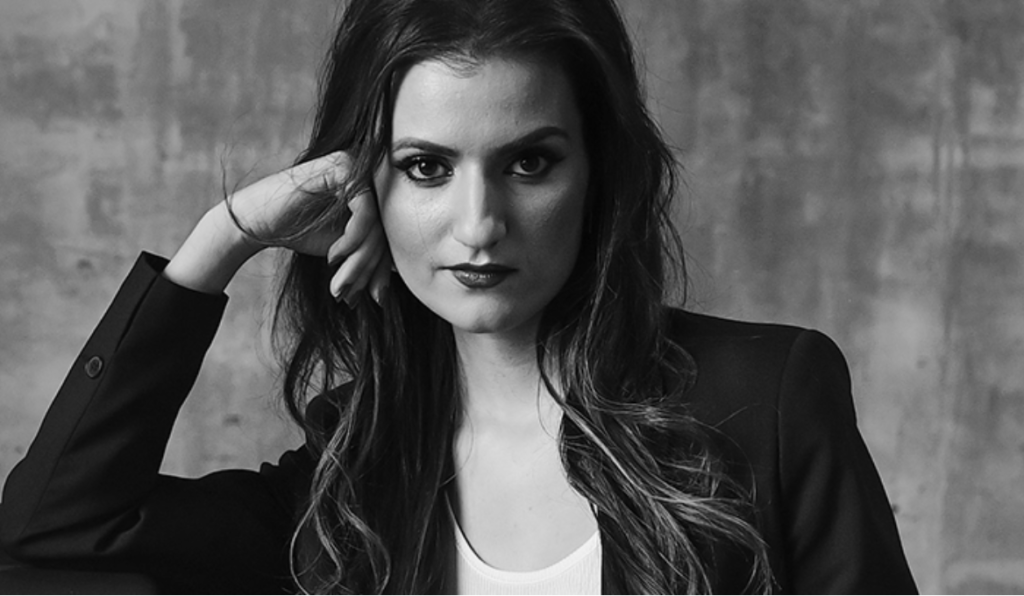
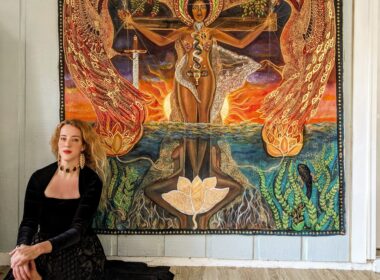
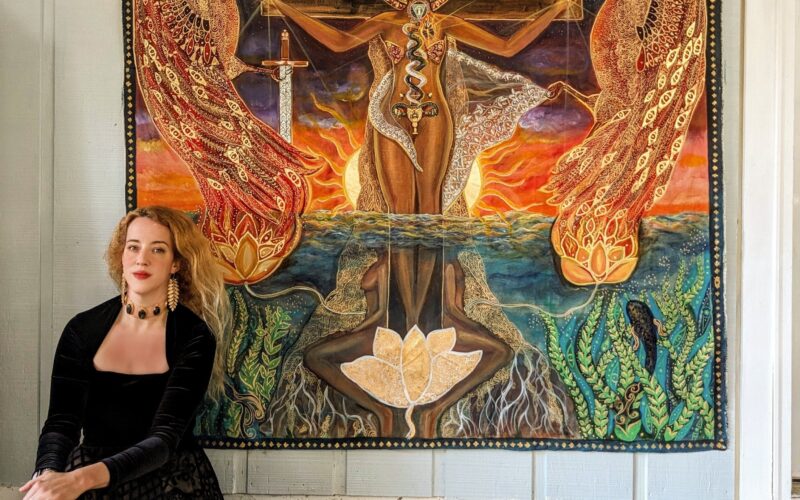
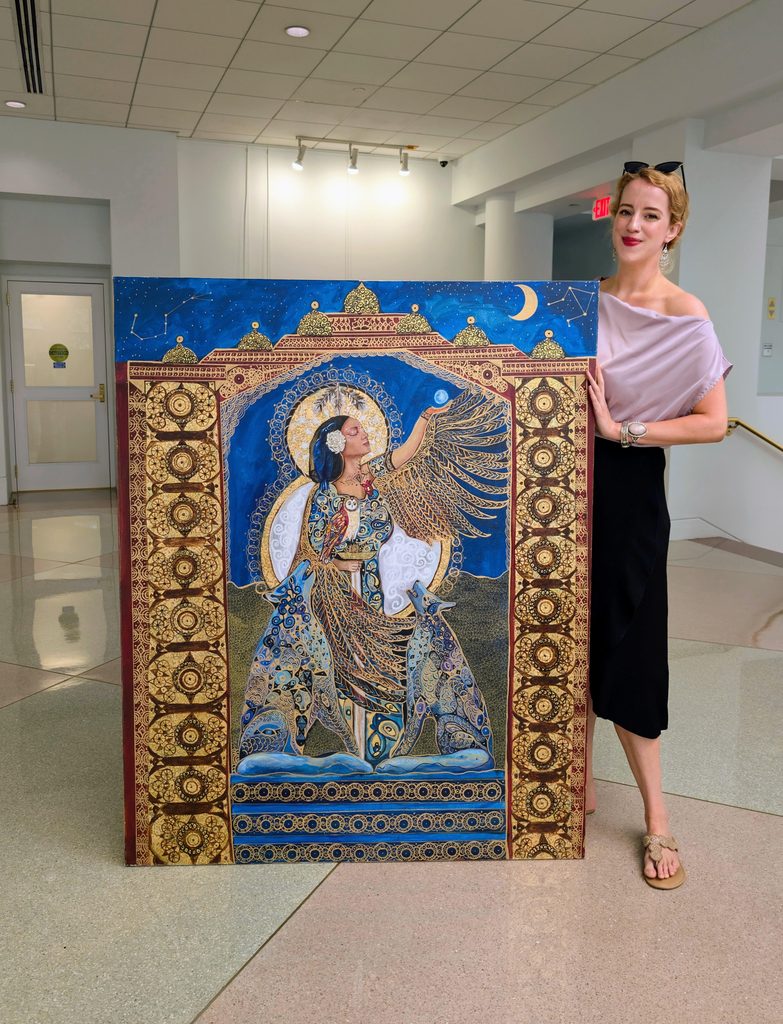
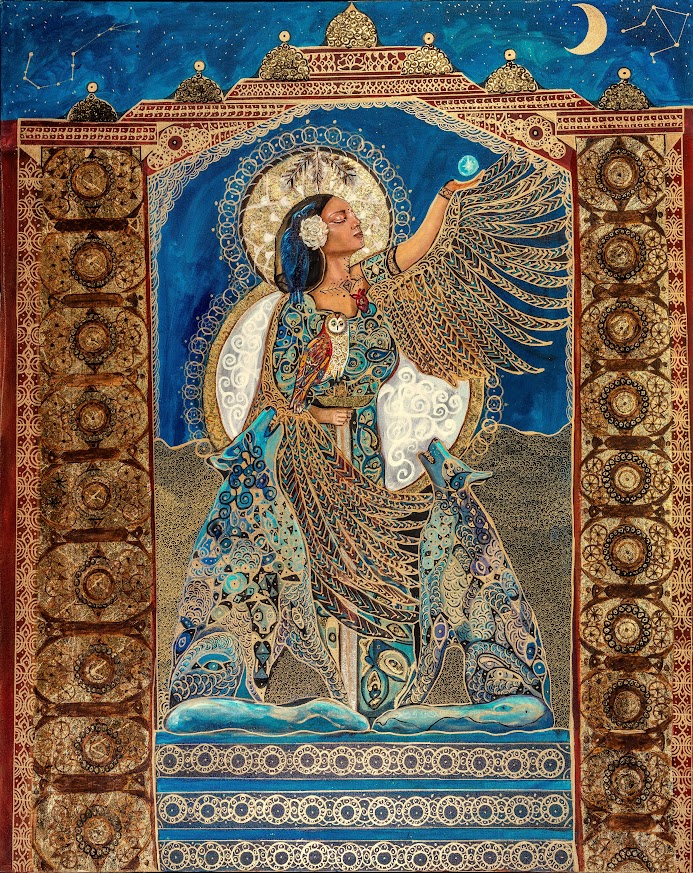
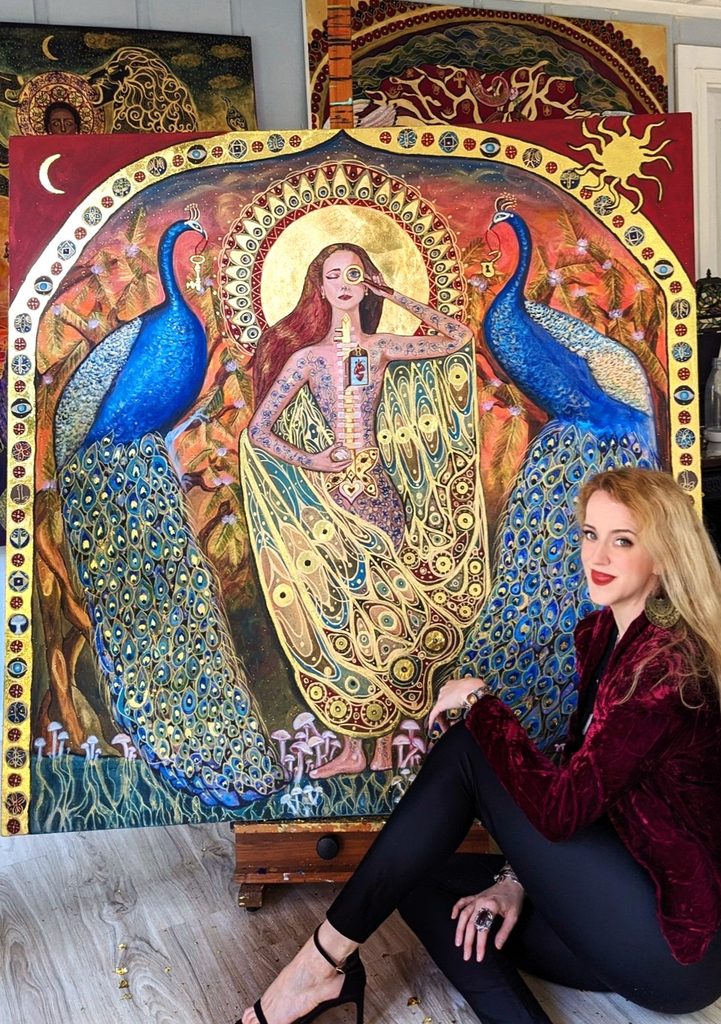
Isabella is a contemporary portrait artist who paints large-scale images of powerful, contemplative women, often haloed in gold leaf, flowers, animals, and symbol. Art, she says, was the first language she ever learned, a way to express herself when words could not, and she sees it as the one truly universal language, something two people from completely different worlds can stand in front of and both feel.
Everything she makes carries a single hope: to remind women everywhere of how powerful they already are.
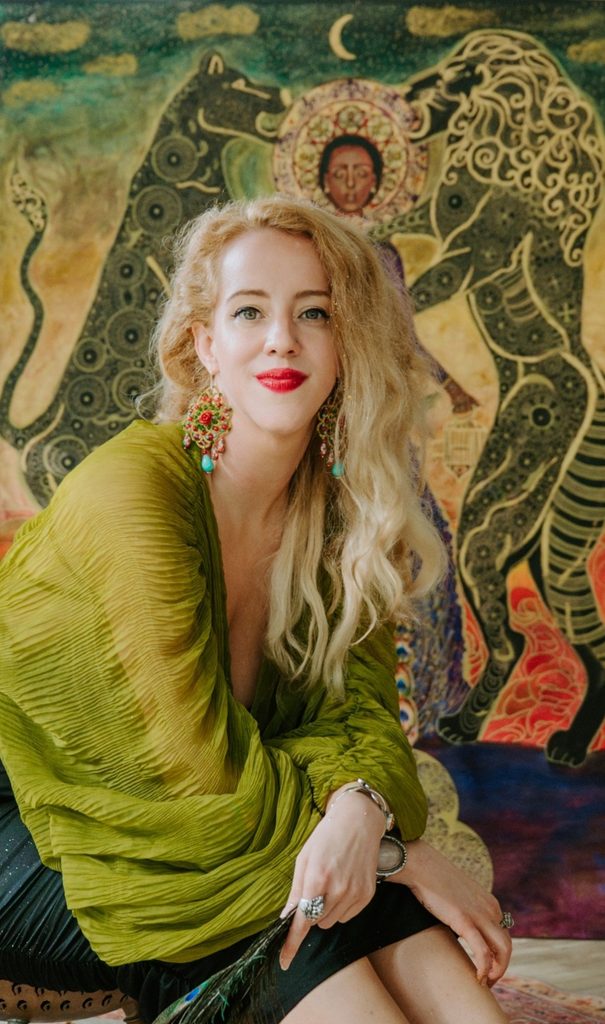
For Isabella, gold leaf is far more than a finishing touch. It catches the light and reflects it back, even in a dark room, which is precisely why she uses it. To her, it stands for the light inside all of us that can never truly go out. No matter how dark things get, something in us keeps shining. You can feel that in everything she paints.
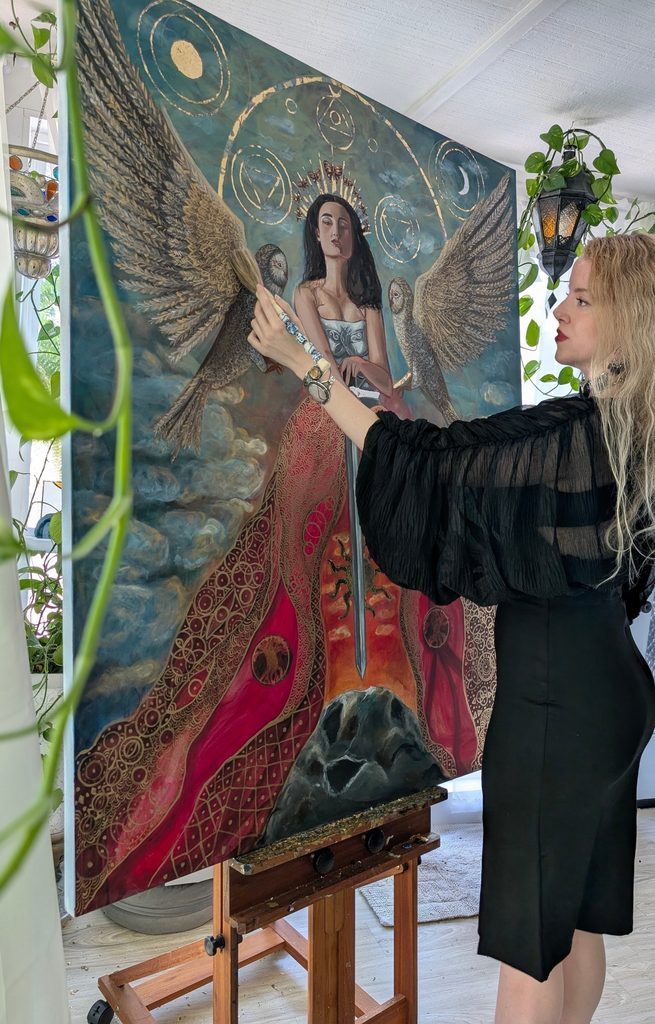
The way she works is very instinctive, almost like a kind of meditation. She barely plans anything ahead of time and hardly ever sketches first. She just starts, stays with it, and lets the images and symbols show up on their own, a little like a monk making a mandala. A lot of her animals and little details come straight from dreams or sudden moments of inspiration. She follows the painting instead of forcing it.
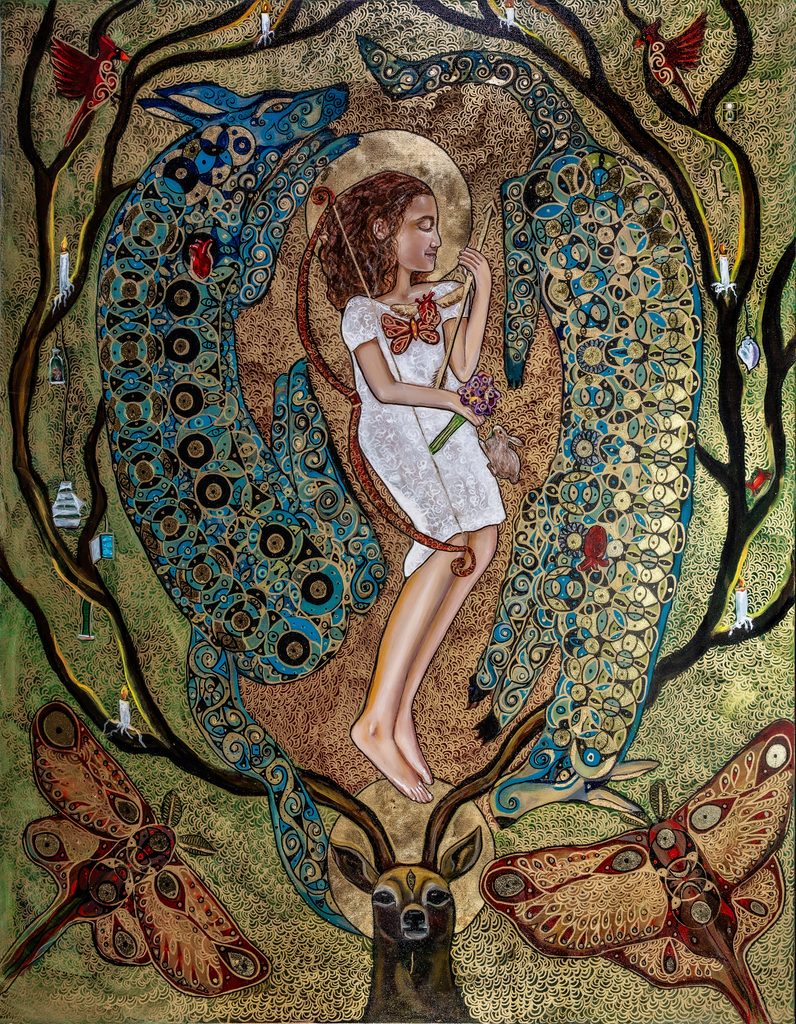
Nature is everywhere in her work, flowers, birds, bees, trees, because to her, nature and women’s strength go hand in hand. She loves the idea of Mother Nature as soft and nurturing but also incredibly strong, always growing, letting go, and beginning again.
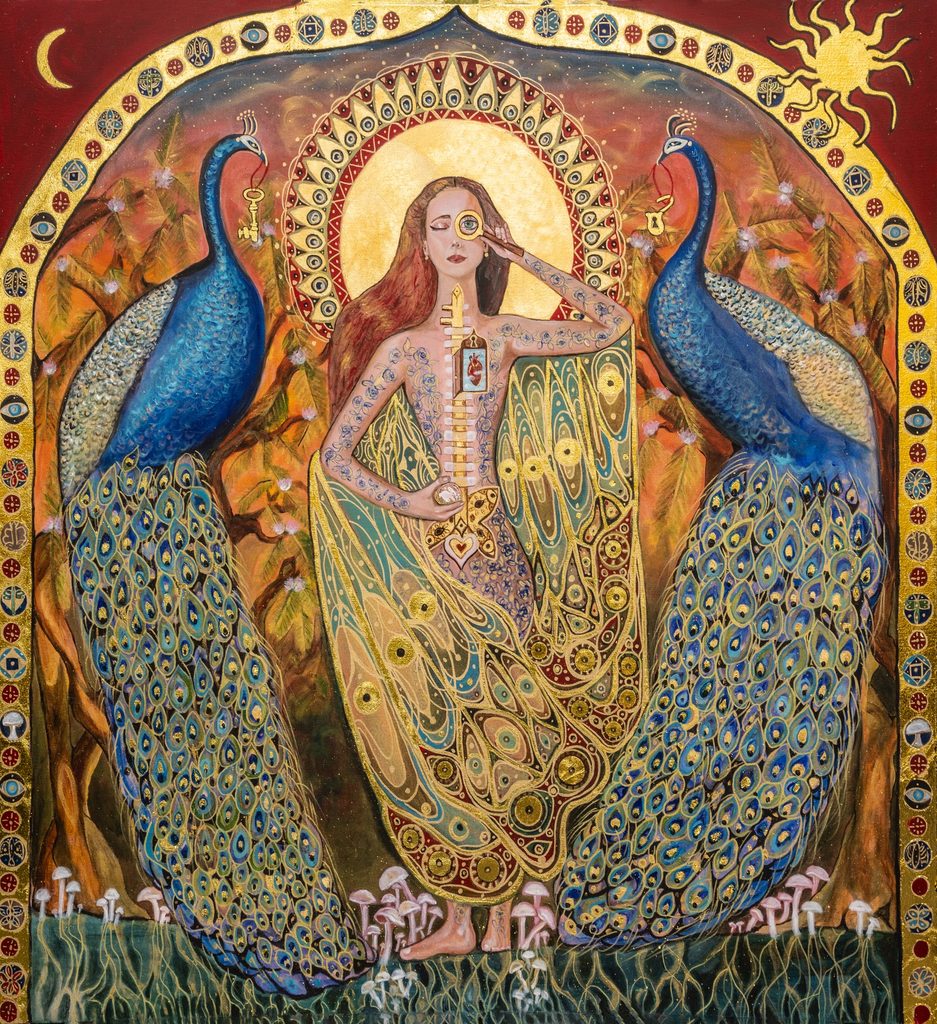
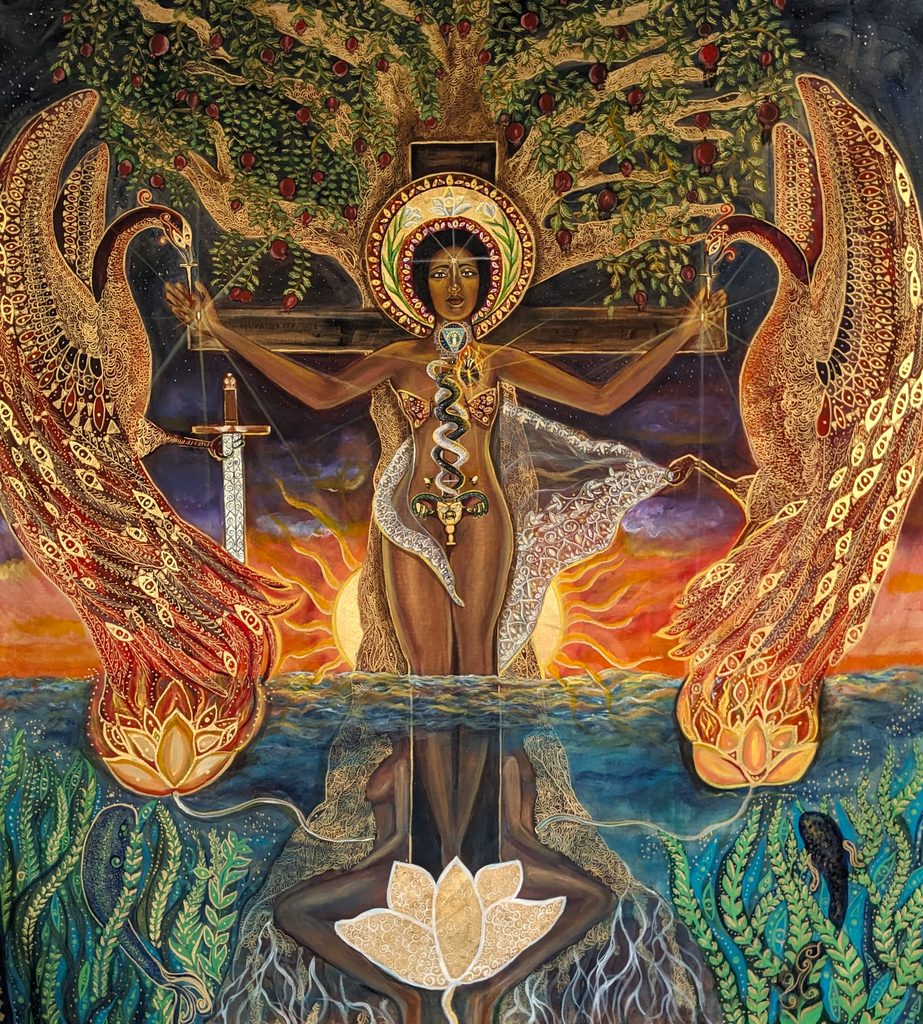
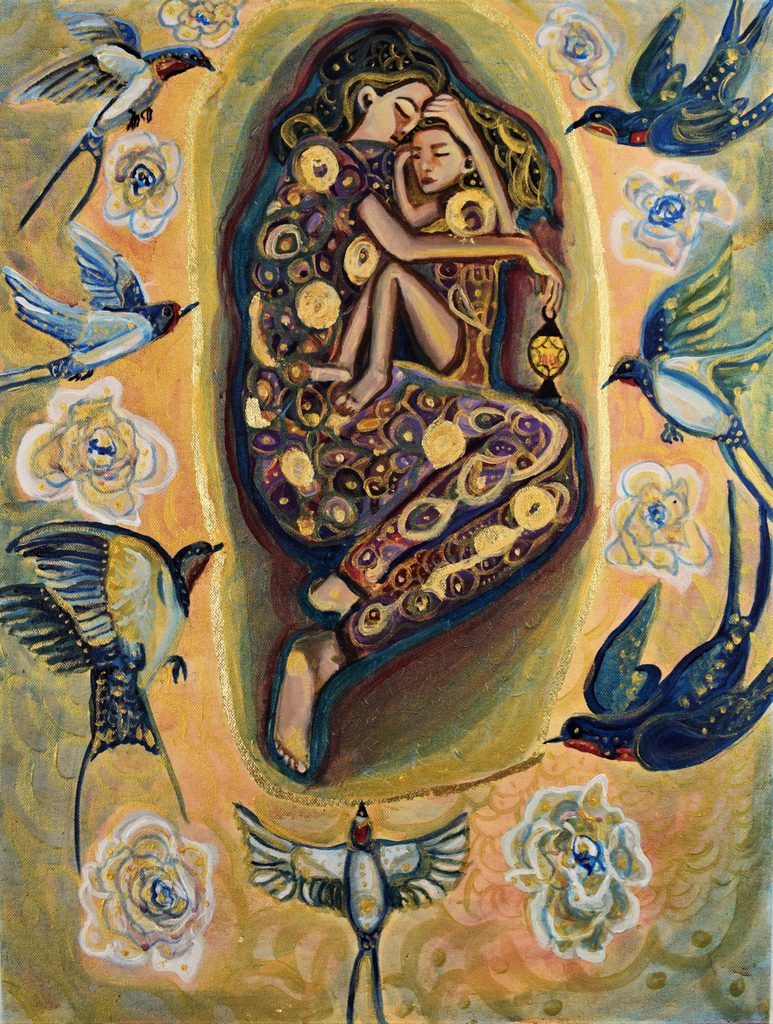
She uses all of that to talk about how resilient women are, how intuitive, and how much they can change and grow. In one piece, a mother and child are tucked into a nest of swallows and roses, a quiet picture of love as a safe place. In another, an old baobab tree stands for endurance and the strength handed down through generations.
She’s a poet too, and she’ll often put a poem next to a painting, usually one that comes to her after the work is finished. It’s her way of connecting the piece to whoever’s looking at it. And on top of her own art, she works as a curator, helping other artists get their work out into the world. For her, making art and curating it come from the same place, wanting to tell stories that matter and bring people together, especially women.
Now let’s hear from Isabella about the light she believes lives in all of us, why she paints without a plan, how nature mirrors feminine strength, and what it means to use art as a universal language of connection.
Q1. Could you tell us a little about the early experiences that shaped your relationship with art and creative expression?
I must credit my mother for fostering the love of creative expression within me. From the time I was born, she exposed me to various creative genres: music, visual arts, theater, dance, and writing. Due to this exposure, I felt a sense of liberty to harness my own creative expression, having experienced so many inspiring avenues of art.
Q2. You’ve described art as the first language you learned. How does that continue to shape your work?
Art gave me an avenue to express myself when words couldn’t. I see Art as the only universal language that connects us all.
Two people from entirely different worlds can both look at a piece of art and find a way to connect through this human experience of expression & emotion. My desire within my work is to create an uplifting message that can be felt by people from all walks of life. I want to remind women all over the world of how powerful they are.
Q3. Your women often appear powerful yet contemplative. What kind of strength do you hope to reveal through them?
Historically, women have often been denied autonomy over their bodies, their minds, and even their dreams.
I believe we are living in a transformative time, as women continue to claim freedoms, opportunities, and spaces that were once denied to them.
Through my work, I want to reflect that transformation and remind women of the strength that already exists within them- that they are powerful, capable, and worthy of taking up space and standing fully in their own power.
Q4. Your figures are surrounded by intricate patterns, animals, and natural motifs. How do you decide which symbols belong in a painting?
My process is deeply intuitive. Animals and symbols often emerge through dreams, intuition, or moments of insight, and I allow those images to guide the direction of the work. I approach each painting as a spiritual practice, almost a form of meditation, similar to the way Buddhist monks create mandalas as a contemplative practice. I rarely sketch my paintings beforehand. Instead, I remain present with the work and allow the imagery, symbolism, and meaning to reveal themselves as the painting unfolds.
Q5. Gold leaf is such a defining element of your paintings. What does gold allow you to express that colour alone cannot?
Gold leaf, to me, represents the light within us that can never be diminished. Unlike gold paint, gold leaf has a luminous, reflective quality; it catches and returns light even in the darkest environments. Because of this, I see it as a symbol of inner illumination and enlightenment. Its very nature embodies the message at the heart of my work: that no matter what darkness we encounter, there is a light within us that remains.
Q6. How does nature connect to your themes of feminine strength and transformation?
Nature and femininity have been deeply connected through mythology, spirituality, and symbolism for thousands of years.
I’m drawn to the idea of Mother Nature as both a nurturing and incredibly powerful force, one that is constantly creating, transforming, shedding, and renewing. I find a great deal of inspiration in that duality. By incorporating flowers, animals, and other natural elements into my work, I use the natural world as a reflection of feminine strength, resilience, intuition, and our capacity for transformation.
Q7. Nest explores motherhood as a form of sanctuary. What inspired you to explore this idea?
Nest was inspired by a very intimate period of early motherhood. When my daughter was young, we were both navigating the exhaustion that comes with sleepless nights, and I would often lie down beside her during the day. There were moments when I would simply watch her sleep, and despite the exhaustion, I experienced an extraordinary sense of stillness and peace.
Those memories became the emotional foundation for Nest. The painting explores motherhood as a form of sanctuary, the instinct to nurture, protect, and create a place of safety for another person. I wanted the work to capture the profound tenderness that can exist within those quiet, seemingly ordinary moments.
Q8. Dual Nature uses the African baobab tree as a symbol of resilience. What drew you to this powerful image?
The baobab tree felt like a natural symbol for Dual Nature because of its extraordinary resilience and deep cultural significance. Native to Africa, baobabs can live for thousands of years and endure incredibly harsh conditions, storing water within their massive trunks to survive periods of drought. They have long been associated with life, endurance, community, and ancestral wisdom.
I was particularly drawn to the way the tree seems to embody both strength and nourishment. There is something deeply feminine in that duality, the ability to withstand adversity while continuing to sustain and create life. In Dual Nature, the baobab becomes a symbol of resilience, spiritual rootedness, and our connection to something much older and greater than ourselves.
Q9. You are also a poet, and your paintings often include writing. How does poetry allow you to explore ideas differently?
I often begin with the painting and allow the poem to emerge after the work is complete.
Painting is a very intuitive and visual language for me, while poetry gives me another way to articulate the emotions, symbolism, and ideas that exist within the work.
I see the poem as a bridge between the painting and the viewer, an invitation to engage with the piece on another level. It allows me to create an additional point of connection while still leaving space for the viewer to bring their own experiences and interpretations to the work.
Q10. Alongside your studio practice, you also work as a curator. How has this influenced your own practice?
Working with artists across so many different genres and stages of their careers has been incredibly inspiring. It continually exposes me to new perspectives, creative processes, personal stories, and ways of approaching art that are different from my own. That experience has broadened the way I think about my own practice and has reinforced how important it is for artists to remain curious and connected to a larger creative community.
There is also something deeply fulfilling about being able to support other artists and help create opportunities for their work to be seen and recognized. I genuinely find so much joy in facilitating those moments. In many ways, curating and creating feel interconnected to me; they both come from a desire to tell meaningful stories and create connections through art.
Q11. How does making your own work differ from curating the work of other artists?
I find the two roles to be closely related, but distinctly separate.
Being both an artist and a curator allows me to understand the creative process from the artist’s perspective while also considering the broader needs of an exhibition and the organization presenting it.
When I enter my own studio, I intentionally allow the expectations of the outside world to fall away. That space is deeply personal and intuitive, and I give myself the freedom to create without thinking about how the work needs to function within a larger context.
As a curator, I shift into a different way of thinking, one that is more representational, organizational, and focused on creating meaningful connections between individual works, artists, and the audience. I value being able to move between those two perspectives, because each has given me a greater appreciation for the other.
Q12. Having experienced both sides of the art world, what do artists often misunderstand about the curatorial process?
Every arts organization operates differently and has its own mission, so the priorities of a commercial gallery may be very different from those of a nonprofit arts organization. As artists, we naturally experience our work as something deeply personal and distinctly our own.
From the curatorial perspective, however, you also have to consider how that work communicates within a larger context. In a nonprofit setting, part of our role is to serve as a bridge between the artist, the artwork, and the community. We want to create opportunities for audiences to connect meaningfully with the work and understand why it matters.
That experience has reinforced for me how valuable it is for artists to develop a strong conceptual foundation and to be able to articulate the ideas and intentions behind their work. The work should remain authentic to the artist, but understanding how to communicate its meaning can help create a deeper connection with the people experiencing it.
Q13. What has been the most meaningful recognition you’ve received in your career so far?
I would say being part of the Arts to Hearts Project and having my work published internationally has been an incredibly meaningful form of recognition. Knowing that my work and its message are reaching audiences beyond my immediate community has been very affirming. My exhibition Her Temple in 2024 was also a significant milestone because it was my first exhibition as a featured artist.
What made that experience particularly special was sharing the exhibition with so many talented and powerful women artists. There was a genuine sense of connection and mutual support that developed between us, and it became much more than an exhibition; it was a beautiful experience of community and creative sisterhood. Those moments are especially meaningful to me because they reflect what I hope my work can ultimately do: create connection, particularly among women.
Q14. What changes when an emerging artist begins to see their practice as a career?
As artists, I think we often struggle with self-doubt and question whether our work is worthy of being taken seriously. There is a significant shift that happens when an emerging artist begins to recognize their practice not simply as something they do, but as a meaningful career and contribution.
When we begin to believe in the value of our own voices, we become more willing to take risks, pursue opportunities, advocate for ourselves, and fully commit to our ideas. Taking yourself seriously doesn’t mean that doubt disappears entirely; it means choosing not to let that doubt determine what you are capable of.
I believe art has the ability to challenge perspectives, create connection, and shape culture.
When artists trust their voices enough to share them fully, they have the potential to create meaningful change in the world.
Q15. What advice would you give to artists who want to create work that is deeply personal while still speaking to a much wider audience?
Creating art is an inherently vulnerable and deeply personal act. It can be frightening to put something so intimate into the world knowing that it may be criticized, misunderstood, or judged. Not everyone will connect with what you create, and I think learning to accept that is an important part of becoming an artist.
What makes that vulnerability worthwhile are the moments when someone does connect, when a person sees themselves in your work, feels understood by it, or is moved by something you created from your own experience. I believe our vulnerability is often where the most universal connections are found, and that art has the capacity to heal through those shared human experiences.
I often return to my belief that art is our universal language. It can communicate across cultures, backgrounds, and experiences in ways that words sometimes cannot. That is why it is so important that we continue to create honestly, protect that language, and keep it alive.
Talking with Isabella left us thinking about how easily we forget our own strength, and how much it can mean, in the middle of a hard time, to be reminded that the light inside us is still there.
So many of us, women especially, are taught in a hundred quiet ways to doubt ourselves, to shrink, to take up less room. Isabella’s work pushes gently back against all of that. She paints women as powerful, luminous, and completely worthy of taking up space, and she lays real gold into each one like a promise that nothing can ever put that light out.
What moves us most is how generous it all is. She isn’t just making beautiful paintings, she’s holding up a mirror, so that any woman standing in front of one might see her own strength looking back. In a world that so often asks women to dim themselves, that is a quietly powerful thing to do.
There’s a lot here for other artists, too. Isabella is honest about how much self-doubt artists carry, and about the shift that happens when you finally start to believe your own voice is worth sharing. Taking yourself seriously, she says, doesn’t mean the doubt goes away.
It means not letting it decide what you’re capable of. She also really believes that our vulnerability is where the truest connections are made, that the braver and more honest we are in our work, the more likely someone is to see themselves in it. And as both an artist and a curator, she’s seen how much further we all go when we lift each other up instead of going it alone.
For art lovers and collectors, Isabella’s work brings warmth, strength, and a quiet sense of the sacred into a room. Luminous, large-scale paintings, full of gold and nature and meaning, that feel less like decoration and more like a daily reminder. People often find their own story somewhere inside them. To live with one of her pieces is to keep that light close by, and a gentle, everyday reminder of the strength you already carry within you.
Follow Isabella Al-Sharif through the links below and see her work for yourself.
There’s a kind of magic in a surface that shows the hand that made it, the build-up, the scrape, the stitch, the layers pressed one over another. Our 101 Art Book: Texture Edition is now open for submissions, and that’s exactly what we’re looking for. If you shape, carve, weave, or layer texture in ways all your own, we’d love to see your work.
The medium doesn’t matter. Where you are doesn’t matter. How long you’ve been at it doesn’t matter. All that counts is that something real is happening on the surface. Every artist in our pages began with a single submission. This could be your edition.