

The Artist Behind Art History’s Strangest Cats
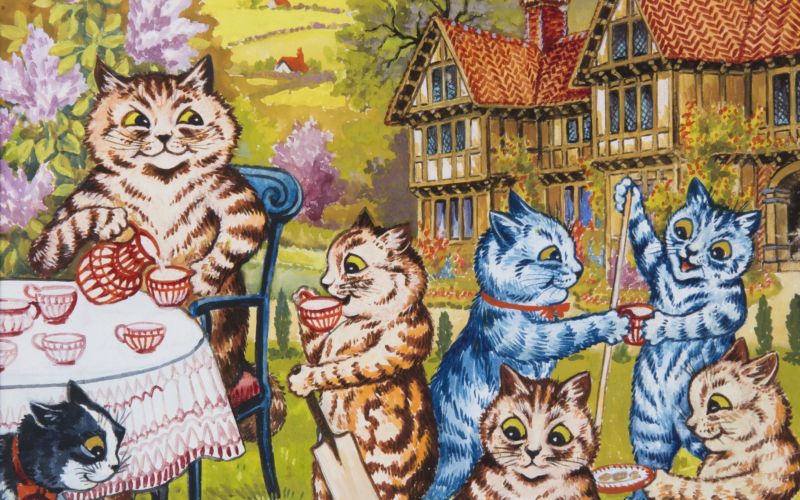
Long before the internet transformed cats into global celebrities, one Victorian illustrator had already built an entire universe around them. In Louis Wain’s strange and endlessly imaginative world, cats hosted dinner parties, gambled over card tables, performed in orchestras, flirted shamelessly at dances, and stared back at viewers with expressions that felt unnervingly human. At first, the drawings appeared playful, comic little mirrors reflecting the rituals and absurdities of polite society. But over time, something inside that world began to shift.
The cats became strangers.
Their faces stretched into hypnotic patterns of electric color and fractured geometry. Wide feline eyes glowed like stained glass windows. Fur dissolved into intricate mosaics that looked less like traditional illustration and more like visions pulled from a dream, or perhaps a fevered hallucination. Decades later, these images would become famous not only for their bizarre beauty, but also for the mythology surrounding the man who created them.
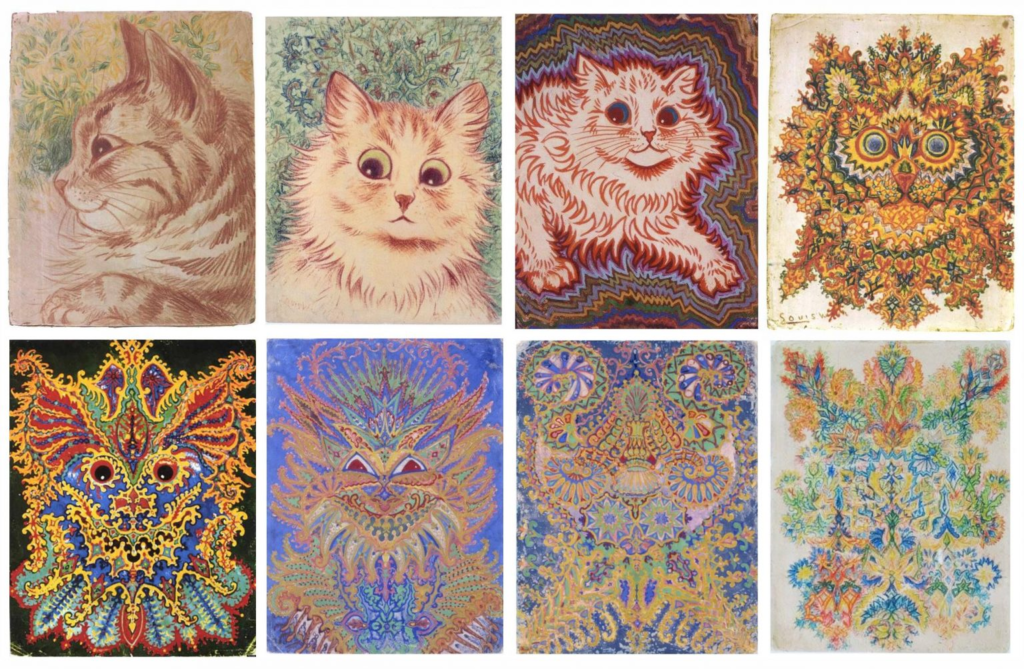
Louis Wain has long been remembered as the “mad cat artist,” a tragic genius whose increasingly psychedelic paintings were supposedly visual evidence of psychological collapse. For years, psychiatrists, historians, and popular media turned his work into a cautionary tale about creativity and mental illness. But the deeper one looks into Wain’s life and art, the more complicated that narrative becomes.
Because these paintings are not merely symptoms.
They are whimsical and eerie, comforting and unsettling, humorous and deeply lonely all at once. They capture Victorian society, personal grief, obsession, commercial fame, and the strange emotional bond humans have always shared with cats. More than a century later, Wain’s feline universe still feels oddly alive, part cartoon, part psychological labyrinth, and entirely impossible to forget.
1. Before They Became Psychedelic, Wain’s Cats Were Victorian Socialites
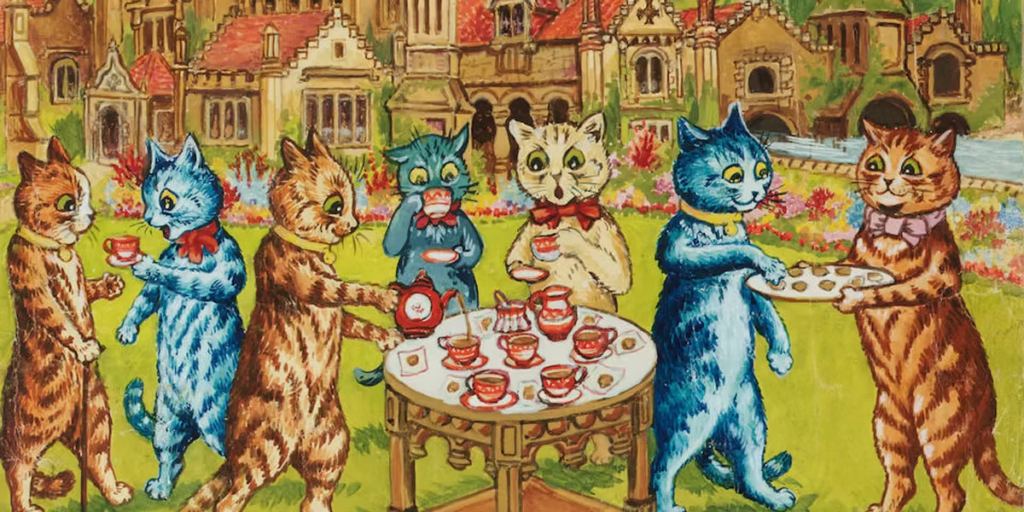
Long before the internet transformed cats into global celebrities, one Victorian illustrator had already built an entire universe around them. The artist behind art history’s strangest cats was Louis Wain, whose strange and endlessly imaginative feline world blurred the line between whimsy and psychological mystery. In Wain’s universe, cats hosted dinner parties, gambled over card tables, performed in orchestras, flirted shamelessly at dances, and stared back at viewers with expressions that felt unnervingly human. At first, the drawings appeared playful, comic little mirrors reflecting the rituals and absurdities of polite society. But over time, something inside that world began to shift.
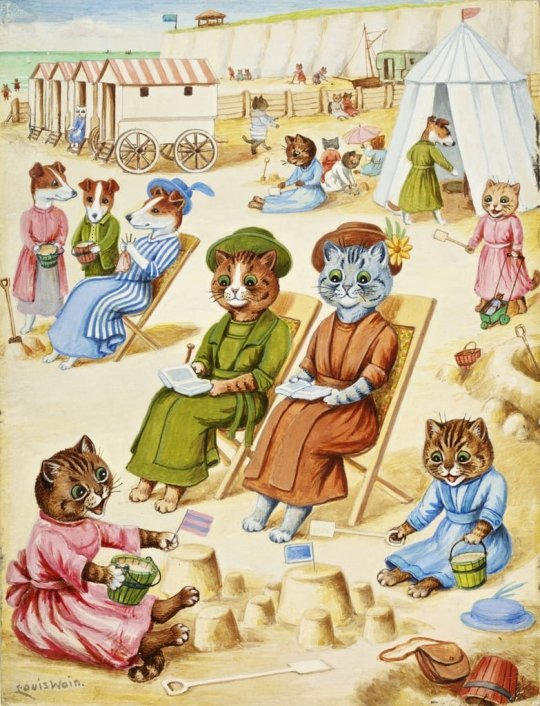
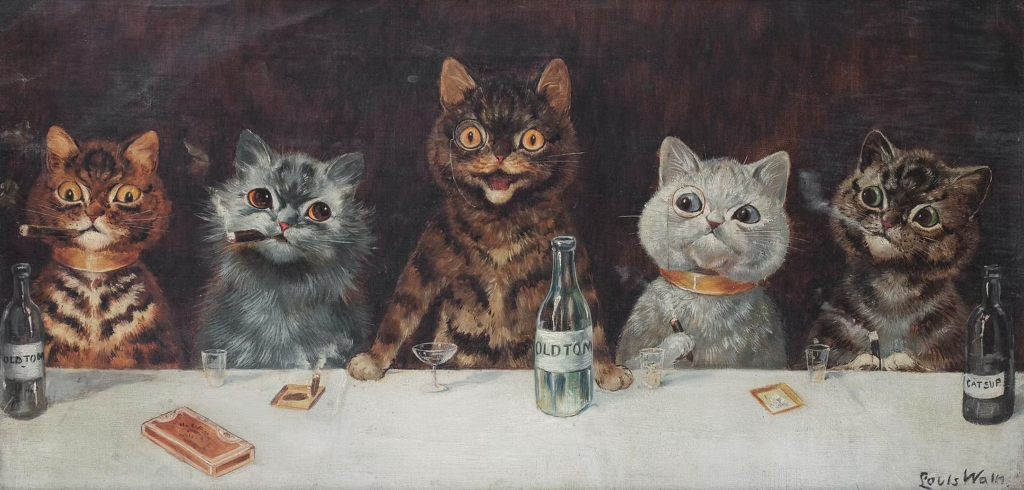
At first glance, Wain’s cats appear charmingly ridiculous: wide-eyed felines dressed in tailored jackets and dainty hats, behaving like members of polite society. But underneath the whimsy was a surprisingly sharp observation of human behavior. Victorian England was obsessed with etiquette, class performance, and social rituals, and Wain transformed those anxieties into comedy by replacing people with cats. His illustrations became a furry mirror held up to middle-class life.
That was precisely why audiences adored them.
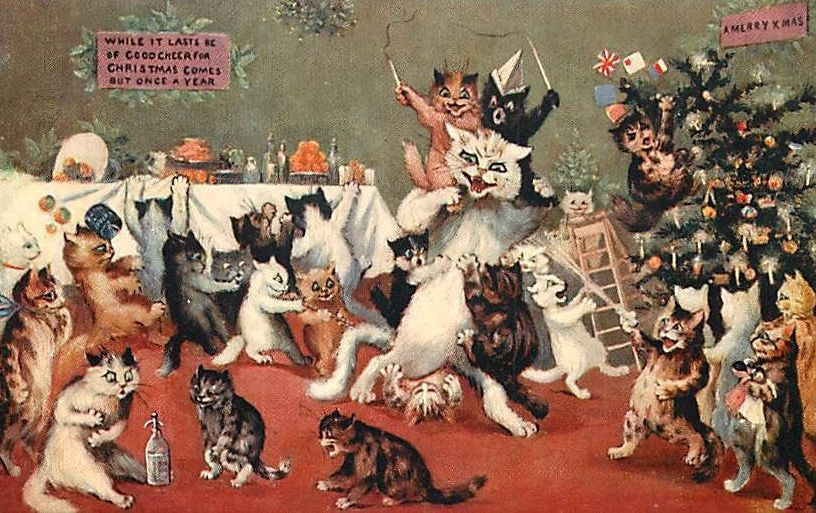
In Wain’s world, cats hosted elaborate dinner parties, played cricket, argued over card games, and stumbled drunkenly through celebrations. Some looked smug and self-important; others carried the exhausted expressions of overworked office clerks. Their exaggerated gestures made human behavior seem absurd in a way that felt safe to laugh at. It was satire disguised as entertainment.
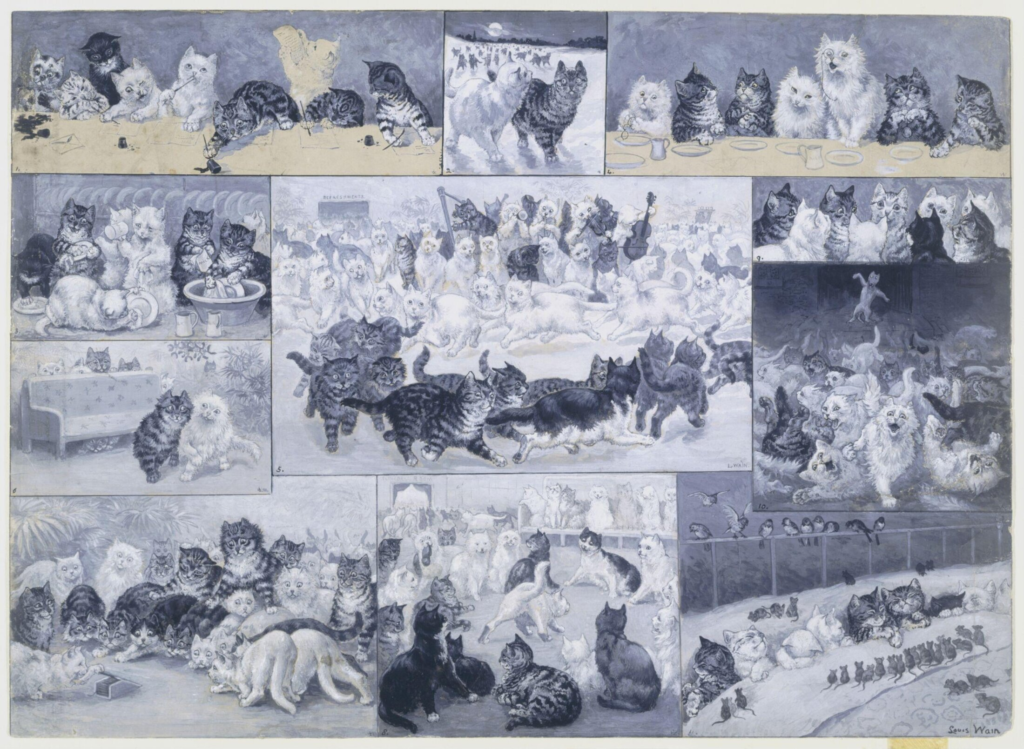
The timing could not have been better. Britain’s growing middle class was consuming illustrated magazines, postcards, and holiday publications at an enormous rate, and Wain’s work slipped perfectly into that expanding visual culture. His breakthrough came in 1886 with A Kitten’s Christmas Party, a crowded festive scene featuring dozens of cats preparing for holiday festivities. Readers were captivated. Almost overnight, Wain’s cats became a national phenomenon.
By the turn of the century, his felines were everywhere. They appeared on postcards, advertisements, annuals, children’s books, and magazine covers, turning Wain into one of the most recognizable illustrators in Britain. In many ways, he had achieved something remarkably modern: he didn’t simply create drawings of cats, he created an entire cat universe audiences wanted to live inside.
2. His Entire Cat Obsession Began With One Sick Wife and One Stray Kitten
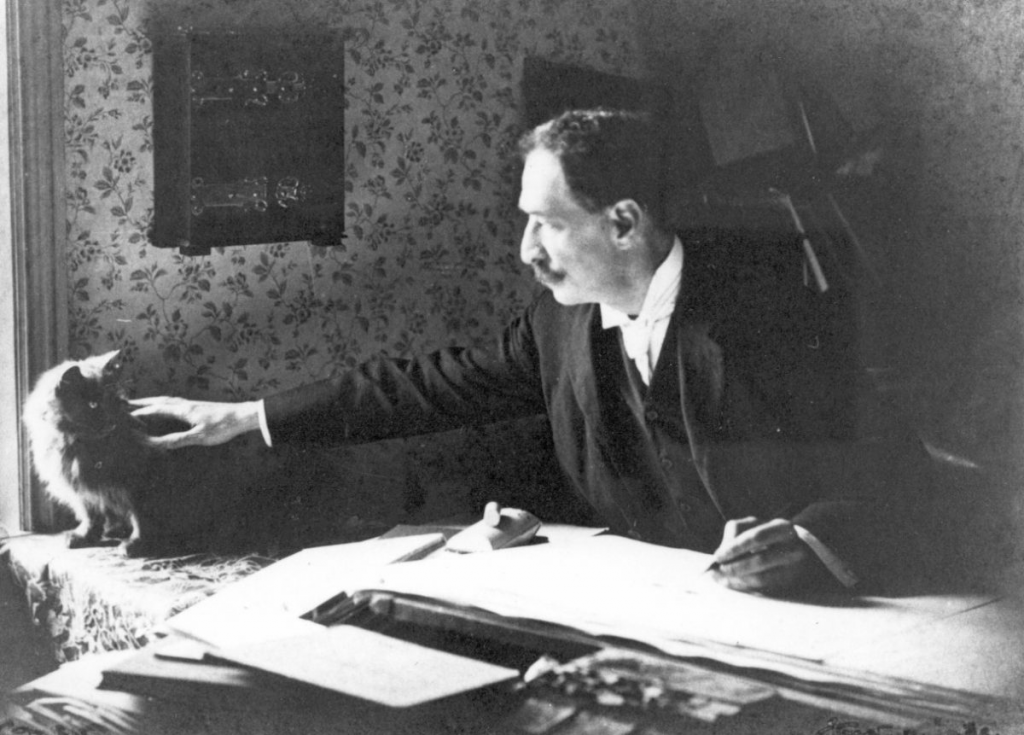
Behind the whimsical chaos of Louis Wain’s cat empire was a far quieter and more intimate story, one rooted in illness, grief, and companionship. Long before his cats became a cultural sensation, they were deeply personal. In many ways, they began as an act of comfort.
In 1883, Wain married Emily Richardson, the governess of his sisters. The relationship itself was unconventional for Victorian England; Emily was older than Wain, and the marriage reportedly caused tension within the family. Yet by most accounts, the two shared a deeply affectionate bond. Not long after their wedding, however, Emily was diagnosed with breast cancer. As her health declined, the couple spent more and more time indoors, caring for a stray black-and-white kitten they had rescued and named Peter.
Peter quickly became the emotional center of their household.
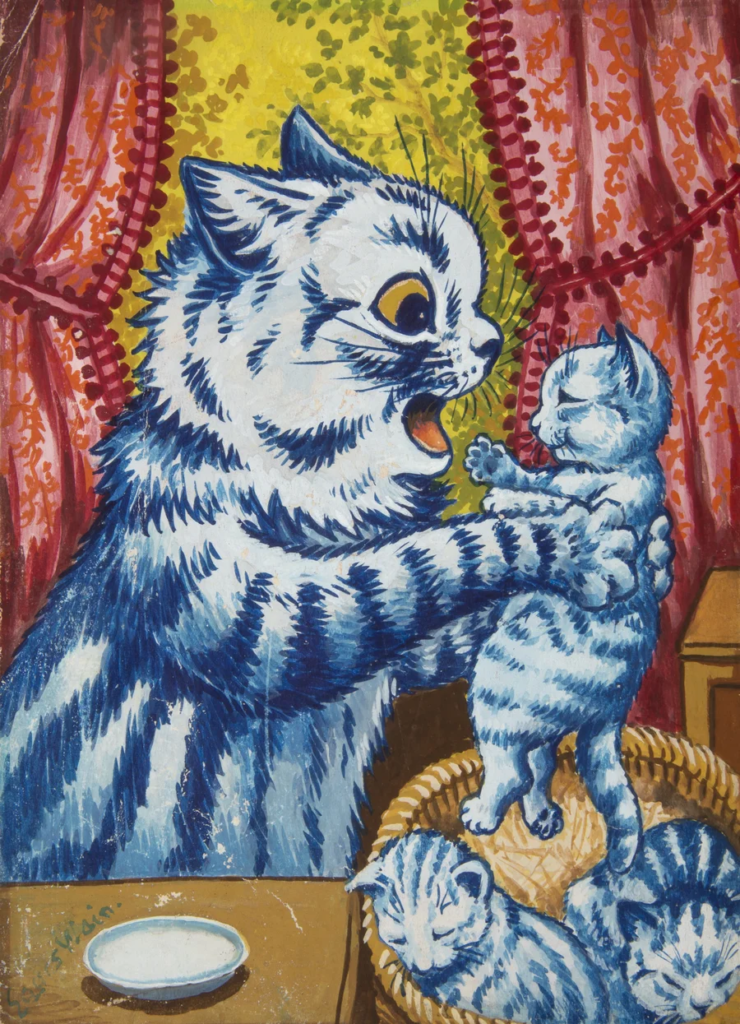
To entertain his wife during her illness, Wain began sketching the cat constantly, watching how it stretched, played, sulked, stared, and curled itself around furniture with theatrical elegance. He gave Peter exaggerated expressions and human-like mannerisms, transforming an ordinary household pet into a tiny performer with an entire emotional range. According to later accounts, Wain believed these drawings made Emily laugh during some of the darkest months of her life.
There is something strangely moving about that origin story. One of the most eccentric visual worlds in modern art history may have begun simply because a husband wanted to comfort his dying wife.
After Emily’s death in 1887, Wain continued drawing cats obsessively. What began as a private gesture of affection slowly evolved into a lifelong fixation. But even as his illustrations became more crowded, humorous, and commercially successful, traces of that earlier emotional attachment remained. His cats rarely feel cold or distant. They grin mischievously, sulk dramatically, flirt shamelessly, and stare back at the viewer with almost uncomfortable familiarity.
It is tempting to see Wain’s cats merely as comic inventions, but Peter changed something fundamental in the artist’s imagination. From that point onward, cats were no longer just animals in his work, they became emotional stand-ins for people, grief, loneliness, joy, and perhaps even Wain himself.
3. Louis Wain Made Cats Famous Before Pop Culture Did
Today, cats dominate the internet with almost frightening efficiency. They rule memes, reaction images, TikTok feeds, merchandise, and entire corners of online culture built around their strange ability to appear both adorable and emotionally detached. But more than a century before digital cat obsession became inevitable, Louis Wain had already discovered something powerful: people never seemed to get tired of looking at cats behaving like humans.
And Wain turned that fascination into an empire.
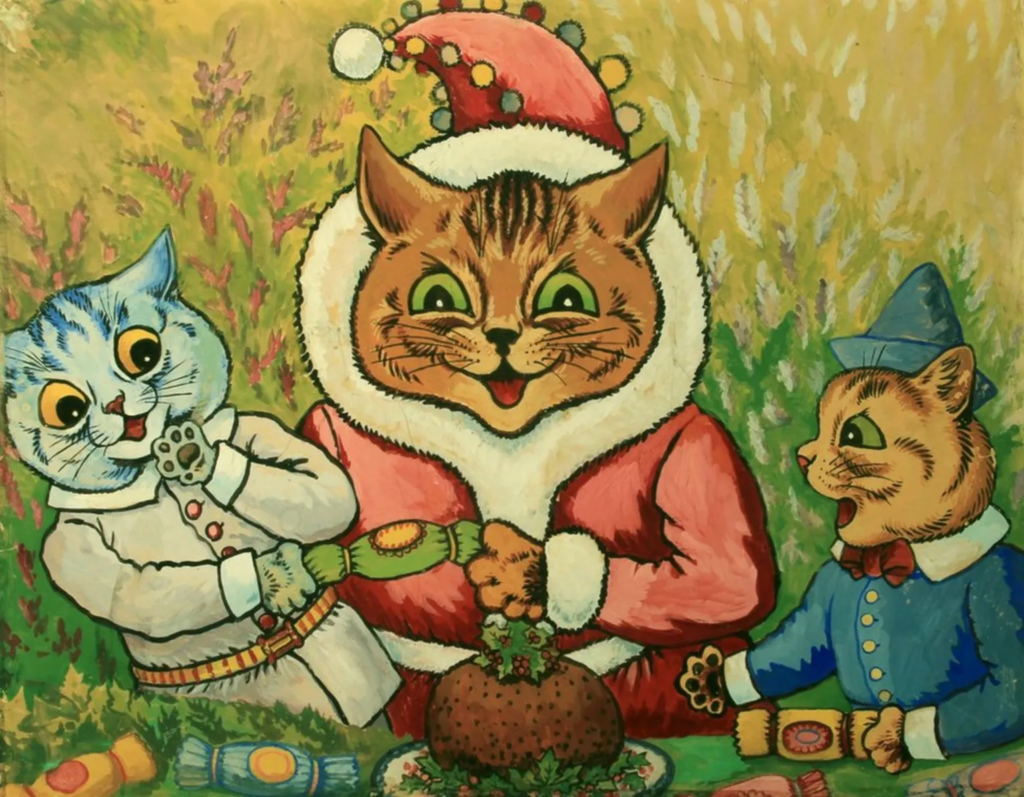
By the early 1900s, his illustrations had become nearly impossible to avoid in Britain. His cats appeared everywhere, on postcards, calendars, newspaper cartoons, advertisements, children’s books, ceramics, and holiday annuals. Families mailed Wain postcards to each other during Christmas. His images hung in living rooms. Publishers constantly commissioned new scenes featuring fashionable felines navigating the rituals of modern life.
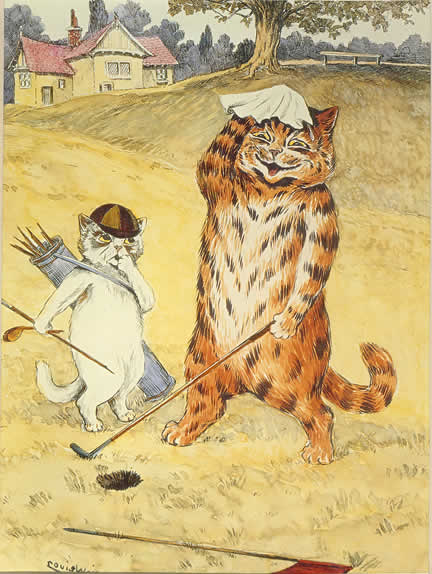
What made the phenomenon especially remarkable was how expansive his “cat universe” became. Wain’s illustrations were not isolated jokes; they felt serialized, as though his cats existed in a parallel society entirely their own. They played golf, attended political meetings, went shopping, smoked pipes, argued at card tables, and flirted at dance halls with the confidence of seasoned socialites. Some scenes were chaotic and comedic, while others captured surprisingly specific emotions: embarrassment, vanity, exhaustion, jealousy, boredom.
The cats became stand-ins for modern people.
At a time when visual culture was rapidly expanding through mass printing technologies, Wain instinctively understood how repeatable imagery could build emotional familiarity. In many ways, he anticipated something deeply modern: character branding. Long before Disney built global mascots or the internet transformed animals into recurring personalities, Wain had already created a recognizable visual language audiences wanted to revisit again and again.
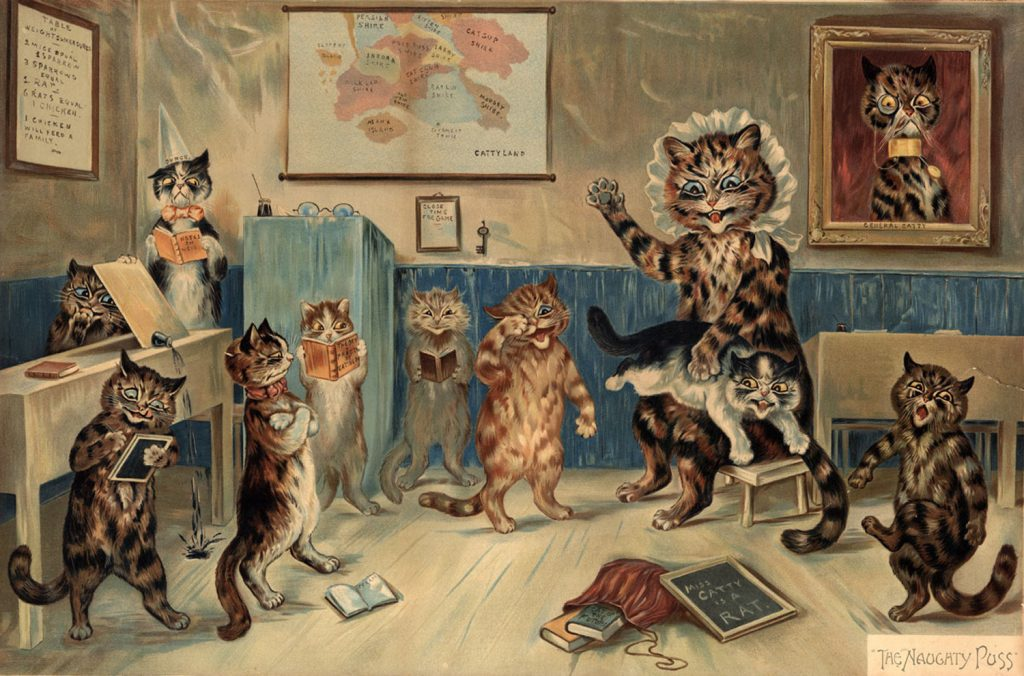
Ironically, despite his enormous popularity, Wain himself struggled financially for most of his life. He disliked negotiating fees, refused to properly copyright much of his work, and often sold illustrations outright for modest sums. While his cats circulated endlessly through British culture, the man behind them remained trapped in constant economic instability.
Still, the scale of his influence is difficult to overstate. Wain did not simply illustrate cats, he helped transform them into emotional entertainers, commercial icons, and cultural mirrors. In some strange way, every cartoon cat, reaction meme, and anthropomorphic internet feline owes at least a tiny debt to the peculiar world he built more than a hundred years ago.
4. The “Mad Artist” Story May Not Be Completely True
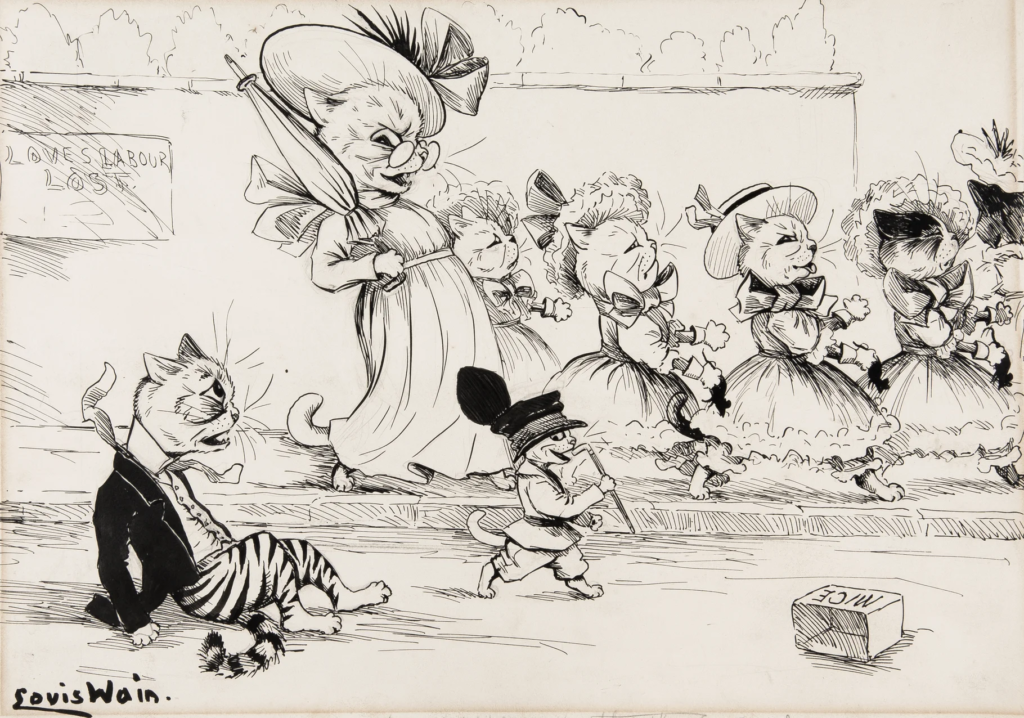
Few artists have been tied to the mythology of “madness” as intensely as Louis Wain. For decades, his name appeared in psychology textbooks and documentaries as the ultimate example of artistic deterioration: the cheerful cat illustrator whose mind supposedly fractured alongside his paintings. The narrative was irresistible. His early works showed charming Victorian cats attending tea parties and concerts, while the later images exploded into jagged patterns, electric colors, and kaleidoscopic eyes. To many observers, the transformation seemed obvious, a visual timeline of a mind collapsing in real time.
But the truth is far more complicated.
Much of the modern understanding of Wain’s mental decline can be traced back to a single figure: psychiatrist Walter Maclay. In the 1950s, Maclay assembled a now-famous sequence of eight cat paintings attributed to Wain, arranging them from realistic to increasingly abstract. The collection was presented as clinical evidence of schizophrenia progressing through art. The final images appeared almost hallucinatory, with cats dissolving into intricate geometric patterns and pulsating color fields.
The problem is that nobody actually knows if Maclay’s sequence was accurate.
Wain rarely dated his works, and many art historians now believe the paintings were arranged according to visual drama rather than chronology. Some of the so-called “psychedelic” cats may have been created alongside his more traditional illustrations rather than years apart. In other words, the abstract works were not necessarily evidence of deterioration at all—they may simply have reflected experimentation, imagination, or a changing artistic style.
That distinction changes everything.
The romantic image of the “insane genius” has always fascinated audiences because it turns suffering into spectacle. Wain’s later paintings became easy material for that narrative: strange, obsessive, and visually overwhelming. Yet people who encountered him during his years at Napsbury Hospital often described him as peaceful, gentle, and deeply absorbed in drawing. Some accounts even suggest that institutional life, for the first time, freed him from the financial pressures and family responsibilities that had burdened him for decades.
This does not mean Wain was mentally healthy. Historical evidence strongly suggests he struggled with severe psychological illness, possibly schizophrenia. But reducing his entire artistic legacy to a case study of madness oversimplifies both the man and the work. His later cats are unsettling not merely because they seem broken, but because they resist explanation altogether. They sit somewhere between fantasy, obsession, decorative design, and private symbolism, still watching us with those enormous electric eyes, daring viewers to decide what they really mean.
5. His Kaleidoscopic Cats Look Shockingly Modern
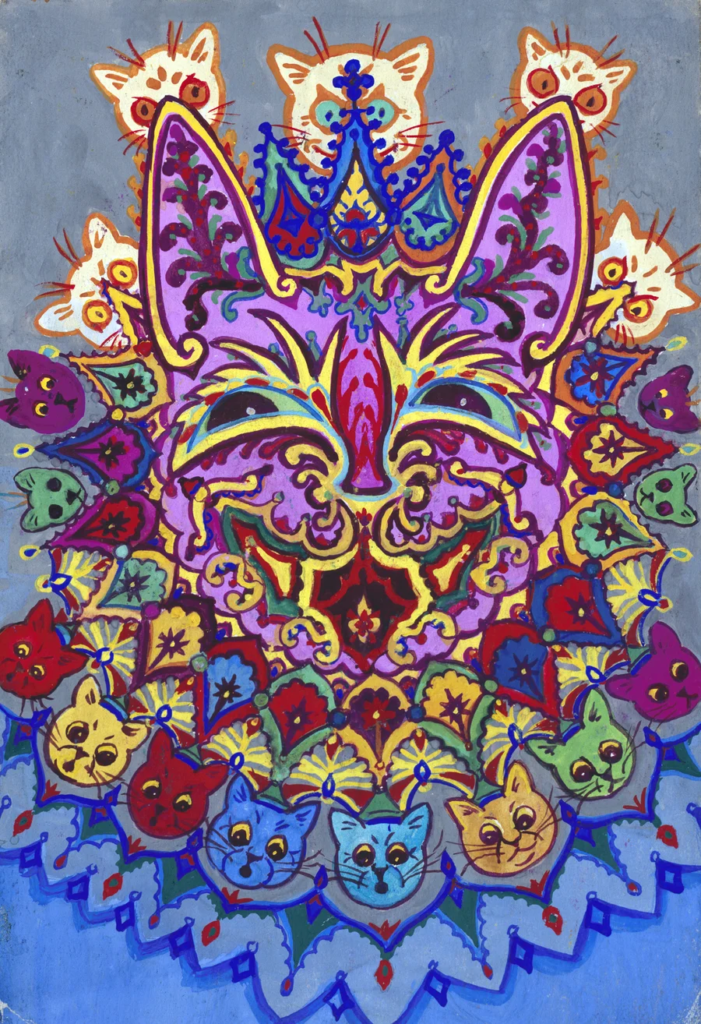
Even now, more than a century later, Louis Wain’s later paintings feel strangely ahead of their time. Scroll past one of his kaleidoscopic cats online without context, and it would not look entirely out of place beside psychedelic album covers, AI-generated dreamscapes, or surreal digital art circulating across the internet today. Their hypnotic symmetry, electric color palettes, and near-fractal patterns feel uncannily modern, as though Wain had somehow wandered decades beyond Victorian illustration into a visual language the 20th century had not fully invented yet.
These were no longer the playful socialite cats from his earlier years.
The latter works pulse with intensity. Fur transforms into repeating geometric motifs. Eyes glow like stained glass windows. Whiskers dissolve into radiating lines that seem to vibrate across the page. In some paintings, the cats remain recognizable beneath the ornamentation; in others, the animal almost disappears entirely into waves of decorative abstraction. The images feel simultaneously joyful and overwhelming, balancing between meticulous control and total visual chaos.
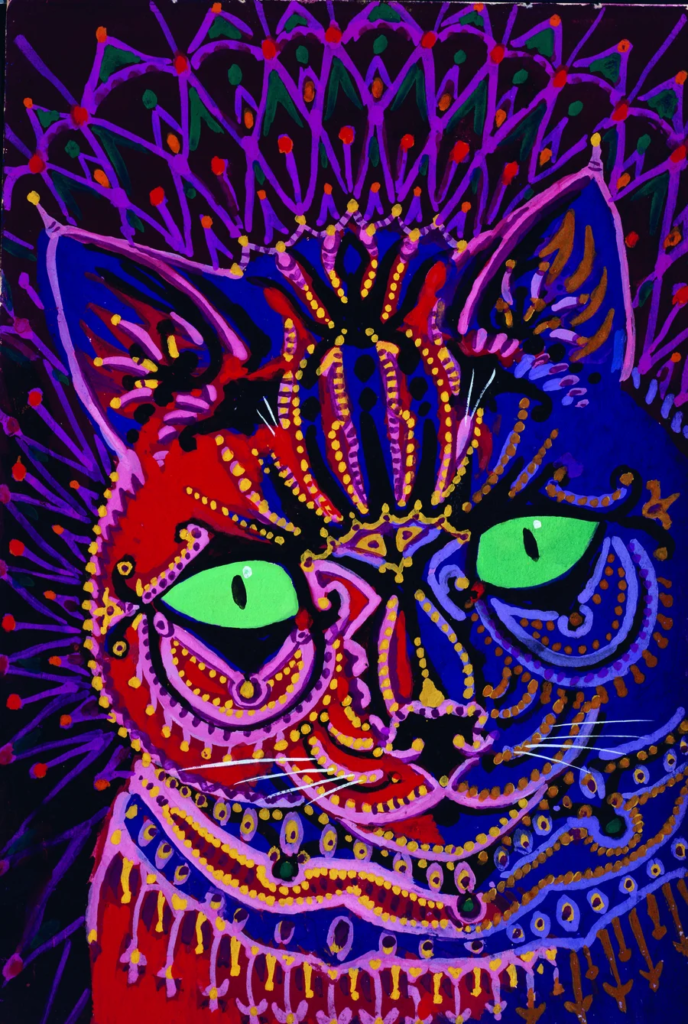
Part of what makes these paintings so captivating is that they seem to exist between categories. They are not fully surrealist, though they often feel dreamlike. They are not entirely abstract, since traces of the cat remain visible beneath the patterns. Nor do they resemble traditional psychiatric art, despite how frequently they are framed that way. Instead, they occupy a strange territory all their own, half illustration, half hallucination.
Modern audiences are especially drawn to this ambiguity.
In the 1960s, during the rise of psychedelic culture, Wain’s later paintings experienced renewed fascination because viewers connected them to altered states of consciousness and visionary art. Today, they resonate for different reasons. Their dense repetition and almost algorithmic symmetry resemble digital aesthetics that dominate contemporary visual culture. Some even compare them to fractals or computer-generated imagery, despite the fact that Wain created them entirely by hand decades before such technologies existed.
There is also something emotionally contemporary about them. The paintings carry a kind of overstimulation familiar to modern life: beautiful, immersive, slightly anxious, impossible to fully process at once. Looking at them can feel less like viewing a traditional artwork and more like entering someone else’s mental atmosphere.
That may be why these cats continue to circulate so widely online. They are eerie without being horrifying, playful without feeling innocent. The longer you stare at them, the harder they become to categorize. And perhaps that unresolved mystery, the sense that the images are revealing something just beyond comprehension, is exactly what keeps them alive in the modern imagination.
6. Wain’s Cats Became a Mirror for Society’s Fascination With Madness
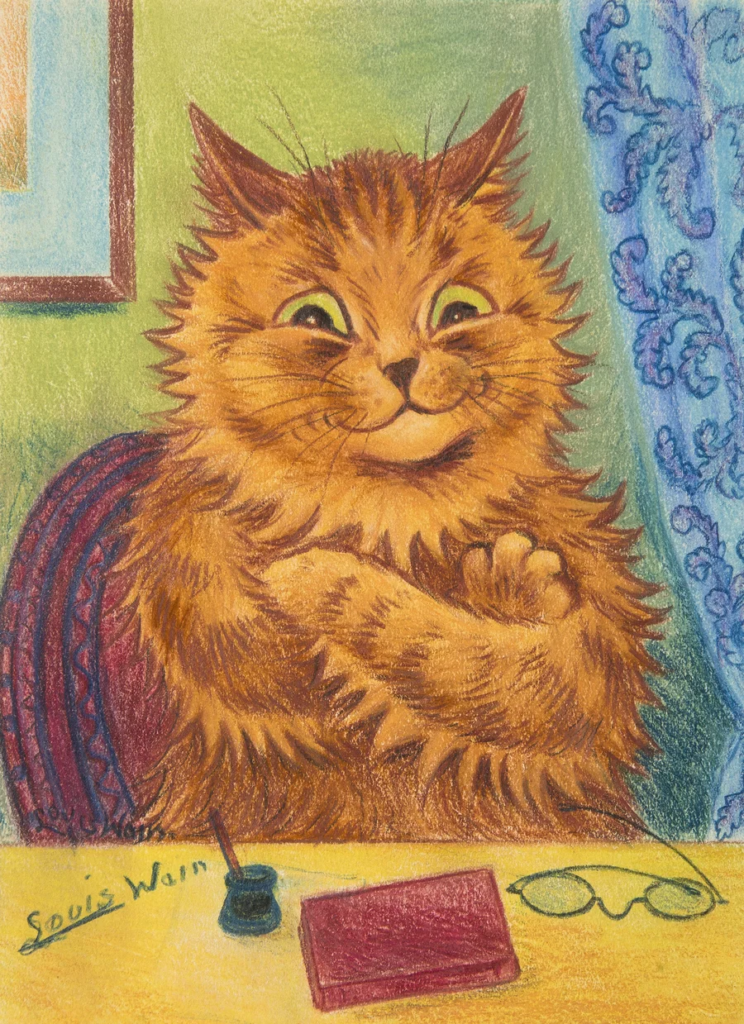
Part of what keeps Louis Wain’s legacy alive is not just the artwork itself, but the story audiences have attached to it. Over time, his cats became more than illustrations, they became symbols in a much larger cultural obsession with the relationship between creativity and mental illness. People do not simply look at Wain’s later paintings; they search them for evidence. Evidence of suffering. Of genius. Of psychological collapse. Of hidden meaning buried somewhere beneath the patterns.
That impulse says as much about us as it does about Wain.
Western culture has long romanticized the image of the tortured artist: the idea that brilliance and instability are somehow inseparable. From Vincent van Gogh to Sylvia Plath, audiences repeatedly turn artistic lives into narratives of beautiful destruction. Wain’s story fits neatly into that mythology, which may explain why the “mad cat painter” narrative became so widely repeated. His later works seem to visually confirm what viewers already expect to see, a mind unraveling in public.
But there is something uncomfortable about that fascination.
The more Wain’s paintings are framed exclusively through illness, the easier it becomes to reduce the artist himself into a spectacle. His work stops being viewed as art and starts being treated like psychological evidence. The cats become symptoms instead of creations. And yet the paintings resist that simplification. They are too intricate, too deliberate, too imaginative to be explained away purely as deterioration.
In many ways, viewers project their own anxieties onto these images. Some see chaos; others see transcendence. Some interpret the patterns as frightening and obsessive, while others find them strangely peaceful, even euphoric. The ambiguity is what gives the paintings their emotional power. They refuse to settle into a single interpretation.
There is also a deeper irony hidden within Wain’s story. During his lifetime, his whimsical cats brought comfort, humor, and familiarity to millions of people. Yet today, audiences are often most interested in the darker mythology surrounding them. The cheerful Victorian entertainer has been overshadowed by the legend of the institutionalized genius.
Perhaps that transformation reflects a broader shift in how modern audiences consume art. We no longer just want images, we want psychological narratives attached to them. We want artists to reveal something intimate, fractured, or emotionally raw. Wain’s later cats satisfy that hunger perfectly because they feel like coded messages from another mental world, even if we can never fully decode them.
And maybe that is precisely why they continue to linger in cultural memory: not because we understand them completely, but because we never really will.
7. More Than a Century Later, His Cats Still Feel Weirdly Alive
More than a hundred years after Louis Wain first began sketching mischievous cats in Victorian drawing rooms, his work still feels strangely difficult to escape. The images continue to resurface across social media feeds, documentaries, gallery exhibitions, psychology discussions, and internet rabbit holes devoted to “unsettling art.” New audiences discover his cats every year, often reacting the same way people did decades ago: first with amusement, then curiosity, and finally with a vague sense of unease that is harder to explain.
Very few artists manage to remain culturally alive in such a peculiar way.
Part of Wain’s endurance comes from how adaptable his work feels to different eras. In Victorian England, his cats reflected the absurdities of polite society. During the psychedelic counterculture of the 1960s, the later paintings looked visionary and hallucinatory. Today, in an internet culture overflowing with surreal humor, anthropomorphic memes, and emotionally expressive animals, Wain’s feline universe feels unexpectedly familiar once again.
His cats almost behave like early internet personalities.
They are expressive, theatrical, chaotic, and oddly human, capable of carrying emotions people struggle to articulate directly. Some appear smug, anxious, overwhelmed, lonely, euphoric, or completely detached from reality, all emotional states modern audiences instantly recognize. Long before reaction memes transformed animals into emotional avatars online, Wain was already using cats to dramatize human behavior in exaggerated, strangely relatable ways.
Yet the lasting power of his work goes beyond novelty or visual weirdness. What makes the paintings linger is the tension inside them. They are simultaneously comforting and uncanny, humorous and melancholic. The earlier cats invite viewers into a playful fantasy world, while the later works feel as though that same world has somehow slipped beyond ordinary reality. Looking across Wain’s career can feel like watching innocence slowly mutate into something stranger and harder to define.
And still, the cats keep smiling.
That may be the most haunting thing about them. Whether seated politely at a Victorian dinner table or dissolving into electric webs of color, Wain’s cats always seem aware of something the viewer cannot fully grasp. They stare outward with expressions that are playful one moment and deeply unsettling the next, as though trapped somewhere between comedy and revelation.
Perhaps that is why they continue to fascinate people today. Not because they offer answers, but because they remain unresolved. Louis Wain created a world that feels whimsical on the surface yet emotionally uncanny underneath, a universe where humor, grief, obsession, imagination, and loneliness all blur together behind the face of a cat.
And somehow, more than a century later, those cats still feel alive enough to stare back.
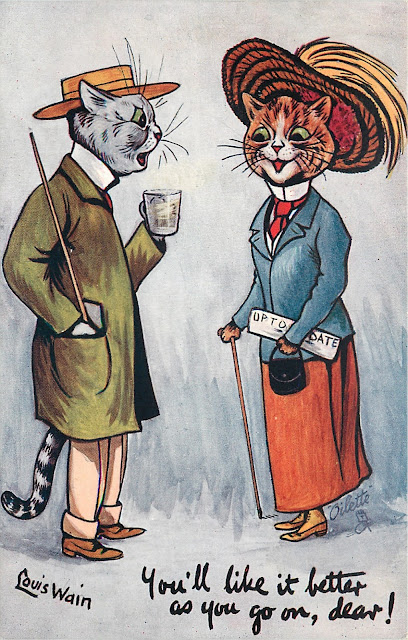
Louis Wain’s cats have survived for more than a century because they refuse to stay confined to a single meaning. They are funny, eerie, theatrical, melancholic, comforting, and occasionally unsettling all at once. Some viewers see playful Victorian satire in them, while others see loneliness, obsession, or even glimpses into a mind struggling to hold itself together. The longer people look at Wain’s work, the stranger and more emotionally layered it seems to become.
That complexity is what continues to make his art feel so modern.
In an age where cats dominate digital culture as emotional stand-ins for human feelings, Wain’s work suddenly feels less like a relic of Victorian England and more like an early blueprint for the surreal emotional language of the internet. His cats grin, sulk, panic, perform, and stare back at us with expressions that feel uncannily familiar, even now.
But perhaps the real reason these paintings continue to fascinate people is because they remain unresolved. Louis Wain’s art exists somewhere between whimsy and darkness, humor and vulnerability, fantasy and psychological mystery. The cats never fully explain themselves, and neither does the man who created them.
And maybe that is exactly why we still cannot stop looking at them.
Do you find Louis Wain’s cats more charming or slightly unsettling?