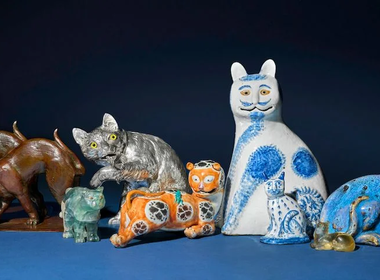

10 artists, 10 creative icons from history they’d love to meet

Art has never belonged to just one time or one place. It has existed for as long as people have existed. In caves lit by firelight, on cathedral ceilings painted over years and years, on scraps of paper folded into pockets, on stretched canvases sitting quietly in tiny studios. Across centuries, cultures, and completely different lives, people have always felt the need to make something. To tell a story. To hold onto a feeling. To leave behind proof that they were here.
And somewhere inside that endless history of art, there are certain artists who stay with us in a deeply personal way. Sometimes we discover them in a museum. Sometimes in a book.
Sometimes during one of those late-night internet spirals where one painting leads to another and suddenly you feel completely understood by someone who lived hundreds of years ago. There’s always that moment of recognition that one. That artist who somehow sees the world in a way that feels painfully familiar.
The artists we love often stay with us for very personal reasons. Sometimes their work makes us feel understood. Sometimes it gives us courage to create more honestly. And sometimes, without even realizing it, they shape the way we see art, creativity, and ourselves.
So we asked our Arts to Hearts community a simple question:

The answers brought together so many different names from across art history some expected, some surprising, and some deeply personal. From legendary painters and sculptors to artists who completely changed the way we look at the world, every answer reflected a different kind of admiration, inspiration, and creative connection.
And honestly, the responses felt too beautiful to keep to ourselves.
The Painter Who Refused to Be Small

You don’t choose Joan Mitchell when you want a gentle afternoon in the studio. You choose her when you want to be pushed. When you want someone in the room who refuses to let you settle for less than everything you’ve got. And that says something about Carol MacConnell @carolpaints_ before she has even picked up a brush.
Because choosing Joan Mitchell isn’t just choosing a painter. It’s choosing a particular kind of energy in the room the kind that is loud and uncompromising and completely uninterested in making itself smaller for anyone. Joan Mitchell painted like she had something urgent to say and not enough time to say it. With her whole body. With huge gesture. With colour that felt like weather. A studio with her in it would never be quiet. And we think that’s exactly the point.
When Everyone Else Was Still Playing With Mud
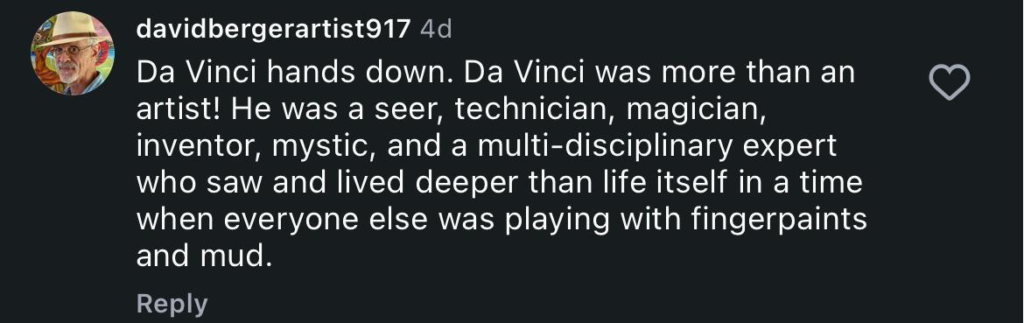
We love the energy of this answer. The certainty of it. Hands down. No hesitation. No consideration of anyone else. Because when you think about what it would actually mean to share a studio with Leonardo da Vinci not just the painter but the seer, the inventor, the person who looked at the world and saw everything everyone else was missing — it makes complete sense that there would be no other answer. There would be no other room big enough for the conversation.
David davidbergerartist917 said it perfectly, da Vinci was more than an artist. He was a technician, a magician, an inventor, a mystic, a multi-disciplinary mind who saw and lived deeper than life itself at a time when everyone else was still playing with fingerpaints and mud. And we think that last line is one of the best descriptions of Leonardo da Vinci we’ve ever come across.
Two Friends Who Built a Universe

Here’s something that makes this answer even more beautiful — Leonora Carrington and Remedios Varo actually did share a creative world together. They were close friends who lived near each other in Mexico City, who influenced each other deeply, who built a whole universe of surreal, mystical, wildly imaginative work side by side. And we think there’s something really moving about choosing two artists who were themselves each other’s people. Who found in one another exactly what this question is asking about.
Claira @virgosunstudio didn’t choose one studio partner they chose two. And we completely understand. Because some creative energies only make sense together. Proof that the right people in the room don’t dilute your vision they expand it.
In the Room With the Darkness
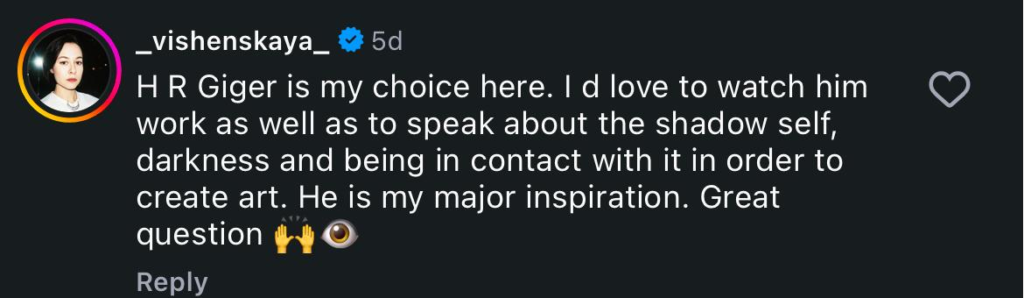
There are artists who inspire you. And then there are artists who change the way you see the world entirely who reach into some dark, strange corner of your imagination and say: this is allowed. This is valid. This is worth making. H R Giger was that kind of artist.
Anna Vishenskaya @_vishenskaya_ would want to watch him work. To sit in the room while he moved through the shadow self, the darkness, the things most artists are too afraid to look at directly. And we think she already understands something many creatives take years to learn that being in contact with the dark parts of yourself is not something to avoid. It is where some of the most honest and powerful work comes from. A studio with Giger in it would not be comfortable. That is exactly why it would be extraordinary.
Where the Subtle Meets the Human
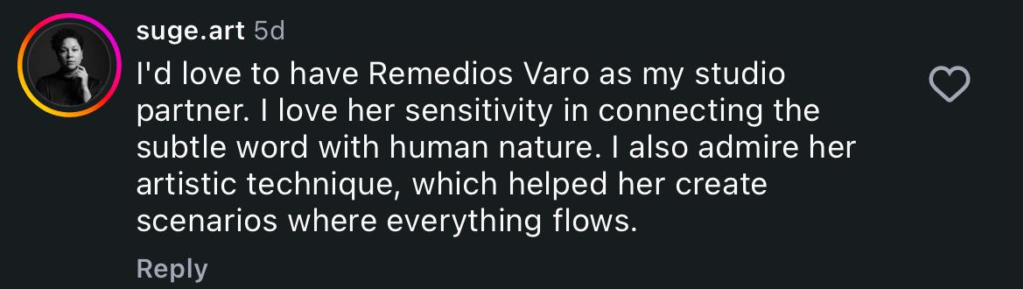
Some artists paint the world as it is. Others paint what hides just underneath the intuition, the inner life, the quiet logic of the soul that most of us only notice in passing. Remedios Varo belonged to the second kind. And Sugery’s answer tells us she sees exactly that.
Sugery Reveron @suge.art spoke about Varo’s ability to connect the subtle world with human nature, and honestly, that feels like such a beautiful way to describe her work. Varo created paintings where everything seems to move together softly and naturally, no matter how surreal the scene is. Nothing feels random. Every detail feels intentional, almost like she was painting thoughts and emotions that usually can’t be put into words.
And maybe that’s why this choice feels so special. Because choosing Remedios Varo isn’t only about loving surrealism or beautiful technique. It’s about being drawn to artists who pay close attention to the invisible things the feelings, intuitions, and inner world’s most people rush past.
Loved for the Door She Kept Closed
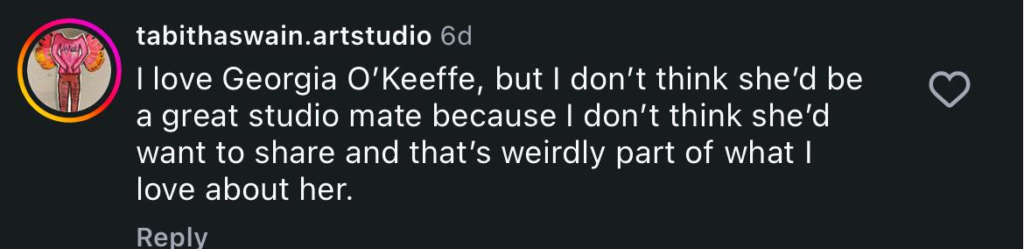
There is something quietly reverent about Tabitha’s @ tabithaswain.artstudioanswer. She chose Georgia O’Keeffe an artist whose entire body of work was inseparable from the solitude she built for herself. And rather than wish that solitude away, Tabitha honours it. She loves her for it.
Georgia O’Keeffe spent decades building a creative world that was completely her own. Ghost Ranch. The bones. The flowers. The wide, sun-scorched landscapes of New Mexico. She protected her solitude with the same care she gave her paintings because the two were never separate. Her work was her solitude.
To love an artist for the very thing that keeps her at arm’s length that is real understanding. It is the choice of someone who knows that some artists were never meant to be shared. And that is exactly why they made what they made.
The Most Alive and Most Aching Place
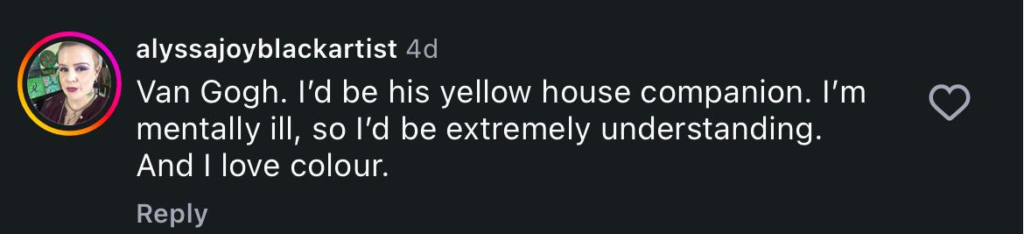
Of course Van Gogh appeared in the responses. But what made Alyssa Joy @alyssajoyblackartist answer stay with us was not just the artist she chose. it was the reason why.
She did not talk about genius or fame or even the paintings first. She talked about being his Yellow House companion. About understanding him. About staying. And honestly, there is something deeply moving about that, especially knowing how much Van Gogh longed for c
What we really loved about Alyssa’s answer was how simply she spoke about colour. It was such a small part of the comment, but it instantly made sense. Because anyone drawn to Van Gogh understands that colour in his work was never just visual it carried emotion. Tenderness, loneliness, intensity, hope. Sometimes it felt like colour was the only language big enough for everything he was trying to express.
A Completely Different Kind of Gaze
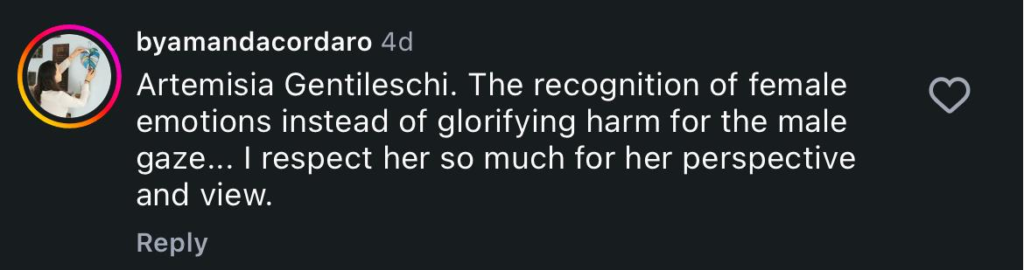
Amanda’s @ byamandacordaro answer immediately caught our attention, not just because she chose Artemisia Gentileschi, but because of the reason she gave. She spoke about the recognition of female emotions instead of glorifying harm for the male gaze, and honestly, that feels like one of the clearest and most thoughtful ways to describe Artemisia’s work.
Because that is exactly what Artemisia did. In a time when women in paintings existed almost entirely to be looked at, she painted women who were doing something. Feeling something real. Surviving something. Refusing something. Her work carried a completely different kind of gaze, and it changed what was possible.
Amanda chose Artemisia for her perspective for what she saw and what she chose to show. And that still feels powerful centuries later. Because Artemisia did not just paint beautifully. She made people confront whose stories mattered, and whose emotions deserved to be taken seriously.
When the Name Is Enough

Some answers come with paragraphs of reasoning. This one came with two words. Frida Kahlo. And we understood completely. Because some artists’ names carry their whole world inside them the colour, the pain, the defiance, the beauty, the entire universe they built and refused to apologise for.
Frida Kahlo painted what most artists would not look at, let alone show us. Her own body. Her own grief. Her own bones. Her own marriage. She turned every difficult thing she lived through into something we are still trying to understand, seventy years after her death. There has never been anyone quite like her. There never will be.
We love that Kiana Cyré @cyre_creations did not feel the need to explain. Because when you choose Frida, you are choosing someone whose name has already done the explaining. The rest is between you and her.
History Isn’t Only in Museums
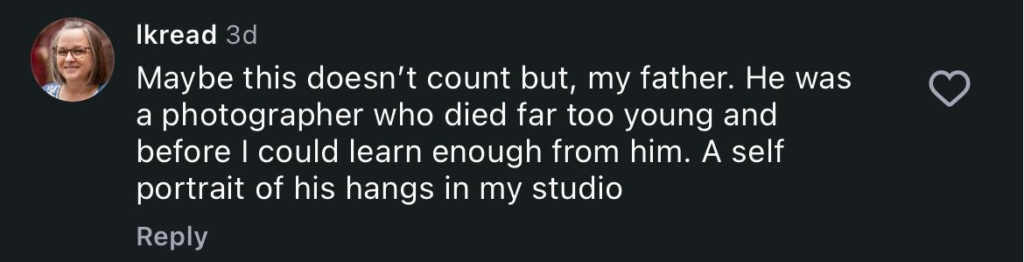
This is the most important answer in this entire article. Because the question asked about artists from history. And what Leah reminded us is that history is not only in museums. It is in the people who shaped us. The ones who showed us what it looked like to see the world a certain way before we even had the language to describe it.
Leah’s @lkread father was a photographer who died far too young before she could learn enough from him. His self-portrait hangs in her studio.
We do not have words for how much that means. But we think every artist who has lost someone who shaped their creative life will read that last line and feel it completely. Sometimes the artist whose absence you feel most is not someone famous. It is someone who was right there. Who left too soon. Who took so much knowledge and so much way of seeing with them when they went.
Reading through these responses, we realised the answers were never just about famous artists. Each choice revealed something personal about the person behind it the kind of honesty, courage, emotion, or creative freedom they are drawn to in their own work.
What moved us most was how many people reached across different centuries, countries, and artistic worlds looking for the same thing: connection. Someone who understood the way they see, feel, or create.
And maybe that is what art has always done best. It reminds us that even across time, people are still trying to express the same human things — love, loneliness, wonder, fear, hope, identity, meaning.
Thank you honestly to everyone who answered this question with so much openness and thoughtfulness. We loved reading every single response.
If you want to see every single response to this question and there were so many good ones that didn’t make it into this article we’ve linked the original post below. Go and read through the comments. You’ll feel very seen and very not alone.
We’re always here asking questions about your creative process, your studio, your inspirations, your blocks, the rituals you swear by, the things that aren’t working, the moments that changed everything because we genuinely believe that the most useful thing artists can do for each other is just be honest about what it’s actually like. Not the polished version. The real one.
So if you’re not already following us on Instagram, come and find us there. We ask questions like this all the time and the conversations that happen in the comments are honestly some of our favourite things on the internet.
Drop your thoughts the next time you see one of our questions. Share what’s true for you. You never know who needs to hear exactly what you have to say.
And who knows maybe next time it’ll be you we’re featuring.