

Carla Petelski’s Playful Paintings Explore the Complicated Nature of Human Relationships
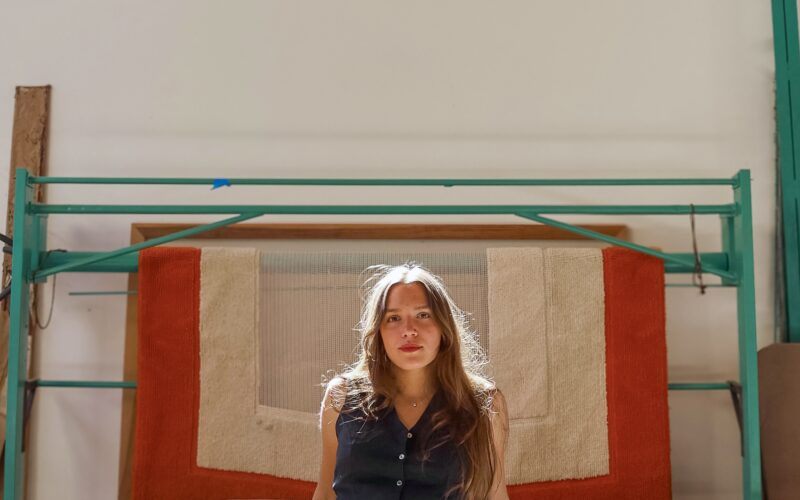
At Arts to Hearts Project, we are always happy to find an artist whose imagination behaves like a garden: a little wild, full of colour, and growing in a direction nobody planned. That is exactly the kind of artist our Best of the Art World editorial goes looking for, the ones whose work keeps unfolding and surprising even the people who know it best. And today we are genuinely delighted to introduce you to one of them.
When Carla Petelski’s paintings first landed in front of us, we caught ourselves smiling before we had even worked out why. There is something about that much colour, that much pattern and that much tenderness in a single image that makes the whole day feel a little lighter. And the longer we looked, the more we realised there was something far more thoughtful going on underneath all that brightness.
Carla is a Belgian artist, born and raised in Brussels, and she has been drawing for as long as she can remember. There is a lovely little story about how drawing first quietened a very restless child, and we will leave her to tell that one herself. What we can say is that the pencil never left her hand.
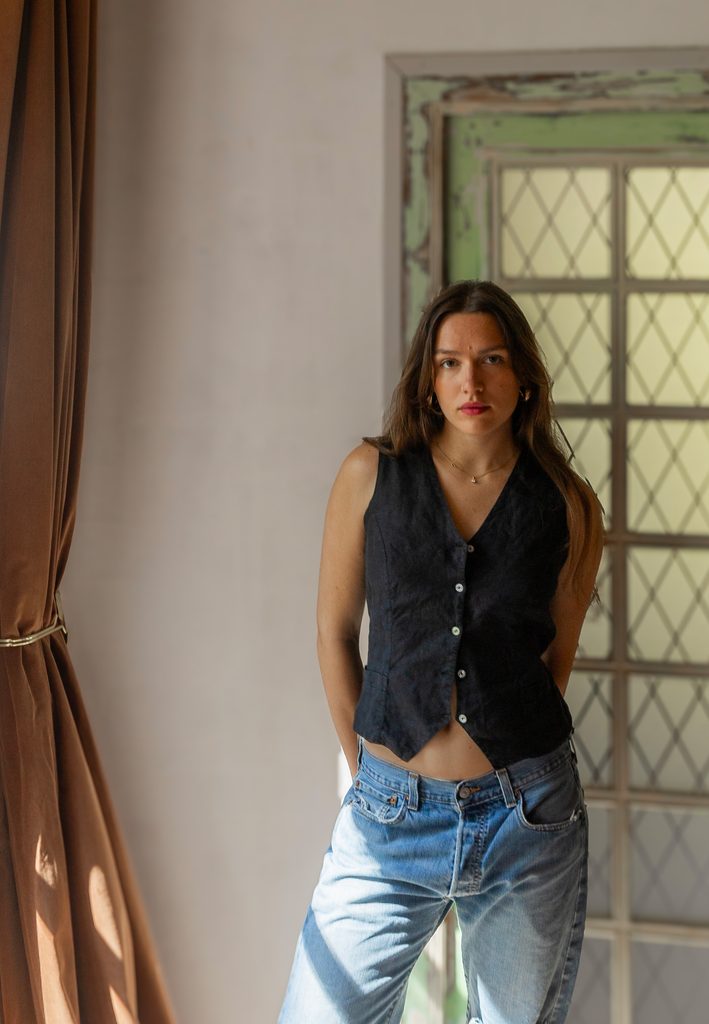
She went on to study graphic design, spent time in Vienna at the beginning of her adult life, and slowly found her way from a graphics tablet to coloured pencils and finally to acrylic paint, building as she went a palette of saturated colour that now feels completely her own.
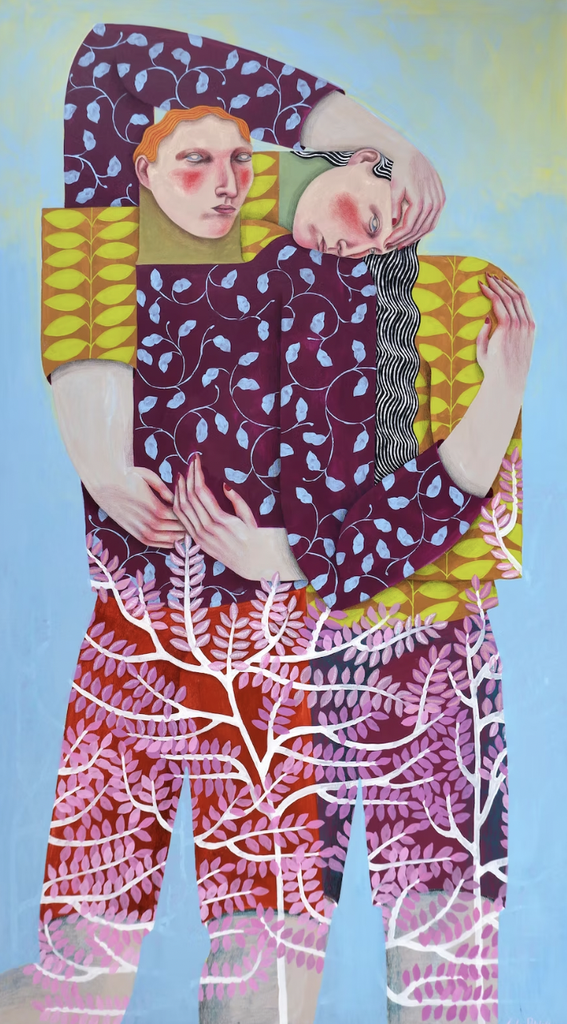
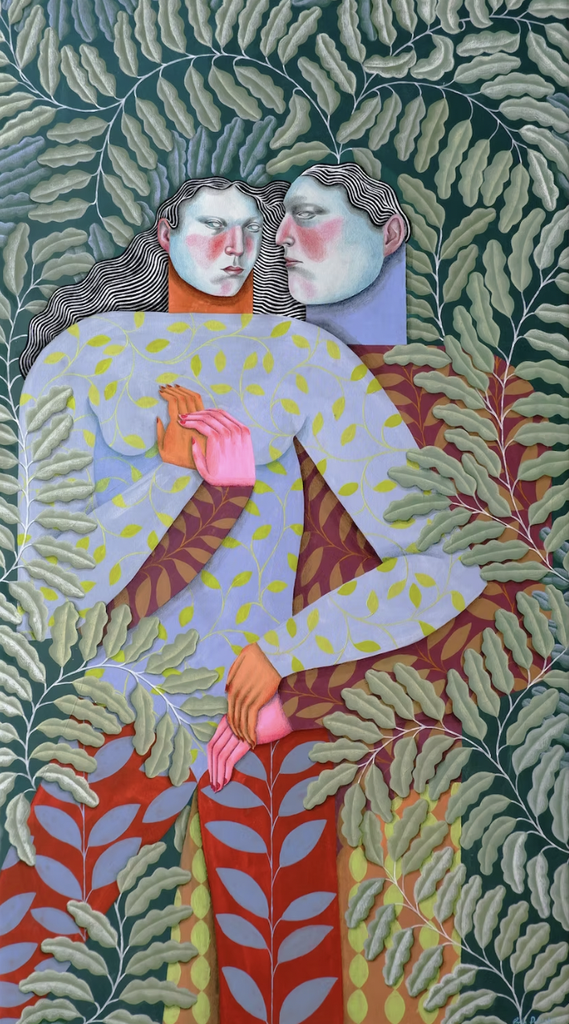
Her paintings are structured botanical compositions filled with expressive characters who hold on to one another among climbing plants, flowers and butterflies, with ribbons and layers of pattern winding through the scene. Perspective, proportion and shadow are happily bent along the way, the way feelings tend to bend everything. Belgium’s surrealist heritage and Polish folk illustration have both shaped her practice, and she has a real love of pattern, from Belgian Art Deco to twentieth-century Polish textiles.
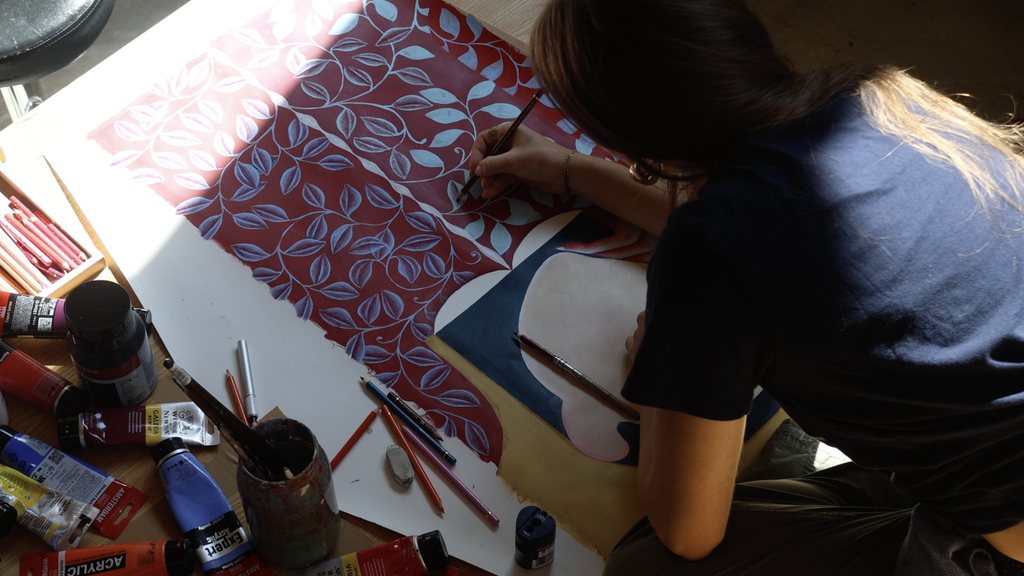
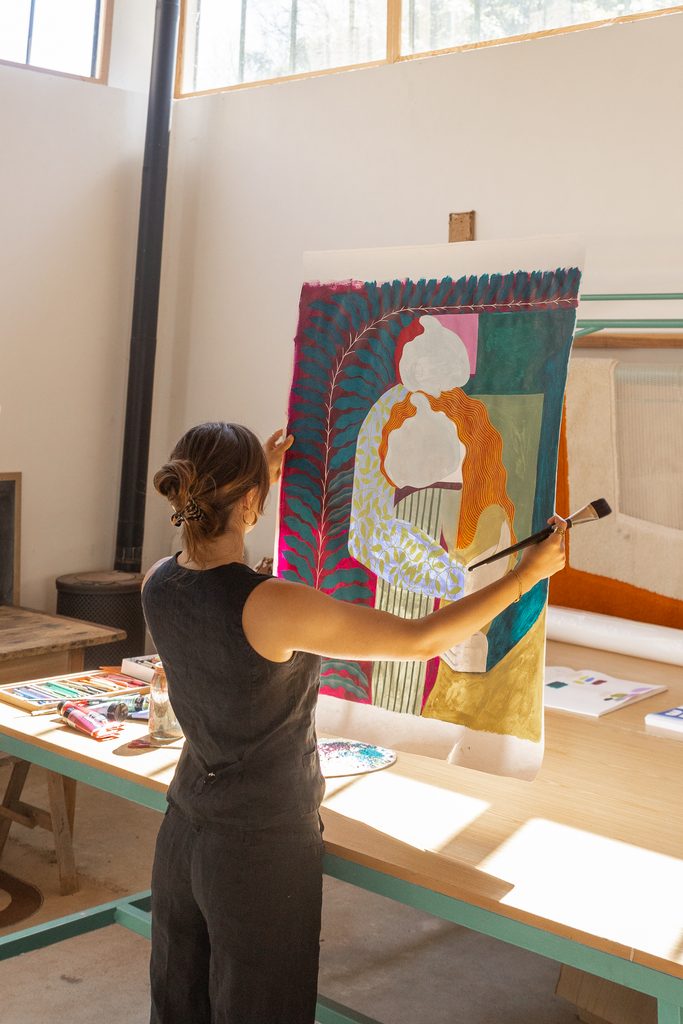
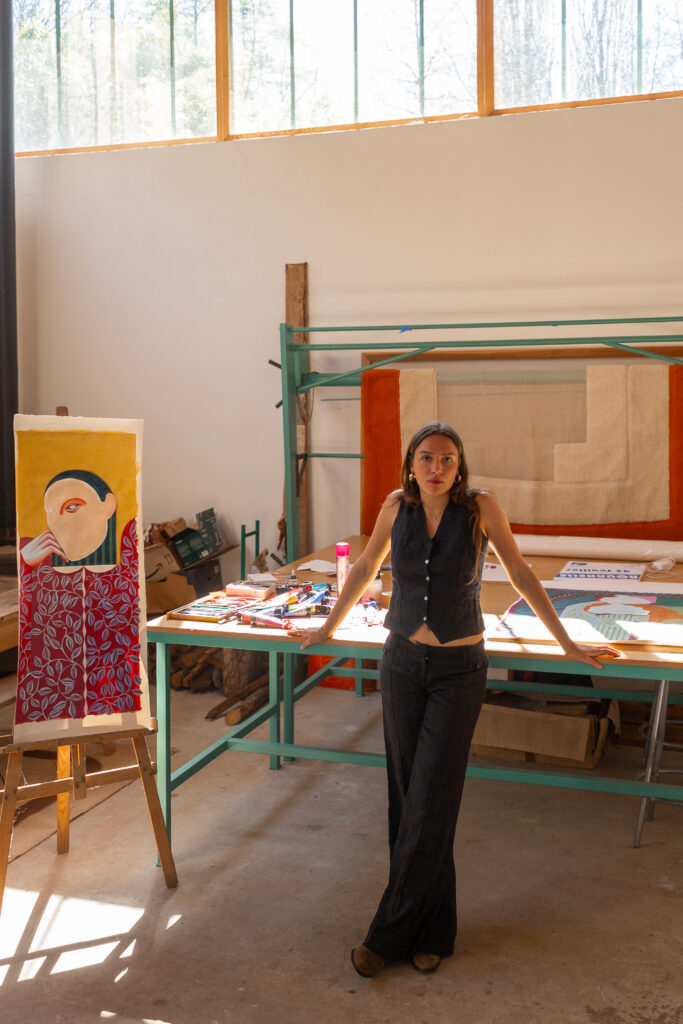
She works mainly in acrylic and coloured pencil on cotton canvas, sometimes adding oil pastel, and she begins with a small sketch before drawing straight onto the canvas and letting each painting grow little by little.
At the centre of it all are love and loss in human relationships, drawn from her own experience, with the emotions and small sensitivities of everyday life turned into something that is both playful and quietly poetic.
Her work has travelled a long way from that first sketch. She has worked with Hermès, ELLE Magazine, Anthropologie and The Architectural Review, and she has presented solo exhibitions in Brussels and Paris, alongside a group exhibition in Stockholm. Collectors have found her originals and prints, and she paints full time, with no shortage of ideas about where the garden might grow next.
We are not going to tell you too much more, because we think the conversation ahead will do it far better than we can. What we will say is that we came away from it feeling warmer, and a little more curious, than when we started.
Let’s get to know Carla through our conversation with her. We have a feeling you will be smiling by the end of it.
Q1. Carla, could you share a little about your background and what first led you to become an artist?
Like many children who are naturally drawn to hands-on activities and creative pursuits, becoming an artist always felt quite natural to me. I’ve been drawing for as long as I can remember, ever since I was able to hold a pencil. My mum loves telling this particular anecdote about me. I was apparently a very restless and rather wild, almost aggressive little girl at school. My mum was called into the headteacher’s office several times because of my behaviour.
She used to explain that I had an older brother at home and that I was simply learning how to defend myself! I was always quite chaotic. She says I went from crawling straight to running, skipping the walking stage altogether. My aunt also used to say I showed signs of hyperactivity.
One day, my mum came home and, instead of hearing the usual noise, shouting and little footsteps running around everywhere, she found the house unusually quiet. She discovered me sitting at the table, completely absorbed in drawing. Apparently, from that day onwards, I became a much calmer and more peaceful child.
Art has been part of who I am and the way I function in my everyday life for as long as I can remember.
Q2. You have worked across drawing, illustration, and painting. How have these different mediums shaped your visual language?
Working with different artistic tools and mediums has really helped me develop my artistic practice. I studied graphic design, where we explored a bit of everything: illustration, photography, typography, as well as different techniques using charcoal, Indian ink and other materials. I started drawing on a graphics tablet, which, as a student, allowed me to avoid spending too much money on materials and brushes, which can often be quite expensive.
I genuinely think this was when I started developing my colour palette. After using the graphics tablet and completing my studies, I turned towards coloured pencils. I love how accessible, easy to use and precise they are. Gradually, I started exploring acrylic painting, which works really well with my style, filled with saturated blocks of colour.
I also combine it with oil pastels and coloured pencils, keeping the comfort and versatility of these tools to create gradients and add more precision. Today, I mainly work with acrylic paint and coloured pencils on cotton canvas.
Q3. Your work feels personal yet playful and imaginative. How did you develop this distinctive approach to making art?
I discovered the world of illustration during my studies, and I was immediately fascinated by it! I love the idea of trying to illustrate a memory or an emotion in your own particular way. Belgium’s surrealist artistic heritage, as well as Polish folk illustration, have also played an important role in shaping my practice. I love all kinds of patterns, from Belgian Art Deco to twentieth-century Polish textiles.
I enjoy playing with layers and shadows, and painting characters who naively hold one another, without necessarily respecting realistic perspectives, proportions or shadows.
It’s a bit like cooking a good chilli sin carne, throwing lots of lovely ingredients together and seeing what happens! I’ve never really enjoyed following strict rules or measurements when it comes to making things by hand, whatever the medium might be.
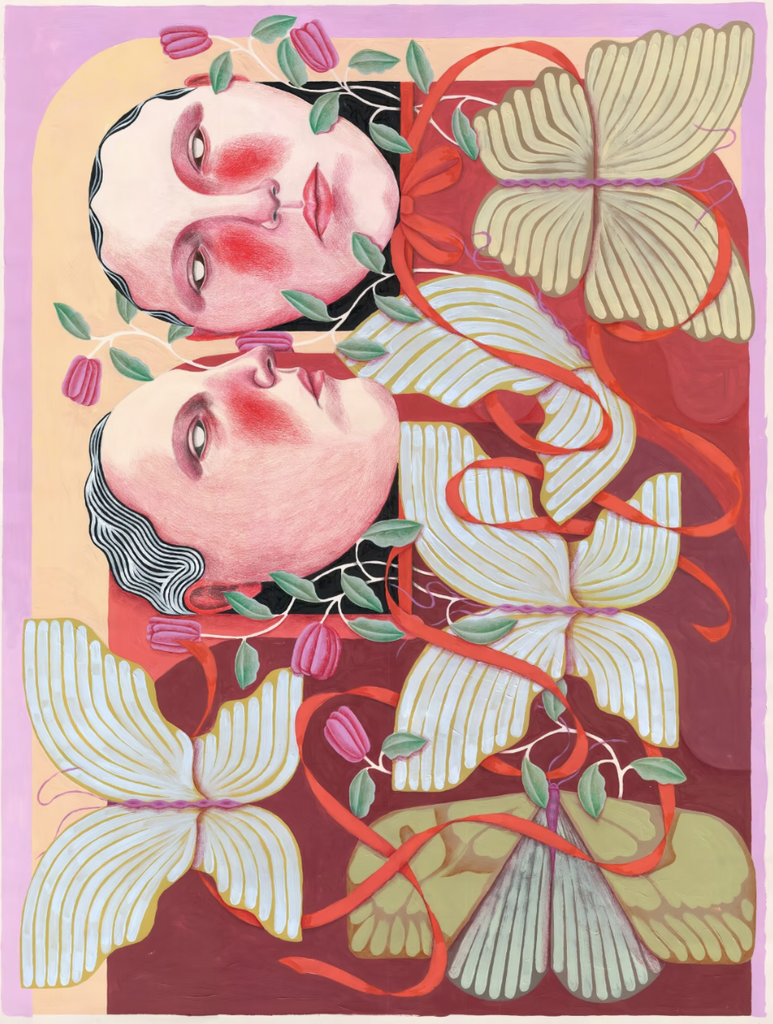
Q4. In works such as Situationships, Bond, and Change, you explore complex human connections. How do you translate these emotions into visual metaphors?
I enjoy exploring the naivety and simplicity of an action or an emotion, whether it’s a situationship or a sudden change, by creating visual metaphors that feel quite intuitive.
I like representing attachment and emotional dependency through something as simple as a hug, with two characters holding each other in their arms.
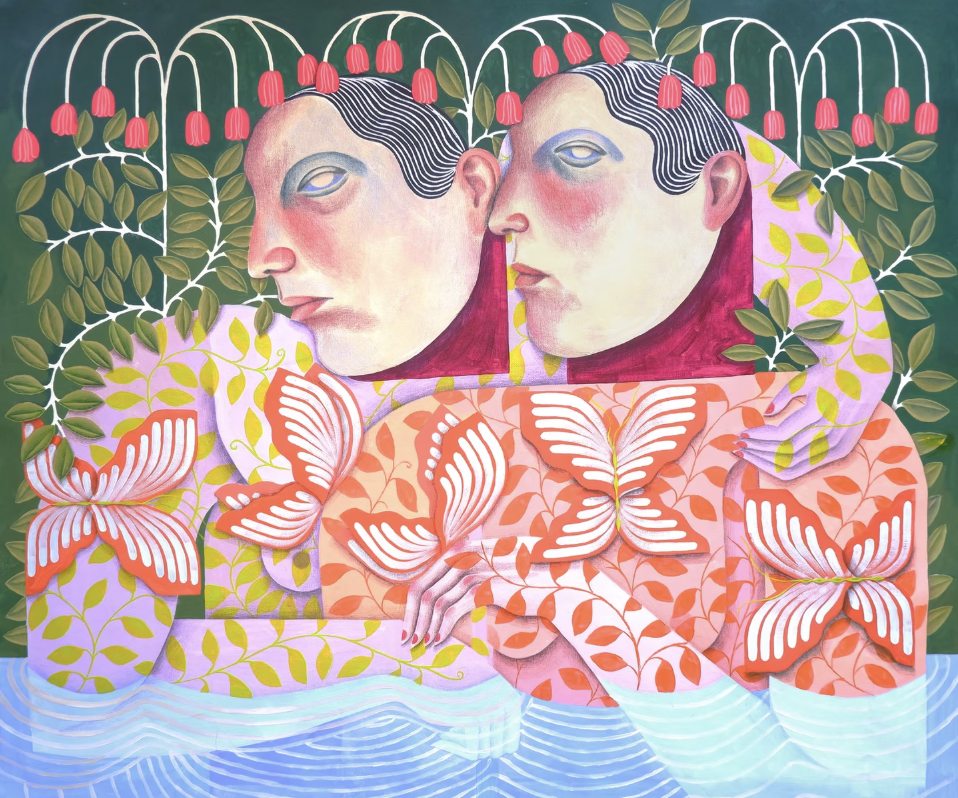
Situationship is a painting I’m particularly happy with. I feel that I managed to express my idea of an ambiguous romantic relationship through a surreal hug.
Some parts of the upper bodies appear in the wrong places, but you can immediately understand that the characters are hugging each other. The patterns clearly distinguish the two individual characters and provide the viewer with more visual information. They are intense, numerous and almost overwhelming. Around the characters’ legs, you can see a climbing plant with pink leaves, tying them together.
All of this takes place against a plain blue background. An empty, cold background, without any information or words, just a cool colour. These ideas are rarely fully defined in my initial sketches. They gradually appear as the painting develops. Of course, I have developed my own visual vocabulary, and there are certain elements I like to use to represent particular emotions. But I think each painting builds itself instinctively, little by little.
Q5. Plants and natural elements often become metaphors for human emotions in your work. What draws you to exploring relationships through nature?
I love playing with metaphors connected to plants and flora. The idea of growing and evolving over time. Being influenced by the people around you, depending on whether you find yourself in a positive or negative environment. Having roots anchored in a particular place or culture.
I also love the satisfaction of drawing lines that become stems or branches, and being able to extend them across the entire length of a canvas I’ve just cut.
I can make them as long and wavy as I want, or, on the contrary, perfectly straight, growing upwards with little branches extending to the left and right.
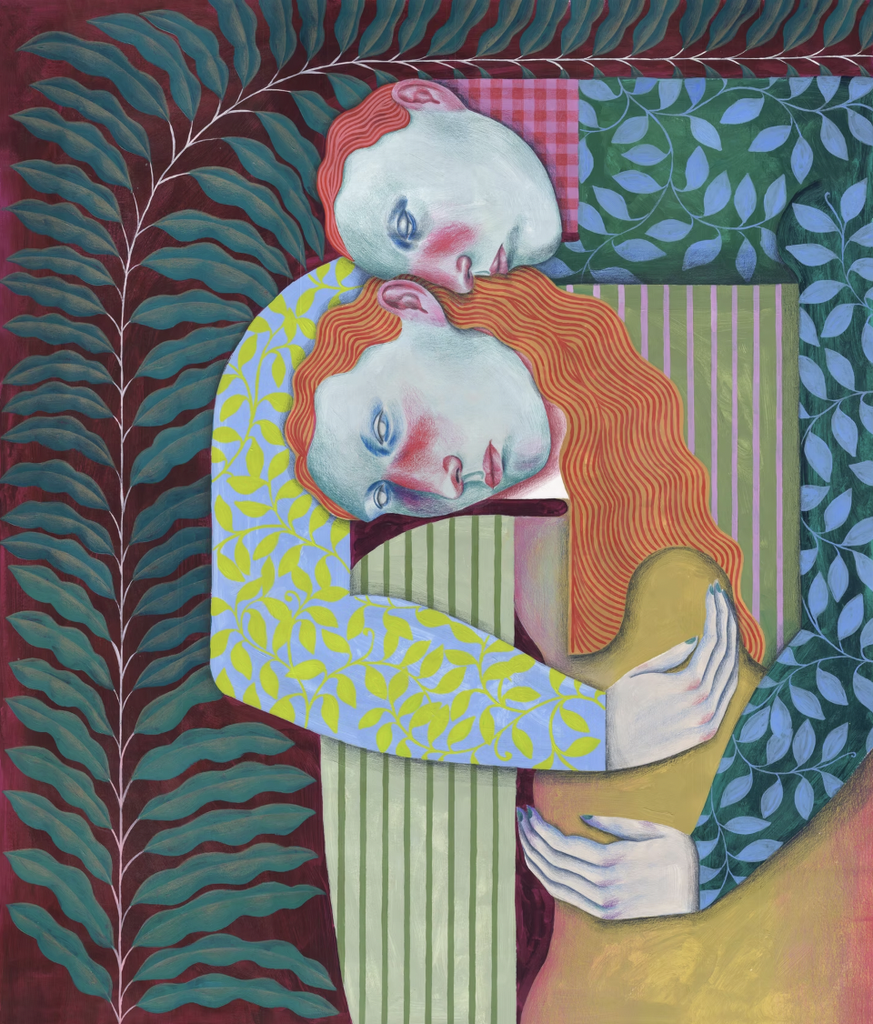
Q6. Butterflies appear throughout your work as symbols of love, excitement, and anxiety. How did they become part of your visual language?
Like many children, I’ve always loved butterflies, partly because of how different they are from other insects, and of course, because of their colours. I’ve always had the impression that some people around me see butterflies as little messages from the universe. I remember having a best friend in primary school who told me, when we were around eight years old, that her grandmother, whom she was very close to, had passed away. From that moment on, she started seeing little white butterflies visiting her: at the window of her childhood bedroom, in her garden, or even in the school playground.
There was something beautiful about the idea of a loved one who had passed away coming back to visit through a tiny visitor with delicate white wings. Several people close to me had their own special connection with butterflies, and I gradually started incorporating them into my paintings. I love the metaphor of having butterflies in your stomach.
It’s such a naive and almost childish expression, yet it is connected to two very powerful emotions: love and excitement on one hand, but also anxiety and fear. Depending on where you stand and how you choose to interpret this idea, some people see it as something positive, while others associate it with something negative.
I love the idea of being able to position yourself anywhere along that spectrum. And, of course, I love having these beautiful creatures as an integral part of my visual vocabulary. I simply find them so beautiful. My real love story with butterflies, however, began when I was 21.
When I was living in Vienna, at the beginning of my adult life and my artistic career, I was already fascinated by butterflies! My group of girlfriends there surprised me with tickets to the Schmetterlinghaus in Vienna, the city’s butterfly house. It’s almost like a greenhouse shaped like a house, where the inhabitants are butterflies of all kinds! They fly freely around you, moving from one room to another.
Q7. Your compositions balance careful structure with spontaneity. How do you combine planning and intuition throughout your creative process?
I think sketching plays a major role in my creative process. I usually start by making a quick little sketch on an A6 sheet of paper, adding some colour ideas, although nothing is final at this stage.
Once I’ve cut my cotton canvas to its final dimensions, I get started on a much more precise pencil drawing directly onto the canvas. This is one of my favourite stages, perhaps even my absolute favourite! I love drawing bodies instinctively, creating climbing flowers and playing with lines. I’ll sometimes take a ruler to draw the beginning of a stem, vertically and parallel to the edge of the canvas, before adding a little loop followed by a rounded curve pointing downwards, allowing the stem to travel across the canvas.
I love watching my pencil move around the surface, finding its way and creating a composition that feels pleasing to the eye. It’s just as enjoyable visually as it is throughout the creative process itself.
Choosing the colours for the final composition is also such a lovely part of the process! I take out all my paint tubes, compare them with one another and look for the most interesting combinations. Sometimes the choices are purely aesthetic, sometimes they’re more interpretative, but I think both aspects play an important role in my paintings.
Q8. Your paintings often revisit themes of attachment, loss, and solitude. How has making art helped you understand your own experiences differently?
I think my artistic practice helps me process emotionally heavy situations, but also allows me to escape from the real world. It’s a bit like listening to a really good song that carries you somewhere else. You play it over and over again, and for a moment, time and everything around you seem to stop. You just enjoy the rhythm and the lyrics of a song that completely takes you away. You find yourself frowning or biting your lip when your favourite part comes on.
I don’t think getting too caught up in your thoughts when faced with a confusing situation is always the best solution for me. Things don’t always unfold logically or the way we want them to. Some situations lead to consequences that make us question so many things, and often, there simply isn’t any logic behind them. There isn’t always an explanation or a valid reason. I’ve lost a lot of childhood friends over the past few years. I’ve always had friendships that were deeply rooted in my everyday life, and having friends with almost family-like bonds was a real source of comfort to me.
I lost some of these friendships because my friends struggled with drug use. It’s not something that’s easy to explain or understand. Losing most of your familiar social landmarks, while knowing that the distance was your own decision, raises a lot of questions. We don’t always think about it, but being a painter can be quite a solitary profession. I’m usually alone in my studio, and that’s when I feel the most productive and connected to my work and my own little universe.
Choosing to distance myself from close, long-standing friendships, for what I believed at the time were good reasons, made me question my relationship with solitude. Is it better to be alone than surrounded by people who don’t have your best interests at heart? Today, two years after that separation, I’ve rebuilt an incredibly caring and supportive circle of people around me.
Something that felt so difficult and almost impossible at the time. Looking back, I’m grateful to the Carla I was back then for choosing the more difficult path. I think the spring that followed that period of my life was one of my favourite creative periods so far! I started working on larger formats. I needed space; I felt a little suffocated. I also made several drawings on paper that I still absolutely love.
Even today, I feel a little sad knowing that all of them have been sold, while at the same time recognising how lucky I am to have people who are sensitive to my art and want to own it! For those who are curious, The Romance of a Toxic Relationship, Hypocrisy Is Pretty Outside and Ugly as Hell on the Inside, as well as The Hug and Dunes, are among my favourite works since the beginning of my career, created during this conflicted period of my life.
They are filled with emotional intensity. Some reveal more than others through their titles. The colours are also part of the message behind each composition, while remaining, in my opinion, aesthetically pleasing to my own eye, and hopefully to others too! During that period, I was drawing a lot of faces to represent the complexity of friendships and human relationships.
Q9. Looking ahead, what new emotional themes or creative directions would you like to explore through your work?
I’m constantly finding new sources of inspiration in my everyday life, as well as new challenges. I love the idea of developing independent projects alongside my full-time work as a painter. I’m particularly drawn to the idea of creating an edition or a book where my imagination would be the main character, with a whole world of possibilities to explore.
I also love the idea of creating collections built around a common element. For example, I would love to create a garden through a series of paintings, all sharing the same format, perhaps a long, narrow canvas measuring 50 × 150 cm. I could create a series of ten paintings, each representing a completely imaginary flower, combining different elements from my own visual vocabulary. Being an artist is a profession full of possibilities.
Unfortunately, in my case, creativity and imagination also come with their fair share of distractions! I have to make a real effort every day to maintain a structured lifestyle. It’s not that I lack motivation or that I don’t enjoy working. Quite the opposite! I’ve always loved what I do. Once I get started, I’m completely absorbed, almost like being caught in a tornado, an endless cycle that just keeps going. The real challenge is organising my thoughts and deciding where to direct them.
My thoughts become ideas, my ideas become sketches, and eventually, those sketches become finished artworks. The perfect comparison would be tidying up your teenage bedroom and suddenly coming across objects that distract you from your original plan. Before you know it, you’ve forgotten what you were supposed to be doing in the first place!
As we concluded our conversation with Carla, we kept coming back to how much a gentle touch can carry. Her paintings are bright and playful, and yet the feelings underneath them are the big, grown-up ones: closeness, change and the ache of letting go.
It would be easy to assume those two things pull in opposite directions, but she shows how well they can work together. A tender subject does not always need a heavy hand. Sometimes the most honest way in is through colour, pattern and a little lightness, which lets the viewer relax enough to feel something real.
There is a lovely tradition behind that way of working. Artists have long trusted simple shapes and generous colour with big emotions, from the cut-outs of Matisse to the folk-art makers whose patterns still decorate homes today, and surrealism has always known that ordinary life becomes more truthful when you let it go a little strange.
Carla belongs happily in that company, and she adds a voice that is entirely her own. Contemporary painting is richer for artists who borrow so freely from the things they love and then turn them into one world that nobody else could have built.
For fellow artists, there is a gentle encouragement in all of this. The colours you keep reaching for, the patterns you cannot resist and the way you like to draw a plant or a hand are not side interests to be edited out on the road to a serious practice. They can be the practice. And a sense of play, kept alive through years of full-time work, is a strength rather than a distraction.
For art lovers and collectors, Carla’s paintings bring colour, rhythm and company into a room. The patterns give the eye somewhere to wander, the embracing figures invite you to read your own story into them, and the whole thing feels a little like having a garden indoors that never goes out of season. It is work that keeps a home feeling warm and curious, and everyone who passes it will notice something different.
Follow Carla Petelski through the links below and see her world for yourself.