
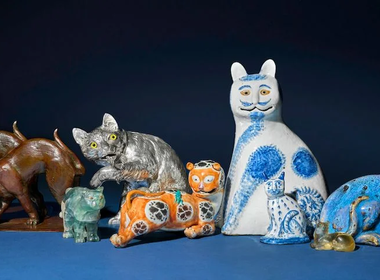

6 Must-See Artworks From In Minor Keys at the Venice Biennale 2026

The Venice Biennale has always reflected the emotional state of the world around it. Some editions arrive loud and politically confrontational, while others become remembered for spectacle, monumental installations, or market-defining moments. But the 2026 Venice Biennale feels strikingly different. This year’s exhibition, In Minor Keys, unfolds with a quieter emotional intensity, one shaped less by visual excess and more by atmosphere, intimacy, memory, and emotional residue.
Conceived by the late Cameroonian Swiss curator Koyo Kouoh, the first African woman appointed to curate the Venice Biennale, the exhibition carries an emotional weight that feels impossible to separate from the work itself. Kouoh passed away unexpectedly in 2025 before the exhibition opened, but her curatorial language moves gently through the Giardini and Arsenale. This emotional atmosphere defines In Minor Keys at the Venice Biennale 2026, where artists move away from spectacle and toward quieter experiences rooted in memory, fragility, sound, materiality, and emotional presence.
Across Venice, artists seem deeply interested in creating experiences that cannot be consumed quickly. Scent drifts through installations. Soundscapes replace spectacle. Raw materials like salt, hair, earth, water, ash, fabric, and metal appear repeatedly throughout the Biennale, carrying histories of migration, environmental collapse, labor, ancestry, and survival within them. Many works resist the polished “Instagrammable” quality contemporary exhibitions often chase, instead asking visitors to sit with discomfort, intimacy, and emotional ambiguity.
From Cauleen Smith’s immersive tribute to poet Wanda Coleman to Alfredo Jaar’s haunting meditation on rare earth minerals and Walid Raad’s unstable reconstruction of war histories, the strongest works in In Minor Keys do not try to overwhelm viewers. Instead, they move carefully, allowing emotion, material, and atmosphere to speak quietly but persistently.
Here are the artworks defining the 2026 Venice Biennale.
Cauleen Smith’s The Wanda Coleman Songbook Turns Poetry Into Atmosphere
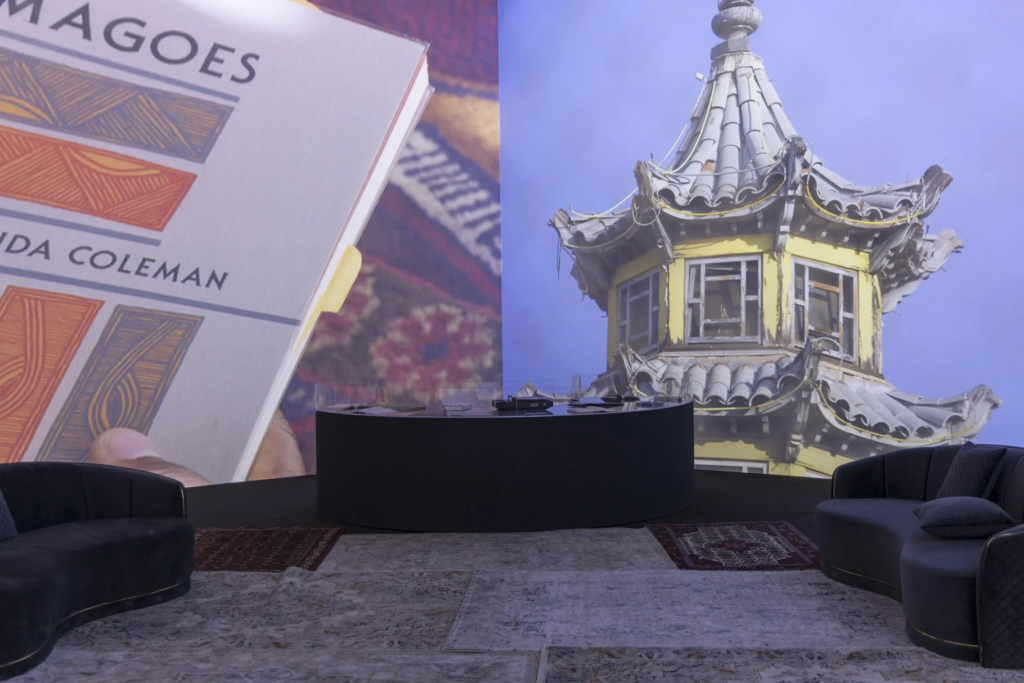
At the 2026 Venice Biennale, many works ask viewers to slow down, but few do it as gracefully as Cauleen Smith’s The Wanda Coleman Songbook. Tucked within the Arsenale, the installation feels less like entering an exhibition space and more like stepping into somebody’s memory. Large screens surround two couches layered with Turkish rugs, while hazy moving images of Los Angeles drift across the room: seagulls circling overhead, dog walkers crossing sunlit streets, glimpses of the Hollywood sign, pages from Wanda Coleman’s poetry collections. Nothing rushes the viewer. The work unfolds gently, almost like a conversation happening at its own pace.
The installation pays tribute to Wanda Coleman, often referred to as the unofficial poet laureate of Los Angeles, whose writing captured the realities of Black life, poverty, humor, exhaustion, and survival in the city with startling honesty. But Smith avoids turning Coleman into a static literary figure. Instead, she transforms her presence into an atmosphere. Jazz- and blues-inspired reinterpretations of Coleman’s poetry drift through the installation while a scent designed to evoke Griffith Park quietly fills the room. The result is immersive without relying on spectacle.
What makes the work especially powerful within In Minor Keys is how naturally it reflects the emotional language of the Biennale itself. This year’s exhibition repeatedly moves away from overt visual excess and toward slower sensory experiences built through sound, memory, intimacy, and emotional residue. Smith’s installation captures that shift perfectly. It refuses the fast consumption demanded by contemporary image culture and instead asks viewers to sit, listen, smell, and remain present.
There is also something deeply moving about how Smith treats poetry here, not simply as text, but as architecture. Coleman’s words become spatial, musical, and physical. The installation turns literature into something you can inhabit. In a Biennale filled with themes of grief, inheritance, fragility, and emotional survival, The Wanda Coleman Songbook quietly becomes one of its most human works.
Maria Magdalena Campos-Pons’s Anatomy of the Magnolia Tree for Koyo Kouoh and Toni Morrison Becomes the Emotional Core of In Minor Keys
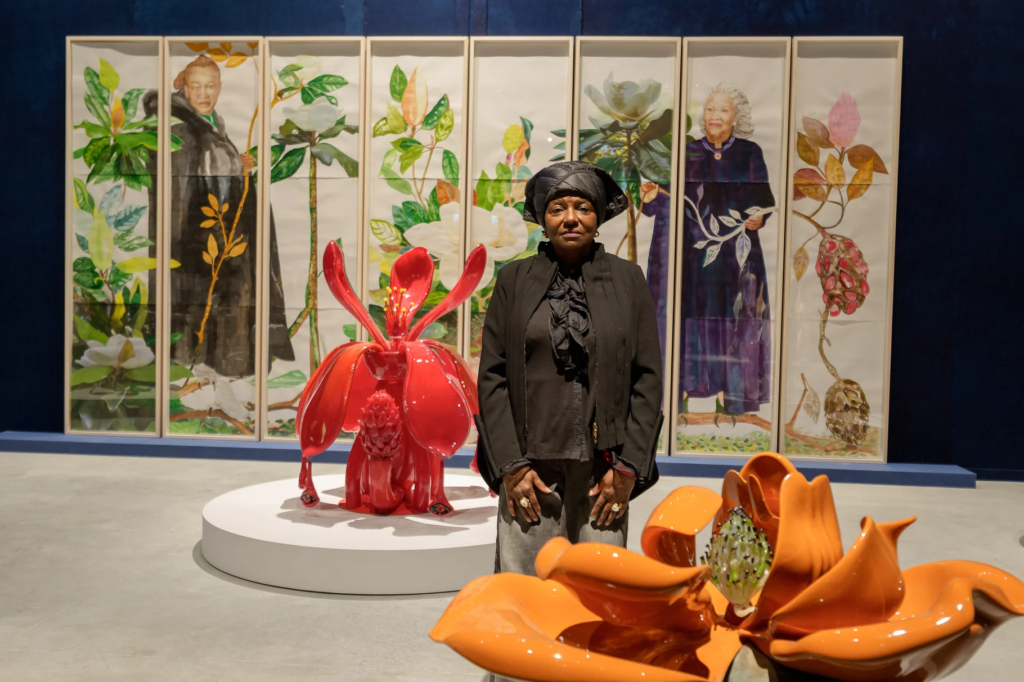
If there is one artwork at the 2026 Venice Biennale that captures the emotional heart of In Minor Keys, it is Maria Magdalena Campos-Pons’s Anatomy of the Magnolia Tree for Koyo Kouoh and Toni Morrison. Positioned near the entrance of the Giardini, the installation feels both monumental and deeply intimate, unfolding like a visual elegy dedicated to memory, lineage, and the intellectual legacy of Black women whose influence continues to shape contemporary culture.
Large vertical panels stretch across the walls, portraying the late curator Koyo Kouoh standing beside Toni Morrison, surrounded by sprawling magnolia branches painted in delicate watercolor, gouache, and ink. The magnolia, historically associated with the American South, becomes more than a botanical symbol here. Campos-Pons transforms it into a metaphor for endurance, ancestry, softness, and emotional resilience. In front of the mural, glass and resin flowers rest on sculptural plinths, their gold and crimson petals appearing almost suspended between bloom and decay.
What makes the installation especially affecting is how quietly it carries grief. Rather than presenting Kouoh through overt memorialization, Campos-Pons honors her through presence. Kouoh does not appear as an absence haunting the Biennale, but as an intellectual force still guiding it. Beside her stands Toni Morrison, whose writings on memory, interiority, and Black life deeply influenced the curatorial language of In Minor Keys. Together, the two figures feel less like portraits and more like guardians of the exhibition’s emotional framework.
The work also reflects one of the strongest undercurrents of this year’s Biennale: the growing importance of softness within contemporary art. Across Venice, artists move away from spectacle and toward emotional intimacy, atmosphere, and reflection. Campos-Pons embraces that shift fully. Even the accompanying sound composition by Kamaal Malak, layered with bass and ambient synth, moves gently through the space rather than dominating it.
In many ways, the installation becomes a reminder that some of the most powerful artworks are not the loudest ones. They are the ones that create space for memory, vulnerability, and emotional continuity. And in a Biennale shaped so profoundly by loss, Campos-Pons offers something unexpectedly tender: a work that mourns, honors, and celebrates all at once.
Tiona Nekkia McClodden’s Ruinous Explores the Beauty of Emotional Scarring
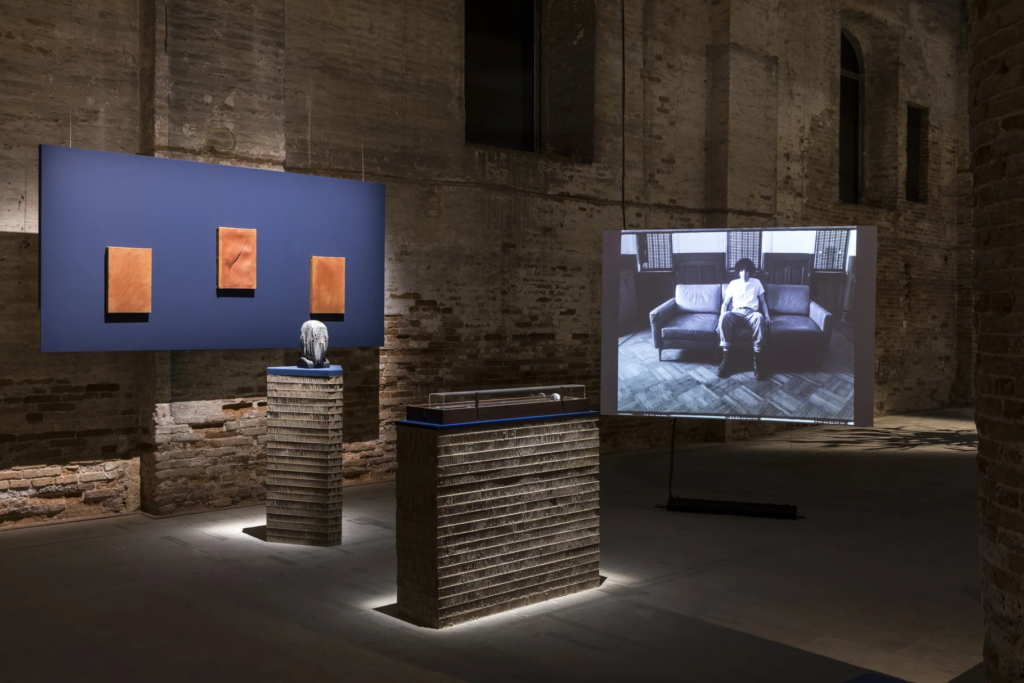
Among the many large-scale installations spread across the Arsenale, Tiona Nekkia McClodden’s Ruinous stands apart for how emotionally restrained it feels. Nothing in the work demands attention immediately. There are no overwhelming visuals or theatrical gestures announcing themselves from across the room. Instead, McClodden builds tension slowly, through fragmented storytelling, intimate symbolism, and an atmosphere that lingers long after leaving the installation.
At the center of the work is a two-channel video in which McClodden plays an abstract painter loosely inspired by herself. On one screen, viewers watch the artist from behind as she studies a painting with visible uncertainty and emotional hesitation. Her face never fully appears, creating a sense of distance that feels intentional. On the opposite screen, another narrative unfolds inside a restaurant where themes of queer longing, vulnerability, family dynamics, and emotional scarring quietly emerge through conversation and gesture rather than dramatic confrontation.
What makes Ruinous so compelling is the way pleasure and pain continuously exist together. Moments of tenderness appear alongside rejection. Desire appears alongside emotional distance. McClodden never separates beauty from discomfort, and that tension gives the installation its emotional depth.
The surrounding sculptural works intensify this feeling further. A delicate chainmail head covering embroidered with gold thread sits nearby like ceremonial armor, while an épée sword displayed inside a custom box references both protection and violence. Behind them hang small leather canvases marked with scratches and cuts, their surfaces appearing wounded but alive. These objects feel less like props and more like emotional extensions of the film itself.
In many ways, McClodden’s work reflects one of the defining emotional shifts happening throughout the 2026 Venice Biennale. This year, many artists seem less interested in direct political statements and more invested in emotional residue, the scars left behind by intimacy, identity, memory, grief, and survival. Ruinous embodies that approach beautifully. It trusts silence, subtext, and vulnerability rather than explanation.
And within a Biennale centered around “minor keys,” McClodden creates one of its most quietly devastating notes.
Alfredo Jaar’s The End of the World Reduces Global Politics to a Tiny Cube
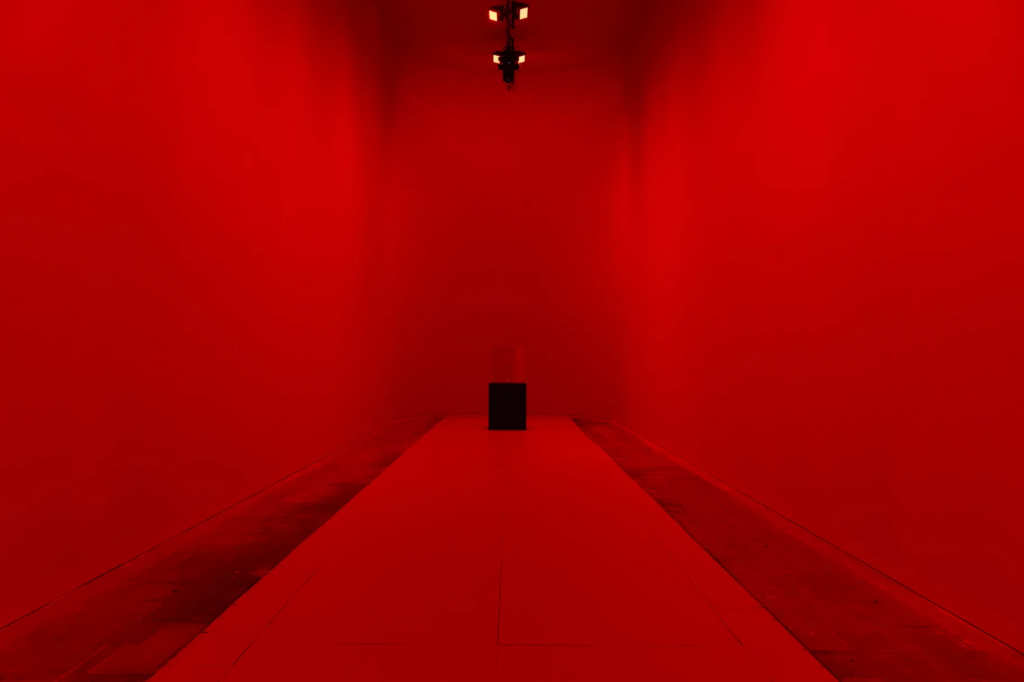
Few installations at the 2026 Venice Biennale feel as visually minimal yet psychologically overwhelming as Alfredo Jaar’s The End of the World. The work occupies a long corridor saturated entirely in red light, creating an atmosphere that feels somewhere between a warning signal, a church interior, and a disaster zone. At the far end of the room sits a small glass box placed alone on a pedestal. Inside it is a tiny cube composed of layered rare earth minerals and industrial metals, materials essential to the technologies shaping contemporary life.
The physical scale of the work is almost shocking. After walking through such a dramatic environment, viewers are confronted not by a monumental object, but by something barely larger than a few centimeters. Yet that disproportion is exactly what gives the installation its force.
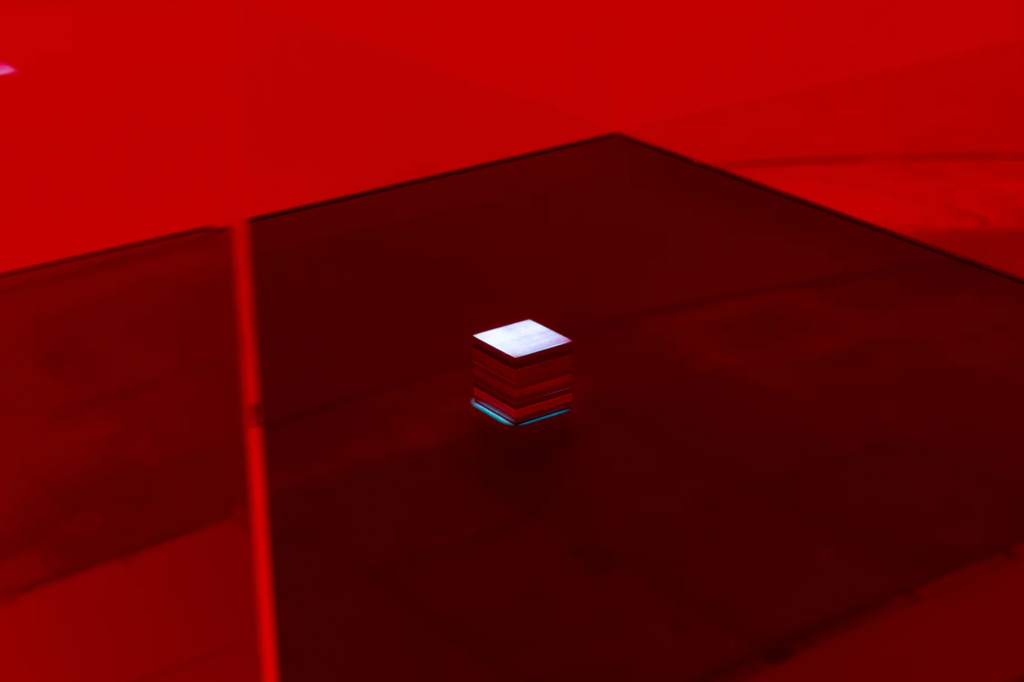
Jaar transforms invisible systems into something emotionally tangible.
The minerals inside the cube are tied to batteries, semiconductors, solar technologies, electronics, and global manufacturing systems. They are also connected to extraction, labor exploitation, environmental destruction, political conflict, and economic power struggles unfolding across the world today. By isolating these materials inside a glowing, almost sacred presentation, Jaar exposes how modern economies quietly depend on forms of violence most people never directly see.
What makes The End of the World especially effective within In Minor Keys is its refusal to overwhelm viewers with information. Jaar avoids spectacle in favor of atmosphere and psychological tension. The installation operates through scale, distance, silence, and anticipation. The long walk toward the cube becomes part of the work itself, forcing visitors to physically move through a space charged with anxiety.
The piece also reflects one of the Biennale’s strongest recurring themes: the return of raw materials as political language. Across Venice this year, artists repeatedly use salt, earth, metal, ash, sand, and minerals to speak about environmental collapse, migration, extraction, and contested land. But Jaar’s installation feels particularly haunting because it reveals how something almost invisible can shape entire geopolitical realities.
In a Biennale filled with emotionally intimate works, The End of the World becomes one of its coldest and most unsettling reminders that contemporary life is built upon systems most people rarely stop to confront.
Walid Raad’s Postscript to the Arabic Edition Turns War History Into Something Unstable
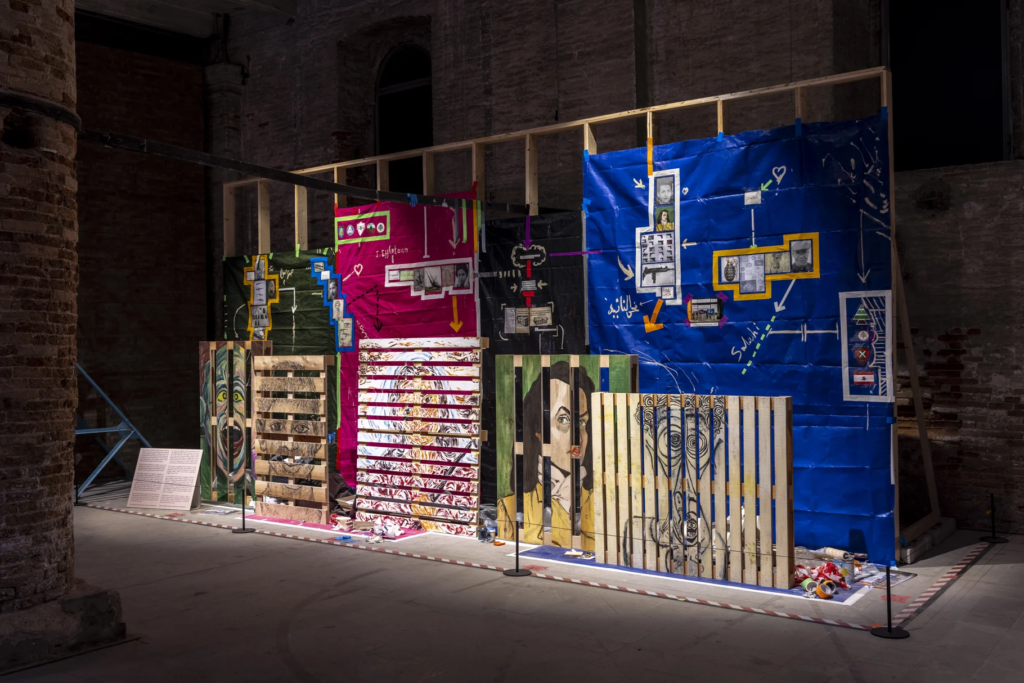
Walid Raad’s Postscript to the Arabic Edition is one of those installations that immediately pulls viewers into a story, only to slowly destabilize their understanding of what they are looking at. Installed within the Arsenale, the work resembles a half-finished warehouse exhibition. Wooden pallets stand upright across the room while tarpaulins, duct tape, printed notes, and improvised display structures create the feeling of entering a temporary storage site rather than a polished Biennale presentation.
Then the details begin to emerge.
According to the narrative surrounding the work, militias in Lebanon sold their weapons after the Lebanese Civil War ended in 1990, with many eventually traveling into the Balkans. When the shipments were opened, the undersides of the wooden pallets were discovered to contain painted reproductions of Turkish and Arabic artworks hidden beneath them. Raad presents these objects almost like accidental archives resurfacing decades later through conflict, trade, migration, and displacement.
As with much of Raad’s practice, the work deliberately blurs the boundaries between fact, fiction, documentation, and performance. Viewers are never entirely certain which parts of the story are historically verifiable and which have been artistically constructed. But that uncertainty becomes the point.
Rather than offering history as something stable or complete, Raad presents it as fragmented, layered, and constantly rewritten through political violence and memory.
That approach feels especially resonant within In Minor Keys, where many artists focus less on direct representation and more on emotional residue, the traces left behind by conflict, displacement, and inherited trauma. Raad avoids dramatic imagery of war entirely. Instead, he focuses on objects carrying invisible histories inside them.
There is also something deeply theatrical about the installation’s unfinished appearance. The exposed materials, temporary structures, and warehouse aesthetic create the sense that history itself is still being assembled in real time. Nothing feels settled. Nothing feels fully resolved.
In a Biennale filled with works exploring memory and fragility, Raad’s installation stands out for how cleverly it transforms geopolitics into something quietly uncanny. The work suggests that history rarely disappears cleanly. It lingers beneath surfaces, hidden in materials, waiting to unexpectedly reappear decades later.
Kaloki Nyamai’s Kwata Kau and Ithyonze nitwavika vaa Feel Like Living Textiles
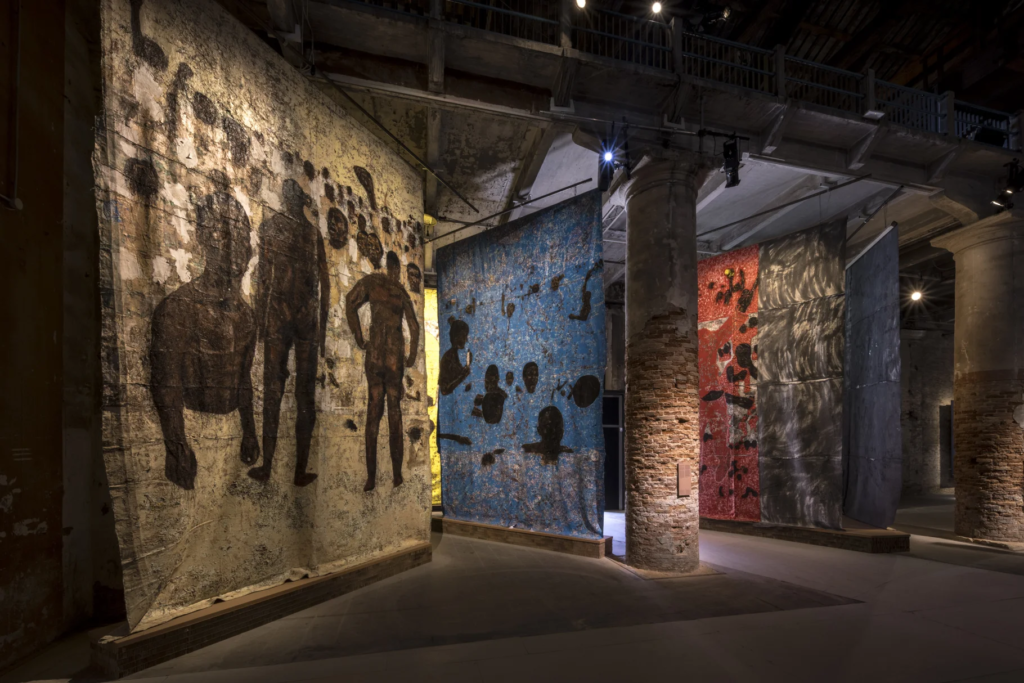
Moving through the Arsenale, it is almost impossible to miss Kaloki Nyamai’s towering textile-like paintings. Suspended dramatically within the space, the works immediately command attention through their scale alone, but what makes them unforgettable is the way they balance monumentality with intimacy. Built from stitched horizontal strips layered with paint, fabric, yarn, and texture, the surfaces feel alive, less like static paintings and more like emotional landscapes carrying memory, labor, and collective experience within them.
Nyamai’s installation includes Kwata Kau, Ithyonze nitwavika vaa, and Ithyonze nitwavika vaa II, large-scale works portraying crowds of fragmented figures whose raised arms emerge across densely layered surfaces. From a distance, the paintings appear almost abstract. Up close, details slowly reveal themselves: stitched seams, rough paint splatters, oversized faces, hanging threads, and textured yarn woven directly into the compositions.
That physicality becomes central to the work.
Rather than hiding the construction of the paintings, Nyamai emphasizes it. The hems, stitching, layering, and exposed surfaces remain visible, allowing viewers to see how the works are physically held together. In many ways, the process itself becomes part of the meaning.
The artist often draws inspiration from storytelling traditions in Kitui, Kenya, as well as the influence of his mother, a textile artist, and his grandmother’s oral narratives. That generational relationship to making, memory, and material feels deeply embedded in the installation. The works carry both personal and communal histories simultaneously.
What makes Nyamai’s paintings especially compelling within In Minor Keys is how naturally they reflect one of the Biennale’s strongest recurring ideas: the emotional power of materiality. Across the exhibition, artists repeatedly turn toward fabric, earth, hair, salt, wood, metal, and organic matter as ways of speaking about ancestry, displacement, labor, and belonging. Nyamai’s works embody that shift beautifully.
Even their scale feels significant. Though monumental, the paintings never feel cold or imposing. Instead, they create a sense of closeness, almost as if the viewer is standing inside a woven archive of collective memory.
In a Biennale filled with quiet emotional gestures, Nyamai proves that softness and monumentality do not have to exist in opposition. His paintings hold both at once.
Trends That are Shaping the 2026 Venice Biennale
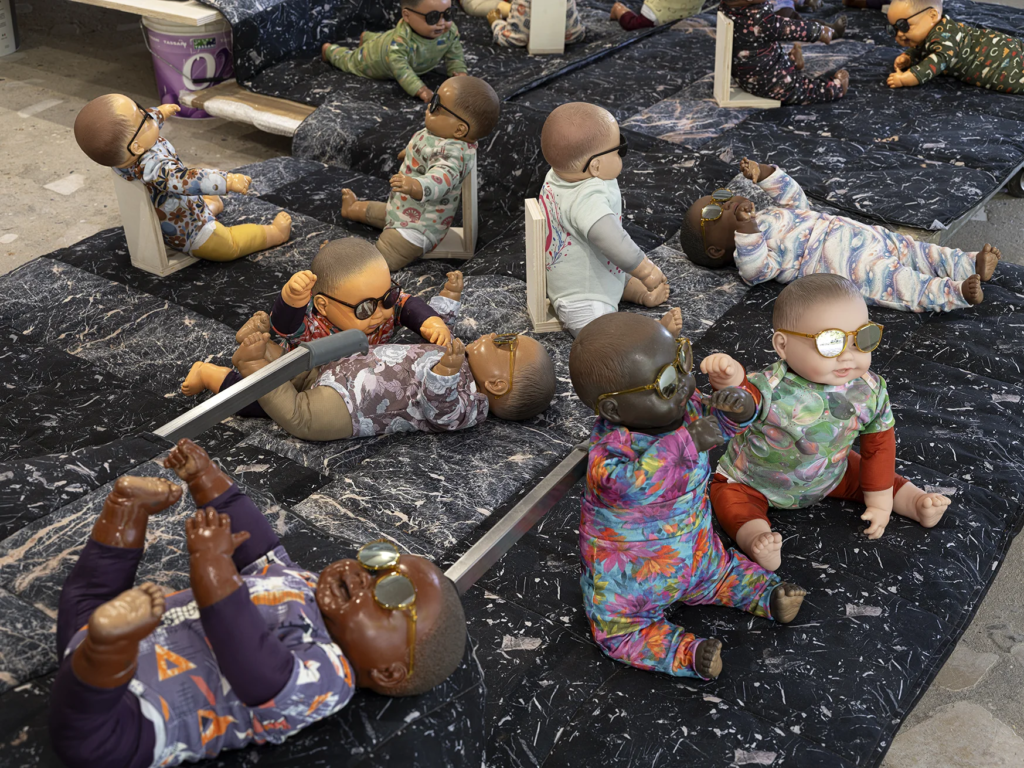
Beyond its standout artworks, the 2026 Venice Biennale is also defined by a series of recurring visual and emotional threads running quietly through the exhibitions. Across the Giardini, Arsenale, and national pavilions, artists repeatedly return to water, raw materials, scent, sound, hair, and bodily experience as ways of responding to a world shaped by climate anxiety, political instability, displacement, and emotional exhaustion. Many works resist the polished “Instagrammable” spectacle contemporary art has become associated with, instead creating experiences rooted in atmosphere, slowness, and physical presence. Scent-based installations, immersive sound works, flooded environments, textiles, salt, earth, wigs, minerals, and organic matter appear throughout Venice, transforming material itself into a form of storytelling. Whether through Abbas Akhavan’s glowing water-filled pavilion, Marina Abramović’s unsettling hair installations, Florentina Holzinger’s chaotic flooded performances, or the recurring use of earth, ash, and salt across multiple national presentations, this year’s Biennale feels deeply concerned with what remains human in an increasingly unstable world. Together, these recurring motifs make In Minor Keys feel less like a spectacle-driven exhibition and more like an emotional landscape shaped by memory, fragility, intimacy, and survival.
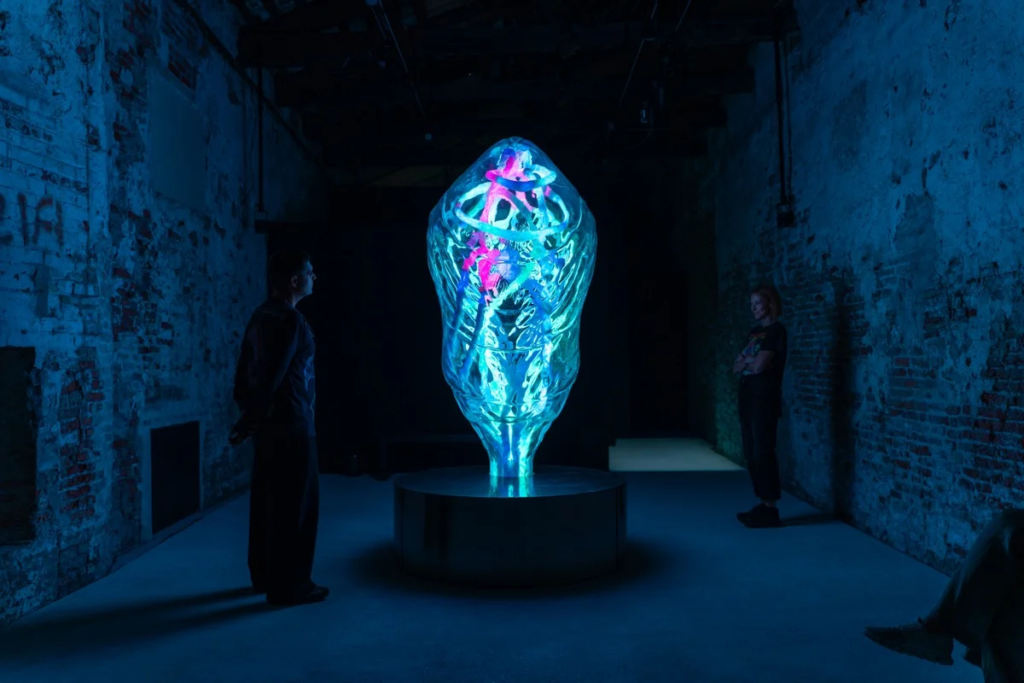
In many ways, In Minor Keys feels like a Biennale resisting the pressure to constantly perform spectacle. Rather than overwhelming viewers with grand statements or oversized visual gestures, the exhibition moves through softer emotional territories – memory, grief, intimacy, fragility, longing, and survival. Across the Giardini and Arsenale, artists repeatedly turn toward poetry, sound, raw materials, scent, water, and the body itself to reflect the emotional realities of the present moment.
What makes this year’s Biennale especially compelling is how deeply human it feels. Even the most political works avoid becoming overly declarative, choosing instead to communicate through atmosphere, texture, and emotional tension. Whether through Maria Magdalena Campos-Pons’s tribute to Koyo Kouoh and Toni Morrison, Tiona Nekkia McClodden’s exploration of emotional scarring, Alfredo Jaar’s unsettling meditation on extraction and geopolitics, or Kaloki Nyamai’s textile-like paintings rooted in collective memory, the strongest works in Venice this year ask viewers not simply to observe, but to feel more carefully.
And perhaps that is what makes the 2026 Venice Biennale so memorable. In a cultural moment shaped by overstimulation, speed, and endless visibility, In Minor Keys embraces slowness instead. It reminds us that art does not always need to shout to leave an impact. Sometimes, the quietest works are the ones that stay with us the longest.
For readers interested in how these conversations continue beyond Venice, our look at Frieze New York 2026 explores another major art moment shaping this year’s cultural landscape.

